


Contents
R.W. Loveless, better known as Bob Loveless (1929–2010), is one of the central figures in modern American knifemaking. His drop point hunters, fighters, chute knives, and compact city knives helped define the language of the handmade custom knife: clean blade geometry, full tapered tangs, carefully fitted guards, and handles shaped for work.
Loveless was not only a maker of famous models; he changed expectations around how a handmade knife should be built. His Drop Point Hunter became a benchmark for hunting-knife design, while his fighters showed how a narrow blade, a double grind, and a sub-hilt could form a coherent design. Micarta handles, stainless blade steels, and disciplined fitting were central to that approach.
This guide covers his career, important knife models, Loveless-style patterns, the shop’s history, and the distinction between historical shop prices and collector-market values. His work remains a reference point for knife makers and custom-knife collectors.

Loveless began making knives in the early 1950s while working in the Merchant Marine. After finding that the Randall knife he wanted involved a long wait, he made a blade from an automobile leaf spring. By 1954, he was supplying knives to Abercrombie & Fitch, then an outdoor outfitter. His early Delaware Maid knives reflected Randall’s influence; his later work developed a more distinctive approach to blade geometry and handle construction.
During the 1950s and 1960s, Loveless built a reputation for practical fixed blades with closely controlled proportions. He did not invent the drop point, but he made the hollow-ground Drop Point Hunter one of the most influential modern hunting-knife patterns. Its lowered tip helps with controlled cuts, while the curved edge provides belly for skinning. Tip strength still depends on the blade’s thickness and grind.
Loveless helped popularize stock-removal knifemaking, full tapered tangs, screw-type handle fasteners, and Micarta scales. A tapered tang becomes thinner toward the butt, removing weight from the handle and changing the knife’s balance. It does not automatically make a knife stronger than an otherwise comparable untapered full tang.
ATS-34 and 154CM are associated with Loveless’s work, while later Loveless Shop specifications list CPM 154. CPM 154 is the powder-metallurgy version of conventional 154CM. For collectors, the useful distinction is between the steel used in a particular knife and the material listed for a later version of the same model.
Jim Merritt joined Loveless in 1982, beginning the long partnership associated with the Riverside shop. Merritt was already an experienced knifemaker and became an important part of its production. Loveless had earlier been a founding member of the Knifemakers’ Guild in 1970 and served as its first secretary.
Loveless also shared his methods through teaching, conversations with other makers, and books, including How to Make Knives, coauthored with Richard Barney. His influence spread through the makers who learned from him and the production companies that adapted his designs.
The Drop Point Hunter is his best-known working pattern, but Loveless’s range also included compact utility knives, chute knives, and large fighters. Dimensions, materials, markings, and fittings varied with the period and the individual knife.
The Drop Point Hunter combines a lowered point, a curved cutting edge, and a contoured handle. The hollow grind and tapered tang are characteristic Loveless features. For hunting knives, the appeal is the relationship between point control, usable belly, and a grip that remains comfortable through repeated cuts.
The knife pictured below bears a Riverside maker’s mark and has dark handle scales with red liners. For size reference, the Loveless Shop’s Dropped Hunter listing gives a 3¾-inch (95 mm) blade and an 8¼-inch (210 mm) overall length. These are published model specifications; dimensions and materials vary among individual Loveless knives.

The New York Special is a compact fixed blade with a short clip-point blade and a reduced handle. A 2012 BLADE report discussed an especially rare early version with a snap in the sheath: seven examples had been reported before an eighth was identified. That count concerned the early snap-sheath version, rather than total production of every New York Special.
The Loveless Shop’s model page lists a 2¾-inch (70 mm) blade and a 7-inch (178 mm) overall length, with a CPM 154 blade and a 416 stainless steel guard and bolts.

The Big Bear is a large fighter associated with a double-ground blade and a sub-hilt behind the main guard. It belongs to a different design family from the Drop Point Hunter. The secondary hilt gives the index finger a defined position within the grip.
The amber-stag example discussed by BLADE on August 15, 2012, was noted for its unusual handle and absence of the usual Loveless bolts. The magazine reported an approximate value of US $35,000, based on information from Dave Ellis. The figure is a 2012 valuation of that individual knife.

The Utility Hunter uses a clip-point blade and a tapered full tang in a general-purpose field knife. For size reference, the Loveless Shop’s Utility Hunter listing gives a 4-inch (102 mm) blade and an 8½-inch (216 mm) overall length. These are published model specifications; dimensions and materials vary among individual Loveless knives.
The knife pictured below bears a Riverside maker’s mark and has brown handle scales, a polished blade, and a single guard. It is photographed resting on a leather sheath.

A sub-hilt is a second guard positioned behind the index finger. On Loveless-style fighters, it creates a defined finger position and helps retain the grip during pushing and pulling movements. That fixed position can also make it less convenient to shift the hand for other cutting tasks.
The Big Bear is a well-known example of this sub-hilt arrangement.

Loveless-style knives are recognized by their clean blade profiles, contoured handles, and balanced proportions. The 11 patterns below range from compact utility knives and drop-point hunters to chute knives and sub-hilt fighters, showing how changes in the point, cutting edge, guard, and grip shape each design.
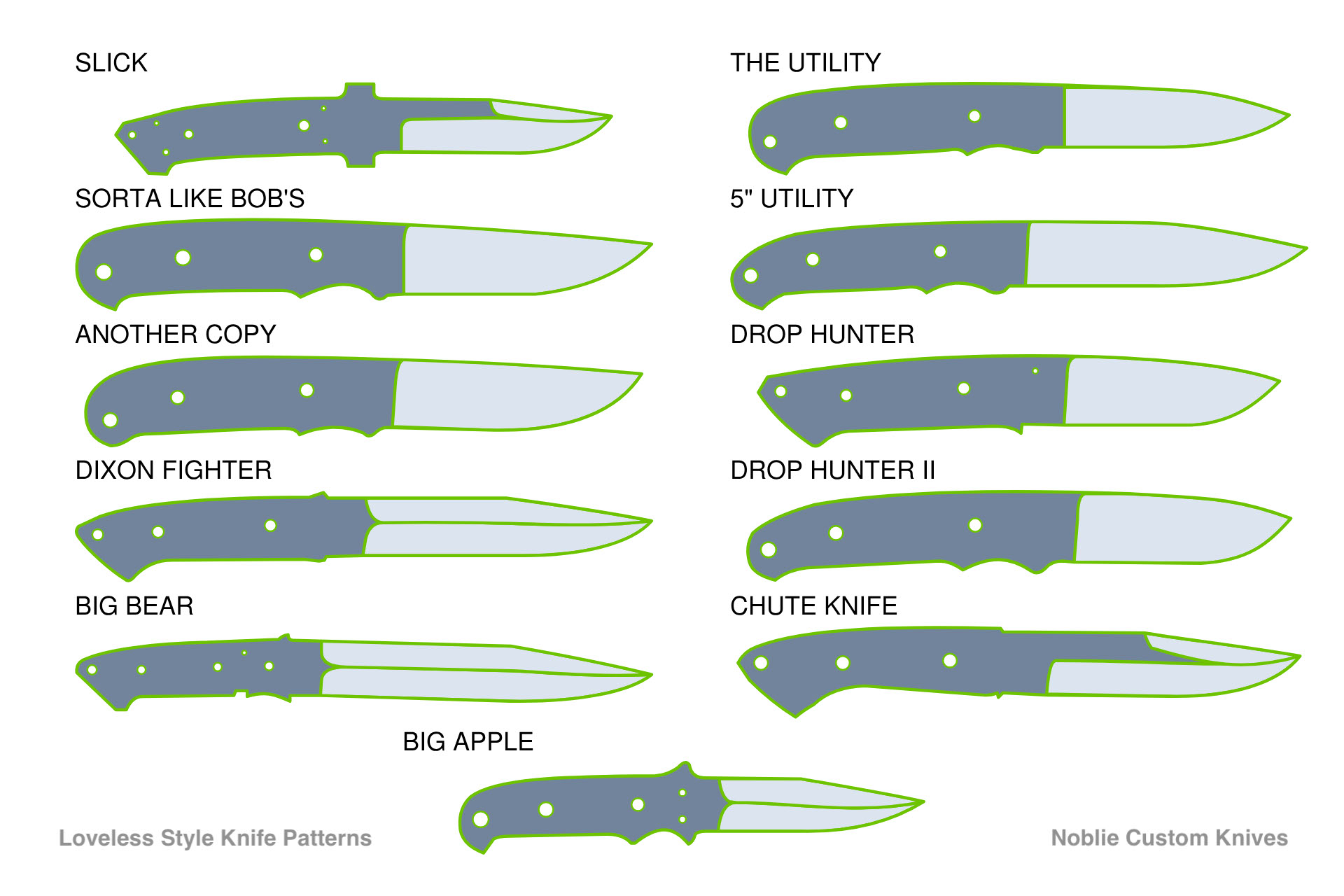
Slick
A chute-style design with a clipped point, a gently curved cutting edge, and pronounced guard shoulders. The handle can be finished with long bolsters or simple scales, allowing different treatments around the same blade profile.
Sorta Like Bob’s
A small, guardless utility knife with a flat-ground blade and a contoured handle. Its short cutting edge suits light, controlled work, while the uncomplicated profile keeps the knife compact.
Another Copy
Similar in outline to Sorta Like Bob’s, but with a more rounded handle butt. Engnath described it as a larger straight-hunter pattern with a tapered tang. The gently curved cutting edge and guardless handle retain the same straightforward working-knife character.
Dixon Fighter
An elongated fighter with a tapered tang and a guard fitted from the blade end. The blade has full-length upper and lower bevels, although the upper edge can be left unsharpened. Its long, pointed profile distinguishes it from the shorter utility and hunting designs.
Big Bear
A large fighter designed for a double-edged blade, with a tapered tang and provision for a sub-hilt behind the main guard. The secondary hilt separates the index finger from the rest of the grip. The pattern can also be built without the sub-hilt.
The Utility
A compact utility design combining a clipped point, a tapered tang, and a guardless handle. The curved cutting edge supports slicing, while the defined point provides access for precise cuts.
5″ Utility
An extended version of the utility design, retaining the clipped point and guardless handle. The longer blade provides additional cutting edge and reach for longer slicing cuts while preserving the simple outline of the smaller version.
Drop Hunter
A drop-point hunting knife with a tapered tang and a front-fitted guard. The spine slopes toward the point, while the curved cutting edge provides belly for skinning and slicing. The guard creates a distinct boundary between grip and blade.
Drop Hunter II
A guardless variation of the drop hunter with a tapered tang and a shorter cutting edge. Finger contours define the grip without a projecting guard, giving the knife a more continuous outline from blade to handle.
Chute Knife
A chute-style knife with a tapered tang, a front-fitted guard, and a pronounced clip. The upper clip can be sharpened to add a cutting edge near the point. The main edge retains a gentle curve for slicing.
Big Apple
A compact pattern similar in concept to the New York Special, with a three-finger grip and a short, pointed blade. Its shortened handle keeps the overall length down. The grip accommodates bolsters or simple scales.
A Loveless knife’s value depends on the model, production period, condition, handle material, markings, sheath, and documented ownership. An original knife from Loveless’s working years, a later shop knife, and another maker’s Loveless-style knife need separate comparisons, even when their outlines are similar.
Historical BLADE reports provide two specific examples. On August 6, 2012, Joe Kertzman described an amber-stag chute knife valued at approximately US $13,000. On August 15, 2012, he reported an approximate US $35,000 valuation for an amber-stag Big Bear. Both figures describe individual knives at that time; asking prices and realized auction results require separate comparisons.
Rarity can matter, but so can evidence: an original sheath, period correspondence, and reliable provenance help establish what is being offered. Engraving and unusual materials should be attributed to the artists involved. Condition also needs close inspection, including sharpening, refinishing, replaced parts, and later alterations.
Our guide to the most expensive knives includes a stag-handled Lawndale sub-hilt recorded with a US $85,000 asking price. Its early provenance, original fittings, and sheath are part of the collector context.

John Denton is a longtime collector and dealer specializing in vintage Loveless knives. His work with his father, J.W. Denton, helped document and circulate important examples. He has also written a book on Loveless knives and contributed recollections and photographs to specialist publications.

Loveless died in 2010. Jim Merritt continued making knives bearing the Loveless name afterward; Merritt himself died in 2018.
Brent Harp is another maker connected directly with that workshop. In a 2011 interview by Jim Matthews, Harp described meeting Loveless in 1986 while seeking advice on heat treatment. He learned from Loveless and Merritt during evenings and weekends. At the time of that interview, Harp was working from a home shop in Perris, near Lake Mathews, and was reported to have sold about 300 knives.
The same interview records a lesson that went beyond grinding and fitting: a maker who plans to sell knives has to be willing to let them go. Harp’s account illustrates how Loveless passed on an approach to working knives through individual instruction. Makers following those methods continue the design tradition under their own names.
Loveless’s lasting contribution is visible in the details: a hunting point placed for control, a grind suited to cutting, a tang tapered to manage weight, and a handle shaped around the hand. Collectors value original examples for their history as well as their construction. Makers studying the style can learn from those relationships while clearly identifying their own work and the source of a pattern.


I have recently found an RW Lovess model 390 it has the proper logo and a reclining nude the address is Riverside California could it be real of a copy?
I’ve got an intriguing 4blade folding pocket knife the handle looks to be bone ok here’s the thing…it’s got the markings ( the bone ) and bottom collector and a pic right in middle..it seems to me it’s a army man maybe with broom& dustpan ..idk maybe I need better glasses…lol . anyways let me know if you got any ideas thanks