


Contents
The best custom knife makers are known for different strengths: Bob Loveless for influential hunting-knife designs, Tony Bose for traditional folders, Bob Kramer for kitchen cutlery, and makers such as Michael Walker and Wolfgang Loerchner for mechanical innovation and art knives. Choosing among them starts with the kind of knife you want and the work you value.
This guide brings together independent knife makers and distinctive workshops from the USA and around the world. It covers hunting knives, traditional and modern folders, forged Damascus, engraved pieces, and sculptural knife art. Historical figures are included alongside contemporary makers; inclusion does not indicate that a maker is accepting commissions.
Want a finished knife without arranging a commission? Explore custom knives currently available from us.

There is no single best knife maker across every discipline. Bob Loveless helped define the modern hunting knife; Bill Moran helped revive modern pattern-welded Damascus; Tony Bose set a demanding standard for traditional folding knives. Ken Onion is known for folding-knife design and assisted-opening mechanisms, while Bob Kramer specializes in kitchen cutlery.
A working hunter, a precise slipjoint, and a richly engraved art dagger ask different things of their maker. Compare the maker’s relevant body of work, construction, finishing, and contribution to the craft rather than treating price or decoration as a universal quality score.

This is an editorial selection, arranged by the names used in the profiles rather than ranked from first to last. It brings together makers with distinctive design work, recognized contributions to knifemaking, or a clear specialty. It is not an exhaustive register or an independent award.
Enrique Peña is associated with modern traditional folders; Owen Wood with art knives and Damascus; Buster Warenski with elaborate collector pieces; and Ben Abbott with bladesmithing and Forged in Fire. Francesco Pachi combines knifemaking and knife photography, Kyle Royer makes art knives and teaches through videos, and Michael Walker is known for innovative folders. Aleks Nemtcev works on design and creative direction for our knives.
We publish this guide and appear in the selection. That entry describes our work; it is not an independently awarded position. The profiles include individuals, collaborations, and workshops, so the name on a knife should be checked against the actual makers, engravers, and production partners involved.
Loveless, Bose, and Warenski are historical figures. Their inclusion is a guide to their work and influence, not an invitation to place a new order.

Quebec, Canada
Alain was familiar with knives at an early age when he used them for camping and hunting. He also began collecting knives as a young boy. In 1999, he decided to try manual work as a change from his computer artist job and chose knifemaking. Alain taught himself knifemaking with the help of books, magazines, and the Internet. He still likes to learn and experiment with new things, techniques, and designs. Alain creates various knives of many styles: hunting knives, tactical knives, neck knives, folders, and art knives. He likes to use natural materials, such as wood-burl, antler, and ivory, and employs metalworking, soldering, sculpture, jewelry, leatherwork, and more.

Noblie Custom Knives; store and workshop in Edison, New Jersey
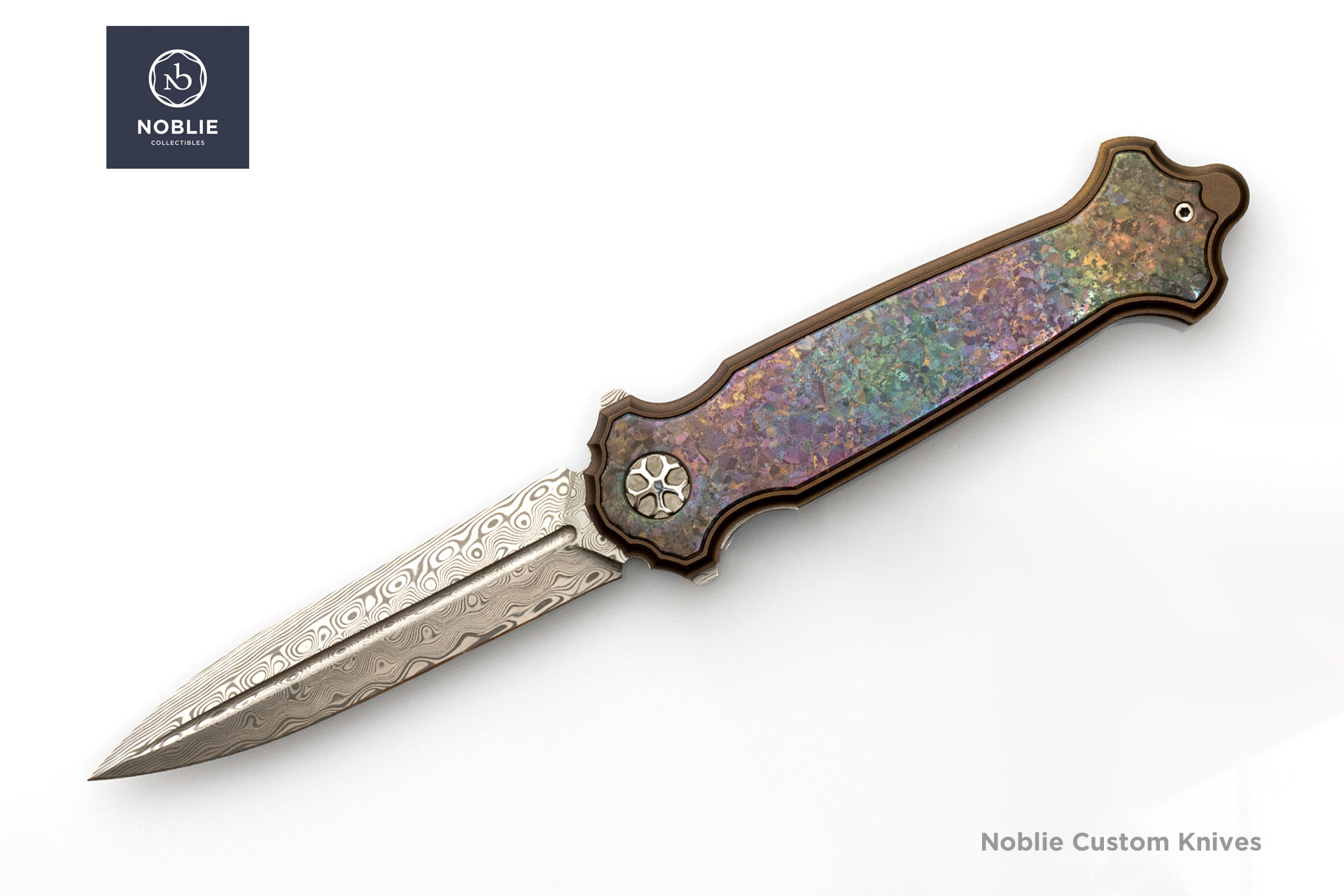
Aleks Nemtcev is a knifemaker and the founder and creative director of Noblie Custom Knives. His work includes collector-knife design and projects combining mosaic Damascus steel, crystallized titanium, timascus, engraving, and fossil handle materials. These projects can involve specialist makers, grinders, and engravers; the finished knife’s credits establish each person’s contribution. We also develop accessories such as paracord beads.
Aleks Nemtcev’s Expert and Knife Maker Website and Reddit.

Bovegno, Italy
Alexis LeCocq is a knife maker whose work includes embellished art folders. His knives combine shaped bolsters, fitted inlays, and decorative metalwork; engraved examples may involve specialist engravers as well as the knifemaker. The Italian knife-makers’ corporation lists him as a master maker based in Bovegno. Attribution matters when assessing these pieces: the maker’s construction and an engraver’s contribution are distinct parts of the finished work.

Pattada, Sardinia, Italy
Antonio Fogarizzu grew up in a family of artisan ironworkers in Pattada, a Sardinian town known for traditional folding knives. He learned in his father’s workshop and made his first knife at 14. His work brings international design influences to that regional tradition, combining hand finishing with experimentation in materials and construction. Homo Faber’s profile records the start of his career in 1992 and his teaching work from 2015.

Albacete, Spain
Antonio began to etch and engrave knives at the age of 21, under the tutelage of his Master Engraver father. He received the honorific title of Master Artisan in 2000. Along with traditional etching and engraving artisan techniques, Antonio uses some new methods he has developed or improved on his own. He also employs the techniques of the goldsmith. Antonio has been awarded many prizes at cutlery competitions in Spain. Antonio’s knives are inspired by classic styles such as Gothic, Renaissance, and Art Nouveau.

Buenos Aires, Argentina
Ariel made his first knife when he was 12 years old and later gained experience in electric facilities and artistic bladesmithing shops. After several years of part-time knifemaking, Ariel became a full-time knifemaker in 2002. Ariel uses his small shop to individually craft his knives each of which is fully hand-made. With a focus on Damascus steel, Ariel often combines various metal elements in his blades. He is constantly expanding his horizons, trying new ways and techniques, which makes every one of his knives unique and amazing.

Riverton (WY), USA
In 1992, Audra began working and apprenticing with Ed Fowler, American Bladesmith Society Master Bladesmith. In 1996, Audra received her Journeyman Smith rating and soon built her own workshop. In 2000, Audra became the first woman to receive her Mastersmith rating from the American Bladesmith Society. Her husband Mike began making knives full-time in 2000, and the whole family got involved in the designing and crafting of knives.

USA
Ben Abbott began experimenting with blades as a teenager and became a two-time Forged in Fire champion and a judge on the program. His work includes forging, heat treatment, and finishing, bringing historical interests into practical bladesmithing. He works with different types of Damascus steel at Ashgrove Forge.

Magaliesburg, South Africa
Bertie has been making knives in his workshop since 1980. Bertie is passionate about sole authorship and expresses his artistic talents in many aspects of his art knives, from self-made Dragonskin Damascus to stonework for handles to gold inlay work. His well-equipped workshop is filled with all sorts of machines each having a specific task. Yet, the principal work is done by hand. Bertie is very particular about details and may spend hours designing and then choosing the appropriate materials for a project.

Portland, Oregon, USA
William “Bill” Tuch makes art folders through Tuch Knives, a workshop in which his son Eric also works. The portfolio includes lockbacks, flippers, liner locks, and dual-action automatic knives. Those different formats bring together decorative work and mechanism design. The workshop’s account credits guidance from makers including Butch Vallotton and Tim Herman; the construction of an individual piece should be assessed on its own specifications.

Methuen (MA), USA
Bill began making knives in 2003. Bill has always had a fascination for knives. He is still proud of being a knifemaker capable of crafting a beautiful knife. Bill’s expertise has been acquired through reading books, the Internet, and precious advice from some of the best knife makers in the world. Today, Bill makes folding knives, boot knives, hunting knives, and kitchen knives of his design. He handcrafts each knife using natural handle materials such as bone, ivory, and pearls and occasionally uses different types of woods and burls.

Bellingham, Washington, USA
Bob Kramer is an American Bladesmith Society Master Bladesmith specializing in kitchen knives. A former chef, he developed a sharpening business before turning to forging his own blades and earned his Master Smith rating in 1997. He founded Kramer Knives, and his work includes pattern-welded chef’s knives as well as other culinary forms. MIT documented his teaching of forging, heat treatment, and grinding during January 2024 classes. His handmade knives should be distinguished from licensed production knives carrying his design name.

(1929-2010)
Riverside, California, USA
Bob Loveless, a pivotal figure in modern knife-making, began crafting knives in the mid-1950s. Located in Riverside, California, his workshop became a hub for innovation and excellence in knife design. Loveless, a former Merchant Marine sailor who also served in the Army Air Corps, brought a practical perspective to his craft, focusing on functional yet elegant designs. His work, particularly the drop point hunter, revolutionized hunting knives, emphasizing utility and simplicity. He co-founded the Knifemakers’ Guild in 1970, contributing significantly to the field through mentorship and collaboration. Loveless’ knives, characterized by their distinctive design and impeccable craftsmanship, remain highly sought after in the knife community.

(1942-2005)
Utah, USA
Fortunate to live in prime hunting and fishing country, and being one who enjoys working with his hands, in 1966 he began making hunting knives as a hobby. After fine-tuning his skills in the shop of Harvey Draper, a knifemaker who influenced his development, Buster began making knives full-time. Most of his productions were high-end art knives, many embellished with his own engraving and gold inlay art. In 1973, Buster joined the Knifemakers Guild, where he later served as director, vice president, and president.

Holliday (TX), USA
Forged in Fire champion Chad Kennedy is a bladesmith from Holliday, Texas, and owner of Chad Kennedy Knives. By forging his own Damascus, he crafts knives into unique works of art in a variety of styles, from hunting knives to cleavers and hatchets. In June of 2021, Chad earned his Journeyman stamp from the American Bladesmith Society, providing further evidence of his skill.

Westminster, South Carolina, USA
Daniel Keown makes traditional-style slipjoint pocket knives through Keown Fine Folders. His background includes welding, metalworking, and quality control, and he began making knives after seeing the work of Ernest “Mooney” Warther. His specialty makes him relevant to collectors comparing traditional pocketknife patterns, spring action, blade alignment, and the fitting of liners, springs, and handle materials.

Los Angeles (CA), USA
With a background in producing handmade cabinetry and furniture, Dave became interested in knives in 2002. After studying books and videos and purchasing the required materials and tools, he started designing folding knives and created his first knife in 2003. Fixed blades are a part of his art, along with folders. Dave’s knives have been approved by four voting members of the Knifemakers Guild. Dave participates in the activities of the American knifemakers community and enjoys its support and experience.

Albany, Australia
David started making knives in 1989 and became a full-time knifemaker in 1993. After meeting artist Carol Ann O’Connor in 1999, they started making knives with medieval and fantasy themes. The combination of David’s knives and Carol’s art was successful right from the start, with several best art knife awards won in the first year. David’s knives are unique and have been sold to collectors in different countries.

USA
David Kramp makes traditional-style folding pocket knives under the D. Kramp Knives name. His work focuses on slipjoints, building on an interest in the craft shaped by his father, knifemaker Ed Kramp. His place in this selection is among makers developing the traditional American pocketknife.

West Virginia, USA
Dellana was immensely creative already as a teenager: she would make her clothes, draw, paint, embroider, and even create things from scratch. In 1979, she started her own goldsmithing business. When Dellana met master knifemaker Jim Schmidt, she was intrigued by the beautiful art of making art knives. By 1996, Dellana became a full-time knifemaker, incorporating her background in jewelry with her fascination with knives. Soon she became a voting member of the Knifemakers Guild, a member of the American Bladesmith Society, and the prestigious Art Knife Invitational group. Dellana has produced many amazing Damascus pocket knives and does engraving herself.

Montana, USA
Deryk Munroe is based in Gallatin Valley, Montana. His knives often feature blued Damascus blades, folding mechanisms, and precisely machined handle construction. His work combines traditional craftsmanship with modern engineering, with details such as titanium frames, dual thumb studs, and ventilated, color-anodized finishes.

Cape Town, South Africa
Des started knifemaking as a schoolboy and crafted his first quality knife in 1970. In 1990, Des started going to international knife shows and has, on many occasions, won awards for his designs and the quality of his work in South Africa and internationally. In 2004, he decided to follow his passion, becoming a full-time knife maker. Des’s main focus is on folding art knives.

Brazil
Dionatam Franco is a Brazilian bladesmith whose work includes Bowies, fighters, and patterned Damascus. He holds the American Bladesmith Society Master Bladesmith rating. His knives bring historical blade forms together with decorative steel patterns and individual handle designs.

Royal Oak (MI), USA
Don made his first knife in the sixties, and ever since has had a lifelong fascination with knives. He got serious about knifemaking in 1994 when he started buying professional equipment. In the nineties, Don taught himself knifemaking with the help of the “Knife List” Internet forum, and still acknowledges a debt of gratitude to its many participants. He pursued his own visions of personal cutlery and developed a style that is uniquely his own. Don is a member of the Miniature Knifemakers Society and contributes as a moderator to online knife forums.

Helotes (TX), USA
Don sold his first knife in 2000 and became a full-time maker in 2004. Slip-joint pocket knives are his main interest and are primarily what he crafts. Don is committed to constructing only the finest quality knives and devotes as much time as needed per knife to ensure his customers receive the best quality knives possible. Don takes whatever time necessary to complete a knife to his exacting standards, whether making a single, double, or three-blade knife. Don co-hosts a slip-joint knife forum on knifeforums.com and is a member of the Texas Knifemakers and Collectors Association.

Texas, USA
Fred has had a long-standing passion for handcrafts and, especially, knives. In 1973, inspired by a handmade knife he saw in a local knife shop, he decided to start crafting hunting knives. Fred ground his first knives on a hard wheel and hand-finished them, before building a small shop for his hobby. In 1976, Fred joined the Knifemakers Guild, in which he later served as Secretary, Treasurer, Vice President, and two terms as President. Dr. Carter has won many awards for his hand-made knives.

Loudon (TN), USA
Dusty grew up in a small ranching community, hunting, fishing, and working on ranches, being naturally exposed to knives. He began creating knives in 1991, totally self-taught in knife making and engraving. Dusty is constantly learning and evolving, while making up to 60 knives and sheaths a year. Dusty regularly attends knife shows and has won 26 knife show awards.

Torino, Italy
Emmanuel Esposito combines traditional Italian craftsmanship with modern machining. Born in Torino, Italy in 1985, he became interested in precision machining and intricate mechanisms early on, working in his family’s machine shop. His work includes fixed blades and folders, with folding designs combining engineered pivots and proprietary locking mechanisms such as the Double C-Lock. He uses materials such as ATS-34 stainless steel, carbon fiber, and natural inlays of pearl and tortoise, with close attention to fit and finish. A member of the Italian Knife Makers Guild, he frequently exhibits at shows such as the CIC in Milan and the East Coast Custom Knife Show in New York. He lives in Buttigliera Alta near Torino, and his knives are collected internationally.

Laredo, Texas, USA
Enrique Peña, based in Laredo, Texas, has gained prominence in the knife-making industry for his blend of traditional and modern designs. Specializing in folding knives, particularly in the slip joint and liner lock categories, Peña’s work demonstrates attention to detail and an adherence to high-quality craftsmanship. His designs often incorporate classic elements with contemporary touches, making them highly sought after by both collectors and everyday users.

Sassello, Italy
Always a nature and outdoor activity lover, Francesco became interested in making knives in 1991 and began his knifemaking activities completely self-taught. In 1995, after a trip to the USA and spending a few days with master Steve Johnson, Francesco decided to devote himself full-time to making. His primary occupation has led him to the presidency of the Italian Knifemaker Corporation and a membership in the American Knifemakers Guild and German Knifemakers Guild.

Anchorage, Alaska, USA
Gabe Fletcher makes knives under the Anchorage Forge name, focusing on culinary blades and patterned Damascus steel. He began knifemaking in 2022 and developed his work through instruction from makers including Mareko Maumasi. In an interview about his process, Fletcher discussed using 15N20 and 1080 in Damascus and developing patterns through forging. The pattern is one part of a culinary knife; its grind and finished edge geometry also matter in use.

Stoneham, Canada
Gaétan has been making knives for over twenty years and has become an expert in many aspects of this craft. A talented artist, Gaétan is known for scrimshaw that adds an individual artistic element to his knives. However, while customized and beautifully adorned, Beauchamp’s knives are truly made to be used: function is their essence. Each knife performs smoothly in a multitude of functions: hunting, fishing, even opening boxes or cutting string. Living in Quebec, the cradle of French civilization in North America, Gaétan strives to preserve the culture and identity of French craftsmen and is independent in terms of ideas and designs.


Massachusetts, USA
George has had an affinity for the fine arts since his youth. His favorite pastimes included visiting museums, drawing, and painting. He felt at an early age that creative handiwork was his calling. After graduating from Rhode Island School of Design in 1973, he taught art and leatherwork. He also made leather sheaths for knives brought to his shop and thus was introduced to hand-made knives, which he quickly learned to love. After taking a course at The Jewellery Institute, George continued to master his knifemaking skills and soon switched to art folders. His rich experience in many artistic skills has resulted in him concentrating on designing and creating unique art folders.

La Grange, Kentucky, USA
Gil Hibben is known for fantasy knives, combat-knife designs, and work associated with film. His career also includes service as president of the Knifemakers’ Guild. Hibben’s handmade work and licensed production designs belong to different production contexts, even when they share an identifiable visual style.

Hirosaki City, Japan
Born in Australia, Glenn has been living in Japan since 1986 and has drawn much inspiration from this nation’s culture. In 1992, when looking for a unique knife in Tokyo, he instead bought some tools and materials along with a book on knifemaking. Glenn started by making fixed-blade knives, and by 1999, started creating Linerlock folders, which became his focus. His background in jewelry resulted in him adding lavish embellishments to his knives. Glenn uses rare materials, such as mammoth ivory, mother-of-pearl, gold, and precious stones for his knives.

São José do Rio Preto, São Paulo, Brazil
Gustavo “Gus” Cecchini (GTC) engineers futuristic folders that pair integral frames and hidden-flipper mechanics with ultra-precise machining. He dials in detent strength, lock geometry, and deployment to exacting standards and finishes titanium frames with sculptural milling and tasteful inlays. His mechanisms and design language set benchmarks in modern folder innovation.

Vila Nova, Brazil
Gustavo started practicing blacksmithing at the age of 18 in his blacksmith father’s shop. His childhood fascination with knives grew into a passion: Gustavo took classes, studied from books, consulted information on the Internet, and did his own research. In 1999, he became a full-time maker. A number of prizes and titles have been collected by Gustavo since, at various shows. In 2002, Gustavo became a member of the Brazilian Knife Makers Society and joined the American Bladesmiths Society.

Saitama, Japan
When studying industrial design at the Tama Art University, Harumi developed a fascination for knives. Her final design project for college was a set of kitchen knives. At the age of 21, Harumi was already a designer and maker of knives, with a high esteem for her skillfully hand-made products. She designed both fixed blades and folding knives, all of which were unique and one-of-a-kind. After qualifying for membership in the Knifemakers Guild, Harumi exhibited her knives at various shows and earned significant awards testifying to her skills.

Belfast, South Africa
Kevin began knifemaking at the age of 12, tutored by his granddad. At the age of 21, he was the youngest member accepted into the Knifemakers’ Guild of Southern Africa. In 2003, Kevin became a Master Bladesmith with the American Bladesmith Society. He enjoys making art knives, Bowie knives, and daggers using his own Damascus or that made by his wife Heather. Heather qualified as a farrier at Montana State University, USA, in 1983. She is South Africa’s first qualified female farrier, blacksmith, and bladesmith. After meeting Kevin, Heather learned to create knives. She enjoys forging Damascus and Mokume Gane, traditional African weapons, and making forged period knives.

Oregon, USA
By the age of 30, Henry was working as a design engineer, devoting his spare time to artistic pursuits, such as painting, woodcarving, stained glass art, jewelry making, gun engraving and gunstock carving. He also started crafting knives embellished with hand engraving. Soon he resigned his engineering job and became a full-time knife maker and a member of the Knifemakers Guild. Henry’s work includes richly adorned and engraved folding knives with a distinctive style.


Kawagoe, Japan
Hidetoshi began making traditional knives in 1990, at the age of 19, guided by the prominent Japanese master Nobuyuki Uekama. At the age of 22, he started studying the traditional Japanese art of carving called netsuke. In 2000, Hidetoshi began creating art knives in his own style, merging knifemaking and his netsuke art. He regards an art knife as an artistic object, on par with a netsuke handiwork. Hidetoshi is a regular participant in exhibitions and shows and has won several awards both in Japan and overseas.

Peterborough (NH), USA
Howard began making knives in the 1960s. His approach emphasizes a knife’s appearance both open and closed, with particular attention to design. Howard gives much thought to selecting suitable materials for the handle, blade, and other parts, to make each knife visually pleasing. All Howard’s lockback and liner lock folding knives are assembled with screws to enable adjustments and make a knife work with smoothness and precision.

Roanoke Rapids, North Carolina
Jack Busfield is known for interframe folders of the 1980s and 1990s. Based in Roanoke Rapids, North Carolina, he sold his first knife in 1979. His knives often carry engraving by artists such as Sam Alfano and typically use ATS-34 steel and 416 stainless steel with rare inlays such as fossil walrus or Tahitian pearl shell. He no longer makes or takes orders for knives, and his existing work remains sought after by collectors.

Argentina
Javier Vogt crafts art-grade knives—folders and fixed blades—with elaborate engraving, precious inlays, and seamless transitions between materials. He uses premium stainless and Damascus, maintains strict symmetry, and composes each build as a cohesive visual statement. His work bridges fine art and high-end knifemaking.

Burgundy, France
Jean-Louis Regel sculpts integrals from single billets, with flowing lines and sculptural detail. He blends hand-forged steels with rare natural materials and executes deep relief carving and sculptural details at a master level. His knives exemplify European art-knife tradition executed with modern precision.

Quebec, Canada
Jeremy Yelle is a Canadian bladesmith whose work includes forged custom knives and culinary knives. He holds the American Bladesmith Society Journeyman Smith rating. His portfolio spans individual forged pieces, bringing blade shaping and material selection together with the practical requirements of the knife’s intended use.

Kentucky, USA
Jerry has always been a fan of hunting, and the challenge of making his own hunting knife intrigued him. In 1991, he was given a piece of steel and a paperback book on knifemaking by a friend, and his knifemaking career began. Soon, Jerry met a few established knife makers living in his area and was introduced to folders, which became his new passion. After visiting some knife shows in 1994, Jerry started creating knives as pieces of art. In 1998, he joined the Knifemakers Guild. In his shop, located behind his home, Jerry performs every operation involved in creating knives except engraving and scrimshaw.

Indiana, USA
Jim joined the Knifemakers Guild in 1978. Unable to find much literature on knifemaking, he visited local knife shops to study knives. He also gathered knowledge from area knifemakers he became acquainted with. With a background in art, Joyce switched from painting to embellishing knives easily. With most of her engraving and carving leaning towards Art Nouveau, she possesses her own distinctive style. Jim and Joyce are happy to work together crafting some truly distinctive knives. Jim’s focus is on folding knives, although he still has a passion for custom daggers and fighters.

Kerrville, Texas
Joe Kious, a pioneering force in knifemaking, lived and worked in Kerrville, Texas, where his passion for artful blades came to life. Selling his first knife in 1969, he quickly established a reputation for the innovative “Pocket Locket” style—a design featuring a hidden, intricately engraved compartment that set his folders apart as true works of art. Operating full-time from his Kerrville workshop, Kious dedicated his craft to producing investment-quality folders that combined technical precision with creative expression, earning him admiration among collectors and fellow artisans alike. His enduring legacy continues to inspire the knife community, even after his passing in 2014.

Pine Plains (NY), USA
Joe started studying metalwork in 1963 as a blacksmith’s apprentice, making knives and cleavers. He has worked as an ironworker, senior detailer in an art foundry, and other metal-working trades. Joe specializes in one-of-a-kind art designs with carved ivory, Damascus steel, and pearl. His blades, including hawks, are not wall hangers but made as functional blades as well as decorated pieces. Joe holds the rank of Master Smith with the American Bladesmith Society, is a voting member of the Knife Makers Guild, and is a field editor for BLADE Magazine.

Kimstad, Sweden
Johan’s fascination for knifemaking started when he decided to make a knife to carry on a hunt. Liking what he had created, he began making more and more knives. After taking some classes and studying forge welding, Johan got totally hooked. For a couple of years, he would forge blades for other knifemakers to use in their knives. After discovering Mosaic Damascus, he experimented for many months until finally achieved his own technique with extraordinary patterns. While forging amazing mosaic Damascus blades for other makers, Johan crafts his own knives in his workshop, thoroughly controlling every aspect of his art, including file work and inlays.

Kentucky, USA
John W. Smith has been a full-time knifemaker in Kentucky since 1993 and is a voting member of the Knifemakers’ Guild. His work consists mainly of embellished locking folders and art fixed blades. In his early years in his Kentucky workshop, he developed his skills in engraving and Damascus fabrication. He uses natural handle materials such as mother-of-pearl, fossil ivories, and stone.

New Braunfels (TX), USA
Johnny became a full-time knife maker in 1992. Most of his heirloom quality knife designs are available in right or left-handed models. Johnny was first exposed to handmade knives in 1983 while visiting the shop of Jim Moore in Texas, where he made his first knife. He still offers the model – High Country Classic Hunter – as one of his standard designs. Today, Johnny offers a variety of folding knives, with various locking devices, as well as slip-joint models.

Frenchtown (MT), USA
Josh began making knives at the age of 11. At the age of 15, he passed his Journeyman Smith and in 2000, at the age of 19, he became the youngest person to ever attain the Master Smith rating in the American Bladesmith Society. Josh enjoys making mosaic Damascus, liner lock folders, automatics, Bowies, and fighters. Josh places greater focus on hunting knives as he used to notice a huge lack of quality hunting knives available on the market for serious hunters. His passion for hunting and his knowledge of blades have combined to create one of the best knife companies in the country.

Uberaba, Brazil
Julian Antunes is a largely self-taught Brazilian bladesmith whose work includes medieval-inspired daggers and swords. Flowing curves and complex Damascus patterns are central to his designs. His Art Knife Invitational biography describes a practice shaped by historical forms and an interest in sculptural blade work.

Berlin, Germany
Jurgen created his first knife at the age of 14, as a member of a metal-craft club. After completing a 3-year apprenticeship as a silversmith, he studied metal design at an art university. Jurgen made his first folding knife the same year he graduated, showing his rich background in sculpture, art, and metal design. Even his first knives were true sculptures in steel, lavishly adorned with exotic materials. After starting to attend exhibitions worldwide in 1989, Jurgen became famous for his knife art which was sometimes difficult to comprehend even for seasoned knifemakers. Jurgen has received many awards for his unique knives.

Edsbyn, Sweden
Kaj had made a few traditional Scandinavian knives by the time he was 20. Soon, Kaj was taught to forge blades by an old smith, and, at the age of 26, Kaj started his career as a full-time knifemaker. Soon, he began making all kinds of knives: hunters, daggers and fighting knives. Kaj has attended many knife shows in the USA, France, Italy and Japan. His focus is on lockback and slip-joint folding knives, but he also enjoys making multi-blade folders and daggers.


Kaneohe, Hawaii, USA
Ken Onion, based in Kaneohe, Hawaii, is a preeminent figure in contemporary knife-making. Renowned for his innovative designs and mechanical inventions in the knife industry, Onion’s contributions significantly influence modern folding knives. He holds acclaim for inventing the SpeedSafe assisted opening mechanism, a pivotal development in the field. His knives blend functionality with unique, ergonomic designs, making them highly prized in both utility and collector markets. Onion’s work extends beyond traditional boundaries, incorporating modern materials and techniques. His partnership with leading knife manufacturers to mass-produce his designs demonstrates the wide appeal and practicality of his innovations. Onion’s impact on knife design and functionality cements his status as a leading innovator in the knifemaking community.

Missouri, USA
Kyle Royer began making knives as a teenager and holds the American Bladesmith Society Master Bladesmith rating. Based in Missouri, USA, Royer specializes in creating high-quality knives, with a particular emphasis on intricate Damascus patterns and art knives. His work is characterized by attention to detail and a deep understanding of metallurgical principles. Royer’s knives are not only functional tools but also artistic masterpieces, reflecting his dedication to both the aesthetic and practical aspects of knife-making.

Pulaski, Tennessee, USA
Lloyd Hale is associated with elaborate art knives, including decorated folders, daggers, and fighters. His work is distinguished by ornate, sculptural embellishment and individual compositions. For collectors, the attraction lies in the relationship between the blade, fittings, handle, and decoration, rather than a single recurring production model or a universal performance claim.

Odessa, Texas
Loyd McConnell is a knifemaker based in Odessa, Texas. He started on a Sears 6×48 grinder borrowed from his father and became a full-time knifemaker in 1989. He is a voting member of the Knifemakers’ Guild and a member of the German Knifemakers’ Guild, and he is known for bespoke designs. As the bespoke knifemaker for Holland & Holland, riflemakers to the British Crown, he makes knives found in collections worldwide. His work is regularly shown at events such as the Knifemakers’ Guild Show, the East Coast Custom Knife Show, Safari Club International, and the German Guild Show in Munich.

Brazil
Luiz Gustavo Gonçalves makes culinary knives and fighters and holds the American Bladesmith Society Master Bladesmith rating. Those knife forms place different demands on blade thickness, taper, and handle shape. His range makes him relevant to readers exploring both culinary cutlery and forged collector pieces.

Santa Fe, New Mexico, USA
Mardi Meshejian trained in jewelry design before turning to bladesmithing in 1995. His knives use sculptural forms, contrasting colors, and mixed materials, reflecting that jewelry background. His work spans art knives, pocket knives, and kitchen knives. He also makes his own titanium Damascus for decorative applications.

Wickenburg (AZ), USA
Michael received a university degree in arts after serving in Vietnam in 1968 and returning home as a disabled veteran. He became hooked on knifemaking when visiting a knife show. Michael specializes in folders, hunting knives, and survival knives. He uses natural materials for handles and is dedicated to using the finest materials available. Michael claims he has gained much from many makers he met who shared their knowledge with him. He strives to increase his knowledge of metallurgy and to craft the highest quality knives.

Berlin, Germany
The son of a forester, Michael grew up close to the forest and game hunting. He began collecting knives as a youth and later finished his training as a cabinet maker. With his knife collection growing, he soon discovered an interest in knife making. In 1997, Michael filed his first knife. He specializes in making integral knives but also enjoys crafting other types of knives. Since 2000, Michael has been a member of the German Knife Makers Guild.

Visalia (CA), USA
Michael was introduced to knifemaking through a forging class in 1995 and received his Mastersmith title in 2003. Michael’s focus is on folding knives, but he makes fixed blades as well. The Bowie knife is his favorite style because of its simplicity. Michael believes that it is harder to craft a simple knife well, as, with the scarcity of detail; any defect will be clearly visible. He enjoys sharing his making expertise with others and, having a degree in Art Education, he teaches in his shop and at the School of Fire Arts in Exeter, California.

Taos, New Mexico, USA
Michael Walker is known for innovative folding knives and for helping establish the modern Linerlock, which combines a spring liner lock with a detent to retain the closed blade. Earlier spring-liner locking arrangements predate his work, so his contribution is more precise than inventing every form of liner lock. His folders bring mechanism design together with detailed machining, material selection, and decorative work. He remains an influential name among knife enthusiasts and collectors.

Malakoff, Texas
Mike “Whiskers” Allen has been making knives since 1984 and has been a member of the Knifemakers’ Guild since 1989. He is known for folders, scale release automatics, and bolster release designs. He does his own work, from the initial design and file work to the engraving that marks each piece. His knives often feature original locking mechanisms and combine traditional techniques with modern craftsmanship.

Vryheid, South Africa
Nico made his first knife as a school project at the age of 14. The humble beginning was the start of a lifelong passion for knives and knife art. Nico’s love for knifemaking made him progress from just making fixed-blade knives to making folders and forging his own Damascus steel. Nico keeps a high standard of excellence and will not allow any knife to leave his workshop until he is 100% satisfied with it. Nico makes mostly folders using exotic materials, but also enjoys making daggers and fixed-blade knives.

Store and workshop in Edison, New Jersey; European workshop
We publish this guide. Led by knifemaker and creative director Aleks Nemtcev, we work on collector knives that combine blade construction with materials, engraving, and decorative design. Projects may bring together specialist makers and artists, whose roles should be credited individually. These knives cater to collectors interested in the finished object, its workmanship, and the people behind it.

Arvada (CO), USA
Owen grew up in Africa and spent much of his time outdoors in the bush. As a child, he always had a pocket knife around. Owen made his first knife in 1979. As interest in modern Damascus steel grew, Owen was immediately fascinated by its potential in knifemaking and started forging his own pattern-welded steel. Owen’s main focus has been on folding knives, but he has also enjoyed making daggers. A founder member and chairman of the Knifemaker’s Guild of Southern Africa for many years, Owen has also been exhibiting and receiving awards in the USA and Europe.

Brazil
Pedro Fornari places particular emphasis on sculpted handle contours and the relationship between handle and blade. His knives combine shaped handles with carefully composed blade profiles. Woods, horn, and synthetic materials give those designs different visual and tactile qualities.

Texas, USA
Ray’s many years of career in tool and die making resulted in his interest in knives. He made his first knife in 1984, after accepting a bet from a local Colorado knife maker, to prove that he would create a better knife than anything in a magazine they were looking through. In 1986, Ray’s son Ron convinced him to show his knives at the Solvang Custom Knife Show. Ron is in many ways as headstrong and independent as his dad. They both have collaborated on many knife projects, creating intricate and unique folding knives.

British Columbia, Canada
Rhidian Gatrill makes traditional slipjoints and lockbacks alongside original folding-knife designs. His work also includes miniatures and collaborations, bringing classic pocketknife construction into both familiar and experimental patterns. His own portfolio describes traditional folders as a main focus, with occasional modern liner locks; miniature work is part of that broader practice.

Mairipora, Brazil
Ricardo began making knives in 1988. First, he made his knives by stock removal but switched to hand forging in 2001, influenced by the teachings of Jerry Fisk at the workshop that became a major event in the Brazilian knifemaking industry. Knifemakers from all over Brazil who had attended Fisk’s workshop founded the Brazilian Knife Makers Society, and Ricardo was elected as its president in 2003. Ricardo is known as one of the most prominent Brazilian knifemakers and attends international shows regularly.


Magdalena, New Mexico, USA
Richard Rogers makes traditional slipjoints and modern folding knives, with clean lines and restrained handle designs. His work offers a useful comparison for collectors interested in pocketknife construction and everyday-carry formats.

San Diego (CA), USA
Growing up in a small rural city and often hunting, fishing, and kayaking, Rik naturally developed a passion for knives. In 2000, Rik decided to give knifemaking a try and was immediately hooked. He signed up with the American Bladesmiths Society and started discovering the universe of design freedom, craftsmanship, and new experiences. Rik received his Journeyman Smith rating in 2004. He is interested in making fixed blades but enjoys making folders too. Rik has explored many different directions in knife design and enjoys creating various types of knives, from simple utility workers to daintily embellished art knives. Rik likes using natural materials like bone and ivory on his knives.

Israel
Rudi’s background as a metallurgist has resulted in him developing a deep interest in edged weapons. After immigrating to Israel in 1993, he began working as a blacksmith, creating edged weapons exclusively. Rudi crafts knives, swords, axes, and other bladed weapons of various styles. He forges his own Damascus steel and does his own hand forging, filing, engraving, and even heat treatment.

Bluffdale, Utah
Shaun and Sharla Hansen are a husband-and-wife team who make knives together in their family workshop. Shaun brings technical skill and Sharla the artistic vision to their collaboration. They work with materials such as Damascus steel, carbon fiber, and rare natural inlays. Their designs feature original locking mechanisms and close attention to detail, combining traditional craftsmanship with contemporary design.

Clearwater (FL), USA
Stan has always enjoyed tools and making handicrafts. He made his first knife from scavenged materials. In 1999, Stan attended the Knifemakers Guild show that changed his life. Stan decided that, as a knifemaker, he would make each knife better than the previous one. Stan began with fixed blades, and after gaining skills, moved into folders, then autos. Lately, he started creating folders with all the screws hidden. Stan is still devoted to the creed that he will make each knife better than the one he made before that.

Bamberg, Germany
Stefan started making knives in 1989. His fancy was driven by his background in precision mechanics and enthusiasm for outdoor sports. Stefan learned techniques from other makers in his region. In 1999, Stefan joined the German Knifemakers Guild and in 2001, he became a full-time maker. His first book about knife materials and knife-making tricks was printed in 2005. Most of Stefan’s knives are design-oriented: serrations and optical elements from nature transform his knives into biomechanoids and genuine collector objects.

Coventry (RI), USA
Stephen always had a love for sporting adventures, nature, and hunting. This inevitably involved the use of knives: Stephen would throw them and use them to carve and whittle. Stephen got hooked by handmade knives and began crafting hunting knives, soon switching to lockbacks. Stephen’s background in art and his career of over 30 years in sculpting have resulted in him developing his style of highly ornamented and fully carved art knives. Stephen crafts lockbacks, liner locks, and automatics, using precious metals, Damascus steels, fossil ivories, and pearls.

Mildmay, Canada
Steve began creating knives in 1998. What began as an endeavor to create a homemade set of throwing knives quickly became a passionate hobby for life. In 2005, Steve won Best of Show Art Knife at the Wolverine Annual Spring Show. His main focus is still on fixed-blade knives, including gent’s knives, Bowies, and art knives.

Texas, USA
Steve grew up surrounded by various tools available to follow his interests. His family included wood carvers, cabinet makers, and mechanics, and there were blacksmiths, silversmiths, and lapidaries in his surroundings. After receiving training in engineering and metalwork, Steve shaped his first knife by hand with file tools. He was exposed to high-quality handmade knives in 1974 when visiting the shop of knifemakers Bob Loveless and Steve R. Johnson. The visit gave him a big boost and resulted in his developing a fascination with folding knives. Soon, he created his first interframe and multiblade folders. Steve is known for high-end interframe folders, including examples embellished by specialist engravers with engraving and gold inlays.

Manti (UT), USA
Steve grew up on his father’s farm, where he had the opportunity to hunt, fish, ride horses, and camp. He was first allowed to make a knife in a shop as a scout. Knifemaking became Steve’s lifetime passion, and he has always enjoyed the personal challenge of making each knife. Steve has served as Secretary/Treasurer on the Knifemakers’ Guild Board of Directors and is associated with many members of the Guild and the knifemaking community worldwide.


Calgary, Canada
Thomas made his first knife and his first sword in his early teens. A European-trained chef for over two decades, he has been involved in knifemaking part-time. In 2000, Thomas became a full-time knifemaker. His knife art embraces many styles, from daily used chef’s knives to highly exquisite art pieces. Thomas each time strives to use a design and a combination of materials that would make a knife graceful, yet functional: even the most intricate design never compromises service properties.

Kansas, USA
Tim painted show cars, produced gold leaf signs, and worked as an illustrator when a teenager. After reading a book on knives and attending a Knifemakers Guild show, knives hooked him. Starting with a primitive lathe, he created knives arduously for several years, as he wanted to be a Guild member. A local knife maker introduced him to lockback folder construction, and Tim decided folders were practical and worthy. Having learned from Steve Hoel, Buster Warenski, Wolfgang Loerchner, and other master knifemakers, Tim is still grateful to them for the skills necessary to produce a fine knife. Tim spent years mastering his techniques to create magnificent folders of his own design.

Spanaway (WA), USA
Todd spent much of his younger years in the deep forests of the Pacific Northwest, camping and hunting. Knives were his companions most of the time, and he naturally developed an appreciation for them. Todd tried making knives while still in high school and realized he had found his passion. Todd became a full-time knifemaker in 2003. Inspired by the grinding skills of Bob Lum and Bill Luckett and the Integral construction of Edmund Davidson and Ted Dowell, Todd developed his own style of integral knives.

Michigan, USA
Tom Overeynder has established a reputation in the knife-making field for his refined folding knives. Specializing in slip joint and liner lock mechanisms, Overeynder combines traditional craftsmanship with modern aesthetics. His knives are known for their precision, balance, and elegant design. Overeynder pays attention to detail, ensuring each knife’s functionality aligns with its visual appeal. His use of high-quality materials, including various steels and handle materials, reflects a deep understanding of the craft. Overeynder’s knives are sought after by collectors and enthusiasts, who appreciate the blend of classic techniques with contemporary design elements.

(1946-2020)
Shelburn, Indiana, USA
Tony Bose, a highly esteemed figure in knifemaking, operated from Shelburn, Indiana. He specialized in traditional folding knives, earning a reputation for exceptional craftsmanship. Bose’s work reflected a deep respect for classic knife-making traditions, combined with an innovative approach to materials and mechanics. His fine attention to detail and quality in every piece set a high standard in the industry. Renowned for his skill in creating complex slip-joint mechanisms, Bose’s knives are celebrated for their precision and durability. His collaboration with major knife manufacturers brought traditional folding knife designs into the modern era. Bose’s legacy in the knifemaking community is marked by his dedication to preserving and advancing the art of traditional knife-making.

North Mankato (MN), USA
Tracy started making knives in 1999 after reading a magazine article on how to create a homemade knife. He got hooked on the new hobby immediately. His first 100 knives were never sold, but thrown away, destroyed in testing, or given away. Tracy is quite exacting and believes that after mastering one aspect of knife making, a good maker shall start mastering another one. Tracy’s work is mainly focused on stainless fixed blades.

West Virginia, USA
Van started making knives full-time after graduating from high school at the age of 17. A self-taught knifemaker, Van has also tried other mediums to express his creativity, as a painter, a sculptor, and a carver. Van’s knives are very artistic, with flowing designs and unique looks. Van believes strongly in sole authorship, therefore, every aspect of each knife is done by himself alone, from designing to forging his own Damascus, engraving, carving, and gold-work. Van strives to craft each of his high-end art knives as truly unique and one-of-a-kind.

Show Low, Arizona, USA
Vince Evans has worked as a full-time bladesmith since 1981, specializing in historically inspired swords and knives. His research includes examining museum and private collections. His portfolio covers Scottish swords and dirks as well as Anglo-Saxon, Vendel, Viking, and Chinese sword forms.

Kentucky, USA
WD Pease has been making knives since 1969. He joined the Knifemakers’ Guild in 1976 and became a full-time maker in 1978. His work is almost exclusively dedicated to folders, a specialty that demands precise mechanisms and fit. His knives combine traditional techniques with materials such as high-grade stainless steel, Damascus steel, and handle materials including pearl, stag, and bighorn sheep.

Bethlehem, South Africa
Bill started studying knifemaking under the guidance of Owen Wood. The benchmark set by the famous master became Bill’s inspiration. Years of experience in his capacity as a professional photographer resulted in him crafting knives that reflect his distinctive personal style. Bill believes that knifemakers are not there only to please customers, but are dedicated artists in their own right, expressing their artistic vision.

Ontario, Canada
Wolfgang made his first knives in 1984. Using dozens of file tools of every configuration, lots of sandpaper and elbow grease, and a few other tools, he began sculpting art knives from steel bar stock. While his use of few power tools limits the number of knives he can create at any given time, it also removes any limitations to the designs of his intricate daggers, folders, and straight knives. Daggers hold a special fascination for him since their symmetry and sizes allow endless possibilities of line and composition. Also, Wolfgang has paid much attention to creating lockback folders of unusual design. Wolfgang has collaborated on several knives with some of the greatest artists involved in this craft.

Northern Ohio, USA
Zane Dvorak of ZD Forge makes hand-forged custom knives, including integral and keyhole designs. His work combines sculpted handles with both plain and pattern-welded blades. He describes a self-taught path into forging, beginning with a traditional forge he built at 14.

Start with the job the knife must do. A collector may prioritize engraving, mechanism design, or sole authorship; a hunter may care more about edge geometry, grip, and sheath retention. A chef needs a suitable profile and grind before decorative details become useful deciding factors.
Custom and handmade are related terms, but neither guarantees that a knife was built to a particular buyer’s specification. A maker may sell an individually made knife from an existing pattern. A licensed factory version of a maker’s design is a different product from that maker’s handmade knife, even when the names are closely associated.

American makers associated with influential designs and distinct specialties include:

There is no single answer across Japanese kitchen knives and art knives. Takeshi Saji and Ichiro Hattori are individual makers associated with distinctive bodies of work. Masamoto Sohonten and Miyabi are brands, so comparing all four as though they were individual craftspeople mixes different categories.
For Japanese art knives and decorated folders, the profiles of Harumi Hirayama and Hidetoshi Nakayama offer a different starting point from a kitchen-brand comparison. Choose the knife type first, then compare the work and construction relevant to it.
A knifemaker makes knives; a bladesmith forges blades. A knifemaker may forge a blade or shape it by stock removal. Engraving, handle work, sheath making, and mechanical design are additional skills that may be carried out by the same person or by collaborators. An ABS Master Bladesmith rating is a specific credential in forged blades, not a universal requirement for making an excellent knife.
Use the locations and specialties in this guide to narrow the field, then verify where the particular knife is made, who made it, and whether the maker is taking orders. For a historical or retired maker, the relevant route is an existing knife with clear provenance rather than a new commission.
Finished custom knives are sold by makers directly, at knife shows, and through dealers; a commission goes through the maker. At Noblie Custom Knives, we sell handmade Damascus and mosaic Damascus knives, daggers, and collector pieces from our store and workshop in Edison, New Jersey, and ship across the U.S. and internationally.

The right maker depends on the knife: a working hunter, a kitchen knife, a traditional folder, or an engraved collector piece. Use the profiles to recognize styles and contributions, then compare construction, authorship, condition, and intended use. A famous name can explain a knife’s place in the craft; the details of the individual knife still deserve attention.
For examples of high-value collector pieces, read about the most expensive knives globally.

Continue reading: How Much Can a Knife Maker Make?


Hey very nice site!! Man .. Excellent .. Amazing .. I’ll bookmark your web site and take the feeds also…I am happy to find numerous useful information here in the post, we need develop more techniques in this regard, thanks for sharing. . . . . .
It’s a true pleasure, to have the chance to look at a few of the master pieces or art you men have made . Myself , I’m a self taught idiot. That loves to learn how to forge metals of all kind together. I have 60 knives out at this point. Mr. Dave Baker has given me a hand ( not in person ) but by the questions I have asked him on line . I it was possible I would buy all you men dinner . Do to the fact, I owe you for the lessons I got for free just watching . Then heating up a piece of metal and try my luck . One thing I have had good luck with , with my forging is I weld the corners a bead in the center , then I dip it into #1 fuel oil . ( now I clean all my metal first. Never use flux. Keep up the great videos so I can learn . When yall get me trained up, I plan to go winn forged in fire.
What kind of “Best Knife Makers: A Comprehensive Guide” list not mentioning Jay Fisher is that?!?
Adding him to the lineup of standout knife makers would, honestly, make the guide a bit more thorough, giving folks a clearer picture of the remarkable artisans in this craft. If you’ve got specifics or can help us get in touch with Jay Fisher, feel free to drop us a line through the email shared on our site.