


Contents
The macuahuitl was a Mesoamerican close-combat weapon built from a shaped wooden body with obsidian blade segments fixed along one or both edges. It is often called an “Aztec obsidian sword” in modern English, but that label is only approximate: the weapon did not share the construction, edge durability, or fighting mechanics of a steel sword.
The weapon is best documented for the Late Postclassic period and the Spanish conquest of Mexico, when it was used by the Mexica and other Mesoamerican peoples. Written accounts describe severe wounds to people and horses, while codices show it in battlefield and ceremonial contexts. Because no fully preserved, securely documented historical example survives today, every modern reconstruction must combine textual evidence, images, archaeological blade technology, and experimental testing rather than rely on a complete original specimen.[1]
This guide examines what historians and archaeologists can establish about the macuahuitl, what remains uncertain, and where later retellings have turned chroniclers’ claims into modern myths. The same interest in edge geometry, materials, and historical craftsmanship also informs our work with collector-grade custom knives.
A macuahuitl was a flat wooden weapon with grooves along its edges holding sharp segments of obsidian. The obsidian created an exceptionally acute cutting edge, while the wooden body supplied mass and structural support. Depending on size and form, the weapon could be used one-handed with a shield or in a larger two-handed configuration.
It could inflict lethal wounds, disable limbs, injure horses, and assist in taking captives. It should not be described only as a “capture weapon,” because Mesoamerican warfare included raids, punitive campaigns, territorial expansion, defense, and battles with substantial fatalities. Capturing enemies was important in some Mexica military and ritual contexts, but that priority did not make the macuahuitl non-lethal.[2]
| Feature | Best-supported interpretation |
|---|---|
| Core | Shaped wood, often paddle-like or sword-like |
| Cutting elements | Obsidian prismatic blade segments, sometimes spaced and sometimes set more continuously |
| Primary actions | Slashing, chopping, impact, and controlled disabling strikes |
| Users | Mexica and other Mesoamerican forces; not exclusively elite Aztec warriors |
| Evidence base | Codices, Spanish accounts, lithic technology, historical catalog images, and experimental archaeology |
The Nahuatl term mācuahuitl is commonly glossed as “hand-wood.” Spellings vary in English and Spanish publications because Classical Nahuatl has been represented through different orthographic systems.
Calling it a sword is useful for search and broad comparison, but the term can mislead. A steel sword has a continuous metal blade that can cut, thrust, parry, and be resharpened. A macuahuitl combines a wooden striking body with replaceable brittle cutting inserts. Its mechanics are closer to a purpose-built composite edged weapon than to a European longsword or rapier.
Mexica warriors are often shown carrying the macuahuitl with a chimalli shield and wearing ichcahuipilli, quilted cotton armor. Larger examples may have required two hands, but exact dimensions varied by region, period, and artistic source.
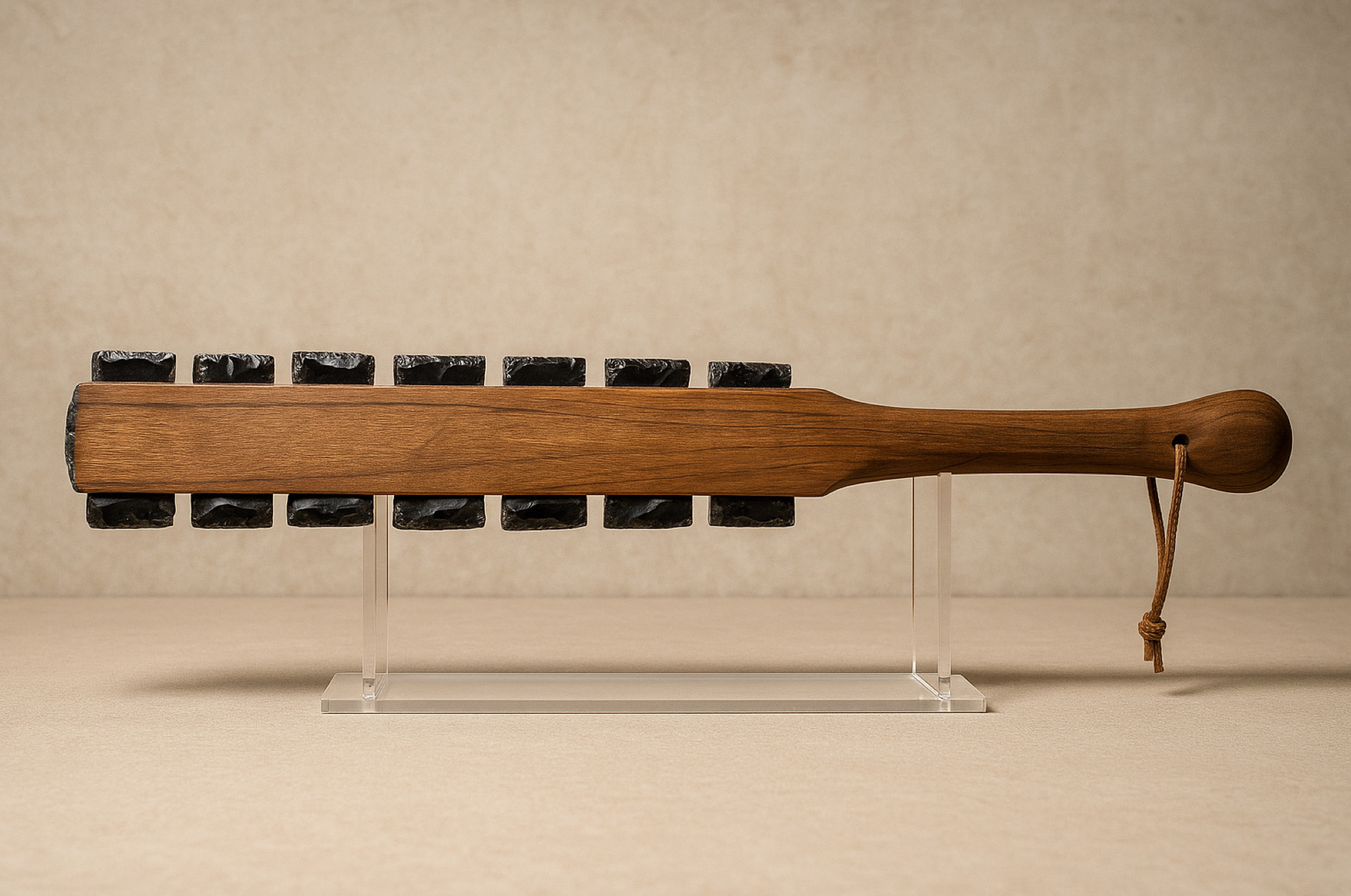
The macuahuitl should not be treated as an invention that appeared suddenly with the Mexica Empire. Related wooden weapons with inserted stone blades and sword-like forms appear across Mesoamerican discussions of warfare, while iconographic evidence suggests a longer developmental history. Marco Antonio Cervera Obregón emphasizes that the weapon’s origin, distribution, and exact typology remain subjects of interpretation rather than settled facts.[1]
By the Late Postclassic and the early sixteenth century, forms of the weapon were used in central Mexico and beyond. Spanish writers often grouped different Indigenous wooden weapons under the broad term macana, which creates additional ambiguity. Not every “wooden sword” in a colonial text can automatically be identified as the same macuahuitl form.
The composite construction offered several advantages in a region with sophisticated obsidian industries but no iron or steel blade tradition:
These advantages came with a trade-off: obsidian is brittle. Contact with bone, stone, another hard weapon, or Spanish metal armor could chip or break the edge.
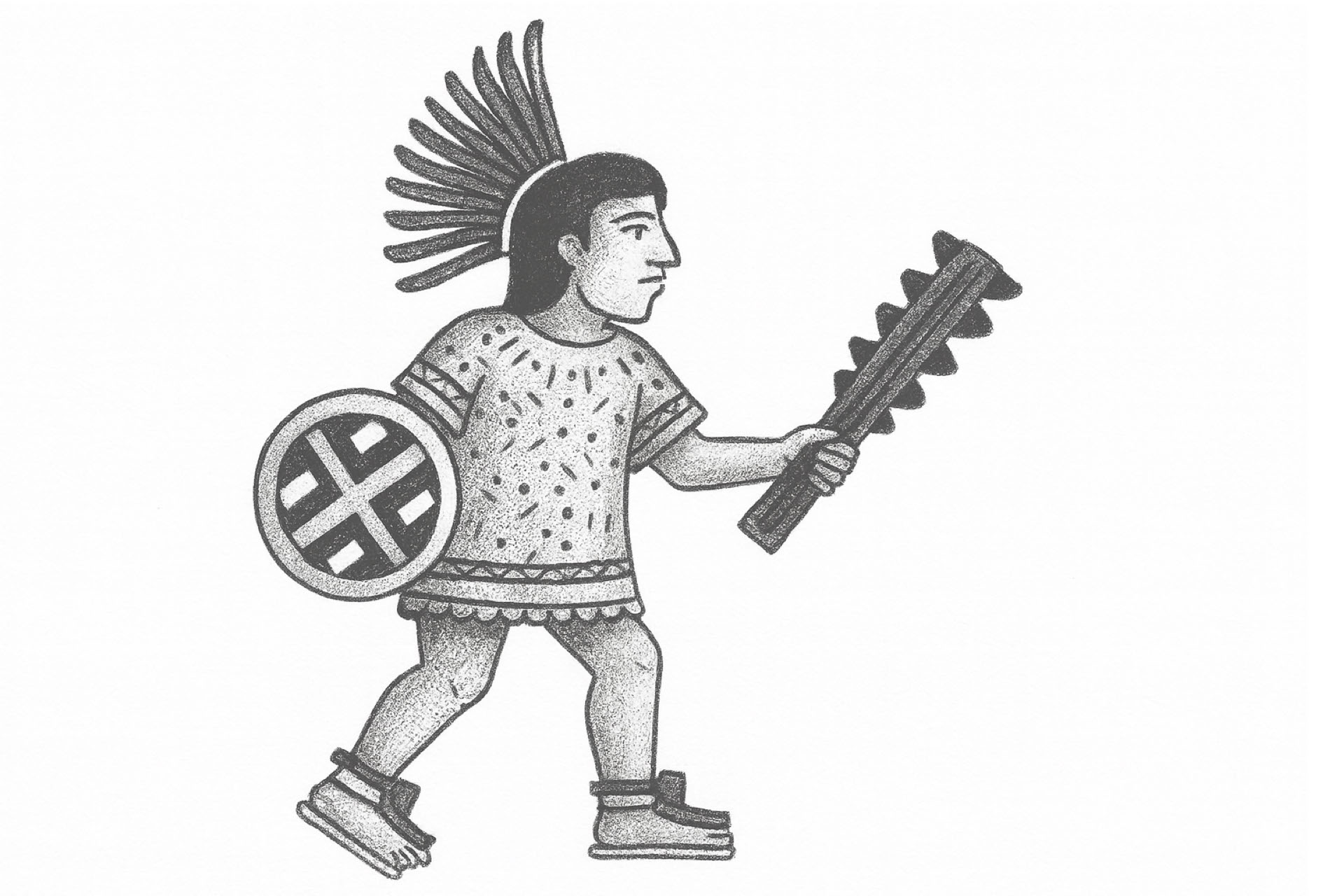
No intact historical specimen is available for destructive analysis, so precise construction details must be stated with caution. The most reliable reconstruction combines period images, colonial descriptions, surviving obsidian-production evidence, and the nineteenth-century documentation of the Madrid example.
The body was carved into a flat elongated form with a handle and grooves or recesses along the edges. Oak is frequently used in modern experimental reconstructions because it provides a hard, durable body, but the exact wood species used across historical Mesoamerica cannot be established as one universal standard. Earlier versions of this article incorrectly presented encino oak, pine, cedar, and willow as a confirmed materials list; the surviving evidence does not justify that certainty.
The inserts were generally segments of prismatic obsidian blades. These were not “forged,” and they were not simply smashed from raw glass. Mesoamerican specialists prepared polyhedral cores and detached long blades, commonly through pressure-flaking techniques. Suitable blade sections could then be cut or snapped into inserts for composite tools and weapons.
Central Mexican obsidian sources included the Pachuca region, particularly Sierra de las Navajas, but the source of every blade used in every macuahuitl is not known. It is more accurate to say that the weapon depended on regional obsidian supply and specialized blade production than to assign all examples to a single quarry.
Colonial and later descriptions refer to natural adhesive or bituminous mastic securing the blade segments. Researchers have proposed plant resins and other organic compounds, but no preserved adhesive sample from a complete macuahuitl has produced a universally accepted formula. Claims that the standard adhesive was specifically “copal plus pine resin,” or that wooden wedges were always used, should therefore be treated as reconstruction hypotheses rather than established fact.[1]
Video credit: AWE me. The video is a modern demonstration, not archaeological proof of one definitive historical design.
Mexica military culture placed real importance on capturing opponents, particularly in status advancement and ritual contexts. That fact has sometimes been overextended into the claim that the macuahuitl was designed mainly to avoid killing. The evidence supports a more complex conclusion.
The weapon could produce deep lacerations, heavy blunt trauma, and potentially fatal injuries. At the same time, a warrior could use the flat wooden face, control strike depth through blade spacing and angle, or target limbs to disable an opponent. Its usefulness for capture came from technique and tactical context—not from an inability to kill.
Ross Hassig’s studies of Mesoamerican warfare show that campaign objectives varied. Tribute enforcement, territorial control, deterrence, rebellion suppression, political expansion, and captive-taking could overlap within the same military system.[2][3]
Obsidian could cut unprotected tissue efficiently, but hard armor changed the problem. Spanish plate, mail, shields, and steel blades presented surfaces likely to damage obsidian inserts. Quilted cotton armor could also absorb and distribute impact while resisting some penetration. A macuahuitl strike could still deliver substantial blunt force even when the edge failed to cut cleanly.
Spanish narratives describe Mesoamerican edged weapons inflicting severe injuries on horses. Bernal Díaz del Castillo’s account includes an episode in which a horse was badly cut in the neck, and later retellings often convert such passages into the claim that a macuahuitl routinely decapitated horses with one blow.[5]
The chronicles are important primary evidence, but they are not controlled mechanical tests. They were written within conquest narratives, sometimes years after the events, and the exact weapon form, strike angle, prior wounds, and condition of the animal cannot be reconstructed. The safest conclusion is that the weapon was capable of causing catastrophic wounds to horses—not that one-stroke decapitation has been scientifically verified.
Marco Antonio Cervera Obregón and collaborators reconstructed a macuahuitl and tested it against animal tissue as part of experimental archaeological research. Their work demonstrated that the weapon could produce serious cutting and impact trauma, while obsidian segments could fracture during contact. Microfragments left in a wound may have complicated healing, but the scale of that effect depends on the strike, blade manufacture, contamination, and medical context.[1]
Modern television tests and enthusiast reconstructions can illustrate possible mechanics, but they vary greatly in wood dimensions, blade quality, adhesive, spacing, and target material. They should not be treated as interchangeable with peer-reviewed experimental archaeology.
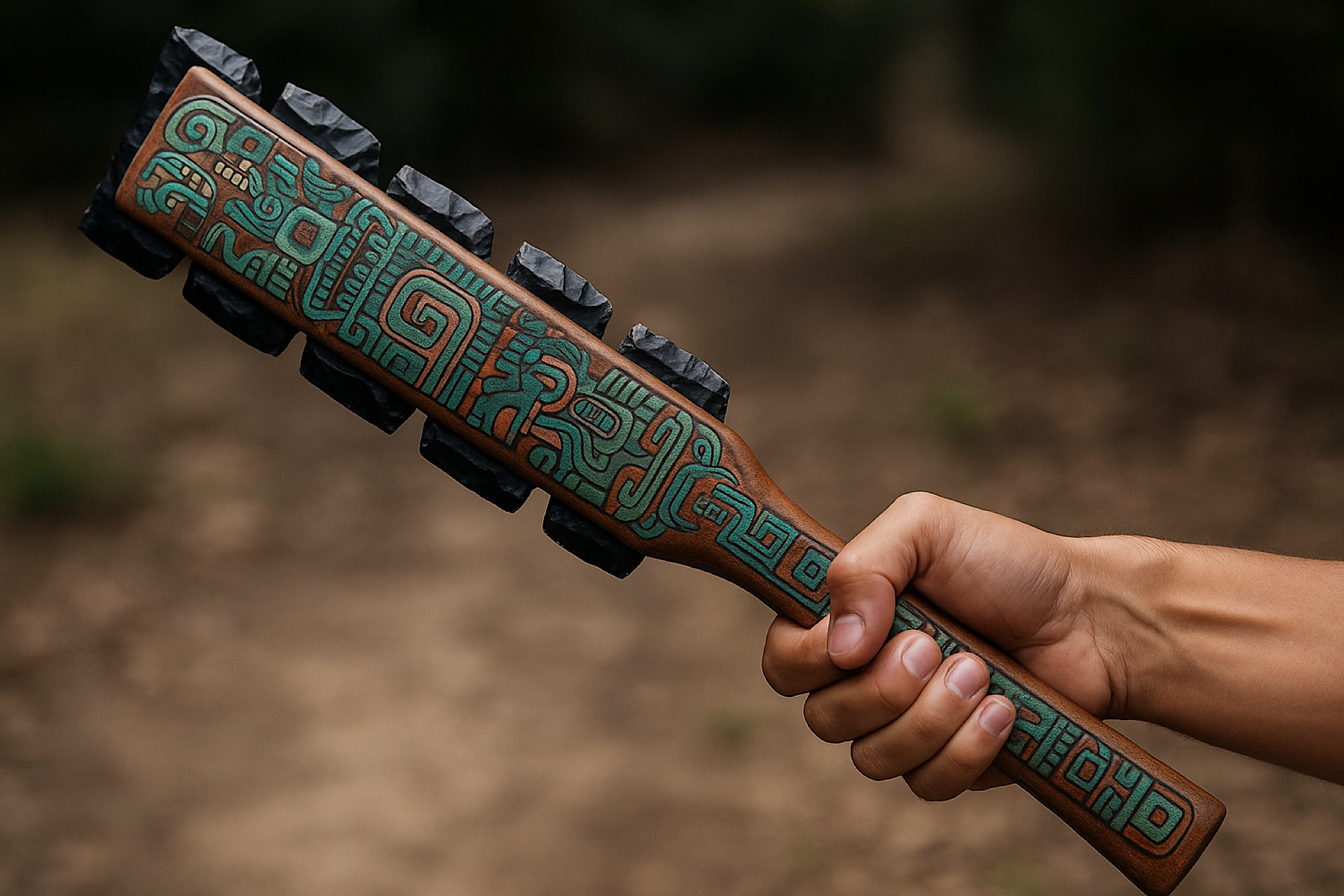
The macuahuitl and European swords solved different engineering problems. Comparing them only by “sharpness” ignores structure, durability, repair, thrusting ability, and armor interaction. For broader context on European classifications, see our guide to European swords.
| Feature | Macuahuitl | European steel sword |
|---|---|---|
| Construction | Composite wooden body with replaceable obsidian inserts | Continuous forged and heat-treated steel blade |
| Edge behavior | Extremely acute, but brittle and segment-dependent | Less brittle, resharpenable, and structurally continuous |
| Primary strengths | Slashing, chopping, impact, replaceable inserts | Cutting, thrusting, parrying, repeated edge contact |
| Hard-target durability | Obsidian may chip against bone, stone, metal, or another hard weapon | Steel may notch or bend but generally tolerates harder contact better |
| Repair | Replace damaged blade segments and adhesive | Resharpen, straighten, or regrind the blade |
| Weight and reach | Varied; no single secure historical standard survives | Varied widely by sword type and period |
Earlier versions of this article gave single “standard” weight figures for both weapons. That was misleading. Macuahuitl reconstructions vary significantly, and European swords range from compact arming swords to large two-handed weapons. A defensible comparison must specify an exact reconstruction and an exact sword type.
The macuahuitl filled a sword-like battlefield role in Mesoamerica, but it belongs to a distinct technological tradition. Our overview of the types of swords explains how the gladius, longsword, katana, sabre, and other steel-blade families differ. Historically inspired modern work can also be seen in our collection of handmade custom swords.
The evidence for the macuahuitl is uneven. Researchers work with:
A well-documented macuahuitl was held in the Royal Armoury of Madrid and recorded in historical catalog imagery. It was lost in the fire that struck the old Royal Armoury during the night of 9–10 July 1884. Spain’s Patrimonio Nacional dates the fire to 10 July 1884, while historical accounts describe it beginning during the preceding night.[4]
The previous article confused the fire date with 1849, the year associated with publication of an early Royal Armoury catalog. The destructive fire occurred in July 1884.
It is safest to call the Madrid object the best-documented complete historical specimen rather than make an absolute claim that it was the only macuahuitl ever to survive into modern collections. Scholarship has discussed additional fragmentary or disputed finds in Mexico, but their identification, preservation, and present status are not as secure as the old Madrid documentation.[1]

There was no single standardized macuahuitl. Cervera Obregón distinguishes a larger macuahuitl from a shorter form called the mācuāhuitzōctli, while colonial descriptions and images show variation in length, profile, blade spacing, and grip.[1]
| Parameter | Responsible interpretation | Confidence |
|---|---|---|
| Length | Smaller forms around 50 cm; larger one-handed examples roughly 70–100+ cm; some two-handed forms described as much longer | Moderate; sources vary |
| Blade segments | Often reconstructed with several prismatic segments per side; spacing varies in images and descriptions | Moderate |
| Weight | No secure universal value; replica weights depend heavily on wood species, dimensions, and blade layout | Low |
| Wood species | Hardwood is plausible; oak is used in experiments, but no single species can be assigned to all historical examples | Low to moderate |
| Adhesive | Natural mastic or bituminous adhesive; exact recipes likely varied and remain uncertain | Moderate for natural mastic, low for one precise recipe |
| Grip | One-handed and two-handed forms are described | High |
The macuahuitl has become a symbol of Mexica martial identity, but its historical importance extends beyond a single modern national or ethnic image. It represents a Mesoamerican weapons tradition built around specialized stone technology, composite construction, and tactical systems adapted to local armor, shields, formations, and political objectives.
Modern replicas serve several purposes:
A replica should be identified honestly as a reconstruction. Without a complete surviving original, choices about thickness, balance, wood, adhesive, blade spacing, and edge exposure remain interpretive. The best reconstructions document those choices instead of presenting them as one proven standard.
Fresh obsidian can form an edge with an extremely small radius, potentially sharper at the microscopic level than many steel edges. That does not make the entire weapon superior to a steel sword. Obsidian is much more brittle and loses integrity differently under hard impact.
Conquest-era accounts describe devastating wounds to horses, but routine one-blow decapitation has not been established through controlled historical testing. The claim should be presented as a chronicler report, not a verified mechanical benchmark.
No. Captive-taking was important in parts of Mexica warfare, but the weapon was fully capable of lethal injury. It could be used to kill, disable, intimidate, or facilitate capture depending on tactical intent.
No universal wood species has been securely established. Oak is common in reconstructions because of its strength, but historical examples may have varied according to region and available material.
They were generally produced as prismatic blades from prepared obsidian cores using specialized lithic techniques, especially pressure flaking, then segmented and mounted in the wooden body.
No complete, undisputed historical specimen is currently available for direct study. The best-documented complete example was destroyed in the Royal Armoury fire of 9–10 July 1884. Other fragmentary or disputed finds have been discussed, but their status is less certain.
Replicas are based on different codex images, catalog drawings, chronicler descriptions, and experimental assumptions. Wood density, length, insert spacing, adhesive, and blade quality can all change the result.
The macuahuitl was not a primitive substitute for a “real sword.” It was a sophisticated composite weapon adapted to Mesoamerican materials, craft specialization, and battlefield practice. Its obsidian inserts offered exceptional cutting potential, while the wooden body added mass and made damaged edge elements replaceable.
At the same time, its performance should not be exaggerated. Obsidian was fragile, exact historical dimensions varied, and the most dramatic conquest accounts cannot be reproduced with certainty. The strongest modern interpretation combines respect for the written sources with clear limits on what archaeology can prove.
Author: Aleks Nemtcev | Knifemaker with 10+ Years of Experience | Connect with me on LinkedIn | Follow me on Reddit
Academic specialist cited: Dr. Marco Antonio Cervera Obregón, archaeologist and researcher specializing in Mesoamerican and military archaeology. Professional profile.


How much does it cost?
Thank you for your interest. At the moment, Noblie Custom Knives does not sell macuahuitl replicas.
As a general market reference, prices vary quite a lot depending on the construction. Simple decorative or cosplay versions may cost around $50–150, while handmade wooden replicas or historically inspired pieces with obsidian-style or real obsidian blades are often in the $225–500+ range.
These pieces are usually made by individual craftsmen, Mexican artisans, or small workshops specializing in Mesoamerican and Aztec-style reproductions. Before buying one, we recommend checking the materials, blade construction, overall size, and local import or weapon regulations in your country.
Best regards,
Noblie Custom Knives
Why is there no related sources to the information of the article. Also the Royal Armory of Madrid was burned down in July of 1884, you have the year wrong.
Thank you for pointing this out. The article has been updated with relevant academic and official sources, and the Royal Armoury fire date has been corrected to July 1884.