A bushcraft knife is a controlled outdoor cutting tool, not just a small survival knife. It is usually optimized for woodcraft: carving notches, making feather sticks, shaping tent pegs, preparing kindling, cutting cordage, and doing repeated hand work around camp.
Comfort is critical. A bushcraft knife may be used for long sessions, so the handle should not create hot spots. Many bushcraft knives use a Scandi grind because it bites into wood cleanly and is relatively easy to guide during carving. Others use flat or convex grinds for more versatility and edge strength.
The ideal bushcraft knife is strong enough for camp work but precise enough for controlled cuts. A thick sharpened pry bar is not automatically a good bushcraft knife. Too much blade thickness can make carving harder and reduce cutting efficiency.
Camp Knives
A camp knife is a general-purpose outdoor knife for people who want one blade to handle many campsite tasks. It may prepare food, cut rope, trim branches, make kindling, open packaging, or handle basic repairs. Camp knives are usually larger and more versatile than small bushcraft knives, but less specialized than dedicated machetes, axes, or hunting knives.
A good camp knife should have enough blade length for light chopping, but not so much length that it becomes awkward for ordinary cutting. Handle traction and sheath retention matter because camp knives are often used with wet hands, gloves, or cold fingers.
Best for: campsite chores, food prep, light chopping, rope, wood, general outdoor utility.
Avoid using for: precision caping, delicate filleting, heavy axe work.
Key feature: versatile fixed blade with balanced size and durable construction.
Skinning and Caping Knives
Skinning and caping knives are specialized hunting knives. A skinning knife has a curved edge that helps separate hide from meat with long, controlled cuts. The tip should be useful but not so aggressive that it easily punctures the hide or organs. Good skinning knives often have a short-to-medium blade and a handle that stays locked in the hand during pull cuts.
A caping knife is smaller and more precise. It is used when the hide and head must be preserved for taxidermy. The blade needs a fine tip, high control, and enough sharpness for careful detail cuts. A large survival knife is a poor substitute for caping work.
Best for: skinning game, trophy preparation, detail hunting cuts.
Avoid using for: batoning, chopping, prying, general camp abuse.
Key feature: task-specific geometry for clean game processing.
Large Outdoor Knives and Machetes
Large outdoor knives, choppers, and machetes are useful when vegetation, brush, or chopping work becomes part of the job. A machete is not just a big knife. It is a long, forward-balanced cutting tool designed for clearing vegetation and making repeated chopping strokes.
For camp and trail use, size must match the environment. A long machete makes sense in dense vegetation but can be excessive in a northern forest where a compact axe or saw may work better. For sharpening larger outdoor blades, see the guide on how to sharpen a machete.
Best for: brush clearing, trail work, vegetation, light chopping.
Avoid using for: field dressing, fine carving, pocket carry, precision food prep.
Key feature: length and forward weight for repeated chopping cuts.
How to Choose an Outdoor Knife
Choosing an outdoor knife is not about buying the toughest-looking blade. Start with the job.
| Use Case | Better Choice | Why |
| Field dressing deer or elk | Drop point hunting knife or skinner | Better control and cleaner cuts |
| Bushcraft and carving | 3.5–5 inch bushcraft knife | Comfortable for repeated woodwork |
| Survival kit | Full-tang fixed blade | Strong, simple, fewer failure points |
| General camping | Medium camp knife | More versatile for mixed chores |
| Brush and vegetation | Machete or large chopper | More efficient than a short knife |
| Trophy prep | Caping knife | Better detail control |
For most users, the best outdoor knife is a medium fixed blade with a comfortable handle, practical blade shape, tough edge, and secure sheath. A knife that looks impressive but cuts poorly, slips in the hand, or rides badly on the belt will not perform well in real field use.
Everyday Carry, Tactical, Combat and Rescue Knives
Everyday carry, tactical, combat, and rescue knives are often discussed together, but they are not the same thing. An EDC knife is mainly a daily utility tool. A tactical knife is built around fast access, grip security, and high-stress utility. A combat knife is a military or defense-oriented blade type with historical and functional roots. A rescue knife is designed for emergency cutting tasks such as seatbelts, webbing, cordage, and clothing.
The safest way to understand this group is by purpose. A pocket knife that opens boxes at work does not need the same construction as a rescue knife carried by an EMT or a fixed blade designed around military use. Blade shape, lock strength, handle traction, edge type, carry position, and local law all matter.

| Knife Type | Best For | Key Features | Practical Note |
| EDC Knife | Daily utility and pocket carry | Compact size, useful blade shape, secure lock or slipjoint, pocket clip | Best when it is legal, comfortable, and easy to maintain |
| Tactical Knife | Duty use, rescue utility, high-stress cutting | Strong grip, fast access, durable lock or fixed blade construction | Should be judged by function, not aggressive styling |
| Combat Knife | Military history, field utility, defense-oriented design | Fixed blade, guard or grip security, reinforced point, durable build | Often collectible or historical; legal context matters |
| Rescue Knife | Emergency cutting, seatbelts, webbing, clothing | Serrations, blunt tip, strap cutter, glass breaker, high-visibility handle | Designed to reduce accidental injury during rescue work |
| Karambit | Collecting, martial arts tradition, specialty utility | Curved blade, ring handle, strong retention | Requires training; not a general-purpose EDC knife |
| Boot Knife | Backup fixed blade, concealed or compact carry where legal | Slim profile, small fixed blade, secure sheath | Carry laws vary sharply by region |
Everyday Carry Knives
An everyday carry knife, or EDC knife, is a compact tool carried for ordinary cutting tasks. It may open packages, cut cordage, trim tape, sharpen a pencil, prepare food on a hike, or handle small repair jobs. Most EDC knives are folding knives because they are easier to carry safely in a pocket.
A good EDC knife should be useful before it is impressive. Blade length, handle thickness, clip position, opening method, lock type, and steel choice all affect whether the knife will actually be carried. A large overbuilt folder may look strong but become annoying in the pocket. A very small knife may carry well but lack enough blade for real work.
For buyers looking at premium folders, Noblie’s pocket and folding knives category includes handmade and collector-grade folders built for everyday carry and collection. Noblie also has a dedicated Herman Knives category for exact-piece titanium folders by Bartosz Herman.
Best for: daily utility, pocket carry, light work tasks, opening packages, travel use.
Avoid using for: prying, batoning, hard twisting cuts, cutting live electrical material.
Key feature: practical blade size, safe carry, reliable lock or spring tension.
Tactical Knives
A tactical knife is built for fast access, secure handling, and reliable cutting under pressure. The word “tactical” is often overused in marketing, so the design should be judged by function rather than coating, color, or aggressive styling. A useful tactical knife needs a controllable handle, dependable lock or fixed blade construction, strong tip geometry, and a blade shape that matches real tasks.
Tactical knives may be folding or fixed blade. Folders are easier to carry discreetly, but they depend on pivot and lock quality. Fixed blades are mechanically stronger and faster to access from a sheath, but they are less convenient and may face stricter carry rules. A tactical knife can also overlap with rescue use when it includes serrations, a blunt safety tip, a strap cutter, or corrosion-resistant steel.
Best for: duty utility, emergency cutting, gloves, rough handling, fast access.
Avoid using for: ordinary kitchen prep, careless prying, illegal carry, decorative-only use.
Key feature: secure grip and dependable construction under high-stress cutting.

Credits: Image by nothingbutknives.com
Combat Knives
A combat knife is a military or defense-oriented knife designed around field utility, retention, and close-quarters use. Historically, this includes fighting knives, trench knives, bayonets, boot knives, push daggers, and certain dagger-style fixed blades. Many combat knives are now collected for their military history, construction, or maker value rather than carried for actual combat.
Combat knives usually prioritize a strong point, secure grip, guard or hand protection, and durable fixed blade construction. Some use spear point, clip point, tanto, or dagger-like blade profiles. For a deeper breakdown of dagger forms and historical blade geometry, see our guide to types of daggers.
For collectible and handmade examples, the custom daggers category is a better commercial destination than forcing dagger content into every knife-type section.
Best for: military history, collection, field utility, defense-oriented design study.
Avoid using for: casual EDC without checking law, food prep, utility tasks where a safer blade is better.
Key feature: strong point, secure handle, fixed blade reliability.

Military Knives
Military knives are not one single design. They include bayonets, fighting knives, survival knives, utility knives, pilot knives, field knives, and modern tactical fixed blades or folders. Their design depends on the role: cutting rope, opening crates, field repairs, survival tasks, rescue, or close-quarters emergency use.
The best military knives are usually simple, durable, and easy to maintain. They often use tough steels, non-reflective finishes, secure grips, and sheaths that can be mounted on belts, packs, or equipment. A collectible military knife may be valued for provenance and history, while a modern field knife should be judged by construction, ergonomics, and task fit.
Best for: military collection, field utility, survival kits, historical study.
Avoid using for: assuming all military knives are suitable for civilian carry.
Key feature: function-driven construction and durable carry system.

Self-Defense Knives
A self-defense knife is any knife carried with personal protection in mind, but that does not make every knife suitable, legal, or advisable for defensive carry. This topic requires caution. Laws can differ by country, state, city, blade length, edge configuration, carry method, and intent. Training, judgment, avoidance, and legal awareness matter more than the knife model.
From a design perspective, defensive knives often emphasize access, retention, handle security, and point strength. Compact fixed blades, boot knives, karambits, push daggers, and some tactical folders are commonly discussed in this category. However, a knife carried for self-defense can create serious legal risk. For most users, it is better to think in terms of lawful utility carry, safe handling, and emergency preparedness rather than aggressive marketing claims.
Best for: legal, trained, responsible users who understand local law and risk.
Avoid using for: intimidation, illegal carry, untrained handling, casual public display.
Key feature: retention, access, and control — but only within legal and responsible use.

Credits: Image by Survival Gear
Karambit Knives
A karambit is a curved knife inspired by Southeast Asian agricultural and martial traditions. Its most recognizable features are a hawkbill-style curved blade and a ring at the end of the handle. The ring can improve retention, but it also changes how the knife is gripped and controlled.
Karambits are highly specialized. They are popular with collectors, martial arts practitioners, and users who like compact curved blades, but they are not the best choice for ordinary cutting tasks. The curved edge can be excellent for draw cuts, rope, straps, and hooked cutting motions, but it is less versatile than a drop point or utility blade for general EDC.
For more focused reading, see Noblie’s karambit knife guide and the broader article on karambits, tactical use and everyday carry.
Best for: collection, martial arts tradition, specialty cutting, curved-blade enthusiasts.
Avoid using for: general food prep, woodcraft, prying, untrained defensive carry.
Key feature: curved blade and ring handle for retention.

Boot Knives
A boot knife is a small fixed blade designed for discreet carry, traditionally near the boot or ankle. Most boot knives are slim, compact, and built around quick access from a dedicated sheath. Some are double-edged, while others use a single edge for broader legal and utility practicality.
The sheath is as important as the knife. A boot knife that shifts, rattles, falls out, or cannot be drawn safely is poorly designed regardless of blade steel. Because boot knives are often associated with concealed carry, local laws should be checked carefully before purchase or carry.
Best for: compact fixed blade carry where legal, backup utility, collection.
Avoid using for: casual public carry without checking law, heavy camp work, food prep.
Key feature: slim fixed blade with secure sheath retention.

Rescue Knives
A rescue knife is designed to cut people free from danger, not to look intimidating. Common features include a serrated or partially serrated edge for webbing, a blunt or rounded tip to reduce accidental punctures, a seatbelt cutter, a glass breaker, corrosion-resistant steel, and a high-visibility handle.
Rescue knives are used by first responders, drivers, boaters, climbers, and anyone who may need to cut straps, rope, netting, clothing, or webbing quickly. Unlike tactical or combat knives, a rescue knife often avoids a sharp piercing tip because safety around trapped or injured people is more important than penetration.
Steel choice should favor corrosion resistance and easy maintenance. Noblie’s knife steel chart is useful here because rescue and wet-use knives benefit from steels that resist rust while still holding a working edge.
Best for: seatbelts, rope, webbing, emergency kits, vehicle carry, marine use.
Avoid using for: combat-style use, fine food prep, prying beyond the tool’s design.
Key feature: emergency cutting features with reduced risk of accidental puncture.
How to Choose an EDC or Tactical Knife
Choosing an EDC or tactical knife should start with use, not appearance.
| Use Case | Better Choice | Why |
| Office or light daily carry | Small folding knife or slipjoint | Compact, less intrusive, easy to carry |
| Warehouse or trade work | Locking folder with durable blade steel | Better control for cardboard, rope, packaging |
| Outdoor backup | Compact fixed blade | Stronger than a folder, simple to maintain |
| Emergency vehicle kit | Rescue knife | Seatbelt cutter, serrations, glass breaker options |
| Collection | Handmade folder, art knife, custom dagger | Materials, maker value, finish, rarity |
| Duty-style use | Strong folder or fixed blade with secure grip | Better access and control under stress |
For most buyers, the best everyday knife is not the largest or fastest-opening model. It is the knife that carries comfortably, opens safely, cuts efficiently, follows local law, and is easy enough to maintain that it actually gets used.
Specialty, Collectible and Custom Knives
Not every knife is bought only as a working tool. Some knives are valued for craftsmanship, rarity, historical form, engraving, steel pattern, handle material, knifemaker reputation, or the story behind the piece. This is where specialty, collectible, and custom knives sit apart from ordinary production knives.
A collectible knife may still be fully functional, but its value is not measured only by cutting performance. Fit and finish, symmetry, blade grind, lockup, hand engraving, Damascus pattern control, scrimshaw work, rare handle materials, and presentation all matter. A one-of-one custom knife can be a field tool, art object, heirloom, or all three at once.
| Knife Type | Best For | Key Features | Practical Note |
| Custom Knives | Collectors, gifts, field use, maker-built performance | One-of-one design, premium steel, hand finishing, specialized materials | The design should still match the intended use |
| Art Knives | Display, collection, luxury gifts | Engraving, sculptural handle work, precious metals, rare materials | Visual craftsmanship is often the main value |
| Damascus Knives | Collecting, display, functional cutting depending on steel and heat treat | Pattern-welded steel, mosaic Damascus, stainless Damascus, etched finish | Pattern alone does not prove performance |
| Engraved Knives | Gifts, heirlooms, presentation pieces | Hand engraving, gold inlay, scrollwork, scenes, personalization | Good engraving should enhance, not hide, the knife design |
| Scrimshaw Knives | Collecting, traditional decorative work | Fine line artwork on bone, ivory alternatives, mammoth tooth, or similar materials | Material legality and provenance matter |
| Balisong / Butterfly Knives | Flipping, mechanical interest, collection | Rotating handles, tuned pivots, trainer or live blade versions | Covered earlier as a fast-deployment/specialty design |
| Fantasy and Themed Knives | Display, cosplay, fan collections, decorative ownership | Stylized forms, aggressive silhouettes, symbolic motifs | Often decorative rather than optimized for real cutting |
Custom Knives
A custom knife is made or finished beyond ordinary mass-production standards. It may be a true one-off commission, a small-batch handmade knife, or a maker-built piece with specific steel, handle material, engraving, blade shape, or sheath work. The word “custom” should mean more than decoration. A serious custom knife should have a clear purpose, sound construction, and a finish level that justifies its price.
For working custom knives, geometry still comes first. A hunting knife needs control and cleanup. A folding EDC needs reliable lockup and pocket comfort. A chef’s knife needs thin geometry and balance. A dagger or art knife may place more emphasis on symmetry, engraving, historical form, and presentation.
For the main commercial entry point, use Noblie Custom Knives. For collectible reading, see the guide to collectible knives.
Best for: collectors, gifts, serious users, custom commissions, heirloom pieces.
Avoid using for: choosing by looks alone without checking steel, geometry, maker, and purpose.
Key feature: maker-level design, materials, finishing, and intent.
Damascus Knives
Damascus knives are recognized by their patterned steel. The pattern may come from traditional pattern-welding, mosaic Damascus, stainless Damascus, Damasteel, or other modern layered steel constructions. Damascus can be functional, decorative, or both depending on the steel combination, heat treatment, grind, and intended use.
A good Damascus knife should not be judged only by the pattern. Clean welds, correct heat treatment, suitable hardness, edge geometry, and corrosion behavior matter. For example, a mosaic Damascus art knife and a working Damascus hunting knife are not evaluated by the same standard.
For deeper reading, see Noblie’s guide to types of Damascus steel and the commercial category for custom Damascus knives.
Best for: collectors, gifts, display pieces, premium working knives when properly made.
Avoid using for: assuming every patterned blade performs the same.
Key feature: patterned steel with performance depending on metallurgy and heat treatment.
Engraved Knives
Engraved knives combine blade craft with metal art. Engraving may appear on bolsters, guards, frames, clips, handle scales, pommels, or blade flats. It can be simple personalization, scroll engraving, wildlife scenes, mythological themes, bulino work, relief engraving, or precious metal inlay.
The best engraved knives are designed as complete pieces. The engraving should follow the lines of the knife, respect the handle shape, and enhance the object rather than make it visually crowded. On premium knives, engraving quality is judged by depth control, line confidence, composition, shading, inlay work, and how naturally the decoration fits the knife.
For commercial browsing, use engraved knives. For technical context, see the guide on how to engrave metal.
Best for: gifts, presentation pieces, collectors, heirloom knives.
Avoid using for: rough work where the finish will be damaged quickly.
Key feature: hand or machine engraving integrated into the knife design.
Art Knives
An art knife is a knife where craftsmanship, concept, and visual execution are central to the piece. It may still have a sharp blade and proper construction, but its primary role is often collection, display, or presentation. Art knives can include sculptural guards, carved handles, gemstone accents, precious metals, mosaic Damascus, scrimshaw, engraving, or historical themes.
The risk with art knives is that decoration can overwhelm function. A good art knife still respects proportions, balance, blade alignment, material compatibility, and finish quality. Even when the knife is mostly for display, poor construction is still poor construction.
For related commercial browsing, use art knives.
Best for: collectors, luxury gifts, display, maker showcases.
Avoid using for: field abuse, kitchen prep, careless handling.
Key feature: high visual craftsmanship and rare material combinations.
Scrimshaw Knives
Scrimshaw knives feature fine engraved or scratched artwork on handle materials such as bone, antler, mammoth tooth, or legal ivory alternatives. Traditional scrimshaw is associated with maritime folk art, but modern knife scrimshaw can include wildlife, portraits, historical scenes, Western themes, and collector motifs.
Material choice matters. Buyers should pay attention to legality, provenance, and export restrictions, especially with animal-derived materials. The artwork should be clean, readable, and properly sealed or finished so it remains stable with handling.
For commercial examples, use scrimshaw knives.
Best for: collectors, wildlife themes, traditional decorative knives, gifts.
Avoid using for: wet field abuse or careless storage.
Key feature: fine image work on natural handle material.
Choosing a Collectible or Custom Knife
When choosing a collectible or custom knife, start with purpose. A display knife, hunting knife, EDC folder, dagger, and art knife should not be judged by the same checklist.
| Buyer Goal | Better Choice | What to Check |
| Working field knife | Custom hunting knife or fixed blade | Steel, heat treat, grind, handle grip, sheath |
| Daily carry | Custom folder or compact fixed blade | Lockup, carry comfort, blade length, clip, legality |
| Gift or heirloom | Engraved knife or art knife | Theme, personalization, finish quality, presentation |
| Steel pattern interest | Damascus knife | Steel type, heat treatment, pattern quality, corrosion care |
| Historical form | Dagger, bowie, dirk, trench-style knife | Accuracy, proportions, materials, legal context |
| Visual collection | Art knife or scrimshaw knife | Composition, craftsmanship, material provenance |
A collectible knife should be more than expensive materials assembled together. The best pieces have design coherence: the blade shape, steel, handle, engraving, sheath, and finish all support the same purpose. For a working knife, function should lead. For an art knife, craftsmanship and composition matter most. For a commission, the brief should define both.
Types of Knives FAQ
What are the main types of knives?
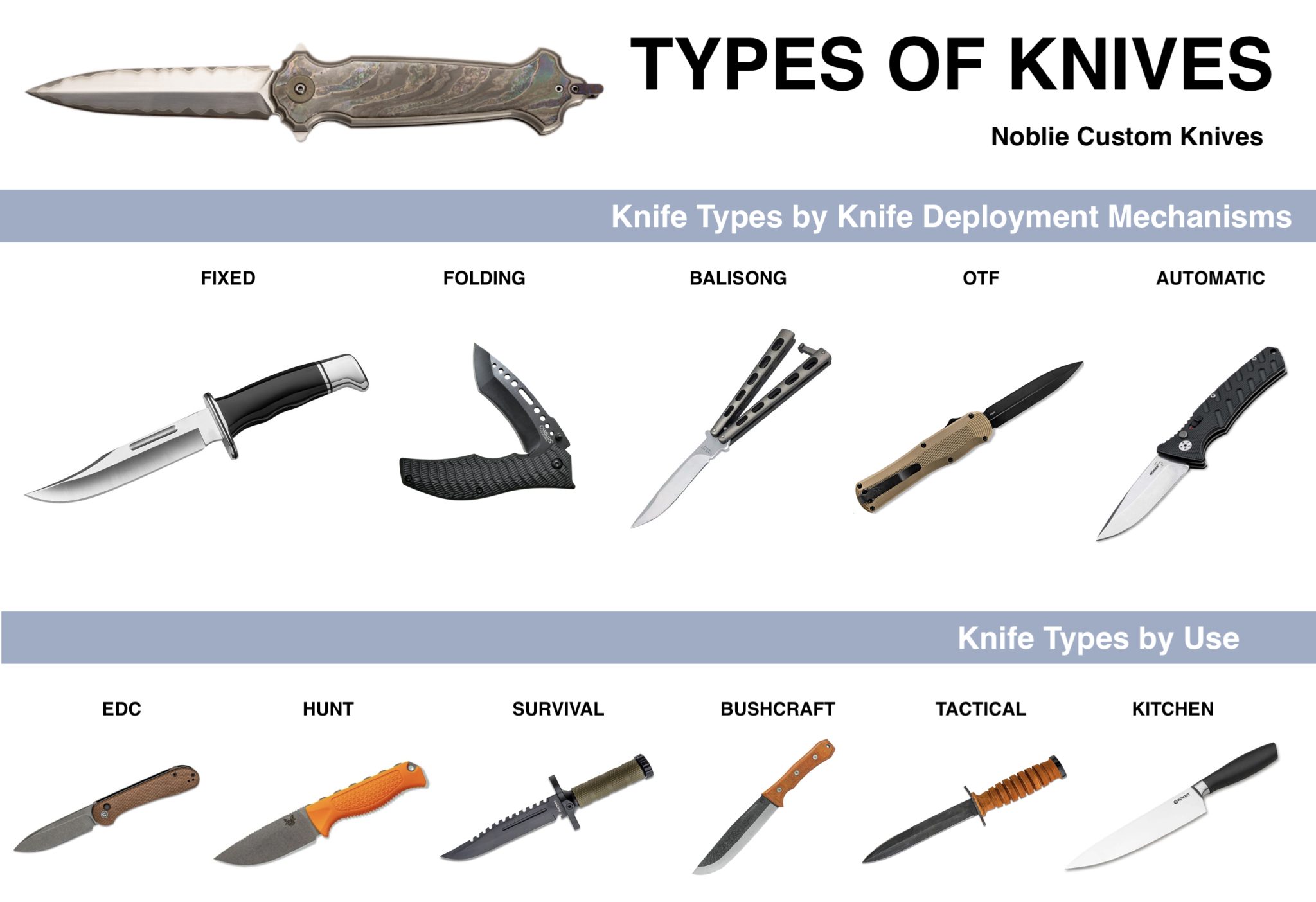
The main types of knives are kitchen knives, pocket knives, fixed blade knives, hunting knives, survival knives, tactical knives, combat knives, utility knives, Japanese knives, automatic knives, rescue knives, and collectible or custom knives. Each type is defined by its purpose, construction, blade shape, carry method, and intended cutting task.
For example, a chef’s knife is made for food preparation, a pocket knife is made for compact daily carry, a hunting knife is made for field dressing game, and a survival knife is made for rough outdoor utility.
How many types of knives are there?
There is no single fixed number of knife types because knives can be classified in several ways: by use, blade shape, construction, opening mechanism, culture, profession, or historical period. A practical modern classification usually includes 10–15 major knife categories, with dozens of subtypes inside them.
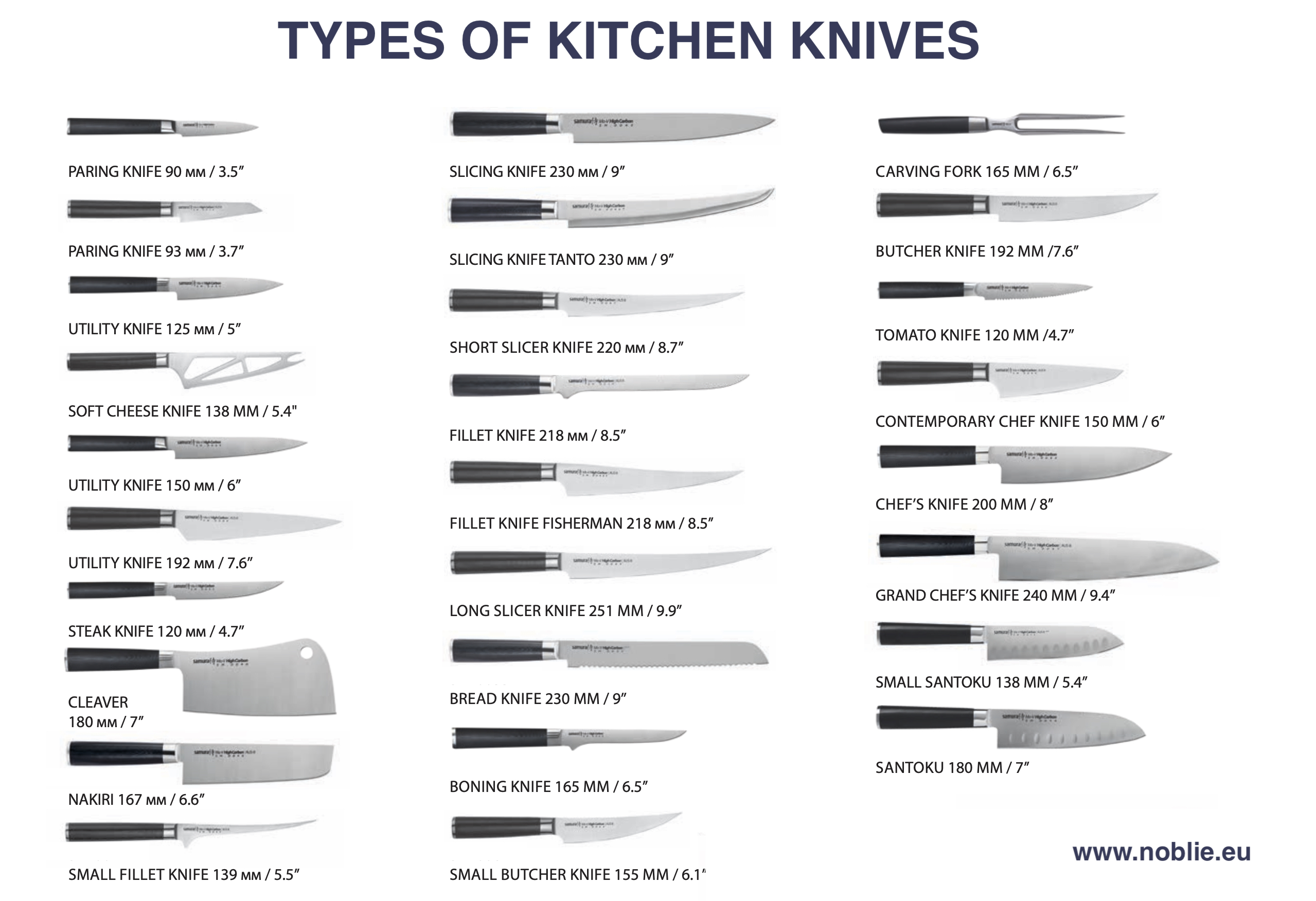
For example, “kitchen knives” include chef’s knives, paring knives, bread knives, boning knives, cleavers, carving knives, and fillet knives. “Outdoor knives” include hunting knives, survival knives, bushcraft knives, camp knives, skinners, caping knives, and machetes.
What is the difference between a knife type and a blade shape?
A knife type describes the job of the knife. A blade shape describes the geometry of the blade.
For example, “hunting knife” is a type. “Drop point” is a blade shape. A drop point blade can appear on a hunting knife, survival knife, folding knife, or EDC knife. The same is true for clip point, tanto, spear point, sheepsfoot, trailing point, and other profiles.
For a deeper breakdown, see the guide to knife blade shapes.
What are the 3 most useful knives to own?
For most kitchens, the three most useful knives are:
- chef’s knife;
- paring knife;
- bread knife.
For general everyday and outdoor use, a practical three-knife setup could be:
- a folding EDC knife;
- a fixed blade outdoor knife;
- a kitchen chef’s knife.
The right answer depends on your use. A home cook, hunter, collector, camper, and tradesperson will not need the same three knives.
What knives should every kitchen have?
Most home kitchens need three core knives: a chef’s knife, a paring knife, and a bread knife. A chef’s knife handles most chopping, slicing, dicing, and mincing. A paring knife handles small detail work such as peeling and trimming. A bread knife handles crusty bread, cakes, tomatoes, and soft foods with firm skins.
Additional knives such as a boning knife, fillet knife, cleaver, carving knife, santoku, nakiri, or utility knife are useful when your cooking style calls for them.
What is the most versatile type of knife?
The most versatile kitchen knife is usually an 8-inch chef’s knife. It can chop vegetables, slice meat, mince herbs, crush garlic, and handle most daily prep work.
For non-kitchen use, the most versatile knife is usually a medium folding EDC knife or a medium fixed blade knife. A folding knife is easier to carry every day. A fixed blade is stronger and better for outdoor, hunting, bushcraft, and survival tasks.
What is the difference between a chef’s knife and a santoku?
A chef’s knife usually has a longer blade and more curved belly, which makes it better for rocking cuts. A santoku is usually shorter, wider, and flatter along the edge, which makes it better for push cuts and straight chopping.
A chef’s knife is often more versatile for larger ingredients and Western cutting techniques. A santoku feels more compact and controlled for vegetables, boneless meat, and fish. Neither is automatically better; the choice depends on cutting style and hand preference.
What is the difference between a pocket knife and an EDC knife?
A pocket knife is any knife designed to fold or carry compactly in the pocket. An EDC knife, or everyday carry knife, is a pocket-carried knife chosen specifically for daily utility.
Many EDC knives are pocket knives, but not every pocket knife is a good EDC knife. A good EDC knife should carry comfortably, open safely, cut efficiently, and comply with local laws. Lock type, blade length, clip position, steel, and handle thickness all matter.
What is the difference between a fixed blade knife and a folding knife?
A fixed blade knife has a blade that does not fold. It is usually stronger, easier to clean, and better suited to hunting, bushcraft, survival, camp work, and heavy outdoor use.
A folding knife has a pivot that allows the blade to close into the handle. It is easier to carry in a pocket and more convenient for daily use, but it depends on the quality of its pivot, lock, washers or bearings, and handle construction.
For hard-use outdoor cutting, a fixed blade knife is usually the more reliable choice. For daily pocket carry, a folding knife is usually more practical.
What is the difference between a hunting knife and a survival knife?
A hunting knife is designed mainly for field dressing, skinning, caping, and processing game. It needs control, a useful belly, a secure grip, and easy-clean construction.
A survival knife is designed for broader emergency and outdoor tasks: cutting cordage, making kindling, striking a ferro rod, carving stakes, shelter work, food prep, and general camp use. It usually needs more toughness and versatility than a dedicated hunting knife.
A hunting knife is more specialized. A survival knife is more general-purpose.
What is the difference between a tactical knife and a combat knife?
A tactical knife is a modern utility-oriented knife built around fast access, grip security, and reliable cutting under pressure. It may be used by military, law enforcement, rescue personnel, outdoor users, or civilians who want a strong utility knife.
A combat knife is more specifically associated with military and fighting-knife design. It often has a fixed blade, strong point, secure handle, and historical connection to battlefield or defense use. Many combat knives today are collected rather than carried.
The terms overlap, but they are not identical. Tactical is broader and often utility-focused. Combat is narrower and more defense-oriented.
Are automatic knives, OTF knives, gravity knives, and balisongs the same?
No. They are mechanically different.
An automatic knife uses a spring to open the blade after the user presses a button, lever, or switch. An OTF knife deploys the blade straight out the front of the handle. A gravity knife opens by gravity or inertia after a latch is released. A balisong uses two rotating handles around the blade tang.
However, laws may group these knives together or restrict them in similar ways. Always check local law before buying, carrying, importing, or shipping one.
Which knife type is best for outdoor use?
For serious outdoor use, a medium fixed blade is usually the best starting point. It is stronger than a folder, simpler to clean, and more reliable in dirt, cold, rain, and field conditions.
For hunting, choose a hunting knife, skinner, or caping knife based on game and task. For bushcraft, choose a comfortable fixed blade with a wood-friendly grind. For survival use, choose a tough full-tang knife with a secure sheath. For vegetation and brush, a machete or large chopper may be more effective than a short knife.
Which knife type is best for collectors?
Collectors often focus on custom knives, art knives, engraved knives, Damascus knives, scrimshaw knives, historical knives, daggers, and limited maker-built pieces. The best collectible knife depends on the buyer’s interest: steel pattern, engraving, rare handle material, maker reputation, historical form, or one-of-one craftsmanship.
For a broader buying perspective, see collectible knives, custom Damascus knives, and engraved knives.
How do I choose the right knife type?
Start with the task. Do not start with the most aggressive shape, most expensive steel, or fastest opening mechanism.
Ask four questions:
- Where will the knife be used?
- What material will it cut most often?
- How will it be carried?
- What matters more: toughness, edge retention, corrosion resistance, easy sharpening, compact size, or craftsmanship?
A kitchen knife should cut food cleanly. A hunting knife should process game with control. A survival knife should handle rough field tasks. A pocket knife should carry safely and cut ordinary materials. A collectible custom knife should show coherent design, quality materials, and strong execution.
Conclusion: Choosing the Right Type of Knife
The right knife type depends on the job. A kitchen knife should cut food cleanly and comfortably. A pocket knife should carry safely and handle daily utility tasks. A hunting knife should process game with control. A survival knife should be tough enough for field emergencies. A tactical or rescue knife should offer secure handling and fast access without sacrificing safety. A collectible or custom knife should combine materials, craftsmanship, design coherence, and purpose.
The most important distinction is this: knife type, blade shape, construction, steel, and mechanism are separate things. A hunting knife can use a drop point blade. A folding knife can have a liner lock. A custom knife can be made from Damascus steel. A tactical knife can be fixed or folding. Understanding these layers helps you choose a knife by function rather than by marketing label.
For most buyers, the best approach is simple:
- choose the knife type by use;
- choose the blade shape by cutting task;
- choose the steel by edge retention, toughness, and corrosion resistance;
- choose the handle by grip security and comfort;
- choose the mechanism or sheath by carry method and safety.
A good knife does not need to be the largest, most expensive, or most aggressive-looking option. It needs to match the hand, the task, the environment, and the level of maintenance the owner is willing to give it. For technical comparison, use the guides to knife blade shapes, knife steels, and knife locking mechanisms. For handmade and collectible pieces, explore Noblie Custom Knives and choose by purpose first: working knife, everyday carry, hunting blade, engraved gift, Damascus piece, or one-of-one collector knife.
Video credit: Knife Talks — Podcasts on Knives & Knifemaking (curated by Noblie Custom Knives)
Author: Aleks Nemtcev | Knifemaker with 10+ Years of Experience | Connect with me on LinkedIn
About the Author: Aleks Nemtcev, knifemaker and founder of Noblie Custom Knives.
Aleks has more than 10 years of experience in handmade knives, blade geometry, Damascus steel, engraving, handle materials, and collector-grade knife design. This guide was written from a practical maker’s perspective: how different knife types are built, what they are designed to cut, and where their real limitations begin.
Reviewed and updated by Noblie Custom Knives editorial team. Last updated: June 5, 2026.
References:






This is an exceptional webpage about knives. I was looking for resources to teach knife safety, and this is simply incredible. I don’t know the last time I was this impressed by a webpage.
Noblie’s knife taxonomy is a blade lover’s encyclopedia—from tactical folders and Bowie brutes to elegant damascus dress knives and survival multi-tools. Each type shines with purpose: EDC for daily wins, hunting for field precision, kitchen for culinary art. A sharp guide to picking your steel soulmate!
It’s missing a knife I’m trying to remember the name of. Similar to a butterfly knife. The handle is 2 parts with the blade in the middle. You separate the hand and the blade slides out the middle. You can basically hold one side of the handle and it’s hinged so the blade cand fold in and out. Does anyone know what this design is called? Thanks!
You might be thinking of a Pantographic Knife?
A very interesting and useful guide..
I’m interested to know the difference in design of a fillet and a boning knife, and how that design is uniquely effective compared to the other.
The Boning or Fillet knife in my kitchen looks similar to both designs in the photos.
A fillet knife has a long, narrow, flexible blade designed for precise cuts on delicate proteins like fish, following contours closely. A boning knife has a stiffer, slightly wider blade with a pointed tip, ideal for removing bones and working through tougher meat and connective tissue. Hybrid designs combine traits of both but may not perform as precisely or powerfully as specialized versions.