


Contents
Swords can be classified by blade shape, edge type, hilt design, region, era, and fighting role. The most recognized sword types include the katana, longsword, gladius, rapier, Viking sword, claymore, scimitar, shamshir, kilij, talwar, dao, jian, cutlass, and broadsword.
This guide is built as a visual sword identification chart. You can compare major sword types by region, blade geometry, typical length, weight, and historical use, then move into a full catalog of European, Japanese, Chinese, Middle Eastern, African, South Asian, Southeast Asian, and American swords.
For readers interested in modern collector-grade interpretations rather than historical originals, our custom swords section shows how traditional blade geometry, guards, pommels, engraving, premium steels, and presentation work can be adapted into contemporary handmade pieces.
Use the quick tables and images first if you want fast identification. Read the full entries if you want the historical context, construction details, and practical differences between similar sword families.
Swords and knives belong to the same wider edged-weapon tradition, but they serve different design goals. For handmade blade work outside full-length swords, the Noblie custom knives homepage is the broader starting point for collector knives, engraved pieces, Damascus work, and finished custom blades.
Below are the most recognizable sword types with pictures, followed by a broader classification table and a complete regional catalog.

Types of swords chart showing common historical sword names, blade shapes, and regional examples.
The easiest way to understand sword types is to compare their silhouettes. A katana, longsword, gladius, rapier, Viking sword, claymore, scimitar, shamshir, kilij, talwar, cutlass, and broadsword all solve different fighting problems through blade length, curve, edge geometry, grip design, and balance.
Use the visual guide below as a quick sword identification chart. Each card links to the full entry later in this guide, where you will find the region, era, blade type, typical dimensions, and historical use.
This sword identification chart compares major sword types by region, blade geometry, edge configuration, typical size, and historical use. Dimensions and weights are approximate because surviving examples vary by period, maker, battlefield role, and regional style.
| Sword Type | Region / Era | Blade Geometry | Edge Type | Length | Weight | Primary Use |
|---|---|---|---|---|---|---|
| Katana | Japan / Muromachi period onward | Curved blade with visible taper | Single-edged | 24–30 in (61–76 cm) | 2.4–3.3 lb (1.1–1.5 kg) | Draw cut, two-handed cutting, cut-and-thrust |
| Longsword | Europe / Late medieval | Straight blade, often diamond or lenticular section | Double-edged | 33–43 in (84–109 cm) | 2.5–4 lb (1.1–1.8 kg) | Two-handed cut-and-thrust, armored fencing |
| Gladius | Rome / Republic and Empire | Short straight blade, broad point | Double-edged | 18–24 in (46–61 cm) | 1.5–2.2 lb (0.7–1 kg) | Infantry thrusting, close combat, shield work |
| Rapier | Western Europe / Renaissance | Long narrow blade with complex hilt | Usually double-edged or sharpened near the point | 38–45 in (97–114 cm) | 2–3 lb (0.9–1.4 kg) | Civilian dueling, thrust-focused fencing |
| Viking Sword | Northern Europe / Viking Age | Broad straight blade, short guard, lobed pommel | Double-edged | 28–32 in (71–81 cm) | 2.2–3.3 lb (1–1.5 kg) | One-handed cutting with shield support |
| Claymore | Scotland / Late medieval to early modern | Large straight blade with long grip | Double-edged | 40–48 in (102–122 cm) | 4.5–6 lb (2–2.7 kg) | Two-handed battlefield cutting and reach |
| Broadsword | Europe / Early modern military | Broad straight blade, often basket hilt | Double-edged or single-edged variants | 30–36 in (76–91 cm) | 2.5–3.5 lb (1.1–1.6 kg) | Military cutting, hand protection, close fighting |
| Naval Cutlass | Europe and America / Naval use | Short heavy blade with protective guard | Single-edged | 24–30 in (61–76 cm) | 2–3 lb (0.9–1.4 kg) | Boarding actions, close quarters, shipboard combat |
| Scimitar | Near East / Broad historical term | Curved blade family | Single-edged | 28–34 in (71–86 cm) | 2–3 lb (0.9–1.4 kg) | Cutting, cavalry use, draw cuts |
| Shamshir | Persia / Early modern | Deeply curved slender saber blade | Single-edged | 30–34 in (76–86 cm) | 1.8–2.6 lb (0.8–1.2 kg) | Draw cutting, cavalry slashing |
| Kilij | Ottoman Turkey / Medieval to early modern | Curved blade, often with widened yalman tip | Single-edged, sometimes sharpened false edge | 28–34 in (71–86 cm) | 2–3 lb (0.9–1.4 kg) | Cavalry cuts, chopping, draw cuts |
| Talwar | India / Mughal and later periods | Curved saber blade with disc pommel | Single-edged | 28–34 in (71–86 cm) | 2–3 lb (0.9–1.4 kg) | Mounted and foot combat, powerful cutting |
| Dao | China / Multiple dynasties | Single-edged saber family, often curved | Single-edged | 24–36 in (61–91 cm) | 1.8–3 lb (0.8–1.4 kg) | Chopping, slashing, military and martial use |
| Jian | China / Classical and imperial periods | Straight narrow blade | Double-edged | 26–32 in (66–81 cm) | 1.5–2.5 lb (0.7–1.1 kg) | Thrusting, precise cutting, martial tradition |
| Khopesh | Egypt and Near East / Bronze Age | Forward-curved sickle blade | Usually sharpened on the outer curve | 20–24 in (51–61 cm) | Varies by bronze casting | Chopping, cutting, hooking shields |
| Falcata | Iberia / Iron Age | Forward-curved blade with heavy belly | Single-edged with sharpened tip area | 20–24 in (51–61 cm) | 2–3 lb (0.9–1.4 kg) | Heavy chopping cuts, close combat |
| Tachi | Japan / Heian to Muromachi periods | More deeply curved than later katana | Single-edged | 27–32 in (69–81 cm) | 2.5–3.5 lb (1.1–1.6 kg) | Mounted combat, slashing cuts, cavalry use |
| Macuahuitl | Aztec / Mesoamerica | Wooden club-sword with inset obsidian blades | Obsidian-edged | Approx. 24–40 in (61–102 cm) | Varies by construction | Severe laceration, shock impact, capture warfare |
↔ Swipe horizontally to see all columns on mobile devices.
To identify a sword type, start with the features that change the silhouette first: blade shape, edge configuration, hilt design, grip length, and intended use. A curved single-edged blade usually points toward saber families such as the katana, shamshir, kilij, talwar, dao, or cutlass. A straight double-edged blade may suggest a gladius, spatha, Viking sword, arming sword, longsword, rapier, or jian, depending on the length, guard, grip, and historical region.
| Feature | What to Look For | Common Examples |
|---|---|---|
| Blade curve | Straight, shallow curve, deep curve, or forward-curved belly | Longsword, katana, shamshir, khopesh, falcata |
| Edge configuration | Single edge, double edge, false edge, or inset cutting material | Talwar, jian, kilij, macuahuitl |
| Grip length | One-handed, hand-and-a-half, or two-handed construction | Arming sword, bastard sword, longsword, claymore |
| Guard and hilt | Crossguard, basket hilt, disc pommel, complex rapier guard, or minimal guard | Rapier, broadsword, talwar, katana, Viking sword |
| Blade role | Cutting, thrusting, cut-and-thrust, cavalry use, naval use, dueling, or training | Gladius, rapier, saber, naval cutlass, feder |
| Region and era | Historical context often narrows the identification faster than shape alone | Japanese katana, Roman gladius, Persian shamshir, Chinese jian |
↔ Swipe horizontally to see all columns on mobile devices.
Straight swords usually favor thrusting alignment, symmetrical cutting lines, or both. The gladius, Viking sword, longsword, rapier, and jian all use straight blade geometry, but they are not interchangeable: a gladius is a compact infantry sidearm, a longsword is a two-handed cut-and-thrust weapon, and a rapier is a civilian thrusting sword with a much narrower blade.
Curved swords improve the drawing cut because the edge travels through the target as the blade moves. A shallow curve appears on many katanas and military sabers, while deeper curvature is typical of the shamshir and some related cavalry sabers. Forward-curved swords such as the khopesh, kopis, and falcata place more mass toward the belly of the blade, increasing chopping power at close range.
A single-edged sword has one primary cutting edge and a thicker spine, which can make the blade more rigid and better suited for hard cuts. Examples include the katana, talwar, shamshir, kilij, dao, and cutlass. A double-edged sword has cutting edges on both sides and is usually better suited to symmetrical attacks, back-edge cuts, and direct thrusting. The longsword, gladius, Viking sword, arming sword, and jian belong to this family.
Some swords also use a false edge or sharpened back edge near the point. This feature improves penetration and allows certain cuts on the return stroke. The macuahuitl is a separate case: it is not a steel sword, but a sword-like wooden weapon with obsidian cutting inserts along the edges.
The hilt often identifies the sword faster than the blade. A long two-handed grip points toward weapons such as the longsword, claymore, zweihänder, or ōdachi. A one-handed grip with a broad crossguard may suggest an arming sword or Viking sword. A basket hilt usually points toward early modern broadswords and backswords, while a complex swept hilt is strongly associated with rapiers and side-swords.
Pommel shape also matters. The talwar is recognized partly by its disc pommel. Many Viking swords use lobed or multi-part pommels. Japanese swords use a different visual language: the grip, or tsuka, is usually wrapped, the handguard is the tsuba, and the sword is carried in a scabbard called a saya.
Sword design follows use. A rapier is long and narrow because it was built around thrusting in civilian dueling. A naval cutlass is short and rugged because it had to work in cramped shipboard fighting. A cavalry saber uses curve, reach, and edge alignment for mounted cuts. A gladius is compact because Roman infantry fought in close formation behind large shields.
Training and sport blades should be separated from battlefield swords. The foil, épée, modern fencing saber, shinai, bokken, and feder are important to sword history and martial practice, but they are specialized training or sporting tools rather than standard battlefield weapons.

Sword types are easiest to understand by region and historical period. A Roman gladius, Persian shamshir, Japanese katana, Scottish claymore, Chinese jian, and Aztec macuahuitl all belong to the broad sword family, but each reflects a different combination of metallurgy, battlefield use, armor, local fighting systems, and cultural preference.
The regional catalog below starts with ancient Mediterranean and Near Eastern swords, then moves through African, European, East Asian, South Asian, Middle Eastern, Southeast Asian, Pacific, and American sword traditions. Each entry includes a quick definition, identifying features, approximate dimensions, and historical use.
Ancient Near Eastern and Mediterranean swords show the transition from bronze-age casting to iron-age forging. These blades include sickle-shaped weapons, short infantry swords, forward-curved cutters, and early cavalry or military sidearms used by Egyptian, Greek, Iberian, Roman, Thracian, and Byzantine cultures.
| Sword Type | Region / Culture | Blade Shape | Edge Type | Typical Length | Primary Use |
|---|---|---|---|---|---|
| Khopesh | Egypt / Near East | Forward-curved sickle blade | Usually outer cutting edge | 20–24 in (51–61 cm) | Chopping, cutting, hooking shields |
| Sappara | Mesopotamia / Near East | Curved or sickle-like bronze blade | Single-edged | Varied by period | Ceremonial, military, and symbolic use |
| Akinakes | Scythian, Persian, Central Asian | Short straight blade | Double-edged | 14–20 in (36–51 cm) | Close combat sidearm |
| Makhaira | Ancient Greece | Curved single-edged blade | Single-edged | 20–28 in (51–71 cm) | Cutting, cavalry and infantry use |
| Kopis | Ancient Greece | Forward-curved blade with heavy belly | Single-edged | 20–26 in (51–66 cm) | Powerful chopping cuts |
| Xiphos | Ancient Greece | Short leaf-shaped straight blade | Double-edged | 18–24 in (46–61 cm) | Thrusting and backup infantry weapon |
| Falcata | Iberia | Forward-curved blade with heavy belly | Single-edged | 20–24 in (51–61 cm) | Heavy chopping and close combat |
| Falx | Dacian / Thracian | Inward-curved blade | Inside cutting edge | Varied; one- and two-handed forms | Hooking, cutting, anti-armor strikes |
| Rhomphaia | Thracian | Long blade on extended grip or shaft | Single-edged or sharpened inner curve | Often over 40 in (102 cm) overall | Long-reach cutting and battlefield use |
| Gladius | Rome | Short straight blade | Double-edged | 18–24 in (46–61 cm) | Infantry thrusting and close combat |
| Spatha | Roman / Late Roman | Longer straight blade | Double-edged | 28–36 in (71–91 cm) | Cavalry and infantry cutting / thrusting |
| Paramerion | Byzantine | Curved saber-like blade | Single-edged | Approx. 30–36 in (76–91 cm) | Military saber use |
↔ Swipe horizontally to see all columns on mobile devices.

Quick definition: The khopesh is an ancient Egyptian and Near Eastern sickle-sword with a forward-curved blade, usually associated with Bronze Age warfare, royal iconography, and shield-hooking cuts.
Region: Egypt and the ancient Near East
Era: Bronze Age, especially New Kingdom Egypt
Blade type: forward-curved sickle blade
Edge: usually sharpened along the outer curve
Typical length: 20–24 in (51–61 cm)
Use: chopping, cutting, hooking shields, ceremonial display
The khopesh is one of the most recognizable Bronze Age sword forms. Its curved profile developed from earlier axe-like weapons, giving it a heavy striking belly rather than the straight thrusting line seen on later infantry swords. In practical terms, the khopesh could deliver chopping cuts and manipulate an opponent’s shield or limb with its hooked curve.
In Egyptian art, the khopesh also carried strong symbolic value. It appears in royal and military contexts as a weapon of authority, conquest, and status, not only as a battlefield sidearm. That mix of practical cutting geometry and ceremonial prestige is why the khopesh remains one of the most important ancient sword types.

Khopesh — Egyptian sickle-sword with a forward-curved blade used for cutting and hooking shields.
Quick definition: The sappara is an ancient Mesopotamian sickle sword, closely related in profile to the Egyptian khopesh, with a curved bronze blade designed for powerful chopping cuts rather than straight thrusting.
Region: Northern Mesopotamia / Assyria
Era: Bronze Age to Middle Assyrian period
Blade type: curved sickle sword
Edge: single cutting edge with a noncutting back edge
Typical length: around 21 in (53 cm) on known museum examples
Use: chopping cuts, status display, royal or military symbolism
The sappara belongs to the same broad Bronze Age family as the khopesh: a curved sword form that sits somewhere between an axe, a chopping blade, and a short sword. Instead of relying on a long straight point, its cutting power comes from the forward curve and concentrated mass near the working part of the blade.
Surviving Assyrian sickle swords also show that this weapon was not only a battlefield tool. Inscribed examples connect the form with royal ownership, palace culture, and political authority. That makes the sappara important not just as a weapon type, but as part of the visual language of power in ancient Mesopotamia.

Sappara — Middle Assyrian bronze sickle sword with a curved chopping blade.
Quick definition: The akinakes, also spelled acinaces, is a short double-edged sword or large dagger associated with Scythian, Persian, Median, and Central Asian warriors of the first millennium BCE.
Region: Scythian, Persian, Median, and Central Asian contexts
Era: Mainly 1st millennium BCE
Blade type: short straight blade
Edge: double-edged
Typical length: about 16–24 in (40–60 cm)
Use: close-combat sidearm, military status weapon, belt-carried short sword
The akinakes sits on the border between dagger and sword, which is why it should be described as a short sword rather than a full-length battlefield blade. Its compact size made it practical as a personal sidearm, while the straight double-edged blade gave it useful thrusting and short cutting ability in close quarters.
One of the most important identifying features is not only the blade, but the way the weapon was carried. Akinakes examples are often discussed together with distinctive scabbards and suspension systems, especially in Persian and Scythian contexts. That makes the akinakes an important weapon for understanding ancient steppe and Achaemenid military dress as much as blade geometry.

Akinakes — Scythian and Persian short sword with a straight double-edged blade.

Quick definition: The makhaira, also spelled machaira, is an ancient Greek single-edged cutting sword or large knife, closely related to the kopis and designed more for powerful cuts than straight-line thrusting.
Region: Ancient Greece and the wider eastern Mediterranean
Era: Late Archaic to Classical period
Blade type: single-edged curved or slightly recurved cutting blade
Edge: single-edged
Typical length: about 20–24 in (51–61 cm), depending on example and interpretation
Use: close-range cutting, cavalry use, and secondary battlefield sidearm
The makhaira belongs to the Greek family of cutting swords rather than the straight thrusting tradition represented by the xiphos. Its single edge and curved profile put more authority into the cut, making it useful where a chopping or slicing blow mattered more than a compact shield-line thrust.
The term can be slippery because ancient and modern writers do not always separate makhaira and kopis in the same way. For a practical identification, treat the makhaira as a Greek single-edged cutting sword, often with a curved blade and a stronger cutting bias than a straight double-edged infantry sword.
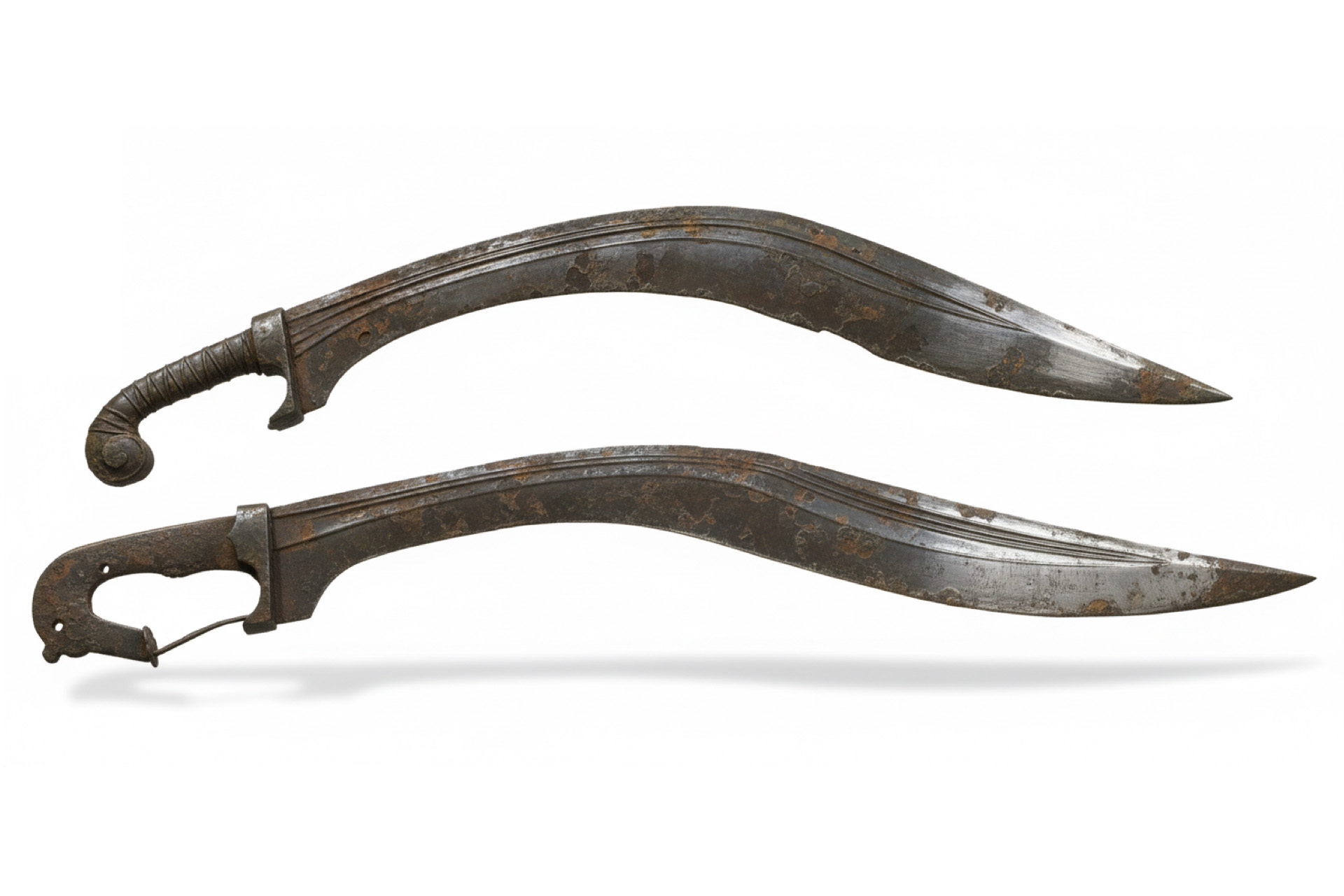
Makhaira — ancient Greek single-edged cutting sword related to the kopis.
Quick definition: The kopis is an ancient Greek single-edged cutting sword with a forward-curved blade, designed to place more mass toward the striking belly for strong chopping and draw-cutting power.
Region: Ancient Greece and the wider Mediterranean
Era: Classical period, with related forms before and after
Blade type: forward-curved cutting blade with a heavy belly
Edge: single-edged
Typical length: about 20–26 in (51–66 cm), depending on example
Use: powerful chopping cuts, cavalry strikes, and close-combat cutting
The kopis is built around cutting authority. Its forward curve shifts visual and functional weight toward the belly of the blade, so the edge lands with more chopping force than a straight short sword of similar size. This makes it very different from the xiphos, which belongs to the straight, double-edged Greek infantry sword tradition.
Because ancient terminology is not always clean, kopis and makhaira often overlap in museum labels and modern writing. For identification, the kopis is best understood as the more visually distinctive forward-curved member of that Greek cutting-sword family: compact, aggressive, and optimized for decisive edge contact rather than elegant thrusting lines.

Kopis — an ancient Greek forward-curved cutting sword with a heavy chopping belly.
Quick definition: The xiphos is an ancient Greek short sword with a straight double-edged blade, often leaf-shaped, used as a secondary weapon by hoplites and other Greek infantry.
Region: Ancient Greece
Era: Archaic and Classical periods
Blade type: short straight blade, often leaf-shaped
Edge: double-edged
Typical length: about 18–24 in (46–61 cm)
Use: thrusting, close-range cutting, backup infantry sidearm
The xiphos represents the straight Greek sword tradition, in contrast to the curved cutting forms such as the makhaira and kopis. Its compact size made it practical as a backup weapon after the spear, especially in close fighting where a long shafted weapon became difficult to use.
Many xiphos blades have a leaf-shaped profile, widening toward the middle before tapering to a point. That shape gives the sword enough mass for short cuts while keeping a strong thrusting point. In practical terms, the xiphos was not a long dueling sword; it was a compact battlefield sidearm built for the tight, violent distance of ancient infantry combat.
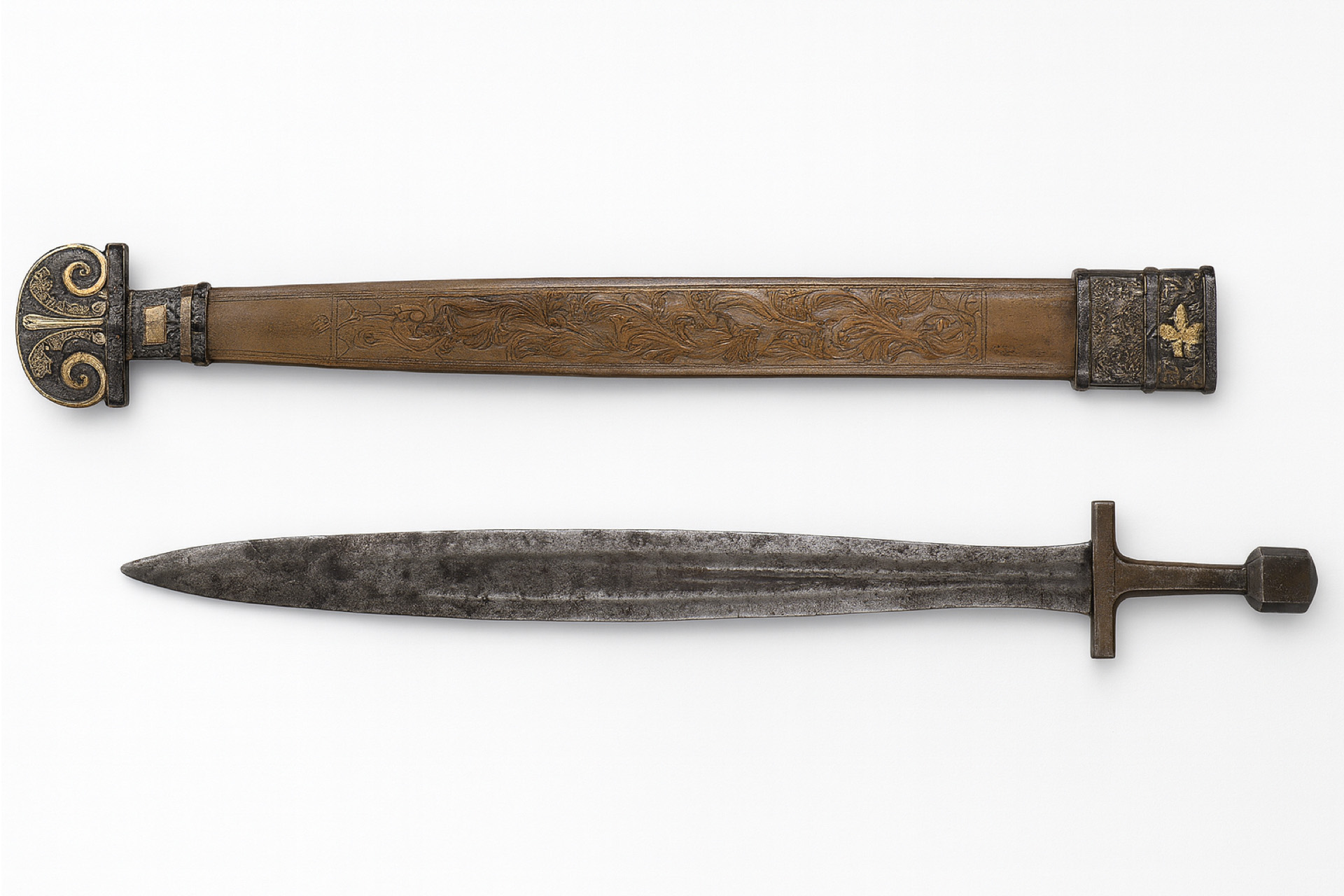
Xiphos — an ancient Greek short sword with a straight double-edged leaf-shaped blade.
Quick definition: The falcata is an ancient Iberian forward-curved sword with a heavy cutting belly, built to deliver powerful chopping cuts at close range.
Region: Iberian Peninsula
Era: Iron Age, especially pre-Roman and Roman-contact Iberia
Blade type: forward-curved blade with a heavy belly
Edge: single-edged, often with a sharpened false edge near the point
Typical length: about 20–24 in (51–61 cm)
Use: heavy chopping cuts, close combat, infantry sidearm
The falcata is one of the most distinctive swords of ancient Iberia. Its blade curves forward and widens toward the striking area, placing more mass behind the cut than a straight short sword of similar length. This gives the weapon a compact but aggressive cutting profile, closer in practical effect to a heavy chopping blade than a narrow thrusting sword.
A typical falcata also has a strong point, so it should not be reduced to a simple chopping weapon. The sharpened belly delivers hard edge contact, while the point and occasional false edge near the tip give it some thrusting and draw-cutting ability. In a sword identification context, the falcata is best recognized by its Iberian origin, forward curve, swollen belly, and close-combat cutting bias.

Falcata — Iberian forward-curved sword with a heavy belly built for powerful cutting.
Quick definition: The falx is a Dacian and Thracian curved blade with the cutting edge on the inside of the curve, used for powerful hooking and chopping cuts.
Region: Dacia and Thrace
Era: Iron Age to Roman-contact period
Blade type: inward-curved cutting blade
Edge: sharpened on the inside curve
Typical length: varied; shorter sword-like forms and longer one- or two-handed forms are both discussed
Use: hooking cuts, chopping, shield manipulation, close battlefield strikes
The falx is visually easy to recognize because its cutting edge is not on the outside of the curve like a saber, but on the inside, closer to a sickle-like cutting motion. This geometry lets the blade pull into the target during the cut, making it useful for hooking around shields, limbs, or exposed equipment.
The falx is often associated with Dacian resistance against Rome, but its exact forms should be described with care. Some examples and reconstructions are short enough to sit near the sword or large-knife category, while others move closer to long-handled battlefield weapons. For sword identification, the key features are the Dacian or Thracian context, the inward curve, and the inside cutting edge.
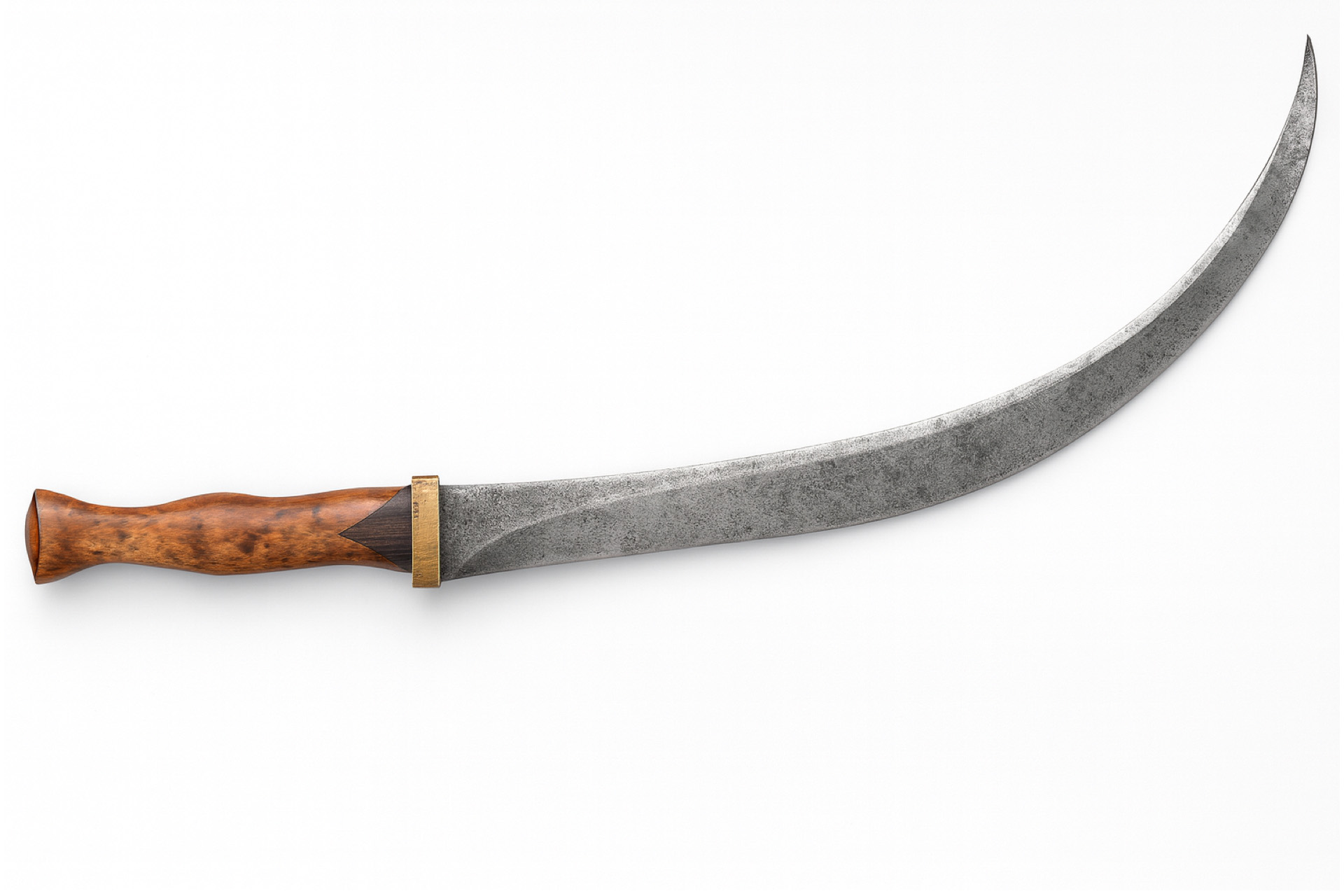
Falx — Dacian and Thracian inward-curved blade with the cutting edge on the inside curve.
Quick definition: The rhomphaia is a Thracian long single-edged bladed weapon, usually straight or slightly curved, built for powerful cutting strikes and greater battlefield reach than a compact side sword.
Region: Thrace and the Balkans
Era: Classical to Hellenistic period
Blade type: long straight or slightly curved blade
Edge: single-edged
Typical length: often longer than standard side swords; examples vary by reconstruction and archaeological interpretation
Use: long-reach cutting, battlefield strikes, anti-shield and anti-formation use
The rhomphaia is often compared with the falx, but the two should not be treated as identical. The falx is strongly associated with an inward-curved cutting profile, while the rhomphaia is usually described with a straighter or only slightly curved blade. This made the rhomphaia more adaptable for long chopping cuts and, in some interpretations, limited thrusting or point-forward work.
Its extended grip or tang gave the weapon leverage beyond a normal one-handed sword. That extra reach and cutting power made the rhomphaia a serious battlefield weapon rather than a compact personal sidearm. For identification, look for the Thracian context, long single-edged blade, extended handle structure, and a profile less aggressively hooked than the falx.

Rhomphaia — Thracian long single-edged blade used for powerful cutting and battlefield reach.
Quick definition: The gladius is the classic Roman short sword: a compact, straight, double-edged infantry weapon designed for close-range thrusting and cutting behind the protection of a large shield.
Region: Ancient Rome
Era: Roman Republic and Roman Empire
Blade type: short straight blade with a strong point
Edge: double-edged
Typical blade length: about 18–24 in (46–61 cm), depending on type
Use: infantry thrusting, close combat, shield formation fighting, short cutting strikes
The gladius became one of the most effective military swords of the ancient world because it matched Roman infantry tactics. Legionaries fought in close order with large shields, where long swinging cuts were less practical. A short, rigid blade with a strong point allowed the soldier to thrust from behind the shield, strike into openings, and recover quickly in tight formation.
Several gladius forms existed, including the Mainz, Fulham, and Pompeii types. Some had broader waisted blades, while later examples often became straighter and more compact. In sword identification, the gladius is recognized by its short blade, double edge, central point, simple hilt, and Roman military context.

Gladius — Roman short sword built for close infantry combat behind the shield.
Quick definition: The spatha is a longer Roman and Late Roman straight sword, usually double-edged, first associated strongly with cavalry and later adopted more widely by infantry.
Region: Roman Empire and Late Antique Europe
Era: Roman Imperial to Late Roman period
Blade type: long straight blade
Edge: double-edged
Typical blade length: about 28–36 in (71–91 cm)
Use: cavalry combat, infantry use, cutting, thrusting, military sidearm
The spatha developed as a longer alternative to the compact gladius. Its added reach made it especially useful for mounted troops, where a short infantry sword was less effective from horseback. Over time, the spatha became more common among infantry as Roman military equipment and tactics changed.
In sword history, the spatha matters because it bridges the Roman and early medieval worlds. Its long straight double-edged form influenced later Migration Period and early medieval European swords, including weapons associated with Germanic, Frankish, and Viking Age traditions. For identification, look for a longer Roman-style blade, double edges, a simple military hilt, and a role that extends beyond the tight shield-line tactics of the gladius.

Spatha — longer Roman sword used by cavalry and later infantry during the Late Roman period.
Quick definition: The paramerion is a Byzantine single-edged, saber-like sword, usually described as slightly curved and associated with later Eastern Roman military use.
Region: Byzantine Empire / Eastern Roman world
Era: Middle Byzantine to Late Byzantine period
Blade type: single-edged saber-like blade, often described as slightly curved
Edge: single-edged
Typical length: varies by interpretation; some Byzantine references describe a sword around 36–37 in (about 94 cm) overall
Use: military sidearm, cavalry use, slashing cuts, Eastern Roman battlefield equipment
The paramerion marks an important shift from the straight Roman sword tradition toward a more saber-like Byzantine weapon. Unlike the spatha, which belongs to the long straight double-edged family, the paramerion is usually identified by its single edge and curved or slightly curved cutting profile.
The weapon reflects the military world of the Byzantine Empire, where Roman inheritance, steppe influence, Persian contact, and eastern cavalry warfare all shaped arms and armor. For sword identification, the paramerion should be treated as a Byzantine saber-like sidearm rather than a classical Roman sword, with the key features being its single-edged blade, Eastern Roman context, and association with mounted or mobile warfare.

Paramerion — Byzantine single-edged saber-like sword associated with later Eastern Roman military use.
African sword traditions include straight double-edged military blades, curved sabers, sickle-shaped swords, short sword-like daggers, ceremonial weapons, and prestige blades connected with rank, ritual, and regional identity. Many of these weapons do not follow the familiar European sword pattern, but they are essential to understanding how different cultures solved the same problems of cutting, reach, defense, status, and authority.
This section covers North African, Sahelian, Horn of Africa, West African, and Central African sword forms. Some, such as the kaskara and takoba, are long straight swords; others, such as the billao and ikakalaka, sit closer to the short sword category; and ceremonial forms such as the akrafena and ngulu show how blade design could carry political, spiritual, or judicial meaning beyond ordinary combat.
| Sword Type | Region / Culture | Blade Shape | Edge Type | Typical Length | Primary Use |
|---|---|---|---|---|---|
| Flyssa | Kabyle / Algeria | Long narrow blade, usually straight or slightly curved | Single-edged | Varies; often sword-length | Status weapon, cutting sidearm, ceremonial display |
| Kaskara | Sudan, Chad, Sahel | Straight broad blade | Double-edged | 30–36 in (76–91 cm) | Military sidearm, cavalry and infantry use |
| Nimcha | North Africa | Curved saber blade | Single-edged | 28–34 in (71–86 cm) | Cutting, mounted use, status weapon |
| Billao | Somalia / Horn of Africa | Short leaf-shaped or broad blade | Double-edged | Short sword / large dagger | Close combat, personal sidearm, status display |
| Shotel | Ethiopia / Eritrea | Deeply curved sickle-like blade | Double-edged | 30–40 in (76–102 cm) | Hooking around shields, slashing, cavalry and infantry use |
| Akrafena | Akan / Ghana | Broad ceremonial or fighting blade | Usually double-edged | Varies by form | Status, ceremony, martial symbolism |
| Ida | Yoruba / West Africa | Broad blade, often leaf-like or flaring | Usually double-edged | Varies by regional form | Warfare, authority, ceremonial use |
| Takoba | Tuareg / Sahel | Straight narrow blade with crossguard | Double-edged | 30–36 in (76–91 cm) | Cavalry, personal sidearm, prestige weapon |
| Ikakalaka | Kuba / Central Africa | Short broad blade with distinctive profile | Usually double-edged | Short sword length | Status weapon, close-range blade, ceremonial use |
| Ngulu | Congo Basin | Large curved or flared execution blade | Single or multiple sharpened edges | Varies widely | Execution, authority, ceremonial display |
↔ Swipe horizontally to see all columns on mobile devices.

Quick definition: The flyssa is a Kabyle North African sword or long knife from Algeria, recognized by its long narrow blade, engraved decoration, and distinctive hilt form.
Region: Kabyle / Algeria, North Africa
Era: Mainly 19th century examples are commonly documented
Blade type: long narrow blade, usually straight or slightly curved
Edge: single-edged, often with a sharp point
Typical length: varies widely; many examples sit between large knife and sword length
Use: status weapon, cutting sidearm, ceremonial display, regional identity
The flyssa is one of the most recognizable North African edged weapons because of its narrow blade and rich surface decoration. Many examples feature engraved geometric or linear ornament along the blade, giving the weapon a visual identity that is as important as its cutting function.
In classification, the flyssa sits between sword and large knife depending on the size of the example. Longer flyssa blades clearly belong in a sword guide, while shorter versions can feel closer to a fighting knife. For identification, look for the Kabyle context, slim blade, decorated steel, minimal hand protection, and a hilt profile that differs sharply from European sabers or Middle Eastern shamshirs.

Flyssa — Kabyle North African sword with a long narrow blade and engraved decoration.
Quick definition: The kaskara is a Sudanese and Saharan straight double-edged sword, recognized by its cruciform guard, long blade, and disc-shaped pommel.
Region: Sudan, Chad, and the eastern Sahara / Sahel
Era: Mainly documented in 18th–20th century examples, with older regional traditions behind the form
Blade type: long straight blade
Edge: double-edged
Typical blade length: about 30–36 in (76–91 cm), with variation by example
Use: cavalry and infantry sidearm, prestige weapon, military and status display
The kaskara looks closer to a medieval European straight sword than to many curved African or Middle Eastern blades. Its long double-edged blade, crossguard, and disc pommel create a simple but highly recognizable silhouette. Many surviving examples also show how active the blade trade was: local Sudanese hilts were sometimes mounted with imported European, Iranian, or older trade blades.
In use and identity, the kaskara belongs to the Islamicized eastern Sahara and Sahel sword tradition. It was not merely a decorative object; it functioned as a fighting sidearm and a symbol of rank, warrior identity, and regional prestige. For identification, look for the straight double-edged blade, cruciform guard, leather grip, circular pommel, and Sudanese or Sahelian context.

Kaskara — Sudanese straight double-edged sword with a cruciform guard and disc pommel.
Quick definition: The nimcha is a North African saber, especially associated with Morocco, Algeria, and Tunisia, recognized by its curved single-edged blade, distinctive hooked pommel, and complex guard with forward-projecting quillons.
Region: North Africa, especially Morocco, Algeria, and Tunisia
Era: Mainly early modern to 19th century examples, with older blade reuse common
Blade type: curved saber blade, often locally mounted with older or imported blades
Edge: single-edged
Typical blade length: varies widely; many examples range from short naval-saber length to full saber length
Use: cutting, naval and corsair use, military sidearm, prestige weapon
The nimcha is best identified by its hilt rather than by blade shape alone. Many examples use curved saber blades, but the guard and grip give the weapon its North African character: a hooked pommel, forward-facing quillons, and often a knuckle guard or additional side bars. This makes the nimcha visually different from the Persian shamshir, Indian talwar, or Ottoman kilij, even when the blade curve looks broadly related.
Surviving nimcha swords also show how active trade and reuse were in the western Islamic world. Local North African mounts could be paired with European blades, older saber blades, or blades from broader Mediterranean trade networks. For identification, look for the North African context, single-edged saber blade, hooked hilt profile, and multi-bar guard rather than assuming every curved sword in the region is simply a scimitar.

Nimcha — North African saber with a curved single-edged blade and distinctive hooked hilt.
Quick definition: The billao, also called belawa, is a Somali short sword or long dagger from the Horn of Africa, recognized by its broad double-edged blade and distinctive horn hilt.
Region: Somalia / Horn of Africa
Era: mainly 19th to early 20th century documented examples
Blade type: short broad blade, often leaf-shaped or asymmetrical
Edge: double-edged
Typical length: varies; often short sword or long dagger length
Use: close combat, personal sidearm, status display, regional identity
The billao sits on the boundary between sword and dagger. Some examples are compact enough to be classified as large knives, while longer forms fit naturally into a sword guide. Its broad blade gives it strong close-range cutting and thrusting potential, but the weapon’s identity is just as strongly tied to its Somali hilt construction and regional use.
For identification, look for a short double-edged blade, often with a leaf-like or asymmetrical profile, paired with a horn hilt and a compact overall format. Unlike the long straight kaskara or the curved North African nimcha, the billao is a close personal weapon of the Horn of Africa, more compact, more dagger-like, and visually distinct from Saharan and Mediterranean sword forms.

Billao — Somali short sword or long dagger with a broad double-edged blade.
Quick definition: The shotel is an Ethiopian and Eritrean curved sword with a sickle-like blade, designed for slashing and reaching around an opponent’s shield.
Region: Ethiopia and Eritrea / Horn of Africa
Era: mainly documented in 18th–20th century examples, with older regional traditions behind the form
Blade type: deeply curved sickle-shaped blade
Edge: often double-edged, though examples vary
Typical length: often about 30–40 in (76–102 cm) overall, depending on example
Use: slashing, hooking around shields, cavalry and infantry use, status display
The shotel is one of the most visually distinctive African swords. Its dramatic curve separates it from straight double-edged weapons such as the kaskara and from more familiar saber forms such as the nimcha. The blade shape allowed the user to attack around shields and strike from unusual angles, making it especially recognizable in Ethiopian arms and armor.
Unlike a simple curved saber, the shotel’s sickle profile changes how the weapon moves through space. It is not built primarily for a straight thrust or a standard cavalry draw cut. Its strength is the ability to curve past a defensive line, catch exposed areas, and deliver cutting or hooking strikes from angles that are difficult to block with a shield.

Shotel — Ethiopian curved sword with a sickle-shaped blade designed to reach around shields.
Quick definition: The akrafena is an Akan ceremonial and symbolic sword from Ghana, closely associated with Asante authority, state regalia, ritual use, and the visual language of leadership.
Region: Akan peoples / Ghana, especially Asante contexts
Era: mainly documented in historical and ceremonial Asante use
Blade type: broad ceremonial or fighting blade, varying by type and function
Edge: often double-edged, depending on the example
Typical length: varies by ceremonial and martial form
Use: authority, ritual, oath-taking, state regalia, ceremonial display, and martial symbolism
The akrafena is not just a weapon shape; it belongs to a larger Akan system of political symbolism, ritual objects, and state ceremony. In Asante culture, swords could signal authority, office, loyalty, spiritual responsibility, and royal legitimacy. That makes the akrafena different from a battlefield sword whose identity is defined mainly by blade geometry.
For identification, look for an Akan or Asante context, a broad blade, symbolic hilt or sheath decoration, and a function tied to ceremony or authority. Some afena forms had martial use, but in a sword-type guide the akrafena is best understood as a ceremonial and political sword tradition as much as a cutting weapon.

Akrafena — Akan ceremonial sword from Ghana associated with authority, ritual, and state regalia.
Quick definition: The ida, or ida gigun, is a Yoruba sword from southwestern Nigeria, used as a fighting weapon, prestige object, and symbol of authority depending on the specific form and context.
Region: Yoruba peoples / southwestern Nigeria
Era: historical Yoruba use, with many documented 18th–20th century examples
Blade type: broad straight or slightly flaring blade, with regional variation
Edge: usually double-edged or sharpened along the main blade edges, depending on form
Typical length: varies; many examples sit in short sword to full sword range
Use: warfare, status display, authority, ceremony, and regional identity
The ida is best understood as a Yoruba sword tradition rather than one rigid blade pattern. Some examples have broad leaf-like profiles, while others are narrower or more utilitarian. The weapon could serve practical martial purposes, but it also belonged to a wider culture of rank, kingship, ritual display, and public authority.
For identification, look for a Nigerian or Yoruba context, a broad blade profile, local hilt construction, and use in either martial or ceremonial settings. Compared with the Sudanese kaskara, the ida usually has a more regional West African visual language and does not follow the same long cruciform straight-sword format. Compared with the akrafena, it is less narrowly tied to Akan state regalia and more specifically associated with Yoruba arms and authority.

Ida — Yoruba sword from Nigeria associated with warfare, authority, and ceremonial display.
Quick definition: The takoba, also spelled takouba, is a Tuareg and Sahelian straight double-edged sword, recognized by its long blade, simple crossguard, leather-covered hilt, and association with warrior status in the Sahara and western Sahel.
Region: Tuareg, Sahara, and western Sahel
Era: mainly documented in 18th–20th century examples, with older regional traditions behind the form
Blade type: long straight blade with simple crossguard
Edge: double-edged
Typical blade length: about 27–33 in (69–84 cm), depending on example
Use: warrior sidearm, cavalry and foot use, status display, regional identity
The takoba is visually close to other straight double-edged sword traditions, but its cultural setting and hilt treatment make it distinct. Tuareg examples often have leather-covered grips and scabbards, with a relatively simple crossguard and long straight blade. Some blades were locally made, while others may reflect trade, reuse, or imported steel moving through Saharan networks.
For identification, look for the combination of a straight double-edged blade, simple crossguard, leather-covered hilt, and Tuareg or Sahelian context. Unlike the curved nimcha or the sickle-shaped shotel, the takoba belongs to the straight broadsword family, but its Sahara/Sahel identity gives it a very different visual and cultural character from European medieval swords.

Takoba — Tuareg straight double-edged sword from the Sahara and Sahel.
Quick definition: The ikakalaka, often associated with Konda and related Central African sword traditions, is a short sword from the Congo region, recognized by its broad flared blade, strong visual profile, and use as both a weapon and a prestige object.
Region: Congo region / Central Africa
Era: mainly documented in 19th to early 20th century examples
Blade type: short broad blade, often flared or leaf-like
Edge: usually double-edged, depending on the example
Typical length: short sword length, with variation by regional form
Use: close-range weapon, prestige object, ceremonial display, status symbol
The ikakalaka is one of the most visually striking Central African short swords. Instead of a long narrow blade, it usually presents a broad, flared profile that gives the weapon a powerful silhouette. Some examples have crescent-like or half-moon shaping near the tip, while others are more leaf-like or asymmetrical.
In identification, the ikakalaka should not be confused with long straight African swords such as the kaskara or takoba. It is shorter, broader, and more sculptural in form. Its importance comes from the combination of blade geometry, regional identity, and social meaning: many Central African blades served not only as fighting tools, but also as markers of authority, rank, ritual use, and prestige.

Ikakalaka — Central African short sword with a broad flared blade and ceremonial status.
Quick definition: The ngulu is a Central African ceremonial and execution sword from the Congo Basin, recognized by its large curved blade, dramatic silhouette, and association with authority, ritual, and status.
Region: Congo Basin / Central Africa, especially Democratic Republic of Congo contexts
Era: mainly 19th to early 20th century documented examples
Blade type: large curved or flared ceremonial blade
Edge: usually single-edged, depending on form
Typical length: often about 21–27 in (54–67 cm) overall on museum examples
Use: ceremonial authority, execution context, ritual display, prestige object
The ngulu is one of the most dramatic Central African blade forms. Its broad curved blade was not designed like a European battlefield sword or a cavalry saber. Instead, it belongs to a cultural category where blade form, public authority, ritual function, and social meaning are inseparable.
In older collections, ngulu examples are often described as execution swords, but modern presentation should be careful and specific. The weapon’s visual power comes from its large iron blade, sculptural curve, and decorated handle construction. For identification, look for the Congo Basin context, oversized curved blade, ceremonial profile, and association with rank, judgment, ritual, or authority rather than ordinary battlefield use.

Ngulu — Central African ceremonial sword with a large curved blade and symbolic authority.
European swords changed dramatically from Bronze Age leaf-shaped blades to medieval arming swords, longswords, Renaissance rapiers, military sabers, basket-hilted broadswords, and modern training blades. The main differences come from metallurgy, armor, cavalry tactics, civilian dueling, naval warfare, and later sport fencing.
| Period / Group | Key Sword Types | Typical Blade Pattern | Primary Use |
|---|---|---|---|
| Bronze & Iron Age Europe | Naue II Leaf-Blade, Hallstatt Sword, La Tène Sword | Leaf-shaped or straight double-edged blades | Early military sidearms, cut-and-thrust use, elite warrior equipment |
| Migration & Viking Age | Ring-Hilt Spatha, Viking Sword, Ulfberht Sword, Krefeld-Type Sword, Long Seax | Broad straight blades, compact guards, shield-era sword forms | One-handed combat with shield, slashing cuts, status display |
| High & Late Medieval Europe | Arming Sword, Longsword, Bastard Sword, Falchion, Messer, Claymore, Estoc | Straight double-edged swords, specialized cutting blades, thrusting weapons | Armored combat, battlefield use, judicial duel, infantry and knightly warfare |
| Renaissance & Early Modern Europe | Side-Sword, Rapier, Broadsword, Backsword, Schiavona, Katzbalger, Small Sword | Complex hilts, thrusting blades, military cutting swords, civilian dueling weapons | Dueling, military sidearms, urban self-defense, officer weapons |
| 18th–19th Century Military & Dress Swords | British Pattern 1796, French Briquet, French Model 1822, Karabela, Szabla, Naval Cutlass | Sabers, short infantry swords, naval blades, officer swords | Cavalry, infantry, naval boarding, military dress, officer status |
| Modern Sport & HEMA Training Blades | Épée, Foil, Fencing Sabre, Feder | Blunted, flexible, or rule-specific training blades | Sport fencing, historical fencing practice, safe training simulation |
↔ Swipe horizontally to see all columns on mobile devices.
Early European swords show the transition from cast bronze blades to forged iron weapons. Many of these blades were short enough for close combat but long enough to move beyond dagger function. Their profiles often balanced cutting ability with a usable point, especially in leaf-shaped and straight double-edged forms.
Quick definition: The Naue II is a Late Bronze Age European sword type with a strong leaf-shaped double-edged blade, widely associated with the transition from earlier bronze sword forms toward more durable cut-and-thrust weapons.
Region: Late Bronze Age Europe, with wide distribution across the Mediterranean and Central Europe
Era: Late Bronze Age into the early Iron Age transition
Blade type: leaf-shaped straight blade
Edge: double-edged
Typical length: varies; many examples sit in short sword to full sword range
Use: cut-and-thrust combat, elite warrior equipment, military sidearm
The Naue II sword is important because it represents one of the most successful sword forms of the Late Bronze Age. Its leaf-shaped blade widens toward the center, giving it enough mass for cutting while preserving a strong point for thrusting. This made it more versatile than many earlier narrow bronze blades.
The type spread widely across Europe and the Mediterranean world, which suggests that its design solved real fighting and manufacturing problems. In sword identification, look for a double-edged leaf-shaped blade, a compact but functional hilt structure, and a Bronze Age context rather than the longer guard-and-pommel architecture of medieval European swords.

Naue II Leaf-Blade — Late Bronze Age European sword with a leaf-shaped double-edged blade.
Quick definition: The Hallstatt sword is an early Iron Age European sword associated with the Hallstatt culture, marking the transition from Bronze Age sword forms to some of the first iron swords made in Europe.
Region: Central Europe, especially Hallstatt culture areas
Era: Early Iron Age, especially Hallstatt C, roughly 8th–6th century BCE
Blade type: long straight blade, often continuing Bronze Age proportions
Edge: double-edged
Typical length: varies; many examples are long sidearms rather than short daggers
Use: elite warrior equipment, cut-and-thrust sidearm, status weapon, early iron military blade
The Hallstatt sword belongs to the early European Iron Age, when iron began replacing bronze for major weapons but did not immediately create a completely new sword shape. Many Hallstatt swords kept the general proportions of earlier bronze blades, including straight double-edged forms suitable for both cutting and thrusting.
These swords are important because they sit at a technological and cultural turning point. Iron offered new possibilities for production and availability, but early iron blades still inherited much from Bronze Age design. In sword identification, look for the Central European Hallstatt context, straight double-edged blade, early iron construction, and simpler hilt architecture compared with later La Tène and medieval European swords.

Hallstatt Sword — early Iron Age European sword that continued many Bronze Age blade forms in iron.
Quick definition: The La Tène sword is an Iron Age Celtic sword type, usually with a straight double-edged iron blade, associated with La Tène culture and the wider expansion of Celtic weapon styles across Europe.
Region: Celtic Europe, especially areas linked to Switzerland, eastern France, Britain, Ireland, and wider continental Europe
Era: Iron Age, especially from about the 5th century BCE into the late pre-Roman period
Blade type: straight iron blade, often long and narrow compared with earlier leaf-shaped forms
Edge: double-edged
Typical length: varies; many examples are full sword length rather than dagger length
Use: warrior sidearm, cut-and-thrust combat, elite display, decorated scabbard tradition
The La Tène sword marks a more recognizably Celtic phase of European sword design. Compared with many earlier leaf-shaped Bronze Age and Hallstatt forms, La Tène swords often have straighter iron blades and a visual identity tied closely to scabbard fittings, suspension systems, and decorated metalwork.
Some of the most striking surviving La Tène swords are valued as much for their hilts and scabbards as for their blades. Anthropomorphic hilts, decorated scabbards, and regional variations show that these swords were not just battlefield tools, but also signs of warrior identity, prestige, and Celtic metalworking skill. For identification, look for the Iron Age Celtic context, straight double-edged blade, scabbard ornament, and La Tène-period fittings.

La Tène Sword — Celtic Iron Age sword with a straight double-edged blade and decorated scabbard tradition.
Migration and Viking Age swords grew out of the late Roman spatha tradition and developed into the broad, straight, one-handed swords of early medieval Europe. These weapons were usually carried with a shield, so their design favored strong cuts, close-range thrusts, compact guards, and secure handling rather than the two-handed fencing mechanics seen in later longswords.
This group includes prestige ring-hilt spathae, Viking swords, Ulfberht-inscribed blades, early Krefeld-type spathae, and the long seax. Some were practical battlefield weapons, while others also served as markers of rank, oath, gift exchange, burial status, and elite warrior identity.
Quick definition: The ring-hilt spatha is a Migration Period variant of the long straight spatha, identified by a small ring attached to the hilt and usually associated with elite Germanic warrior culture.
Region: Germanic Europe, including Anglo-Saxon, Frankish, Alemannic, Scandinavian, and continental Migration Period contexts
Era: mainly 6th–7th century CE
Blade type: long straight spatha-type blade
Edge: double-edged
Typical blade length: about 28–32 in (71–81 cm), with variation by example
Use: elite warrior sidearm, status display, one-handed sword use with shield
The ring-hilt spatha belongs to the broader Migration Period sword family that grew out of the Roman spatha tradition. Its blade is usually long, straight, and double-edged, but the defining feature is the small ring fixed to the hilt. That ring should not be confused with later ring-pommel swords; here it is a separate fitting attached to the hilt structure.
The ring was probably more symbolic than functional. Ring-hilt spathae are usually discussed as high-status weapons, connected with elite ownership, oath symbolism, gift exchange, and warrior identity. For sword identification, look for a straight spatha-like blade, short guard, early medieval Germanic context, and the distinctive small ring on the hilt.

Ring-Hilt Spatha — Migration Period prestige sword with a small ring attached to the hilt.
Quick definition: The Viking sword is an early medieval one-handed sword with a broad double-edged blade, short crossguard, fuller, and distinctive pommel, used primarily with a shield during the Viking Age.
Region: Scandinavia and wider Viking Age Europe
Era: roughly 8th–11th century CE
Blade type: broad straight blade, usually with a central fuller
Edge: double-edged
Typical blade length: about 28–32 in (71–81 cm)
Use: one-handed cutting and thrusting with shield support, warrior sidearm, prestige weapon
The Viking sword developed from earlier Migration Period and spatha-type swords, but it has a recognizable early medieval identity of its own. Most examples have a broad double-edged blade, a short guard, and a pommel built in lobed or multi-part forms. The fuller running along the blade is not a “blood groove”; it reduces weight and improves stiffness without making the sword unnecessarily heavy.
In use, the Viking sword was not a two-handed fencing weapon. It was normally paired with a round shield, which shaped how the sword was handled. The blade had enough width for strong cuts, while the point could still be used in close fighting. High-status examples could include pattern-welded blades, decorated hilts, silver or copper-alloy inlay, and inscriptions, making the Viking sword both a practical weapon and a visible marker of rank.

Viking Sword — early medieval one-handed sword with a broad double-edged blade and lobed pommel.
For related early medieval blade traditions, see our guide to Damascus steel patterns and historical blade steel.
If the Norse blade tradition speaks to you, explore Noblie's collector swords and custom sabers.

Quick definition: The Ulfberht sword is a group of high-status early medieval swords, usually dated to the Viking Age, recognized by the +VLFBERH+T or related inscription inlaid into the blade.
Region: Northern and Western Europe, especially Viking Age and Carolingian-influenced contexts
Era: mainly 9th–11th century CE
Blade type: straight early medieval sword blade, usually with a fuller
Edge: double-edged
Typical blade length: generally similar to Viking Age swords, often about 28–32 in (71–81 cm)
Use: elite warrior sword, prestige weapon, one-handed use with shield
The Ulfberht is not a separate sword shape in the same way as a katana, rapier, or gladius. It is better understood as a famous inscription group within the early medieval straight sword tradition. The blade geometry is broadly related to Viking Age and Carolingian swords: straight, double-edged, one-handed, and usually built with a fuller to reduce weight while preserving stiffness.
What makes Ulfberht swords important is the inscription and the quality range behind it. Some examples appear to have been exceptionally well made for their period, while others may represent later copies, imitations, or lower-quality blades using similar lettering. For identification, look for the inlaid +VLFBERH+T-style mark, early medieval blade profile, broad fuller, short guard, and high-status Viking Age or Carolingian context.
The +VLFBERH+T blades are often discussed alongside early crucible-steel debates — see our guide to Damascus steel history and myths.

Ulfberht Sword — Viking Age sword group recognized by +VLFBERH+T blade inscriptions.
Quick definition: The Krefeld-Type Spatha is an early Migration Period straight double-edged sword type, named after finds from Krefeld-Gellep and positioned between the late Roman spatha and later Germanic sword traditions.
Region: Lower Rhine / Germanic and late Roman frontier context
Era: early Migration Period, mainly 5th century CE
Blade type: long straight spatha-type blade
Edge: double-edged
Typical blade length: about 28–32 in (71–81 cm), broadly comparable to other early spathae
Use: military sidearm, warrior burial weapon, transitional Roman-Germanic sword form
The Krefeld-Type Spatha is important because it shows the sword world between Rome and the early medieval Germanic kingdoms. It still belongs to the spatha family: long, straight, double-edged, and suitable for one-handed use with a shield. But its archaeological setting places it in the period when Roman military traditions, Germanic warrior burial customs, and early Frankish presence were beginning to overlap.
Unlike later Viking swords, the Krefeld-Type Spatha is usually plainer and earlier in character. It should not be treated as a separate fantasy-like sword shape; it is a historically specific early spatha type. For identification, look for the late Roman frontier context, straight double-edged blade, early Migration Period dating, and a simpler hilt tradition before the more ornate Merovingian and Viking Age sword forms became common.

Krefeld-Type Spatha — early Migration Period straight sword linked to Krefeld-Gellep grave finds.
Quick definition: The long seax, or langseax, is an early medieval Germanic and Anglo-Saxon single-edged long blade, sitting between a large knife and a sword in both size and function.
Region: Anglo-Saxon England and Germanic Europe
Era: early medieval period, especially 7th–10th century CE
Blade type: long single-edged blade with knife-like ancestry
Edge: single-edged
Typical blade length: varies widely; long examples can reach about 20–24 in (51–61 cm) or more
Use: fighting sidearm, utility blade, status weapon, close-combat cutting and thrusting
The long seax is one of the clearest examples of a blade that challenges the line between knife and sword. Short seaxes were everyday utility and fighting knives, while long seaxes reached a size where they could function as true sidearms. Their single-edged construction separates them from double-edged Viking swords and spathae, even when they appear in similar early medieval contexts.
A long seax is usually identified by its straight or slightly tapering cutting edge, thick spine, angled back toward the point, and broad tang. Some high-status examples were decorated with inlay, runes, or complex patterning. For sword identification, the key point is that the long seax is not a standard crossguard sword; it is a Germanic single-edged long blade with knife ancestry, martial use, and strong cultural identity.

Long seax with single-edged blade, angled back, broad tang, and early medieval Germanic profile
High and Late Medieval European swords developed around mail, plate armor, shields, mounted combat, judicial duels, and increasingly specialized fencing systems. This period includes the classic one-handed arming sword, the two-handed longsword, the hand-and-a-half bastard sword, heavy cutting blades such as the falchion and messer, and thrusting weapons such as the estoc.

Quick definition: The arming sword is the classic medieval European one-handed sword, usually built with a straight double-edged blade, cruciform hilt, and a grip designed for use with a shield or buckler.
Region: Medieval Europe
Era: mainly High to Late Middle Ages, especially 11th–15th century
Blade type: straight one-handed blade, often with a fuller or flattened diamond section
Edge: usually double-edged
Typical blade length: about 27–33 in (69–84 cm), depending on type and period
Use: one-handed cut-and-thrust combat, shield use, knightly sidearm, sword-and-buckler fencing
The arming sword is what many people picture when they think of a medieval knight’s sword: a straight blade, simple crossguard, one-handed grip, and pommel. It grew out of earlier spatha and Viking Age sword traditions but became more refined in the medieval period, with better point control, improved hilt geometry, and blade forms suited to both cutting and thrusting.
Unlike the longsword, the arming sword was normally used in one hand. The other hand could hold a shield, buckler, reins, or another defensive tool. This made it practical for mounted knights, infantry, and civilian fencing contexts. For identification, look for the single-handed cruciform hilt, straight blade, double edge, and medieval European context rather than the longer two-handed grip of a longsword.
Browse Noblie's handcrafted custom swords for modern collector-grade interpretations of this classic medieval form.

Arming Sword — medieval one-handed European sword with a straight double-edged blade and cruciform hilt.
Quick definition: The longsword is a late medieval and Renaissance European two-handed sword, usually built with a straight double-edged blade, cruciform hilt, and extended grip for cut-and-thrust fencing.
Region: Medieval and Renaissance Europe, especially German, Italian, and broader Western European fencing traditions
Era: mainly 14th–16th century
Blade type: straight two-handed blade, often diamond-section or fuller-based depending on period and type
Edge: double-edged
Typical blade length: about 33–43 in (84–109 cm)
Typical weight: usually about 2.5–4 lb (1.1–1.8 kg), not the extremely heavy weapon often shown in fiction
Use: two-handed cut-and-thrust fencing, armored and unarmored combat, judicial duel, martial training
The longsword is one of the most technically important European sword types because it was used in organized fencing systems, not merely as a battlefield chopping tool. Surviving German and Italian fencing traditions show the longsword used with cuts, thrusts, binds, guards, footwork, half-swording, pommel strikes, and close grappling actions.
A proper longsword is not a massive iron bar. Most functional examples balance reach, stiffness, edge geometry, and point control. Earlier forms often kept broader cutting blades, while later types became more specialized for thrusting into gaps in armor. For identification, look for the long two-handed grip, straight double-edged blade, cruciform hilt, and a size clearly beyond the one-handed arming sword.
Want to own a blade in this lineage? See our handcrafted swords made to collector standards.
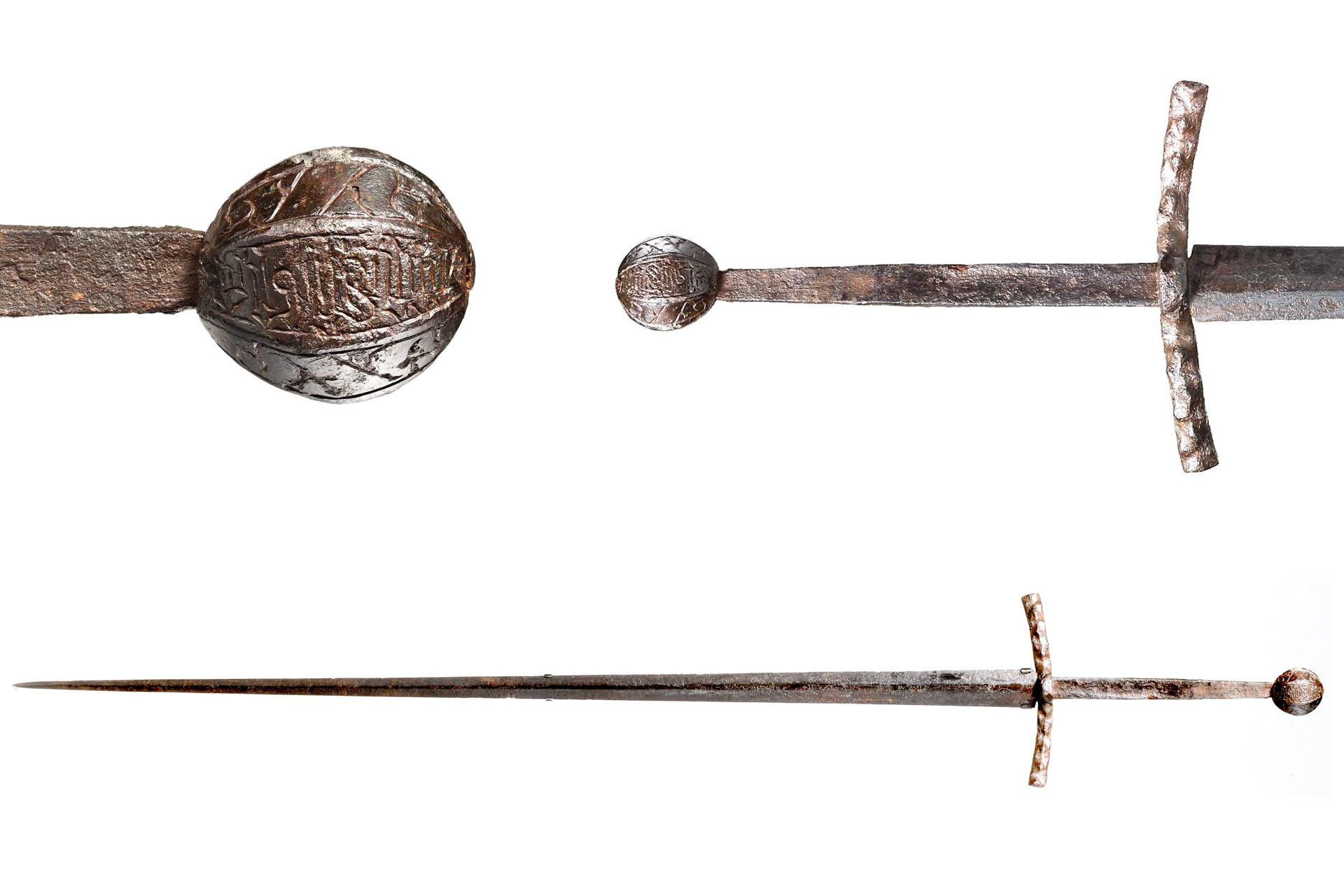
Longsword — late medieval European two-handed sword for cut-and-thrust fencing.
Quick definition: The bastard sword, also called a hand-and-a-half sword, is a medieval European sword with a grip long enough for two-handed use but compact enough to remain more agile than a full longsword.
Region: Medieval Europe
Era: mainly 14th–16th century
Blade type: straight cut-and-thrust blade with an extended grip
Edge: double-edged
Typical blade length: about 30–38 in (76–97 cm), depending on example
Use: one- or two-handed fencing, mounted and foot combat, cut-and-thrust use, transitional weapon between arming sword and longsword
The bastard sword occupies the middle ground between the one-handed arming sword and the full longsword. Its extended grip gives the user extra leverage for stronger cuts, better point control, and more secure handling, while the overall size can remain shorter and more maneuverable than larger two-handed swords.
The term “bastard sword” is not always used with strict consistency. In many modern classifications, it describes a hand-and-a-half sword: a blade that can be used in one hand when needed, but performs best when the second hand assists on the grip or pommel. For identification, look for a straight double-edged blade, cruciform hilt, and a grip longer than an arming sword but usually shorter than a large battlefield longsword.

Bastard sword with straight double-edged blade, cruciform hilt, and hand-and-a-half grip
Quick definition: The falchion is a medieval European single-edged sword with a broad cutting blade, combining sword-like handling with the chopping power of a heavy knife or cleaver-like blade.
Region: Medieval Europe
Era: mainly 13th–16th century
Blade type: broad single-edged cutting blade, with several regional and period variations
Edge: single-edged, often with a strong point or clipped tip depending on form
Typical blade length: about 24–32 in (61–81 cm), depending on example
Use: heavy cutting, close combat, infantry use, sidearm for soldiers and civilians
The falchion is often described as a sword with the cutting attitude of a large knife. Unlike the straight double-edged arming sword, the falchion usually has one sharpened edge and a blade profile that puts more authority into the cut. Some forms are broad and cleaver-like, while others are narrower with a more pronounced point.
The weapon should not be treated as crude or primitive. A good falchion could be a serious fighting sword, capable of powerful edge work while remaining compact enough for practical carry. For identification, look for the medieval European context, one-handed hilt, single cutting edge, broad blade profile, and stronger cutting bias compared with the arming sword or longsword.
For more on single-edged historical blades and their dagger cousins, see our companion guide to types of daggers.

Falchion — medieval European single-edged sword with a broad cutting blade.
Falchion Sword: The Cleveland Museum of Art

Quick definition: The messer family includes medieval and Renaissance German single-edged sword-like knives, such as the langes Messer and grosses Messer, recognized by their knife-style hilt construction, cutting blade, and often a side guard called a nagel.
Region: German-speaking Europe
Era: mainly 14th–16th century
Blade type: single-edged cutting blade, ranging from large knife to sword length
Edge: single-edged, sometimes with a clipped or reinforced point
Typical blade length: varies widely; long examples can reach sword length
Use: civilian self-defense, military sidearm, fencing practice, cutting and close-range combat
The messer is one of the most interesting European blade families because it sits between knife and sword. The name literally means “knife,” but many long messers were large enough to function as serious fighting swords. Instead of the cruciform hilt of an arming sword, the messer usually has slab-style grip scales pinned to a tang, giving it a construction style closer to a large knife.
A key identifying feature is the nagel, a small side projection near the guard that protects the hand. Messer fencing appears in several German martial sources, showing that these were not crude peasant tools but sophisticated weapons with their own technical tradition. For identification, look for a single-edged blade, knife-like grip construction, side nagel, and German late medieval or Renaissance context.
The messer's knife-style construction sits exactly on the line between sword and dagger — explored further in our types of daggers guide.

Messer — medieval German single-edged sword-like knife with a knife-style hilt and cutting blade.
Quick definition: The claymore is a Scottish two-handed great sword, best recognized by its long double-edged blade, extended grip, and angled crossguard, often with quatrefoil or spatulate terminals.
Region: Scotland, especially Highland contexts
Era: mainly late medieval to early modern period, especially 15th–17th century
Blade type: long straight two-handed blade
Edge: double-edged
Typical blade length: about 40–48 in (102–122 cm), depending on example
Use: battlefield cutting, reach, two-handed combat, Highland warfare, status display
The claymore is the famous Scottish two-handed sword of the late medieval and early modern Highlands. Its long blade gave the user reach and cutting authority, while the extended grip allowed two-handed leverage. The most recognizable examples have forward-sloping quillons, often ending in rounded or quatrefoil shapes, which create a silhouette distinct from many continental European great swords.
The word “claymore” can cause confusion because it has also been used for later Scottish basket-hilted broadswords. In a sword-type guide, it is best to separate the two: this entry refers to the large two-handed Highland claymore, not the later basket-hilt military sword. For identification, look for a long straight double-edged blade, two-handed grip, angled crossguard, Scottish context, and a size clearly larger than a standard arming sword or hand-and-a-half sword.

Claymore — Scottish two-handed great sword with a long blade and angled crossguard.
Quick definition: The estoc is a late medieval and Renaissance European thrusting sword with a stiff, narrow blade designed to drive into gaps in armor rather than deliver broad cutting strikes.
Region: Medieval and Renaissance Europe
Era: mainly 14th–16th century
Blade type: long rigid thrusting blade, often triangular, square, or diamond-section
Edge: usually unsharpened or minimally sharpened; optimized for the point
Typical blade length: often about 35–45 in (89–114 cm), depending on example
Use: armored combat, thrusting into armor gaps, cavalry sidearm, anti-armor fencing
The estoc developed for a world where plate armor changed the job of the sword. Against well-made armor, broad cuts were often ineffective. A rigid thrusting blade gave the user a better chance of driving the point into vulnerable openings: visor gaps, mail voiders, armpits, joints, and other exposed areas.
Unlike a longsword, the estoc was not meant to be a balanced cut-and-thrust weapon. Many examples have little or no functional cutting edge, because the blade’s strength comes from its stiff cross-section and narrow point. For identification, look for a long straight blade, minimal cutting geometry, strong thrusting point, cruciform hilt, and a clear association with armored combat.

Estoc — late medieval thrusting sword with a rigid blade designed for armored combat.
Quick definition: The Swiss degen is a short Swiss side sword or long dagger of the late medieval and Renaissance period, recognized by its compact blade and distinctive crescent-shaped guard.
Region: Switzerland and German-speaking Europe
Era: mainly 15th–16th century
Blade type: short straight blade, often between large dagger and short sword length
Edge: usually double-edged, depending on example
Typical blade length: often about 16–28 in (40–70 cm), with considerable variation
Use: personal sidearm, Swiss mercenary weapon, civilian carry, close-range defense, status display
The Swiss degen sits between dagger and sword. It is shorter than most arming swords and longswords, but more substantial than a simple utility knife. Its compact size made it practical as a sidearm for soldiers and civilians, especially in crowded streets, military camps, and pike formations where a long blade could be awkward.
The easiest identifying feature is the hilt. Many Swiss degen examples use a distinctive double-crescent guard, visually connecting the weapon to Swiss dagger and baselard traditions. For sword identification, look for the Swiss or German-speaking context, short straight blade, compact sidearm proportions, and crescent-like hilt shape rather than the long cruciform form of a medieval knightly sword.

Swiss Degen — short Swiss side sword with a compact blade and distinctive crescent-shaped guard.
Quick definition: The broadsword is a broad-bladed European military sword term, most often used for early modern one-handed swords with wider blades than narrow thrusting weapons such as the rapier or small sword.
Region: Europe, especially Britain, Scotland, and military contexts in early modern usage
Era: mainly 16th–19th century as a practical classification term
Blade type: broad straight blade, often built for strong cuts and some thrusting ability
Edge: commonly double-edged, though related backsword forms are single-edged
Typical blade length: about 30–36 in (76–91 cm), depending on pattern and period
Use: military sidearm, cutting, close combat, cavalry or infantry use, officer and Highland traditions
“Broadsword” is a useful but sometimes imprecise word. It does not describe one single medieval weapon in the same clean way that “katana” or “gladius” does. In early modern European usage, it often distinguished broader cutting swords from narrow thrusting swords, especially rapiers and small swords.
Many broadswords were one-handed military weapons with straight blades and protective hilts. Some had simple guards, while others developed into basket-hilted forms with extensive hand protection. For identification, look for a broad straight blade, one-handed military proportions, and a cutting bias. When the sword has a full protective basket around the hand, it is more precise to call it a basket-hilted broadsword.

Broadsword — early modern European sword term for a broad-bladed military sidearm.
Quick definition: The katzbalger is a German Renaissance short sword associated with Landsknecht infantry, recognized by its broad double-edged blade, compact proportions, and distinctive S-shaped or figure-eight guard.
Region: German-speaking Europe, especially Landsknecht contexts
Era: early to mid-16th century
Blade type: short broad blade, usually straight and flat
Edge: double-edged
Typical blade length: often about 24–28 in (61–71 cm), depending on example
Use: infantry sidearm, close combat, last-resort weapon for pike and missile troops, status display
The katzbalger was the short side sword of the Landsknecht world. Its compact size made it practical in the crush of infantry combat, especially when a pike, halberd, arquebus, or crossbow was no longer useful at close range. The blade is usually broad and strong, favoring cuts and short-range handling rather than elegant civilian thrusting.
The easiest way to identify a katzbalger is by the hilt. Many examples have a bold S-shaped or figure-eight guard with rounded terminals, giving the weapon a profile unlike a rapier, arming sword, or side-sword. For classification, treat the katzbalger as a Renaissance infantry short sword: compact, rugged, visually distinctive, and strongly tied to German Landsknecht military culture.

Katzbalger — German Landsknecht short sword with a broad blade and S-shaped guard.
Quick definition: The side-sword, or Italian spada da lato, is a Renaissance cut-and-thrust sword with a straight double-edged blade and a more complex guard than the medieval arming sword.
Region: Renaissance Europe, especially Italy and Spain
Era: mainly 15th–16th century
Blade type: straight cut-and-thrust blade, usually more slender than a medieval arming sword but broader than many later rapiers
Edge: double-edged
Typical blade length: about 32–40 in (81–102 cm), depending on example
Use: civilian carry, military sidearm, cut-and-thrust fencing, urban self-defense, early Renaissance swordplay
The side-sword stands between the medieval arming sword and the later rapier. It keeps enough blade width and edge geometry for meaningful cuts, but its hilt becomes more protective, often adding finger rings, side rings, knuckle guards, or swept bars. That makes it better suited to Renaissance fencing, where the unarmored hand needed more protection than a simple cruciform guard could provide.
In practical terms, the side-sword should not be treated as just a short rapier. It is a true cut-and-thrust weapon. The point matters, but so does the edge. For identification, look for a straight double-edged blade, one-handed grip, Renaissance hilt complexity, and a balance between cutting authority and point control rather than the very narrow thrusting emphasis of the mature rapier.

Side-Sword — Renaissance cut-and-thrust sword with a complex guard and straight double-edged blade.
Quick definition: The rapier is a Renaissance and early modern European thrusting sword with a long narrow blade and complex protective hilt, closely associated with civilian dueling, urban self-defense, and refined fencing systems.
Region: Renaissance and early modern Europe, especially Italy, Spain, France, Germany, and England
Era: mainly 16th–17th century
Blade type: long narrow thrusting blade, usually straight
Edge: often double-edged, though many rapiers were optimized far more for the point than for cutting
Typical blade length: about 38–45 in (97–114 cm), depending on period and school
Use: civilian dueling, thrust-focused fencing, urban self-defense, status display, courtly carry
The rapier is one of the most recognizable Renaissance sword types because its blade and hilt evolved around point control. Compared with the side-sword, the rapier usually has a longer, narrower blade and a more developed guard. Swept bars, rings, cups, knuckle bows, and pierced plates helped protect the hand during precise thrusting exchanges.
A rapier should not be described as completely useless for cutting. Many rapiers had sharpened edges and could deliver cuts, especially against unarmored opponents. Still, its main advantage was the thrust: reach, line control, and the ability to threaten the opponent before heavier cutting swords could close distance. For identification, look for the long slender blade, complex civilian hilt, one-handed grip, and strong association with Renaissance dueling culture.
If the era's blade craft draws you in, see how a Renaissance-style blade comes together in our step-by-step sword making guide.

Rapier — Renaissance thrusting sword with a long narrow blade and complex protective hilt.
Quick definition: The schiavona is a Venetian basket-hilted sword associated with Dalmatian and Balkan soldiers in Venetian service, while the earlier schiavonesca refers to related Renaissance sword forms with distinctive guards and Italian-Adriatic military context.
Region: Venice, Dalmatia, the Adriatic, and Balkan military contexts
Era: mainly 15th–17th century, depending on schiavonesca or schiavona form
Blade type: straight military blade, usually broad enough for effective cutting
Edge: commonly double-edged, though related single-edged military forms exist
Typical blade length: about 32–38 in (81–97 cm), depending on example
Use: military sidearm, cutting and thrusting, Venetian service, officer or guard weapon, status display
The schiavona is best recognized by its complex basket hilt. Unlike the rapier, which uses a long narrow thrusting blade and civilian fencing profile, the schiavona usually feels more like a military broadsword: protective in the hand, strong in the cut, and practical for close fighting. Many examples also have the distinctive “cat-head” pommel that helps identify the type.
The term schiavonesca is often used for earlier or related sword forms connected with Slavic, Dalmatian, and Adriatic military traditions. It should not be treated as exactly identical to the later basket-hilted schiavona, but the names belong to the same broad historical environment. For identification, look for Venetian or Adriatic context, a protective hilt, a straight military blade, and visual features that separate it from both the narrow rapier and the Scottish basket-hilted broadsword.

Venetian schiavona sword with basket hilt, straight double-edged blade, and cat-head pommel
Quick definition: The spadroon is a light European cut-and-thrust sword with a straight blade, positioned between the small sword and the broader military broadsword or saber.
Region: Europe, especially Britain, France, Germany, and officer-sword traditions
Era: mainly late 17th to early 19th century
Blade type: straight light cut-and-thrust blade
Edge: single-edged or double-edged, depending on example
Typical blade length: often about 30–34 in (76–86 cm), with variation by national pattern and maker
Use: officer sidearm, infantry and naval service, light cutting, thrusting, dress and military carry
The spadroon occupies an awkward but important place in European sword terminology. It is lighter and more agile than many broadswords, but more blade-forward and cutting-capable than a pure small sword. That makes it a transitional military sidearm: useful for thrusts, capable of cuts, but not as specialized as either a rapier, small sword, saber, or basket-hilted broadsword.
Identification depends on proportion rather than one single hilt shape. Many spadroons have straight blades, relatively light guards, and officer-style mounts. Some are single-edged with a sharpened back edge near the point; others are double-edged. For classification, look for a light straight blade, one-handed military hilt, late 17th- to early 19th-century context, and a design that clearly sits between civilian thrusting sword and heavier cutting sword.

Spadroon — light straight cut-and-thrust sword used by European military officers.
Quick definition: The basket-hilted broadsword is an early modern Scottish and British military sword with a broad blade and a basket-shaped guard built to protect the hand in close combat.
Region: Scotland, Britain, and wider early modern European military contexts
Era: mainly 17th–18th century, with later military descendants
Blade type: broad straight military blade
Edge: usually double-edged for broadsword forms; single-edged variants are more precisely called backswords
Typical blade length: about 30–36 in (76–91 cm), depending on pattern and maker
Use: military sidearm, Highland warfare, cavalry or infantry use, close combat, hand protection, cutting and thrusting
The basket-hilted broadsword is defined by its guard as much as by its blade. The basket protects the knuckles, fingers, and back of the hand, allowing harder engagement in close combat than a simple crossguard would permit. This made it especially practical for military use, where the sword might meet enemy blades, bayonets, shields, or equipment at short range.
In Scottish contexts, the basket-hilted broadsword is often confused with the claymore. The distinction matters: the Highland claymore is a large two-handed sword, while the basket-hilted broadsword is a one-handed military sword with a protective guard. For identification, look for the broad straight blade, full basket guard, one-handed grip, Scottish or British military context, and a cutting-oriented profile distinct from the narrow rapier or small sword.

Basket-Hilted Broadsword — Scottish and British military sword with a protective basket guard.
Quick definition: The backsword is an early modern European single-edged sword with a thick unsharpened back, built as a practical military cutting weapon with more blade stiffness than many double-edged broadswords.
Region: Britain, Scotland, and wider early modern Europe
Era: mainly 16th–18th century, with later military descendants
Blade type: straight single-edged blade with a thick back
Edge: single-edged, sometimes with a short false edge near the point
Typical blade length: about 30–36 in (76–91 cm), depending on pattern and maker
Use: military sidearm, cutting, cavalry or infantry use, close combat, training in broadsword and backsword systems
The backsword is closely related to the broadsword, but the blade construction is different. A true broadsword is normally double-edged, while a backsword has one sharpened edge and a thicker back. That thick spine can make the blade stiffer and more durable, especially for military cutting use.
Many backswords were mounted with protective hilts, including basket hilts, half baskets, or other military guards. This is why the terms can overlap in casual writing: a basket-hilted sword may be either a double-edged broadsword or a single-edged backsword. For identification, look first at the blade. If it has one cutting edge and a thick back, it is more precise to call it a backsword.

Backsword — an early modern European single-edged military sword with a reinforced back edge.
Quick definition: The dusack, also spelled dussack or tessak, is an early modern European single-edged cutting sword, often curved, associated with Central European sidearms and German fencing practice.
Region: German-speaking Europe, Central Europe, and related Scandinavian / North Sea contexts
Era: mainly 16th–17th century
Blade type: single-edged cutting blade, often curved but not always identical across surviving examples
Edge: single-edged
Typical blade length: often about 25–38 in (64–97 cm), with variation by military, civilian, and training form
Use: cutting sidearm, fencing practice, military or civilian carry, training weapon in early modern German systems
The dusack is a slippery term because it appears both as a real steel sidearm and as a training weapon in early modern fencing sources. Some dusacks resemble short sabers or cutlasses, while others sit closer to messer-related cutting weapons. Many are single-edged and curved, but the exact hilt and blade form can vary by region and source.
In German fencing, the dussack also became a training tool for one-handed cutting sword work. Practice versions could be simple wooden or leather-like training forms, while surviving steel examples show more developed guards and military sidearm features. For identification, look for a single-edged cutting blade, early modern Central European context, saber-like handling, and a relationship to both messer traditions and later cutlass or saber forms.

Dusack — early modern European single-edged cutting sword related to sabers, messers, and training weapons.
Quick definition: The colichemarde is a small sword blade type with a broad, stiff forte near the hilt and a much narrower thrusting section toward the point, designed to combine strong parrying ability with fast point control.
Region: Western Europe, especially French and courtly small sword traditions
Era: mainly late 17th to early 18th century
Blade type: small sword blade with broad forte and narrow foible
Edge: primarily thrusting; cutting ability is minimal compared with broadswords or sabers
Typical blade length: often about 28–34 in (71–86 cm), depending on example
Use: civilian dueling, dress carry, thrusting, parrying, small sword fencing
The colichemarde blade solves a very specific fencing problem. A normal small sword is fast and precise, but its narrow blade can feel weak when parrying heavier weapons. The colichemarde keeps extra width and stiffness near the hand, where parries occur, then narrows sharply toward the point for speed and accuracy in the thrust.
For identification, look for the sudden transition in blade width: broad and triangular near the hilt, then slim and needle-like toward the tip. It should not be confused with a rapier, which is generally longer and earlier in character, or with a standard small sword, which usually has a more evenly narrow blade. The colichemarde is best understood as a specialized small sword blade form for refined thrusting fencing.

Colichemarde small sword with broad triangular forte and narrow thrusting blade
Quick definition: The executioner’s sword is an early modern judicial sword designed for decapitation, not battlefield combat, usually recognized by its broad blade, short guard, two-handed grip, and blunt or squared tip.
Region: Germany and wider early modern Europe
Era: mainly 16th–18th century, especially 17th-century documented examples
Blade type: broad straight blade with blunt or squared tip
Edge: double-edged, sharpened for cutting rather than thrusting
Typical blade length: often about 32–36 in (81–91 cm), depending on example
Use: judicial execution, ceremonial authority, legal symbolism, public punishment context
The executioner’s sword looks impressive, but it was not built like a battlefield longsword. Its squared or blunt tip makes sense because thrusting was not its purpose. The weapon was designed to deliver a clean, controlled cut in a formal judicial setting, usually with two hands and without the need for advanced hand protection.
Many surviving executioner’s swords carry inscriptions, moral texts, or symbolic imagery connected with justice, death, punishment, and divine judgment. For identification, look for the broad straight blade, blunt end, short quillons, long grip, and legal or ceremonial context. If the sword has a sharp thrusting point and battlefield proportions, it is probably not a true executioner’s sword.

Executioner’s Sword — an early modern judicial sword with a broad blade and blunt, squared tip.
Quick definition: The Zweihänder and Montante are large European two-handed swords of the late medieval and Renaissance periods, built for reach, powerful cuts, battlefield control, and specialized fencing systems.
Region: Germany, Iberia, Italy, and wider Renaissance Europe
Era: mainly 15th–17th century
Blade type: very long straight two-handed blade, often with parrying hooks, side rings, or an extended ricasso on some examples
Edge: usually double-edged
Typical blade length: often about 40–60 in (102–152 cm), with large variation between battlefield, fencing, and ceremonial examples
Use: two-handed fencing, area control, bodyguard work, battlefield presence, anti-pike or formation contexts, ceremonial display
The Zweihänder and Montante belong to the great-sword family, but they should not be reduced to fantasy “giant swords.” Functional examples were large, but they still needed balance, edge alignment, and control. A fighting great sword was not meant to be swung like a club; it used leverage, footwork, guards, sweeping cuts, thrusts, and controlled circular movements to manage space.
The German Zweihänder is often associated with Landsknecht imagery, while the Iberian Montante appears in formal fencing traditions for controlling multiple opponents, protecting a passage, or defending a person. Some examples include parrying hooks or side rings near the base of the blade, helping the user manage binds and protect the hands. For identification, look for the long two-handed grip, oversized straight blade, Renaissance military context, and scale far beyond a standard longsword.
Explore our range of collector-grade swords and sabres crafted in the spirit of historical European blade traditions.

Zweihänder / Montante — large European two-handed sword used for reach, area control, and battlefield presence.

Quick definition: The small sword, or smallsword, is a light European thrusting sword of the 17th and 18th centuries, associated with civilian dress, dueling, court culture, and refined point-focused fencing.
Region: Western Europe, especially France, Britain, Italy, and courtly European contexts
Era: mainly late 17th to late 18th century
Blade type: narrow thrusting blade, often triangular, hollow-ground, or stiff diamond-section
Edge: primarily thrusting; many examples have little practical cutting ability
Typical blade length: often about 28–34 in (71–86 cm), depending on example
Use: civilian dueling, dress carry, court wear, gentlemanly status, thrusting fencing
The small sword developed after the rapier as European civilian sword culture moved toward lighter, shorter, and more wearable blades. It was easier to carry in formal dress, faster in point control, and better suited to the close, precise fencing style of the 18th century. Unlike a broadsword or saber, it was not built around heavy cuts.
Many small swords were also luxury objects. Hilts could be made or decorated with silver, gold, enamel, porcelain, steel, or other fine materials, making the sword part weapon, part jewelry, and part social signal. For identification, look for a narrow thrusting blade, compact shell or pas d’âne hilt elements, elegant dress proportions, and a civilian or courtly context rather than battlefield construction.
 Small Sword — light 18th-century thrusting sword worn as a gentleman’s dress and dueling weapon.
Quick definition: The hanger sword is a short European side sword, usually single-edged and compact, used for hunting, naval service, infantry carry, and close-range self-defense during the early modern period.
Region: Western Europe, especially Britain, France, Germany, and naval or hunting contexts
Era: mainly 17th–18th century
Blade type: short straight or slightly curved blade, often broad enough for strong cuts
Edge: usually single-edged, sometimes with a short false edge near the point
Typical blade length: about 20–28 in (51–71 cm), depending on hunting, naval, or military form
Use: hunting sidearm, naval boarding weapon, infantry sidearm, close-quarters cutting, practical carry
The hanger sword is defined by compact utility. It is shorter than a full military saber or broadsword, but more substantial than a knife or dagger. That made it useful in places where a long sword was awkward: forests, ships, camps, crowded streets, and close military work.
Hunting hangers often appear with decorative hilts and elegant mounts, while naval or infantry hangers are usually more rugged and practical. The form also overlaps with early cutlasses, which can make terminology difficult. For identification, look for a short single-edged blade, compact sidearm proportions, early modern European context, and a practical cutting role rather than a long dueling or battlefield sword profile.

Hanger Sword — short European side sword used for hunting, naval service, and close military carry.
Quick definition: The British Pattern 1796 Heavy Cavalry Sword is a regulation British cavalry sword with a straight blade, designed for heavy cavalry service during the Napoleonic period.
Region: Britain and British cavalry forces
Era: adopted in 1796; strongly associated with the Napoleonic Wars
Blade type: straight cavalry blade, usually broad and robust
Edge: usually single-edged, with a spear or hatchet-style point depending on modification and example
Typical blade length: about 35 in (89 cm), with variation by maker and surviving example
Use: heavy cavalry service, mounted combat, thrusting and cutting, regulation military sidearm
The Pattern 1796 Heavy Cavalry Sword was built for a different tactical role than the curved light cavalry sabre. Heavy cavalry relied on mass, shock, and formation impact, so the sword used a straighter, heavier blade that could deliver forceful cuts and direct thrusts from horseback.
The design is often criticized for being less elegant than later cavalry swords, but its rugged construction matched its intended role. Many surviving examples also show service modifications, especially to the point, because soldiers and armorers adjusted blades for more effective thrusting. For identification, look for the straight heavy blade, disc or bowl-like guard, British 1796 regulation context, and a more forceful cavalry profile than the lighter curved sabre.
 British Pattern 1796 Heavy Cavalry Sword — a straight British cavalry sword built for heavy cavalry use.
Quick definition: The French briquet, or sabre briquet, is a short infantry sabre associated with French Revolutionary and Napoleonic military use, recognized by its compact curved blade and simple brass hilt with knuckle guard.
Region: France and French-influenced European military forces
Era: late 18th to 19th century, especially Revolutionary and Napoleonic periods
Blade type: short curved sabre blade
Edge: single-edged, usually with a compact cutting profile
Typical blade length: about 23–24 in (58–61 cm), depending on pattern and example
Use: infantry sidearm, artillery sidearm, close-quarters cutting, military utility, regulation carry
The French briquet is short, rugged, and practical. It was not designed for the same role as a cavalry sabre, where reach from horseback mattered. Instead, the briquet served as a compact military sidearm for soldiers who needed a blade that could be worn easily, used in close quarters, and carried alongside other equipment.
Its brass hilt is one of the easiest identification points. Many examples have a one-piece cast brass grip and knuckle bow, paired with a short curved blade. The weapon was simple, durable, and widely copied or adapted outside France. For identification, look for the short sabre blade, brass knuckle-guard hilt, compact infantry proportions, and French Revolutionary or Napoleonic military context.

French Briquet — short French infantry sabre with a brass hilt and compact curved blade.
Quick definition: The French Model 1822 Light Cavalry Sabre is a 19th-century curved cavalry sword with a single-edged blade, wide fuller, leather grip, and brass multi-bar guard, widely associated with French light cavalry service.
Region: France and French-influenced cavalry forces
Era: adopted in 1822 and used through much of the 19th century
Blade type: curved light cavalry sabre blade with fullers
Edge: single-edged, usually with a point suitable for cavalry thrusts and cuts
Typical blade length: about 35–36 in (89–91 cm), depending on trooper, officer, and production variant
Use: light cavalry service, mounted cutting and thrusting, military regulation sidearm, later influence on other cavalry sabres
The French Model 1822 Light Cavalry Sabre is one of the most influential European cavalry swords of the 19th century. Its curved blade gave mounted troops strong cutting ability, while the point remained useful for thrusting from horseback. The blade usually carries a broad fuller to reduce weight and a narrower secondary fuller near the spine, giving the sword its recognizable French military profile.
The hilt is another major identification point. The brass three-bar guard protects the hand better than a simple stirrup guard while keeping the sword practical for cavalry use. Many examples also show arsenal markings, especially from French state manufactories such as Châtellerault. For identification, look for the curved single-edged blade, wide fuller, brass multi-bar guard, leather-and-wire grip, and French 19th-century cavalry context.
 French Model 1822 Light Cavalry Sabre — curved French cavalry sword with a brass three-bar guard.
Quick definition: The Mameluke sword is a curved officer’s sword with a distinctive cross hilt, inspired by Ottoman-Egyptian saber forms and widely adopted in 19th-century Western military dress and presentation sword traditions.
Region: Ottoman Egypt origin in inspiration; later Britain, France, United States, and other Western military traditions
Era: especially 19th century in Western officer and ceremonial use
Blade type: curved saber-like blade, often lighter and less deeply curved than Ottoman kilij forms
Edge: usually single-edged, with a point suitable for light cutting and thrusting
Typical blade length: often about 28–32 in (71–81 cm), depending on national pattern and ceremonial form
Use: officer dress sword, presentation sword, ceremonial sidearm, military status symbol
The Mameluke sword is best recognized by its hilt. The grip usually has a flared, pistol-like form with a straight or slightly curved crossguard, often ending in rounded or decorative quillons. The blade is curved like a saber, but Western military Mameluke swords are usually more restrained than true Ottoman kilij blades.
In European and American service, the Mameluke sword became strongly associated with officers, presentation weapons, and ceremonial dress. It was valued as much for visual identity and prestige as for practical blade performance. For identification, look for the curved saber blade, cross hilt, ivory-style or bone-style grip slabs, decorative scabbard mounts, and 19th-century officer or ceremonial context rather than an ordinary cavalry trooper’s saber.
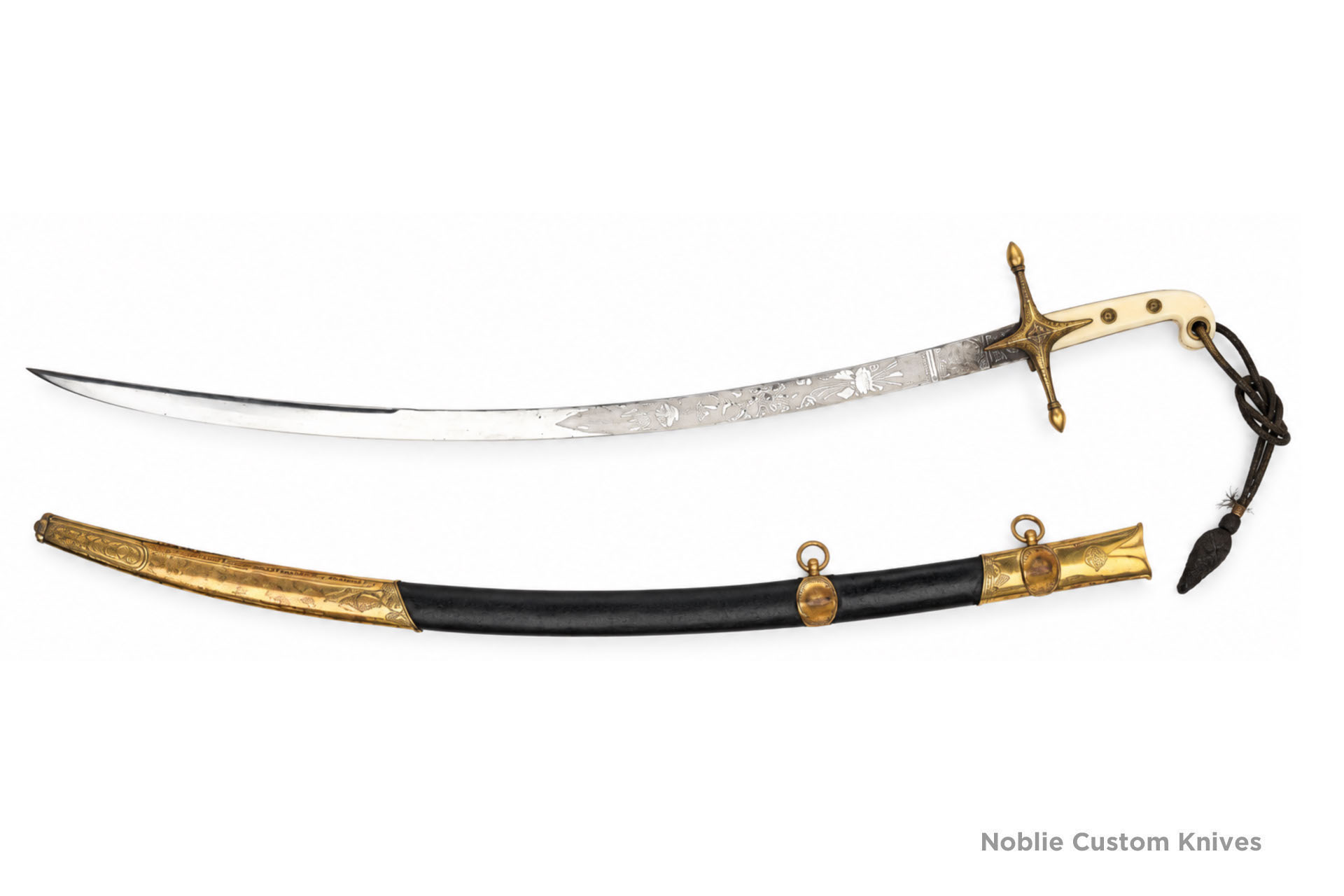
Quick definition: The karabela is a Polish sabre type associated with the Polish-Lithuanian Commonwealth, recognized by its curved blade, open crossguard, and distinctive hilt often shaped with a bird-head or eagle-head profile.
Region: Poland, Lithuania, and the Polish-Lithuanian Commonwealth
Era: mainly 17th–18th century
Blade type: curved sabre blade, often influenced by Ottoman, Persian, Hungarian, or Eastern European sabre forms
Edge: single-edged, often with a sharpened false edge near the tip on some examples
Typical blade length: often about 29–34 in (74–86 cm), depending on example
Use: noble sidearm, cavalry and infantry weapon, dress sabre, status display, ceremonial carry
The karabela is one of the most recognizable Polish sabres because of its hilt. The grip often ends in a stylized bird-head or eagle-head shape, giving the weapon a profile very different from a standard military cavalry sabre. Many karabelas were richly decorated, especially those worn with noble dress, but the form could still be functional rather than purely ceremonial.
In the Polish-Lithuanian Commonwealth, the sabre was more than a battlefield weapon. It became part of noble identity, clothing, ceremony, and social rank. For identification, look for the curved single-edged blade, open crossguard, bird-head style pommel, decorative grip scales, and Polish or Commonwealth context. It should not be grouped with Middle Eastern swords simply because it reflects Eastern sabre influence.
The watered Turkish and Hungarian steel behind a karabela's edge belongs to the wider crucible-steel family — read more in our types of Damascus steel overview.
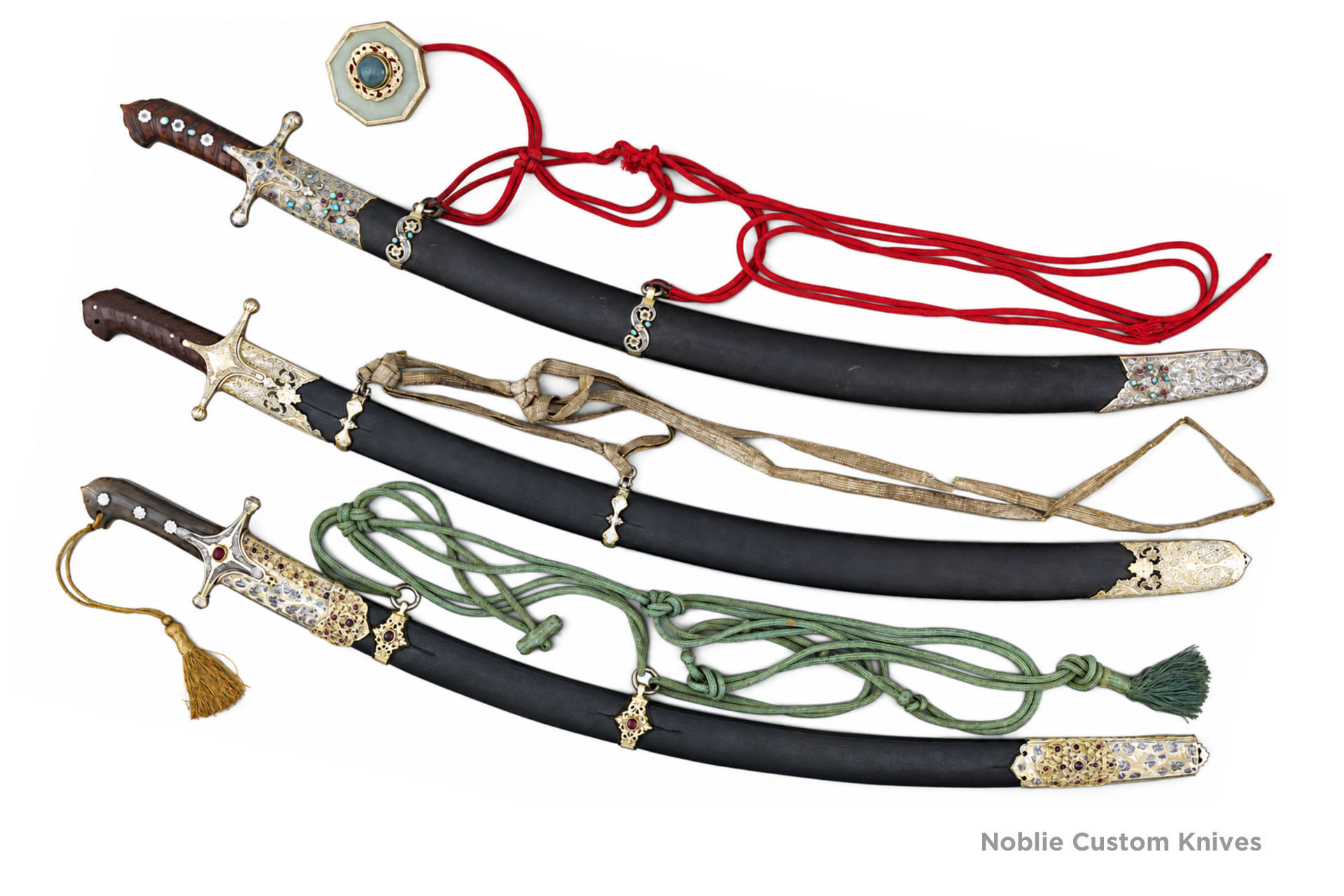
Quick definition: The szabla is the Polish sabre tradition: a curved single-edged sword used by cavalry, nobles, officers, and soldiers, especially in the Polish-Lithuanian Commonwealth and later Polish military culture.
Region: Poland, Lithuania, and Eastern Europe
Era: mainly 16th–19th century, with later ceremonial and military descendants
Blade type: curved sabre blade with regional and military pattern variations
Edge: single-edged, often with a false edge near the point on some forms
Typical blade length: often about 30–35 in (76–89 cm), depending on type and period
Use: cavalry combat, noble sidearm, officer sword, military dress, cutting and thrusting
The Polish szabla is not one single narrow pattern. It is a broader sabre tradition that includes several forms used by nobles, cavalrymen, officers, and soldiers. Some examples were richly decorated and worn as part of noble dress, while others were practical military weapons built for mounted and foot combat.
Polish sabres often show influence from Ottoman, Hungarian, Tatar, and broader Eastern European blade culture, but they developed a strongly local identity. In use, the szabla favored fast cuts, draw cuts, and mobile fencing rather than the straight thrusting mechanics of a rapier or small sword. For identification, look for the curved single-edged blade, Polish or Commonwealth context, protective hilt forms, and a role tied to cavalry, nobility, or officer service.
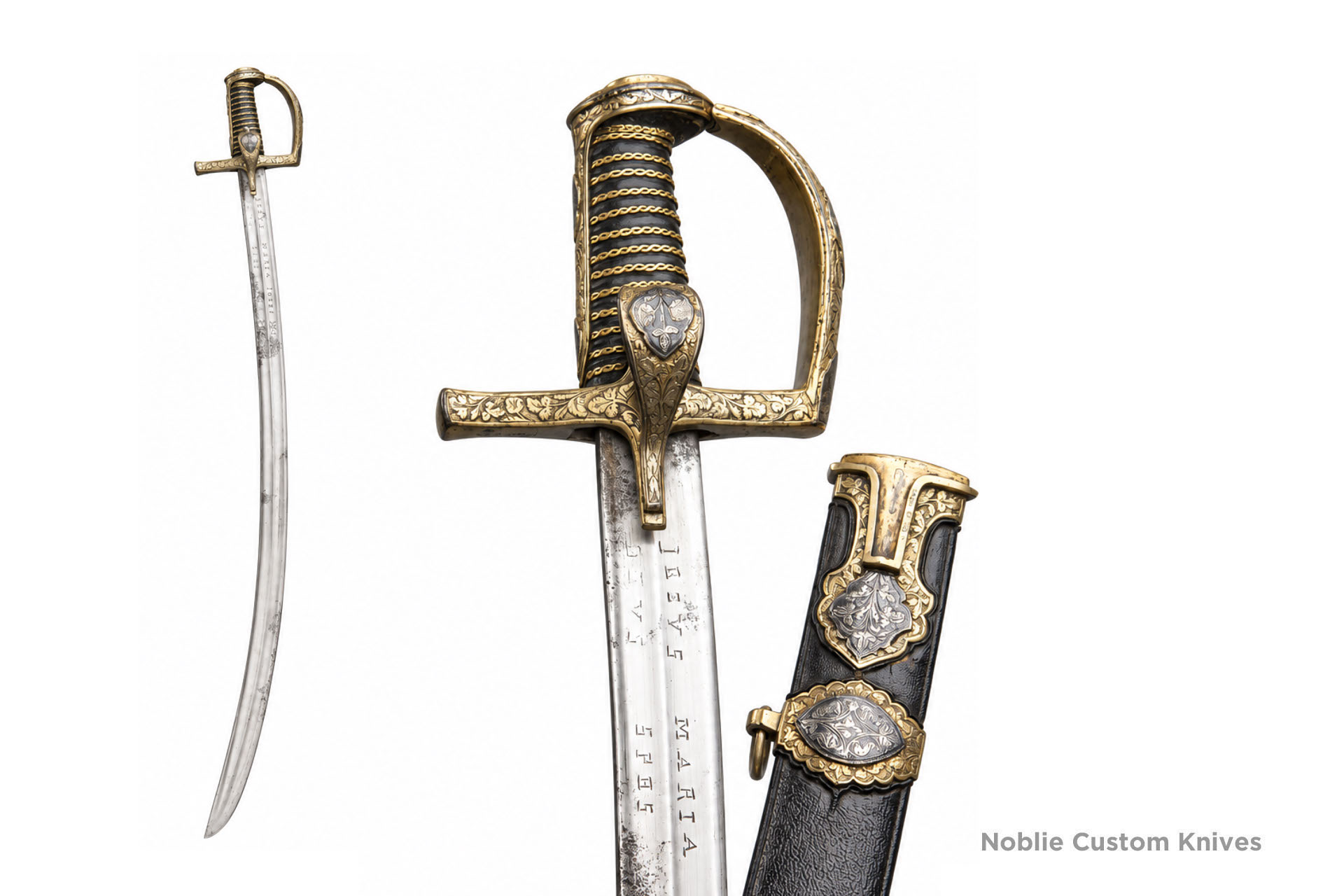
Quick definition: The naval cutlass is a short military sword used by sailors and naval forces, designed for close-quarters shipboard fighting, boarding actions, and practical cutting work in cramped spaces.
Region: European and American naval traditions, especially Britain, France, and the United States
Era: mainly 18th–19th century, with regulation naval patterns continuing into the early 20th century
Blade type: short straight or slightly curved blade, usually broad and rugged
Edge: usually single-edged, sometimes with a false edge or spear-like point depending on pattern
Typical blade length: often about 24–29 in (61–74 cm), depending on national pattern
Use: naval boarding, shipboard close combat, deck fighting, utility cutting, enlisted sailor sidearm
The naval cutlass was built for the physical reality of ships. A long cavalry sabre or rapier would be awkward on a crowded deck, belowdecks, or during boarding actions. The cutlass solved that problem with a short, tough blade and a protective guard that helped shield the hand in chaotic close-range fighting.
The form overlaps with the hanger sword, but the naval cutlass is more strongly tied to sea service, sailors, boarding parties, and regulation naval patterns. Some examples are slightly curved and saber-like, while others are straighter and more utilitarian. For identification, look for the compact blade, broad guard or bowl-like hand protection, naval context, and a practical design built for confined spaces rather than formal dueling.

Naval cutlass with short blade, protective guard, and compact shipboard fighting profile
East Asian swords include straight double-edged blades, curved single-edged sabers, Japanese long and short swords, Korean military sidearms, and training weapons used in martial arts. The main differences come from blade curvature, edge type, mounting style, battlefield role, social status, and the development of formal fencing and martial traditions.
This section covers Chinese, Japanese, and Korean sword types. Chinese sword traditions are often divided between the straight double-edged jian and the single-edged dao; Japanese swords developed from early straight forms into curved tachi, katana, wakizashi, and battlefield variants; Korean swords include ring-pommel prestige weapons, officer swords, and large two-handed forms.
Chinese swords are usually grouped into two major families: the jian, a straight double-edged sword, and the dao, a single-edged saber or cutting sword. The jian is strongly associated with precision, status, and martial refinement, while the dao became the more common military cutting weapon in many later periods.

Quick definition: The jian is a Chinese straight double-edged sword, traditionally associated with precision, thrusting, controlled cutting, elite status, and refined martial practice.
Region: China and wider Chinese-influenced martial traditions
Era: ancient China through imperial and modern martial arts contexts
Blade type: straight balanced blade, often diamond-section or lenticular in cross-section
Edge: double-edged
Typical blade length: often about 24–32 in (61–81 cm), depending on period, function, and mounting
Use: thrusting, controlled cuts, officer or elite sidearm, martial arts practice, ceremonial and status display
The jian is one of the central sword forms of China. Unlike the single-edged dao, the jian has two sharpened edges and a straight blade, making it suitable for precise thrusts, short cuts, deflections, and point control. Its handling is usually more refined than brute-force chopping, which is why it became strongly associated with skilled martial use and gentlemanly status.
In identification, the key features are the straight symmetrical blade, double edge, compact guard, balanced hilt, and Chinese cultural context. A jian should not be confused with a dao: the jian belongs to the straight double-edged tradition, while the dao is the single-edged saber family that became more common in many military settings.
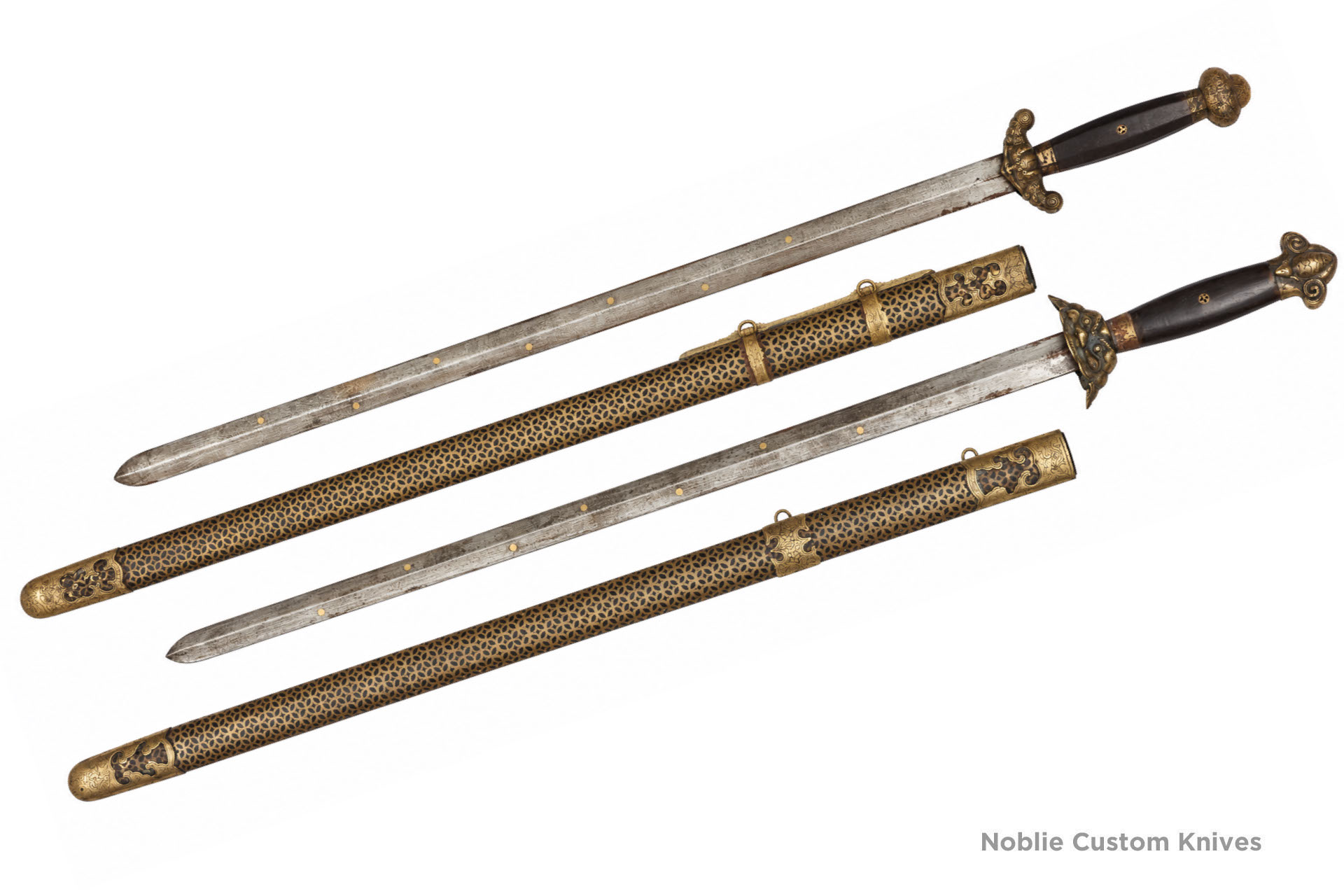
Quick definition: The shuangshou jian is a Chinese two-handed straight sword with a long double-edged blade and extended grip, built for greater reach, leverage, and controlled cut-and-thrust use than a standard one-handed jian.
Region: China
Era: historical Chinese military and martial traditions, with examples and reconstructions associated especially with later imperial periods
Blade type: long straight blade with two-handed grip
Edge: double-edged
Typical blade length: varies widely; generally longer than a standard one-handed jian
Use: two-handed cut-and-thrust work, battlefield reach, martial training, controlled slicing and thrusting techniques
The shuangshou jian keeps the straight double-edged identity of the jian but changes the handling system. The extended grip allows both hands to drive the blade, giving the weapon more reach, stronger edge control, and better leverage in cuts, thrusts, and deflections. It is not simply a larger dress sword; the two-handed format changes how the weapon moves.
For identification, look for a straight symmetrical blade, double edges, Chinese jian-style geometry, and a grip long enough for two hands. Compared with a regular jian, the shuangshou jian has more battlefield scale and leverage. Compared with the dao family, it remains part of the straight double-edged sword tradition rather than the single-edged saber tradition.
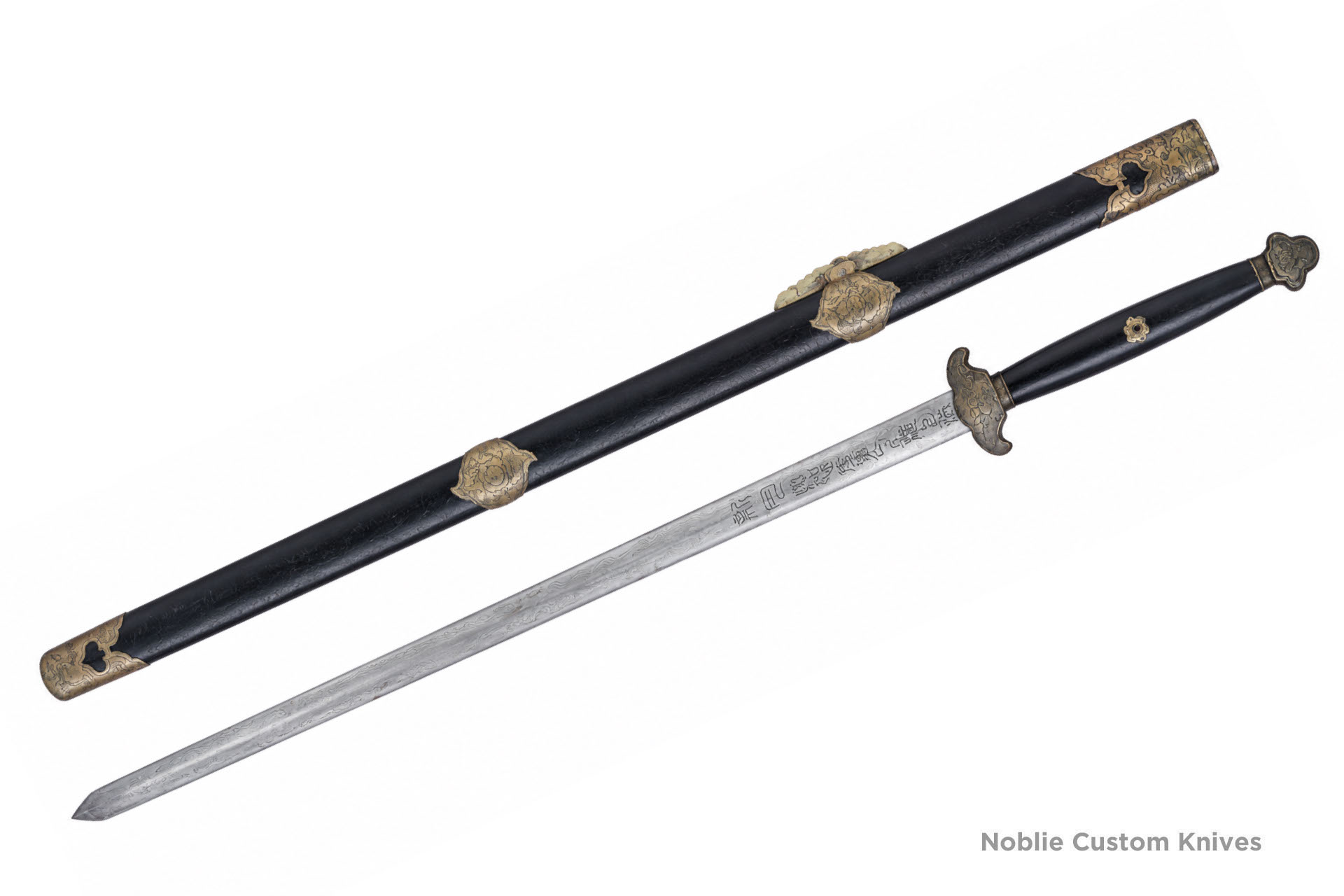
Quick definition: The dao is the Chinese single-edged sword or saber family, covering many straight, slightly curved, and deeply curved cutting weapons used in warfare, self-defense, martial arts, and ceremonial contexts.
Region: China and Chinese-influenced martial traditions
Era: ancient China through imperial, Republican, and modern martial arts contexts
Blade type: single-edged cutting blade; straight, slightly curved, or saber-like depending on subtype
Edge: single-edged, often with a false edge near the point on some forms
Typical blade length: varies widely; many one-handed forms sit around 24–34 in (61–86 cm)
Use: military cutting, cavalry and infantry use, self-defense, martial arts training, ceremonial display
The dao is often called the Chinese saber, but that shorthand can hide how broad the family really is. Some dao forms are fairly straight, while others curve like cavalry sabers. Common historical and martial categories include the yanmaodao, liuyedao, niuweidao, dadao, and other regional or period-specific cutting swords.
Compared with the jian, the dao is usually more cut-oriented and more common in military settings. Its single edge allows a thicker spine, stronger chopping geometry, and simpler maintenance under hard use. For identification, look for one sharpened edge, Chinese mounting style, a cutting-biased blade profile, and a practical martial role distinct from the straight double-edged jian.
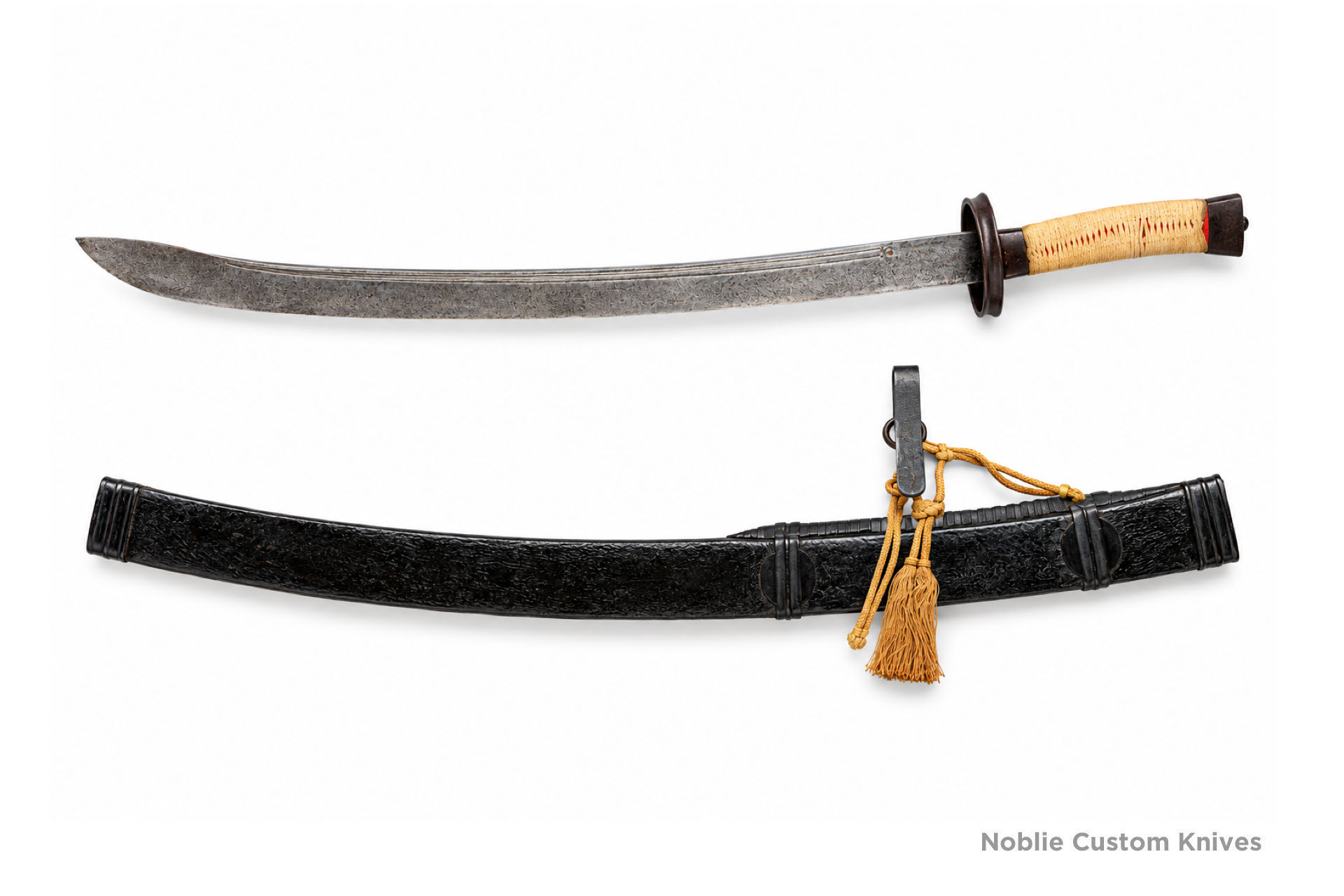
Quick definition: Butterfly swords are paired Chinese short swords from the dao family, usually built with broad single-edged blades, compact grips, and protective D-shaped guards for close-range cutting, trapping, and martial arts use.
Region: China, especially southern Chinese martial traditions
Era: Qing period through modern martial arts practice
Blade type: short broad dao-style blade, normally used as a pair
Edge: single-edged, sometimes with a short sharpened false edge near the point
Typical blade length: often about forearm length, commonly shorter than full-size dao swords
Use: close-range cutting, trapping, deflection, paired-weapon forms, southern Chinese martial arts
Butterfly swords are not the same thing as a modern folding butterfly knife or balisong. In Chinese arms terminology, they are paired short swords, often carried together in one scabbard and drawn as a matched set. Their compact length makes them useful at close distance, where a full-length saber would be harder to maneuver.
The broad blades can cut, thrust, and deflect, while the guards help protect the hand and support trapping actions. Butterfly swords are especially associated with southern Chinese systems, including Wing Chun and related martial traditions. For identification, look for two matching short single-edged blades, D-shaped hand guards, compact grips, and a paired fighting method rather than a single long battlefield sword.
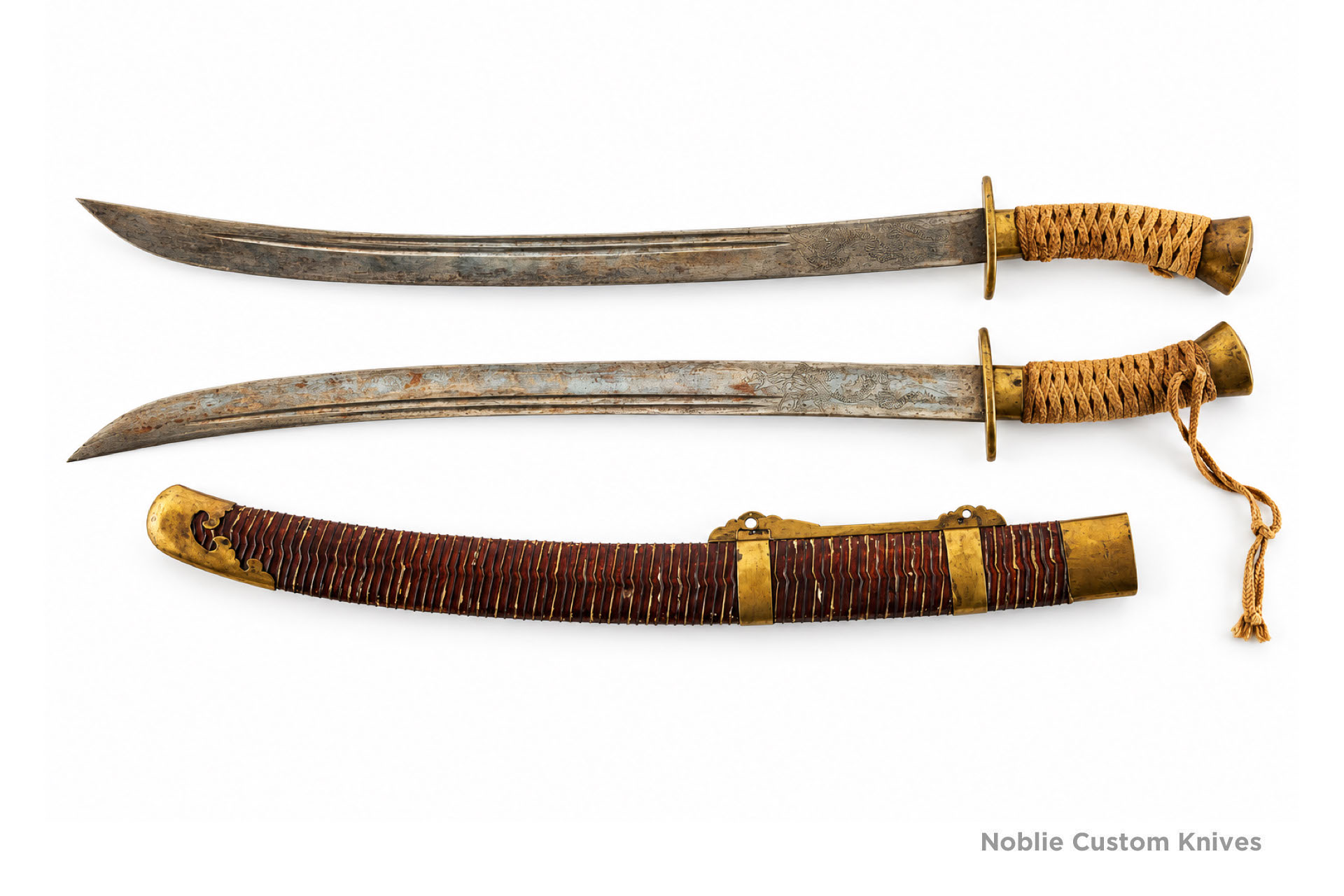
Quick definition: Hook swords, or shuang gou, are paired Chinese martial weapons with hooked blade tips, crescent-shaped hand guards, sharpened outer edges, and pointed pommels used for trapping, cutting, linking, and deflecting.
Region: China, especially northern Chinese martial arts traditions
Era: mainly associated with later imperial and modern martial arts practice
Blade type: straight blade with hooked tip, crescent guard, and pointed pommel
Edge: usually sharpened along the outer blade edge; functional edges vary by example and training form
Typical length: often about 30–40 in (76–102 cm), depending on form and school
Use: paired-weapon forms, trapping, hooking, deflection, linking techniques, martial arts demonstration and training
Hook swords are among the most visually unusual Chinese sword-like weapons. Their hooked tips can catch, redirect, or link with the opposite weapon, while the crescent guards protect the hand and can also be used offensively at close range. The pointed pommel gives the weapon another striking or thrusting surface, making the overall design more complex than a standard dao or jian.
They should be treated carefully in a historical sword guide because many surviving associations come from martial arts practice rather than clear battlefield standardization. For identification, look for the paired format, long straight bodies, hooked ends, crescent guards, and spike-like pommels. Unlike the jian or dao, the hook sword is defined by specialized control and trapping mechanics rather than simple cutting or thrusting geometry.
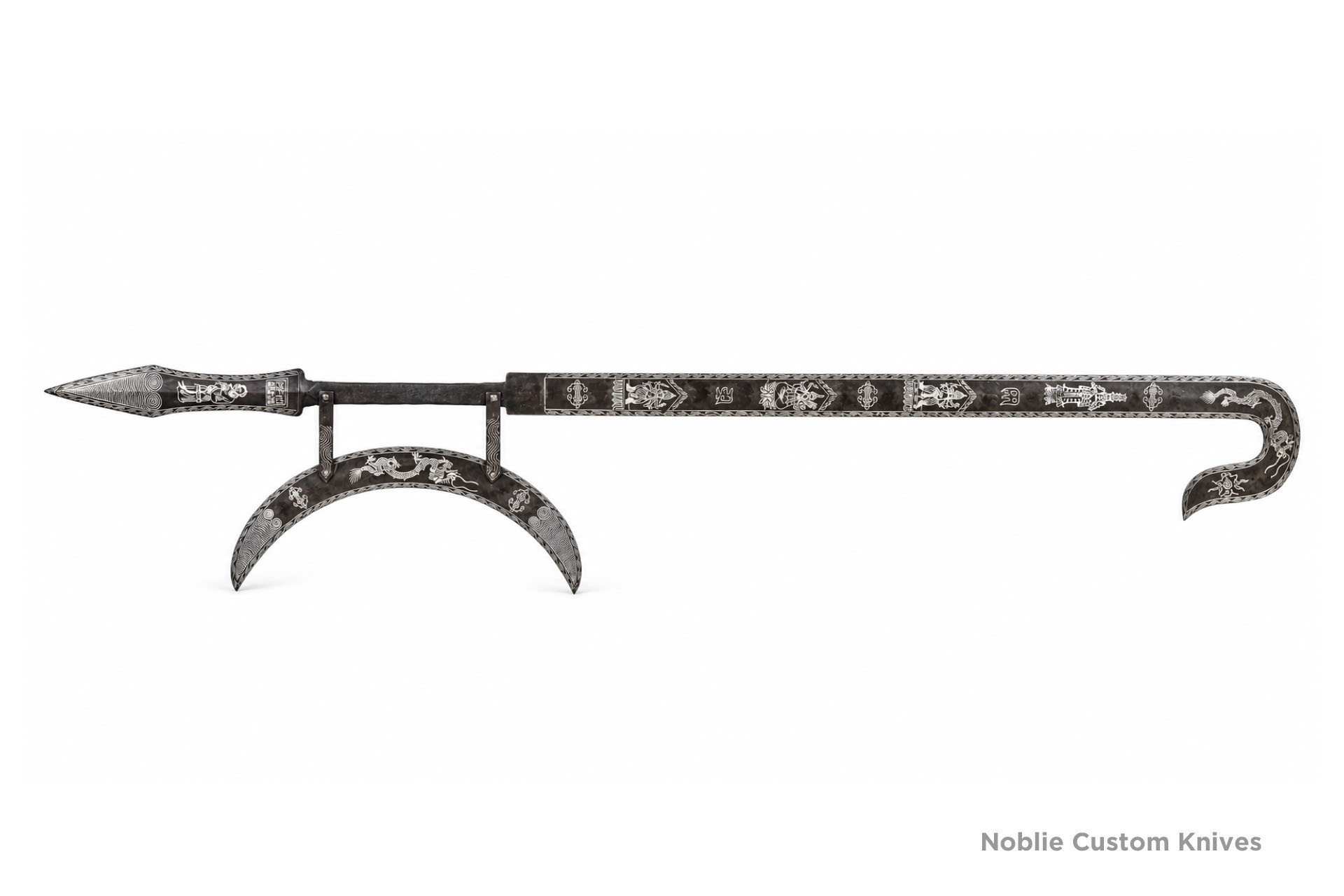
Japanese swords developed from early straight blades into the curved single-edged forms most people now associate with samurai arms. The main differences between Japanese sword types come from blade curvature, mounting style, wearing position, battlefield role, period, and whether the weapon was made for war, personal carry, ceremony, or martial training.
This section begins with early straight swords such as the tsurugi and chokutō, then moves into tachi, katana, wakizashi, battlefield variants, military guntō, concealed swords, and training weapons.
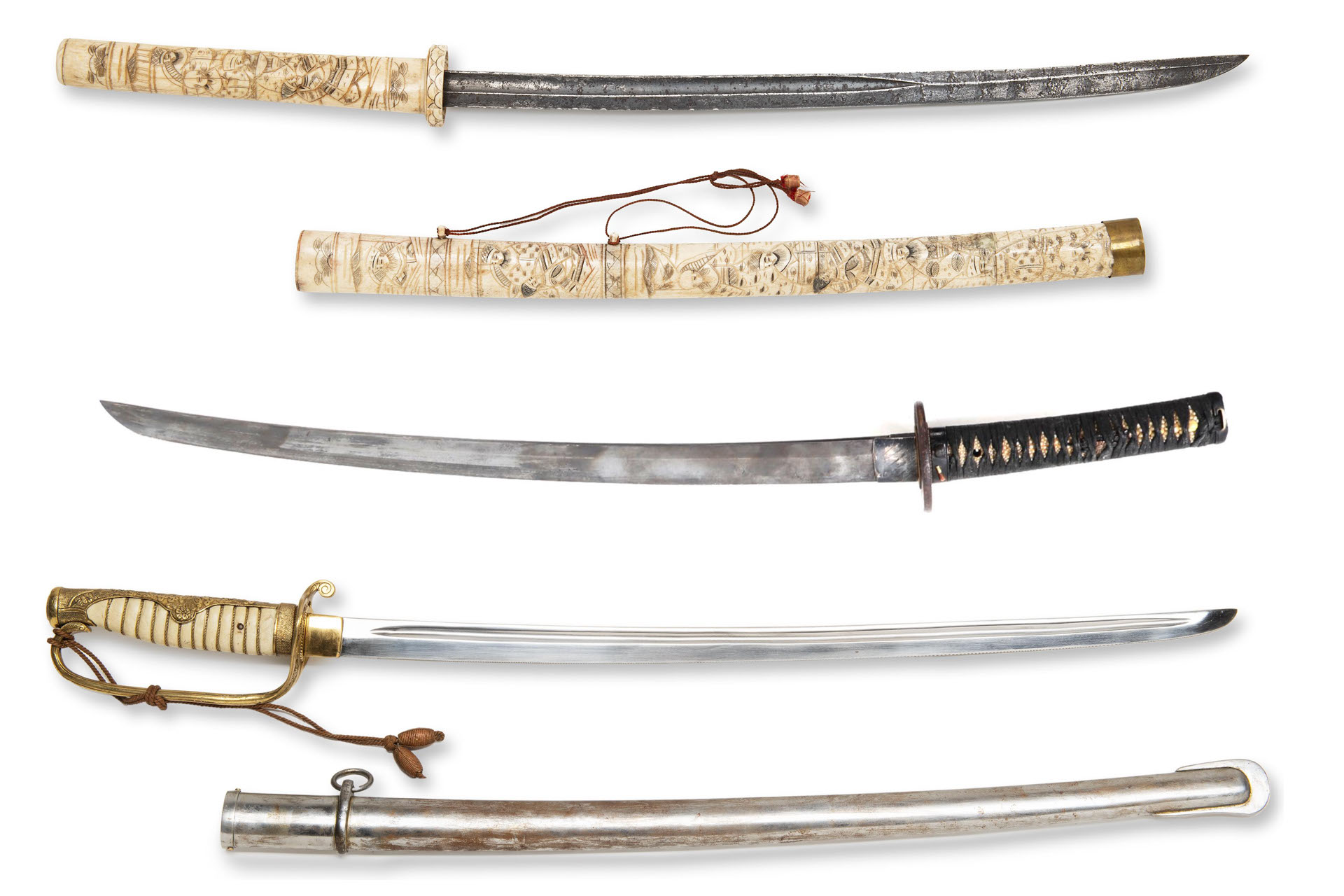
Quick definition: The tsurugi, also called ken, is an early Japanese straight double-edged sword, older in form than the curved single-edged tachi and katana.
Region: Japan, with strong influence from ancient Chinese and continental sword forms
Era: early Japanese antiquity, especially Kofun-period and earlier straight-sword contexts
Blade type: straight symmetrical blade
Edge: double-edged
Typical length: varies widely; surviving examples include short and full sword-length forms
Use: early weapon, prestige object, ritual sword, burial object, later religious and ceremonial symbolism
The tsurugi belongs to a much older phase of Japanese sword history than the katana. Its straight double-edged blade reflects continental influence before the single-edged curved Japanese sword became dominant. Because both edges are sharpened, the tsurugi is closer in geometry to a Chinese jian than to a tachi, uchigatana, or katana.
In later Japanese culture, the ken or tsurugi also gained strong ritual and symbolic meaning. Straight double-edged swords appear in religious contexts, mythology, and ceremonial objects, while practical Japanese battlefield swords moved toward single-edged curved forms. For identification, look for a straight symmetrical blade, two cutting edges, early Japanese context, and a shape that lacks the curvature and mounting style of later samurai swords.
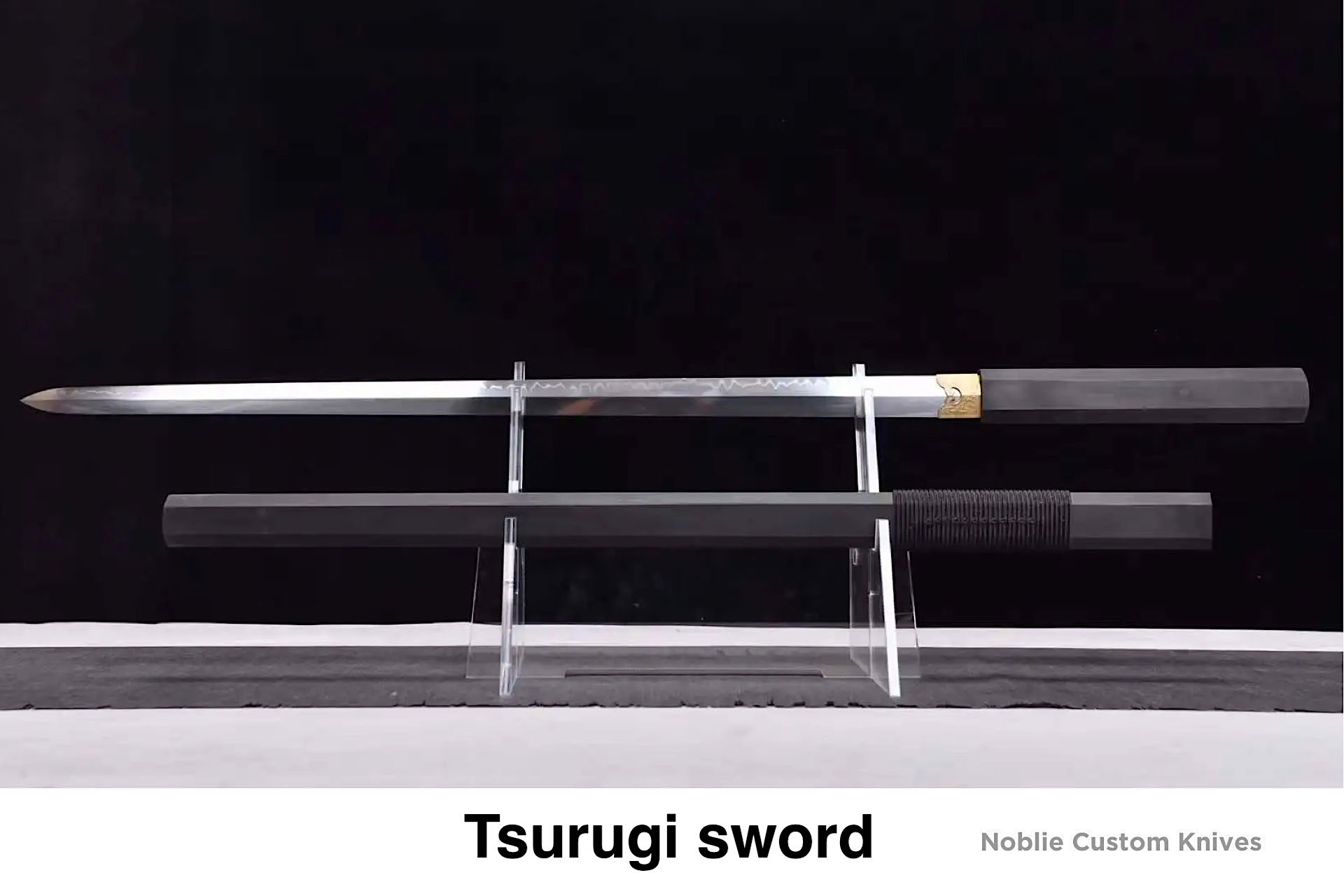
Quick definition: The chokutō is an early Japanese straight single-edged sword, used before the curved tachi and katana became the dominant forms of Japanese sword design.
Region: Japan, with influence from continental East Asian sword traditions
Era: mainly Kofun, Asuka, and Nara-period contexts, before the widespread rise of curved Japanese swords
Blade type: straight blade
Edge: usually single-edged
Typical length: varies widely; many examples fall within short sword to full sword range
Use: early military weapon, prestige object, burial sword, court or ceremonial weapon
The chokutō belongs to the early straight-blade phase of Japanese sword history. Unlike the later tachi and katana, it does not have the pronounced curvature now associated with samurai swords. Its straight profile reflects older continental influence and a period before Japanese swordsmiths fully developed the curved, differentially hardened blade forms that became central to later sword culture.
For identification, look for a straight single-edged blade, early Japanese context, and a mounting style that feels older and less specialized than later samurai swords. The chokutō should not be confused with the tsurugi or ken, which are straight and double-edged. It is also not an early katana: it belongs to the pre-curved sword tradition that came before the mature tachi, uchigatana, and katana lineages.
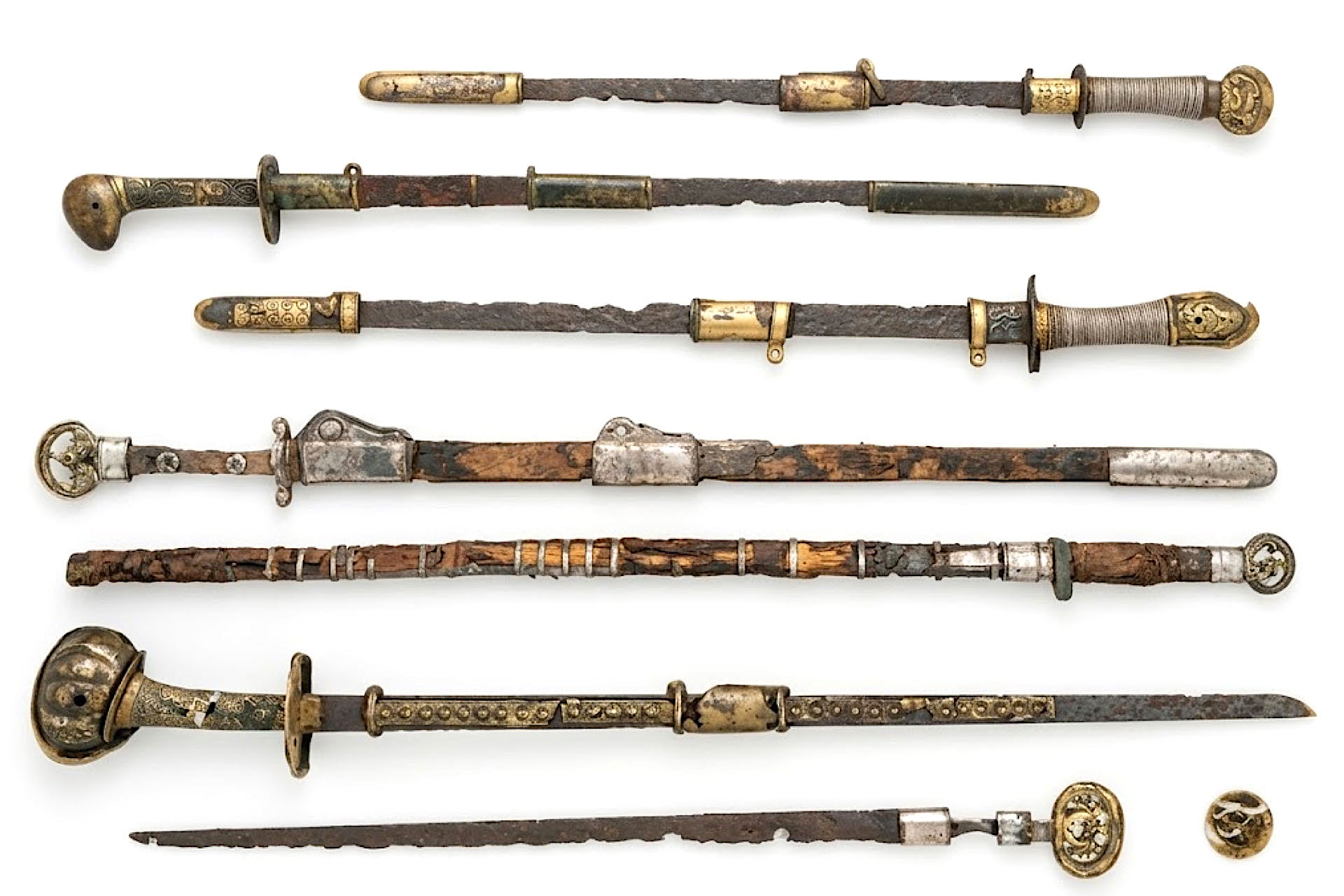
Quick definition: The kenukigata tachi is an early Japanese tachi form, recognized by its distinctive open hilt design and its position between ancient straight swords and the fully developed curved Japanese sword tradition.
Region: Japan
Era: Heian period, especially early curved Japanese sword development
Blade type: early curved tachi-style blade
Edge: single-edged
Typical length: varies; surviving examples can reach full tachi length
Use: elite weapon, ceremonial sword, court or shrine-associated object, prestige display
The kenukigata tachi is important because it belongs to the formative stage of the Japanese sword. It is not yet the familiar katana, but it already points toward the curved single-edged blade tradition that later defined tachi, uchigatana, and katana development. The name refers to the distinctive open hilt form, often described as resembling the shape of tweezers.
For identification, look for an early Japanese tachi context, a single-edged curved blade, and the unusual open hilt construction. Unlike the chokutō, it is not a straight ancient blade. Unlike the later katana, it belongs to the older tachi world of slung swords, aristocratic display, shrine treasures, and early samurai-era weapon evolution.
Quick definition: The tachi is a traditional Japanese curved single-edged sword, generally older than the katana, worn suspended from the belt with the cutting edge facing downward.
Region: Japan
Era: mainly late Heian through Muromachi period, before the katana became the dominant samurai sidearm
Blade type: curved Japanese long sword, often with deeper curvature than later katana forms
Edge: single-edged
Typical blade length: often about 27–32 in (69–81 cm), with variation by period and school
Use: mounted combat, samurai warfare, elite carry, ceremonial mounting, slashing cuts from horseback
The tachi is one of the key ancestors of the later katana. Its curved blade was well suited to cutting from horseback, where a draw or passing cut benefits from reach, curvature, and edge alignment. Compared with many later katana, older tachi often show more pronounced curvature and were mounted for suspended carry rather than being thrust through the belt.
The easiest way to identify a tachi is by its mounting and wearing style. A tachi is traditionally worn edge-down from hangers, while a katana is worn edge-up through the obi. Some old tachi blades were later remounted as katana, which can make classification difficult. For identification, look for the Japanese curved single-edged blade, older sword-making context, edge-down suspension, and a stronger connection to mounted samurai warfare than to later urban katana carry.
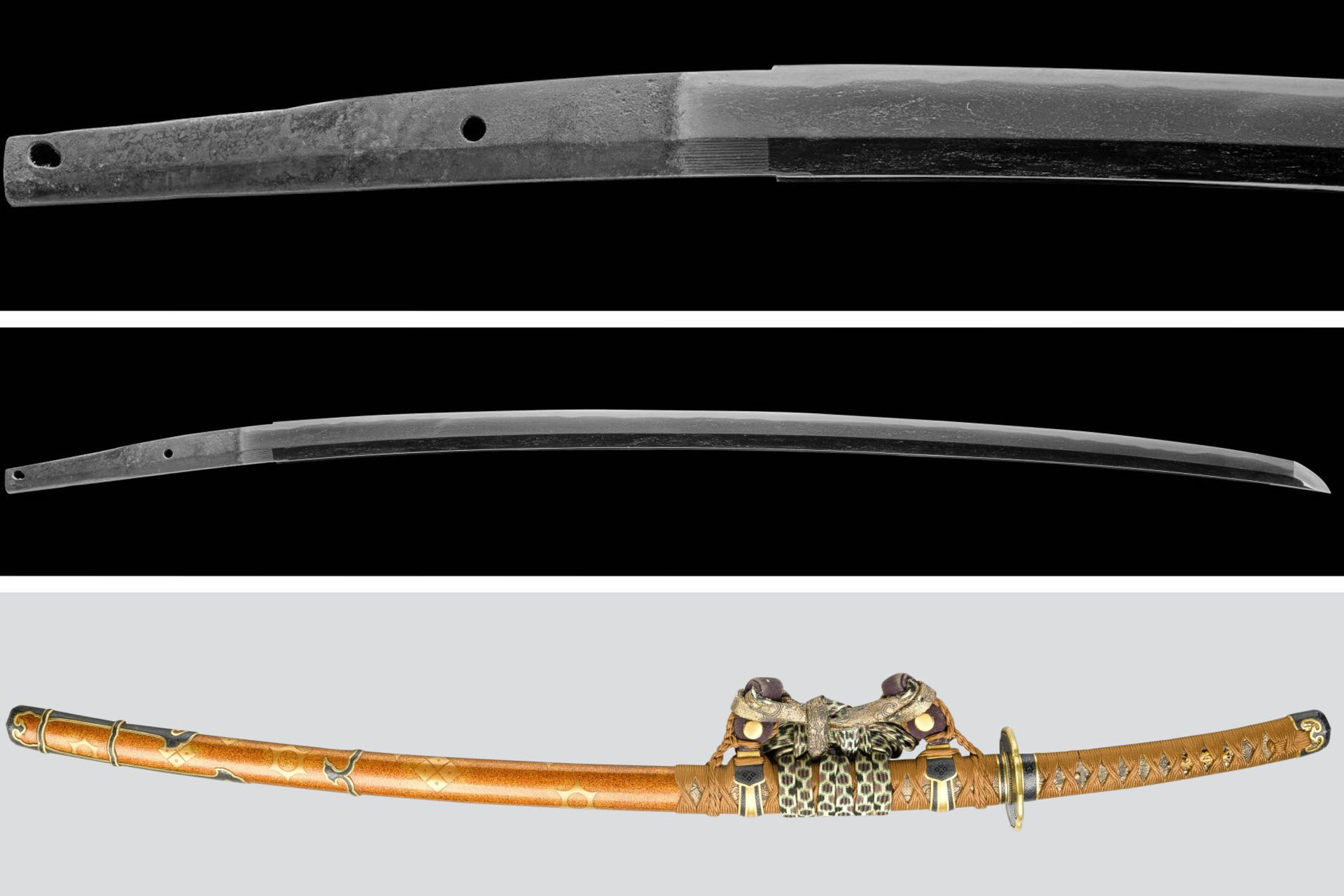
Quick definition: The kodachi is a short Japanese sword, literally a “small tachi,” with a curved single-edged blade shorter than a full tachi or katana but longer and more sword-like than many knives or daggers.
Region: Japan
Era: mainly medieval Japanese sword contexts, especially before the wakizashi became the more familiar short companion sword
Blade type: short curved Japanese blade, often tachi-like in mounting and character
Edge: single-edged
Typical blade length: usually short-sword length; often below full katana or tachi size, with variation by example
Use: close-range sidearm, companion sword, personal defense, short sword carry
The kodachi is best understood as a short tachi-type sword rather than simply a small katana. Its identity comes from both size and mounting style. While a full tachi was a long sword associated with mounted samurai warfare, the kodachi offered a more compact blade for situations where a long sword was less convenient.
It should not be automatically treated as the same thing as a wakizashi. The wakizashi became strongly associated with the later daishō pairing and Edo-period samurai carry, while the kodachi belongs more naturally to the older tachi vocabulary. For identification, look for a short curved single-edged Japanese blade, tachi-like character, and a length clearly below a full long sword.
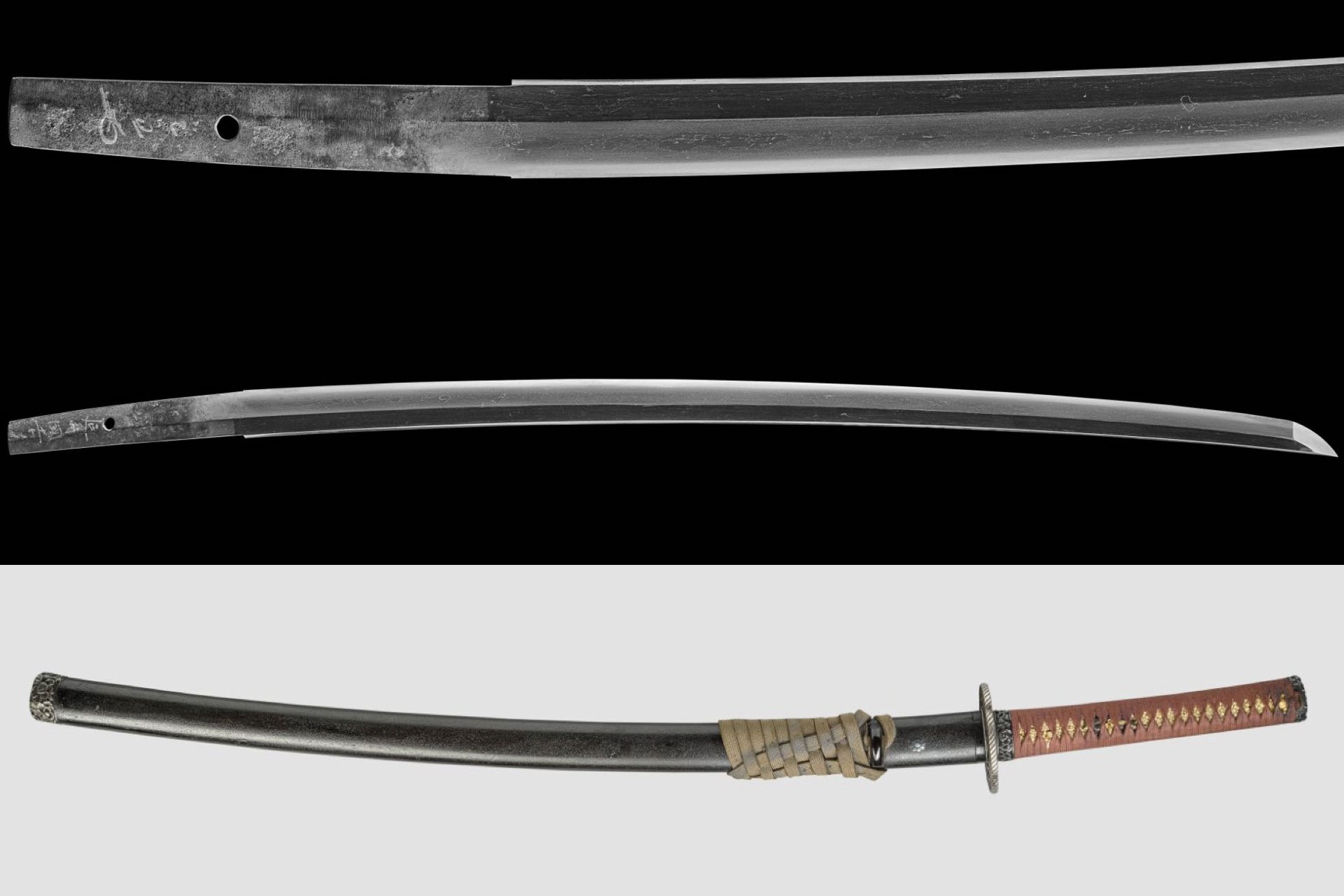
Quick definition: The ōdachi, also called nodachi in many contexts, is an oversized Japanese long sword with a curved single-edged blade, usually much larger than a standard tachi or katana.
Region: Japan
Era: mainly medieval Japanese warfare, especially Kamakura through Muromachi-period contexts, with later ceremonial and shrine examples
Blade type: very long curved Japanese blade
Edge: single-edged
Typical blade length: often above about 35.8 in / 90.9 cm, though definitions vary
Use: battlefield reach, open-field combat, anti-cavalry or formation use in some interpretations, ceremonial display, shrine dedication
The ōdachi is best understood as the large-sword end of the Japanese tachi tradition. It keeps the curved single-edged geometry of Japanese long swords, but scales the weapon up dramatically. That extra length gives reach and cutting authority, but it also makes drawing, carrying, and close handling more difficult than with a katana or standard tachi.
The terms ōdachi and nodachi are often used loosely, so identification should focus on size, blade form, and context rather than one rigid label. For classification, look for an oversized curved Japanese blade, long two-handed grip, battlefield or ceremonial scale, and proportions clearly beyond a normal katana. It should not be confused with the nagamaki, which has a long blade but is defined by its extended polearm-like handle construction.
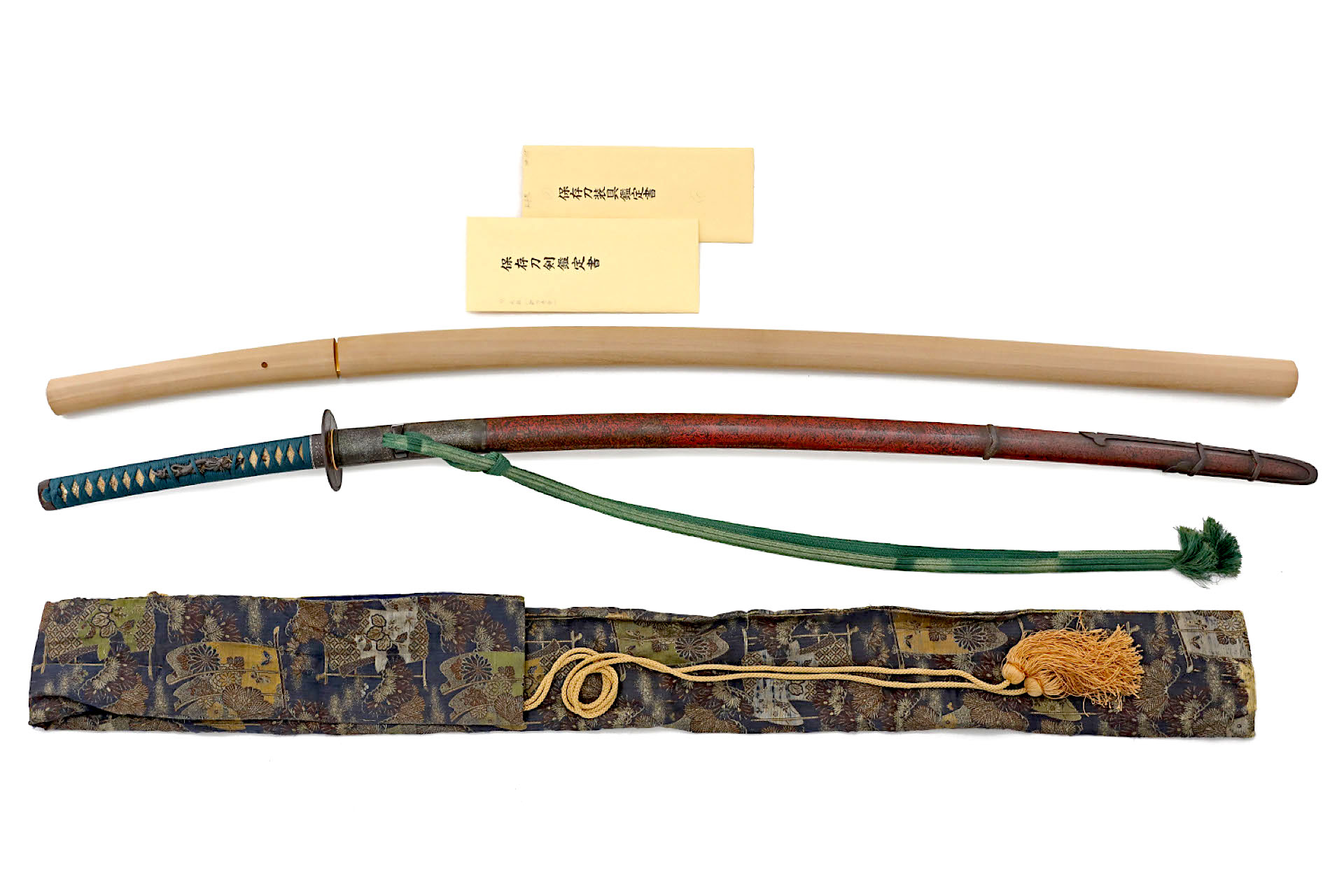
Quick definition: The nagamaki is a Japanese long-handled sword with a curved single-edged blade and an extended wrapped grip, sitting between the long sword and polearm worlds in both appearance and use.
Region: Japan
Era: medieval Japan, with documented Kamakura-period examples
Blade type: curved Japanese blade with an unusually long handle
Edge: single-edged
Typical length: varies widely; many examples are defined more by blade-to-handle proportion than by one fixed measurement
Use: battlefield cutting, two-handed leverage, reach control, anti-cavalry or open-field use in some interpretations, later ceremonial or preserved weapon context
The nagamaki is defined by its long handle as much as by its blade. Unlike a standard katana or tachi, the grip is extended dramatically, giving the user two-handed leverage and a different cutting rhythm. The result is a weapon that can deliver powerful sweeping cuts while still retaining the identity of a Japanese bladed weapon rather than becoming a simple spear or staff weapon.
It should not be confused with the ōdachi or nodachi. The ōdachi is primarily defined by its oversized blade; the nagamaki is defined by the long wrapped handle and the relationship between blade and grip. It should also be separated from the naginata, which is more clearly a polearm with a sword-like blade mounted on a long shaft. For identification, look for the curved single-edged blade, extended wrapped grip, Japanese mounting style, and proportions that place it between sword and polearm categories.
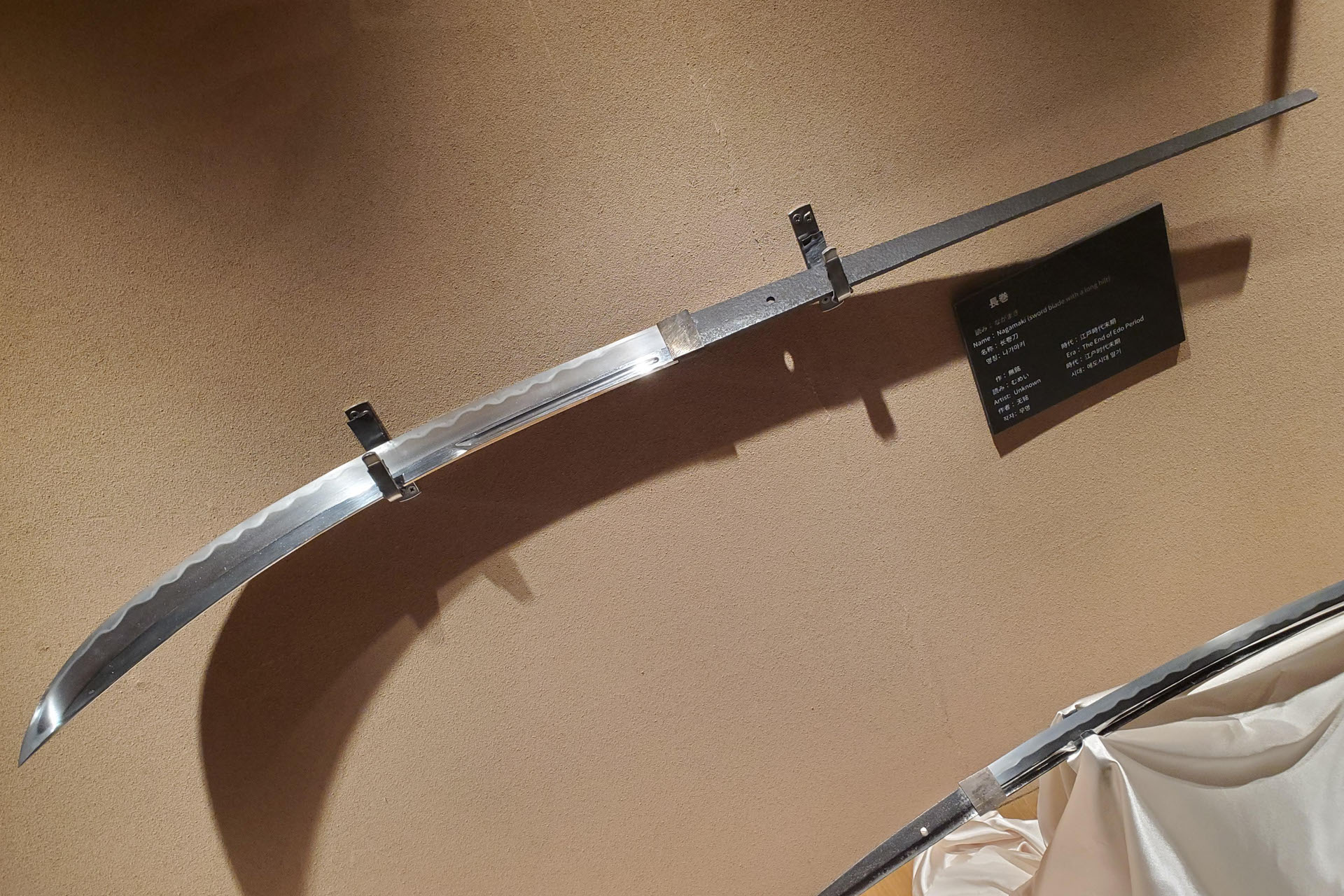
Quick definition: The uchigatana is a Japanese curved single-edged sword worn edge-up through the belt, historically important as the mounting and carry style that led toward the classic katana.
Region: Japan
Era: late medieval Japan, especially from the Muromachi period onward, with earlier rare forms documented
Blade type: curved Japanese sword blade, generally shorter and more belt-carried than earlier long tachi
Edge: single-edged
Typical blade length: varies; later katana-style examples are commonly over 60 cm cutting-edge length
Use: samurai sidearm, quick draw, close combat, personal carry, transition from tachi to katana-style mounting
The uchigatana marks a major shift in Japanese sword use. Unlike the tachi, which was usually suspended edge-down, the uchigatana was worn thrust through the belt with the cutting edge facing upward. That carry method made the sword faster to draw and better suited to changing battlefield and urban combat conditions.
The term can be confusing because many later katana are fitted in uchigatana-style mountings. In practical classification, the uchigatana is the bridge between older tachi culture and the familiar katana. For identification, look for a curved single-edged Japanese blade, edge-up belt carry, shorter and more practical sidearm proportions, and mounting features distinct from the suspended tachi.
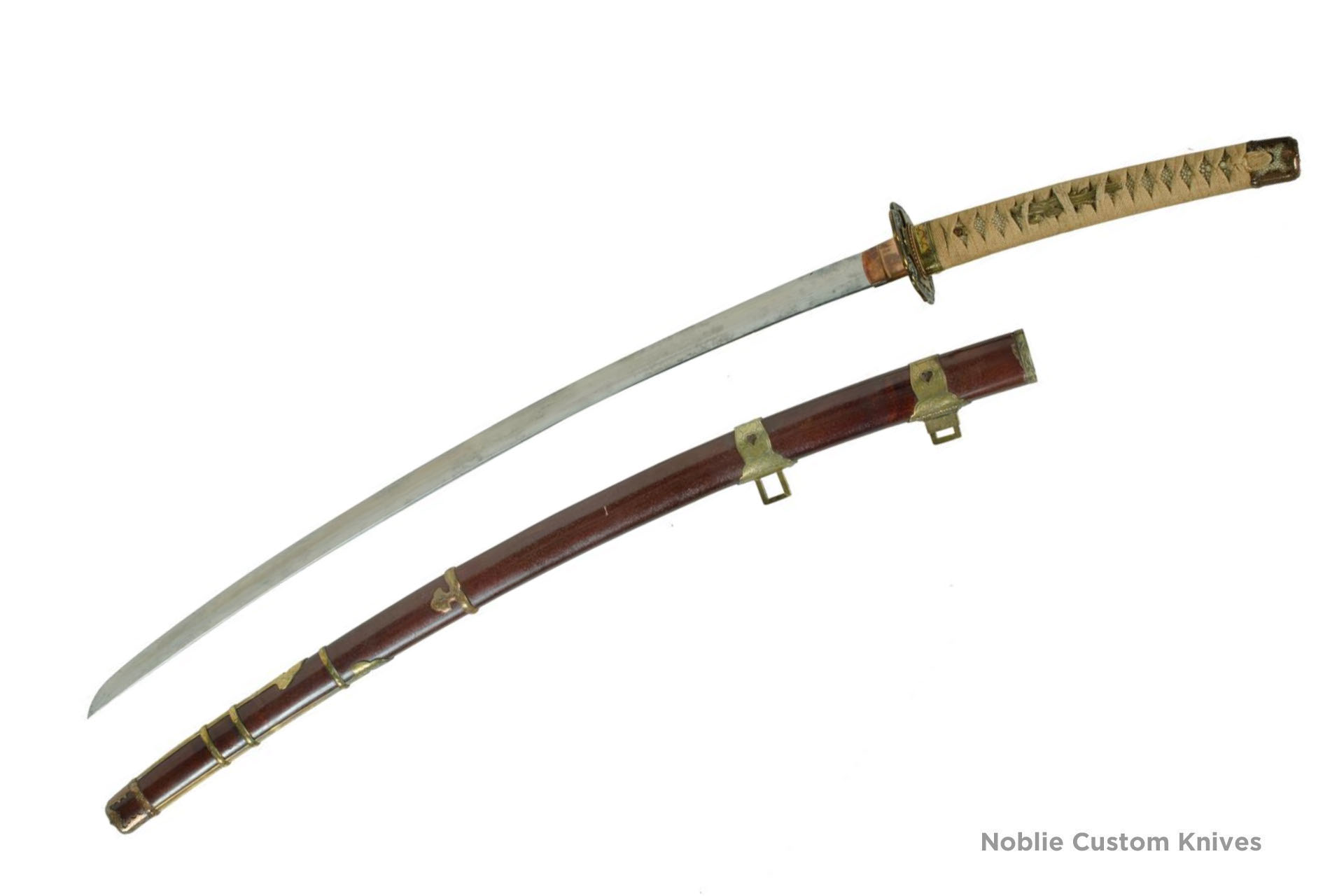
Quick definition: The katana is the classic Japanese curved single-edged long sword, worn edge-up through the belt and strongly associated with samurai sidearm carry from the late medieval period onward.
Region: Japan
Era: mainly Muromachi period onward, especially Momoyama and Edo-period samurai culture
Blade type: curved Japanese long sword with a ridged spine and single cutting edge
Edge: single-edged
Typical blade length: usually over 60 cm nagasa; many examples fall around 24–29 in (61–74 cm)
Use: samurai sidearm, cutting, drawing cuts, close combat, paired daishō carry with wakizashi, ceremonial and status display
The katana is the most widely recognized Japanese sword, but it should not be used as a generic label for every samurai blade. Its identity comes from the combination of a curved single-edged blade, edge-up belt carry, two-handed grip, tsuba guard, and mounting style developed from the uchigatana tradition. Compared with the older tachi, the katana is generally more closely tied to edge-up carry and faster draw-oriented use.
A traditional katana balances cutting geometry, point control, curvature, hardened edge structure, and mounting. Its reputation comes not from raw weight, but from efficient edge alignment, sharpness, handling, and the cultural role it held in samurai society. For identification, look for a curved single-edged blade over wakizashi length, a wrapped grip long enough for two hands, a tsuba, edge-up mounting, and a Japanese long-sword context distinct from tachi, kodachi, or guntō.
Noblie crafts katana to order in Damascus steel with traditional fittings — see our custom katana.

Katana — Japanese curved long sword worn edge-up and associated with samurai sidearm carry.

Quick definition: The wakizashi is a Japanese short sword with a curved single-edged blade, traditionally worn with the katana as the shorter companion sword in the samurai daishō pair.
Region: Japan
Era: mainly Muromachi through Edo period, especially associated with Edo-period samurai carry
Blade type: short curved Japanese sword blade
Edge: single-edged
Typical blade length: usually about 30–60 cm nagasa, shorter than a katana but longer than a tantō
Use: companion sword, indoor defense, close-quarters use, samurai status, daishō pairing, ceremonial carry
The wakizashi is best understood as the shorter partner to the katana. It was worn edge-up through the belt and often matched the katana in mounting style, creating the paired daishō that became a visible marker of samurai status. Its shorter length made it more practical indoors, in tight spaces, or when a full-length katana was inconvenient.
The wakizashi should not be confused with the kodachi. Both are short Japanese swords, but the wakizashi belongs more strongly to later samurai sidearm culture and the katana-wakizashi pairing. For identification, look for a curved single-edged blade shorter than a katana, Japanese mounting with tsuba and wrapped grip, edge-up carry, and a role as the short sword of the daishō rather than an older tachi-style short blade.
Quick definition: The shikomizue is a Japanese concealed sword mounted inside a plain walking-stick or cane-like scabbard, designed to hide the blade rather than display formal samurai fittings.
Region: Japan
Era: mainly Edo to Meiji-period contexts, with later reproductions and theatrical associations
Blade type: concealed sword blade, often straight or only slightly curved depending on example
Edge: usually single-edged, though blade construction varies
Typical blade length: varies widely; many examples fall between short sword and katana-length forms
Use: concealed carry, personal defense, disguise, travel weapon, later popular culture and theatrical use
The shikomizue differs from most Japanese sword types because its identity is based on concealment, not formal sword mounting. A katana, tachi, or wakizashi normally has visible fittings such as a tsuba, wrapped grip, and decorated scabbard. A shikomizue removes or hides those signals, presenting itself as a simple cane or walking stick.
For identification, look for a plain cane-like exterior, minimal or absent guard, and a blade hidden inside the shaft. It should not be classified as a standard katana simply because the blade may be Japanese. The shikomizue is best understood as a concealed sword format, with a very different social and practical role from open samurai carry, battlefield weapons, or ceremonial mountings.
Curious about concealed blades? Our custom dagger collection includes stilettos and dirks built in this same spirit of discretion and craft.
Quick definition: The Kyū Guntō is an early modern Japanese military sword, mainly associated with Meiji and early 20th-century officers, combining Western saber-style mounts with Japanese sword and tachi-style blade influence.
Region: Japan
Era: late 19th to early 20th century, before later Shin Guntō patterns became dominant
Blade type: military sword blade; sometimes traditionally made, sometimes machine-made, often mounted in Western-influenced officer fittings
Edge: usually single-edged
Typical blade length: varies; often close to katana-length military sword proportions
Use: officer sidearm, military dress sword, rank symbol, army or naval service weapon
The Kyū Guntō belongs to Japan’s modern military period, when the army and navy adopted sword forms that looked closer to European officer sabers than to older samurai mountings. The guard often includes a knucklebow or D-shaped protection, and the scabbard may be metal, lacquered, or otherwise adapted for uniformed military carry.
The blade can make classification tricky. Some Kyū Guntō mounts hold traditionally made Japanese blades, while others use more modern military blades. For identification, focus on the combination of Japanese military context, Western-style guard, officer fittings, metal or military scabbard, and the transitional look between samurai sword culture and modern imperial military dress. It should not be confused with the later Shin Guntō, which deliberately returned to a more traditional Japanese appearance.
Quick definition: The Shin Guntō is a Japanese military sword of the 1930s–1940s, designed to resemble traditional samurai swords while serving as an officer or NCO sidearm and rank symbol in Imperial Japanese military service.
Region: Japan
Era: Shōwa period, especially 1935–1945 wartime military production
Blade type: curved military sword blade, sometimes traditionally forged but often mass-produced or arsenal-made
Edge: usually single-edged
Typical blade length: often close to katana length, with variation by officer, NCO, and production type
Use: officer sidearm, NCO sword, rank symbol, military dress, wartime service weapon, ceremonial authority
The Shin Guntō was introduced after the Western-influenced Kyū Guntō and deliberately moved back toward a more traditional Japanese visual language. Instead of a European-style knucklebow, many Shin Guntō mounts use a tsuba, wrapped grip, menuki, military fittings, and a scabbard that echoes older samurai sword presentation while still belonging to a modern army system.
Classification depends heavily on the blade. Some Shin Guntō contain traditionally made Japanese blades, including older blades remounted for military service, while many wartime examples were arsenal-made or machine-assisted weapons. For identification, look for the Japanese military context, 1930s–1940s production, curved single-edged blade, army or naval fittings, wrapped grip, tsuba, rank-related details, and a more traditional appearance than the earlier Kyū Guntō.
Quick definition: The bokken, also called bokutō, is a Japanese wooden training sword shaped after a real sword, used in martial arts practice instead of a sharpened steel blade.
Region: Japan
Era: historical and modern Japanese martial arts training
Blade type: solid wooden training blade, usually shaped like a katana or tachi
Edge: unsharpened wooden edge profile
Typical length: varies; many standard daitō-style bokken are close to katana length
Use: kenjutsu, aikido, kendo kata, iaidō practice, solo drills, paired forms, safe replacement for live steel in training
The bokken is not a sword in the battlefield sense, but it belongs in a sword-type guide because it preserves the handling vocabulary of Japanese blades. A good bokken can teach grip, posture, distance, edge alignment, cutting line, and body mechanics without using a sharpened katana. Different schools use different shapes, weights, curves, and lengths depending on the sword style they are trying to represent.
For identification, look for a solid wooden construction, sword-like curvature, a grip formed as part of the same piece of wood, and sometimes a removable tsuba. It should not be confused with the shinai, which is made from split bamboo and used mainly for kendo sparring. A bokken is safer than a live blade, but it is still a hard wooden weapon and can cause serious injury in contact practice.
Quick definition: The shinai is a Japanese bamboo training sword used in kendo, designed for striking practice and competition with protective armor rather than live-blade cutting.
Region: Japan
Era: modern kendo and Japanese martial arts training
Blade type: slatted bamboo or approved synthetic training sword
Edge: unsharpened training weapon; one side represents the cutting edge in kendo use
Typical length: varies by age group and competition rules; adult shinai are commonly around katana-length training size
Use: kendo sparring, competition, striking drills, armored practice, safe simulation of sword technique
The shinai is not a steel sword and should not be presented as a battlefield weapon. It is a purpose-built training tool that allows full-speed striking practice when used with bōgu, the protective armor of kendo. Its slatted construction gives it more flex and shock absorption than a solid wooden bokken, making it better suited to controlled contact practice.
The main difference between a shinai and a bokken is construction and use. A bokken is a solid wooden sword used for kata, solo work, and paired forms; a shinai is a bamboo or synthetic training sword used for kendo striking and competition. For identification, look for the bundled slats, leather fittings, cord, tsuba guard, and light training profile rather than the solid wooden body of a bokken or the steel blade of a katana.
Korean swords include early ring-pommel prestige blades, Joseon-period military sidearms, two-handed battlefield swords, ceremonial blades, and sword forms preserved in martial and court traditions. Compared with Japanese swords, Korean sword history is less dominated by one iconic blade type; it is better understood through period, rank, military function, and ceremonial meaning.
This section covers Korean sword types from the Three Kingdoms period through Joseon military culture. Some entries, such as the hwandudaedo, are archaeological prestige weapons, while others, such as the hwando and ssangsudo, belong more clearly to practical military use.
Quick definition: The hwandudaedo is an ancient Korean ring-pommel sword, best recognized by the circular pommel at the end of the hilt and its association with elite status, rank, and Three Kingdoms-period burial culture.
Region: Korea, especially Silla and Gaya archaeological contexts
Era: Three Kingdoms period, with important examples from large-scale tombs
Blade type: straight sword blade with a distinctive ring-shaped pommel
Edge: generally treated as a single-edged large sword form in Korean classification, though surviving condition and typology vary by example
Typical length: varies by archaeological specimen; many are full sword-length prestige weapons rather than small knives
Use: elite sidearm, prestige object, political rank symbol, burial good, ceremonial display
The hwandudaedo is one of the most visually distinctive Korean sword types because the pommel is not a simple cap or disk. It forms a ring, and in high-status examples that ring may contain openwork decoration such as dragons or phoenixes. That decoration was not merely ornamental; museum descriptions connect these swords with political rank, status, and restricted elite ownership.
For identification, look first at the ring pommel. A hwandudaedo may look plain at the blade level, but the hilt and pommel reveal its cultural role. It should not be described as a katana-like weapon or a generic East Asian saber. It belongs to ancient Korean elite weapon culture, where the sword functioned as a marker of authority as much as a blade for combat.
Quick definition: The hwando is a Korean military sidearm, especially associated with the Joseon dynasty, usually built as a light single-edged sword with a gently curved or sometimes nearly straight blade.
Region: Korea
Era: mainly Joseon dynasty, with earlier roots in late Goryeo and later military use
Blade type: light Korean sidearm blade, gently curved or sometimes nearly straight
Edge: usually single-edged
Typical length: often around 70 cm overall, with variation by period and military function
Use: military sidearm, officer or soldier carry, personal defense, use alongside bow, arrows, shield, or armor
The hwando was designed as a practical sidearm rather than an oversized battlefield sword. Joseon soldiers often had to carry bows, arrows, shields, armor, and other equipment, so a shorter and lighter sword made more sense than a very long blade. Its compact proportions made it easier to wear, draw, and manage in mixed-weapon military use.
The name is commonly linked to the rings on the scabbard, which allowed the sword to be tied or suspended with a cord. For identification, look for a Korean military context, light single-edged blade, simple guard, practical sidearm proportions, and scabbard fittings rather than the edge-up katana mounting style of Japan. The hwando may resemble some Japanese swords at first glance, but it belongs to a separate Korean military tradition.
Quick definition: The ssangsudo is a Korean two-handed long sword associated with Joseon military training, built around a large blade and extended grip for powerful two-handed cutting and battlefield sword methods.
Region: Korea, especially Joseon military martial traditions
Era: late Joseon military manuals and training culture, with roots in 16th-century wartime adaptation
Blade type: long two-handed sword or saber-like blade
Edge: usually treated as single-edged in Korean sword classification
Typical length: varies; defined more by two-handed use and long-sword scale than by one fixed surviving measurement
Use: military training, battlefield sword methods, two-handed cuts, infantry combat practice, Joseon martial curriculum
The ssangsudo stands apart from the lighter hwando because it is built around two-handed use. Its older name, jangdo, literally points to a “long sword,” and the weapon was large enough that both hands were used on the grip. In the Joseon military context, it belonged to organized martial training rather than casual personal carry.
The ssangsudo should not be reduced to “Korean katana.” Its documented role sits inside Joseon military manuals and Korean battlefield adaptation, with influence passing through Chinese military systems and wartime contact. For identification, look for the long blade, extended two-handed grip, Korean martial context, and military training role rather than the shorter sidearm proportions of the hwando.
Quick definition: The Saingeom, or Four Tiger Sword, is a Korean Joseon-period ritual sword made when the Tiger year, Tiger month, Tiger day, and Tiger hour aligned, traditionally associated with royal protection, talismanic power, and the symbolic cutting away of evil forces.
Region: Korea, especially Joseon royal and ceremonial contexts
Era: Joseon dynasty
Blade type: straight ceremonial sword blade, often with ritual inscriptions and talismanic decoration
Edge: double-edged
Typical length: varies; documented royal examples can be full sword length or larger ceremonial forms
Use: royal ritual object, protective talisman, symbolic sword, ceremonial display, status and spiritual authority
The Saingeom belongs to a different category from the hwando or ssangsudo. It was not primarily a soldier’s sidearm or battlefield weapon. Its meaning comes from the repeated Tiger sign in the traditional calendrical system: Tiger year, Tiger month, Tiger day, and Tiger hour. In Joseon thought, that alignment was associated with strong yang energy and the power to ward off harmful forces.
Surviving examples often carry dense symbolic decoration. Museum descriptions mention inscriptions, the Big Dipper, the twenty-eight lunar mansions, Sanskrit characters, and talismanic motifs intended to strengthen the sword’s protective function. For identification, look for the straight double-edged blade, Korean royal or ritual context, engraved or inlaid celestial and protective symbols, and a ceremonial role rather than ordinary military use.
Quick definition: Jingeom is best treated as a Korean term for a real or live sword, while Ingeom refers to a Joseon ceremonial “tiger sword” made for royal ritual, protection, and apotropaic symbolism. They should not be treated as one fixed blade design.
Region: Korea
Era: Joseon dynasty for Ingeom; broader modern and martial usage for Jingeom
Blade type: varies for Jingeom; Ingeom is usually a straight ceremonial sword with ritual inscriptions and symbolic decoration
Edge: varies by example; Ingeom is commonly presented as a double-edged ceremonial sword
Typical length: varies; documented royal Ingeom examples can exceed 1 m overall
Use: live-blade terminology, royal ritual sword, protective talisman, ceremonial authority, symbolic cutting away of evil forces
This entry is mainly a terminology clarification. Jingeom should not be listed as though it were a single historical sword pattern like hwando or ssangsudo. In practical modern usage, it often means a real or live sword rather than a wooden, bamboo, blunt, or purely decorative training object. Its shape depends on the sword being described.
Ingeom is more specific. It belongs to Joseon royal ceremonial culture and is connected with the Tiger sign in the traditional calendrical system. The better-known Saingeom is a Four Tiger Sword, while Samingeom is a Three Tiger Sword. For identification, look for a straight ceremonial blade, Korean royal context, inscriptions, celestial symbols, and talismanic meaning rather than battlefield wear, cavalry use, or ordinary sidearm function.
Quick clarification: Bonguk Geom is best understood as a Korean sword method or martial form, not as one fixed physical sword type. The term is connected with Korean military sword traditions recorded in the Muye Dobo Tongji, the late Joseon illustrated martial manual.
Region: Korea
Era: Joseon-period martial manual tradition
Category: sword method / martial form, not a separate blade pattern
Associated source: Muye Dobo Tongji
Use: military training, sword forms, Korean martial heritage, court-preserved martial curriculum
In a sword-type guide, Bonguk Geom should not be presented beside hwando or hwandudaedo as if it were a separate weapon shape. It is more accurate to treat it as a Korean sword practice or method associated with historical martial training. The physical sword used for such practice could vary, so the term does not identify one stable blade geometry.
For readers trying to identify Korean swords, this distinction matters. Hwando refers to a Korean sidearm, hwandudaedo refers to an ancient ring-pommel sword, and ssangsudo refers to a large two-handed sword method and weapon type. Bonguk Geom, by contrast, is primarily a named Korean sword form within the martial curriculum.
South Asian swords include broad straight blades, curved sabres, imported or hybrid European-bladed forms, flexible swords, and gauntlet-mounted weapons. Indian sword traditions are especially diverse because blade design was shaped by regional warfare, cavalry use, armor, court culture, martial arts, and religious symbolism.
This section covers the khanda, talwar, firangi, urumi, and pata. Some are primarily cutting weapons, some are thrusting or cut-and-thrust hybrids, and others are specialized forms that do not fit neatly into European sword categories.
Quick definition: The khanda is an Indian broad straight sword, usually associated with a heavy cutting blade, reinforced hilt, and strong religious, martial, and status symbolism in South Asian weapon culture.
Region: Indian subcontinent
Era: ancient roots, with later medieval and early modern South Asian examples
Blade type: broad straight blade, often widening toward the tip
Edge: commonly double-edged or double-edged toward the point, depending on example
Typical length: varies widely; many surviving examples are full sword-length weapons rather than short blades
Use: powerful cutting, martial arts, elite weapon, ritual symbolism, religious and royal imagery
The khanda is visually different from the curved talwar. Its blade is usually straight, broad, and heavy in the cut, often widening toward a spatulate or blunt-looking tip rather than ending in the needle point of a thrusting sword. Some examples have reinforcing plates or langets running along part of the blade, adding mass and strength near the spine and forte.
The hilt is another major identification point. Many khanda swords use a protective Indian basket hilt, a disc pommel, and sometimes a spike projecting from the pommel. In South Asian art and religion, the khanda also carries symbolic meaning beyond ordinary combat. For identification, look for the broad straight blade, strong chopping geometry, Indian hilt form, and cultural context distinct from the curved talwar or European-bladed firangi.
Quick definition: The talwar, also spelled tulwar, is an Indian curved sabre with a single-edged blade and a distinctive Indo-Persian hilt, often recognized by its disc pommel, short quillons, and protective knuckle guard.
Region: Indian subcontinent
Era: mainly medieval to early modern South Asia, especially Mughal, Rajput, Sikh, Maratha, and princely-state contexts
Blade type: curved sabre blade, usually less radically curved than a shamshir
Edge: single-edged, often with a sharpened false edge or double-edged section near the point on some examples
Typical blade length: often about 29–34 in (74–86 cm), depending on period, region, and blade source
Use: cavalry combat, infantry sidearm, draw cuts, military carry, noble status display, court and ceremonial use
The talwar is one of the most recognizable swords of the Indian subcontinent. Its curved blade places it in the broader sabre family, but the hilt gives it a distinctly South Asian identity. The disc pommel, compact grip, quillons, and knuckle guard create a secure hand position and a sword optimized for fast cutting actions rather than loose wristy handling.
A talwar should not be confused with the Persian shamshir or Ottoman kilij. It shares the curved-sword world with both, but the Indian hilt, disc pommel, blade proportions, and regional decoration make it its own type. For identification, look for the curved single-edged blade, Indo-Persian hilt, flat disc pommel, knuckle bow, and South Asian military or court context.

Indian talwar or tulwar sword with curved single-edged blade, disc pommel, quillons, and knuckle guard
Quick definition: The firangi is an Indian sword type that typically combines a long foreign or European-style blade with a South Asian hilt, often a protective basket hilt related to khanda-style construction.
Region: Indian subcontinent, especially Deccan, Maratha, Rajput, Mughal, and related South Asian contexts
Era: mainly early modern to 19th century
Blade type: long straight blade, often imported European or locally made in European style
Edge: single-edged or double-edged, depending on the blade fitted
Typical blade length: often long by Indian sword standards; many examples use full sword-length European blades
Use: cavalry combat, elite sidearm, cut-and-thrust use, martial status display, court and military carry
The firangi is defined less by one fixed blade profile and more by the combination of parts. The word is commonly understood as “foreign,” and many firangi swords use blades of European origin or European inspiration mounted into Indian hilts. That makes the weapon a strong example of South Asian arms culture absorbing useful imported steel and adapting it to local fighting preferences.
Many firangi swords use a basket-style hilt with a disc pommel and sometimes a projecting pommel spike, giving the hand substantial protection and allowing strong leverage. Compared with the curved talwar, the firangi is usually straighter and better suited to a mixed cut-and-thrust role. For identification, look for the long straight blade, Indian basket hilt, disc pommel, langets or blade reinforcements near the forte, and the hybrid identity of European blade plus South Asian mounting.
Quick definition: The urumi, also called chuttuval, is a South Indian flexible sword with a long ribbon-like steel blade, used in Kalaripayattu and known for whip-like slashing movements rather than rigid blade work.
Region: South India, especially Kerala and Tamil martial traditions
Era: historical South Indian martial culture, with continued use in Kalaripayattu practice and demonstrations
Blade type: long flexible ribbon-like blade, sometimes made with multiple steel strips
Edge: sharpened flexible edge or edges, depending on example
Typical blade length: varies widely; many examples are several feet long and can be coiled for carry
Use: advanced martial arts weapon, circular slashing, area control, intimidation, performance, and specialist close-combat training
The urumi is one of the most unusual sword forms in South Asia because it behaves less like a rigid blade and more like a sharpened steel whip. Instead of relying on point thrusts or heavy chopping cuts, it uses speed, rotation, body movement, and continuous circular motion. That makes distance control essential: a poorly controlled urumi is dangerous to the user as well as the opponent.
In classification, the urumi should not be grouped with straight swords like the khanda or firangi, nor with curved sabres like the talwar. Its defining feature is flexibility. Some examples have a single long blade, while others use multiple flexible strips attached to the same hilt. For identification, look for the ribbon-like steel blade, coiled or whip-like form, South Indian martial context, and a fighting method based on sweeping motion rather than conventional sword fencing.
Quick definition: The pata is an Indian gauntlet sword with a long blade fixed to an armored hand guard and forearm cuff, creating a weapon that protects the hand while locking the blade into a thrusting and cutting line.
Region: Indian subcontinent, especially western, central, and southern Indian contexts
Era: mainly 16th–19th century, with strong association with Maratha and Deccan weapon traditions
Blade type: long straight blade fixed to a gauntlet-style hilt
Edge: usually double-edged or thrust-capable, depending on the blade fitted
Typical blade length: often full sword length; many museum examples are over 40 in / 100 cm overall
Use: thrusting, powerful committed cuts, cavalry or infantry combat, martial display, elite weapon, Maratha and Deccan arms culture
The pata is one of the most distinctive South Asian sword forms because the hilt is not a normal grip. Instead, the user’s hand fits inside a metal gauntlet, often with a cuff extending along the forearm. The blade is controlled through a transverse grip inside the guard, which makes the weapon feel closer to an extension of the arm than to a loose wrist-driven sabre.
This construction gives strong hand protection and a direct thrusting line, but it also changes handling. A pata is not used like a talwar, firangi, or European rapier. Its strength lies in committed body-driven attacks, long reach, protected hand position, and dramatic battlefield presence. For identification, look for the straight blade, enclosed hand shell, forearm cuff, internal cross-grip, and Indian martial context.
Middle Eastern and Central Asian swords include curved sabres, Ottoman and Persian cutting blades, Afghan military swords, Arab sword terminology, and short sword-like weapons from frontier regions. Many of these weapons share a single-edged curved blade profile, but they should not all be called “scimitars” when a more precise name is available.
This section covers the broad Western term scimitar, then moves into more specific forms such as the Persian shamshir, Ottoman kilij, yatagan, Afghan pulwar, and the Khyber knife. The key identification points are curvature, blade width, point shape, hilt construction, region, and whether the sword was designed mainly for cavalry cutting, infantry use, ceremonial carry, or close fighting.

Quick definition: Scimitar is a Western umbrella term for curved single-edged swords associated with the Middle East, western Asia, North Africa, and nearby regions; it is not one precise historical sword type.
Region: Western term applied to swords from the Middle East, western Asia, North Africa, Central Asia, and sometimes South Asia
Era: mainly medieval to early modern usage in Western descriptions; the underlying sword forms vary by culture and period
Blade type: curved sabre-like blade, usually optimized for cutting
Edge: single-edged, often with a sharp point or a false edge depending on the regional type
Typical blade length: varies widely; many curved sabre forms fall around 29–36 in (74–91 cm)
Use: cavalry cutting, military sidearm, infantry weapon, ceremonial carry, Western descriptive category for Eastern curved swords
Scimitar is useful for readers because it is a familiar search term, but it is less useful as a strict weapon classification. In older European and English-language writing, the word was often applied broadly to curved Eastern swords, even when the actual weapon had a more accurate regional name such as shamshir, kilij, talwar, nimcha, or pulwar.
For identification, treat “scimitar” as a general curved-sword label, not as the final answer. A deeply curved Persian blade with a simple crossguard is more precisely a shamshir. An Ottoman sabre with a widened yelman near the tip is more precisely a kilij. An Indian curved sword with a disc pommel is a talwar. Use “scimitar” only when the exact regional type is unknown or when explaining the broad family of curved single-edged swords.
 Curved scimitar sword with single-edged blade, narrow profile, and Middle Eastern sabre style
Quick definition: The shamshir is a Persian curved sabre with a slender single-edged blade, optimized for fast draw cuts and strongly associated with Iranian and Persianate sword culture.
Region: Persia / Iran and the wider Persianate world
Era: especially early modern to 19th-century Persian and Indo-Persian arms culture
Blade type: slender curved sabre blade, often with continuous curvature and a narrow profile
Edge: single-edged, usually sharpened for cutting rather than heavy chopping
Typical blade length: often about 30–34 in (76–86 cm), with many complete examples around 35–37 in overall
Use: cavalry cutting, draw cuts, military sidearm, elite weapon, court and ceremonial carry
The shamshir is one of the sword types that people often call a scimitar, but “shamshir” is the more precise term when the weapon is Persian in form. Its blade is usually narrow, graceful, and continuously curved, giving it excellent slicing ability. It is not built like a European broadsword or an Indian khanda; the shamshir’s strength is speed, curvature, and cutting efficiency.
The hilt is usually simple compared with highly protective European basket hilts. Many shamshirs have a small crossguard, a pistol-grip-like handle, and langets that help seat the sword in the scabbard. For identification, look for the slender deeply curved blade, single cutting edge, Persian or Indo-Persian context, and a draw-cutting profile distinct from the Ottoman kilij, which often has a broader tip section or yelman.

Persian shamshir sword with slender deeply curved single-edged blade, simple crossguard, and sabre hilt
The watered pattern of wootz — the steel that made the shamshir legendary — is explained in full in our Damascus steel history and properties guide.
Quick definition: The kilij is a Turkish and Ottoman curved sabre, usually single-edged, often recognized by its strong cutting geometry and widened tip section known as the yelman or yalman.
Region: Ottoman Empire, Turkey, and broader Turkic sabre traditions
Era: medieval Turkic roots, with major Ottoman military and ceremonial use from the early modern period into the 19th century
Blade type: curved sabre blade, often with a widened and sometimes sharpened back-edge section near the tip
Edge: single-edged, often with a sharpened false edge or yelman near the point on many examples
Typical blade length: varies widely; many museum examples are full sabre-length weapons around 30–35 in / 76–89 cm overall or longer depending on mounting
Use: cavalry cutting, military sidearm, Ottoman officer or elite weapon, ceremonial carry, status display
The kilij belongs to the same broad curved-sabre world as the shamshir and talwar, but its blade geometry is different. A typical Ottoman kilij often has a stronger forward cutting presence and may broaden near the tip. That widened section, commonly called the yelman, gives the point area more mass and can improve the authority of the cut.
Compared with the Persian shamshir, the kilij usually feels more aggressive at the tip. Compared with the Indian talwar, it is identified less by a disc pommel and more by Ottoman-Turkish hilt and blade character. For identification, look for the curved single-edged blade, Turkish or Ottoman context, compact crossguard, pistol-grip style hilt, and a widened tip or sharpened back-edge section rather than a slender continuous curve from hilt to point.

Ottoman Turkish kilij sword with curved single-edged blade, widened yelman tip, crossguard, and pistol-grip hilt
Quick definition: The yatagan is an Ottoman short sword or short sabre with a recurved single-edged blade, a guardless hilt, and a distinctive eared grip, widely associated with Turkish and Balkan weapon culture.
Region: Ottoman Empire, Turkey, the Balkans, and Ottoman-influenced regions
Era: mainly 16th–19th century, especially common in 18th–19th-century Ottoman and Balkan contexts
Blade type: short recurved blade, often with a forward-sweeping profile and no hand guard
Edge: single-edged, usually sharpened along the concave cutting side
Typical blade length: often about 20–28 in (51–71 cm), with variation by region and example
Use: infantry sidearm, Janissary-associated weapon, close-range cutting, personal carry, ceremonial and decorated presentation weapon
The yatagan is immediately recognizable because it lacks the kind of guard seen on a kilij, talwar, or European sabre. Instead, the grip usually ends in two flared “ears,” often made from horn, bone, ivory, silver, or decorated metal. This hilt shape helped anchor the hand during cutting, but it also gives the weapon a very different silhouette from guarded military sabres.
The blade form is equally distinctive. A yatagan is usually shorter than a cavalry sabre and often has a recurved or double-curved profile, making it effective as a close-range cutting sidearm. For identification, look for the guardless hilt, eared pommel, Ottoman or Balkan context, short single-edged blade, and inward cutting edge. It should not be grouped too loosely with the kilij: the kilij is a full sabre with a guard and often a widened yelman, while the yatagan is a compact guardless short sword.
Quick definition: The pulwar is an Afghan curved sabre with a single-edged blade and Indo-Persian style hilt, usually recognized by its disc pommel, compact grip, and short quillons that often curve downward.
Region: Afghanistan and surrounding Central Asian / Indo-Persian border regions
Era: mainly early modern to 19th-century Afghan and regional military use
Blade type: curved sabre blade, often influenced by Persian shamshir and Indian talwar forms
Edge: single-edged, usually optimized for cutting
Typical blade length: often about 29–34 in (74–86 cm), depending on blade source and mounting
Use: cavalry and infantry sidearm, cutting weapon, tribal or military carry, status display, regional fighting sword
The pulwar sits between several major sabre traditions. Its curved blade can resemble a Persian shamshir or Indian talwar, and some examples may even use imported or reused blades. The hilt, however, gives the pulwar its own identity: a compact grip, disc-like pommel, and quillons that often turn downward instead of extending straight like many Persian crossguards.
For identification, look for the Afghan or Central Asian context, curved single-edged blade, Indo-Persian hilt vocabulary, disc pommel, and short downward-curving guard. Compared with a shamshir, the pulwar usually has a more distinctive hilt. Compared with a talwar, it belongs to the Afghan and Central Asian frontier rather than the broader Indian sabre tradition.
Quick definition: The Khyber knife, also called chura, is an Afghan large knife or short sword with a long straight blade, heavy reinforced spine, and strong thrusting and cutting potential.
Region: Afghanistan, the Khyber Pass region, and surrounding Central Asian frontier zones
Era: mainly 18th–19th century, with later traditional and collectible examples
Blade type: long straight blade with a thick reinforced back, often T-section or wedge-like in construction
Edge: single-edged, usually with a strong point for thrusting
Typical blade length: varies widely; many examples sit between large dagger and short sword length
Use: close combat, thrusting, cutting, tribal or regional sidearm, military and frontier weapon, personal carry
The Khyber knife is one of the clearest examples of a weapon that sits between categories. It is often called a knife or dagger, but many examples are long and substantial enough to function like a short sword. The heavy reinforced spine gives the blade stiffness, while the long point makes it effective for powerful thrusts.
The form is very different from curved sabres such as the shamshir, kilij, talwar, or pulwar. Instead of relying on deep curvature and draw cuts, the Khyber knife uses a straight blade, strong spine, and direct point control. For identification, look for the long straight single-edged blade, thick T-shaped back, simple grip, Afghan or frontier context, and proportions larger than an ordinary belt knife but shorter and heavier than a full sabre.
Southeast Asian and Pacific sword traditions include mainland sabres, island short swords, ritual blades, fighting knives, headhunting weapons, and status arms shaped by local warfare, maritime culture, tribal identity, and ceremonial use. Many of these weapons sit between European categories such as sword, short sword, machete, and large knife, so blade function and regional context matter more than modern labels.
This section covers the dha, kris or keris, kampilan, barong, and mandau. The main identification points are blade curvature, edge geometry, hilt form, scabbard style, island or mainland origin, and whether the weapon was used for combat, ritual, status display, or everyday utility.
Quick definition: The dha, also spelled da, is a Southeast Asian single-edged sword or large knife family associated with Burma/Myanmar, Thailand, Laos, Cambodia, and nearby mainland traditions.
Region: Mainland Southeast Asia, especially Burma/Myanmar, Thailand, Laos, Cambodia, and surrounding regions
Era: historical and 19th-century documented examples, with older regional roots and continued traditional forms
Blade type: single-edged blade, often straight or slightly curved, sometimes widening toward the point
Edge: single-edged
Typical blade length: varies widely; examples range from knife-sized dha to full sword-length forms
Use: fighting sword, utility blade, ceremonial weapon, status object, regional sidearm, martial and ethnic identity marker
The dha is best treated as a regional blade family rather than one fixed sword pattern. Some examples are long enough to be classified as swords, while others are closer to large knives or short swords. Many have simple cylindrical grips, little or no guard, and blades that are straight on the spine side but slightly curved along the cutting edge.
Compared with a European sabre, the dha often has a simpler hilt and less formal hand protection. Compared with island weapons such as the kampilan or barong, it belongs more clearly to mainland Southeast Asian traditions. For identification, look for the single-edged blade, plain or decorated long grip, minimal guard, Southeast Asian scabbard style, and Burmese, Thai, Lao, or neighboring regional context.
Quick definition: The kris, or keris, is an Indonesian ritual dagger or short sword-like weapon, recognized by its distinctive straight or wavy blade, asymmetrical base, carved hilt, and deep cultural and spiritual meaning.
Region: Indonesia and the Malay world, especially Java, Bali, Sumatra, Malaysia, and surrounding island traditions
Era: medieval to modern Southeast Asian cultural use, with many museum examples from the 16th–19th century
Blade type: short straight or wavy blade with an asymmetrical base and often patterned steel
Edge: usually double-edged, though the blade is valued as much for form, symbolism, and status as for cutting utility
Typical length: often short weapon length; many museum examples are around 17–20 in overall, depending on region and mounting
Use: ritual object, status weapon, personal talisman, court and ceremonial carry, cultural identity, close-range weapon
The kris is one of the most culturally important blades in Southeast Asia. Its wavy blade is the best-known form, but not every kris is wavy; many have straight blades. The deeper identification points are the asymmetrical blade base, regional hilt and sheath forms, layered or patterned steel, and the spiritual role attached to the weapon.
In a sword guide, the kris needs careful wording because it is not a standard battlefield sword like a sabre, dao, or talwar. It often functions as a ritual dagger, prestige object, heirloom, and personal protective object. For identification, look for the distinctive blade base, straight or serpentine blade, carved hilt, Southeast Asian island context, and ceremonial or talismanic meaning rather than full-length sword proportions.
Quick definition: The kampilan is a Philippine long sword, especially associated with Mindanao and Moro weapon traditions, recognized by its long single-edged blade, widening tip, and distinctive carved wooden hilt.
Region: Philippines, especially Mindanao, Sulu, Lanao, and related Moro / Iranun traditions
Era: historical Philippine use, with many museum examples dated to the 18th–19th century
Blade type: long straight blade that often widens toward the tip
Edge: single-edged, usually with a strong chopping and slashing profile
Typical length: often about 37–40 in (94–102 cm) overall in documented museum examples
Use: fighting sword, status weapon, martial identity, close combat, ceremonial or prestige display
The kampilan is one of the most recognizable swords of the southern Philippines. Its blade is usually long and straight, but unlike many European straight swords it often grows broader toward the tip, giving the weapon strong cutting authority. Some examples also have an angled or split-looking terminal shape, which makes the silhouette easy to identify.
The hilt is just as important as the blade. Kampilan hilts are often carved into zoomorphic forms, sometimes interpreted as crocodile, bird, naga, or other symbolic figures, and some examples include hair, fiber, rattan, or decorative bindings. For identification, look for the long single-edged blade, widened tip, carved wooden hilt, Philippine / Moro context, and sword-like length rather than the shorter profile of the barong or kris.
Quick definition: The barong is a Moro short sword or large knife from the southern Philippines, recognized by its broad leaf-shaped blade, powerful cutting profile, and carved hilt often ending in a stylized cockatoo or parrot form.
Region: Southern Philippines, especially Sulu Archipelago, Mindanao, and Moro / Tausug / Yakan weapon traditions
Era: historical Philippine use, with many museum examples dated to the 18th–19th century
Blade type: broad leaf-shaped blade, usually short but heavy and strongly cut-oriented
Edge: usually single-edged near the base; some examples become double-edged near the tip
Typical length: often short sword or large knife length; many examples fall around 20–25 in (51–64 cm) overall
Use: close-range cutting, warfare, personal sidearm, prestige weapon, ceremonial display, warrior status
The barong is shorter than the kampilan, but it is not a light utility knife. Its broad leaf-shaped blade concentrates mass toward the cutting area, giving it strong chopping and slashing authority at close range. That compact power is the main reason the barong stands apart from slimmer daggers, kris blades, and longer Philippine swords.
The hilt is another key identification point. Many barong hilts use the kakatua form, a stylized cockatoo or parrot-head pommel, often carved from hardwood, horn, ivory, or decorated material on high-status examples. For identification, look for the broad leaf-shaped blade, short but heavy fighting profile, Moro or Sulu context, and carved bird-head hilt rather than the long straight profile of the kampilan or the wavy ritual blade of the kris.
Quick definition: The mandau, also known as parang ilang, is a Dayak sword from Borneo, usually built as a single-edged short sword or machete-like fighting blade with a carved hilt, decorated scabbard, and strong cultural status.
Region: Borneo, especially Sarawak, Kalimantan, and inland Dayak communities
Era: historical Dayak use, with many museum examples from the 19th to early 20th century
Blade type: short sword or machete-like blade, often with asymmetrical shaping and decorative inlay or pierced work
Edge: single-edged
Typical length: often short-sword length; documented museum examples can be around 30 in / 76 cm overall
Use: fighting weapon, status object, ceremonial blade, cultural identity marker, practical cutting tool in less ornate forms
The mandau is one of the most important sword forms of Borneo. Its blade is usually practical and cut-oriented, but the weapon is not defined by blade geometry alone. The carved hilt, decorated scabbard, rattan binding, hair or fiber ornaments, and sometimes a smaller companion knife make the mandau a complete cultural object rather than a plain jungle blade.
The name can vary by people and region, which is why mandau and parang ilang often appear together in museum descriptions. For identification, look for the single-edged Bornean blade, carved antler or bone-style hilt, decorated wooden scabbard, and Dayak context. It should not be reduced to a generic machete: fine mandau examples combine practical cutting ability with prestige, ritual meaning, and regional craftsmanship.
American sword history includes Indigenous weapon forms, Spanish colonial blades, naval cutlasses, artillery swords, cavalry sabers, officer swords, and ceremonial military sidearms. Some of these weapons are true steel swords in the European sense, while others, such as the macuahuitl, belong to a different technological and cultural tradition.
This section begins with Indigenous and colonial sword-like weapons, then moves into United States military patterns from the 19th and early 20th centuries. The main identification points are material, blade construction, military branch, date, guard style, intended use, and whether the weapon served primarily in combat, uniform dress, rank display, or ceremony.
Quick definition: The macuahuitl is a Mesoamerican wooden sword-like weapon with sharp obsidian blades set into the edges, especially associated with Mexica / Aztec warfare and other Late Postclassic Mesoamerican armies.
Region: Mesoamerica, especially central Mexico and Mexica / Aztec military culture
Era: especially Late Postclassic period, c. 1300–1521 CE
Blade type: flat wooden body with inset obsidian blades along one or both edges
Edge: replaceable obsidian cutting blades rather than a continuous forged metal edge
Typical length: often about 70–80 cm for common forms, with smaller variants also documented
Use: close combat, disabling cuts, capture of enemies, warrior equipment, ritual and military symbolism
The macuahuitl is often called an “Aztec sword,” but that phrase is only partly accurate. It did not have a forged steel blade like a European arming sword, sabre, or rapier. Instead, it used a wooden body fitted with rows of sharp obsidian blades. That made it capable of serious cutting wounds, while still belonging to a completely different weapon technology from metal swords.
Its role also reflected Mesoamerican warfare, where disabling and capturing enemies could be as important as killing them outright. For identification, look for the paddle-like wooden form, dark obsidian inserts along the edge, absence of a metal blade, and Mexica or wider Mesoamerican context. In this article, the macuahuitl belongs in the American section as an Indigenous sword-like weapon, but it should always be explained as a unique Mesoamerican edged club rather than a standard sword.
For a deeper standalone guide, see our full article on the macuahuitl.
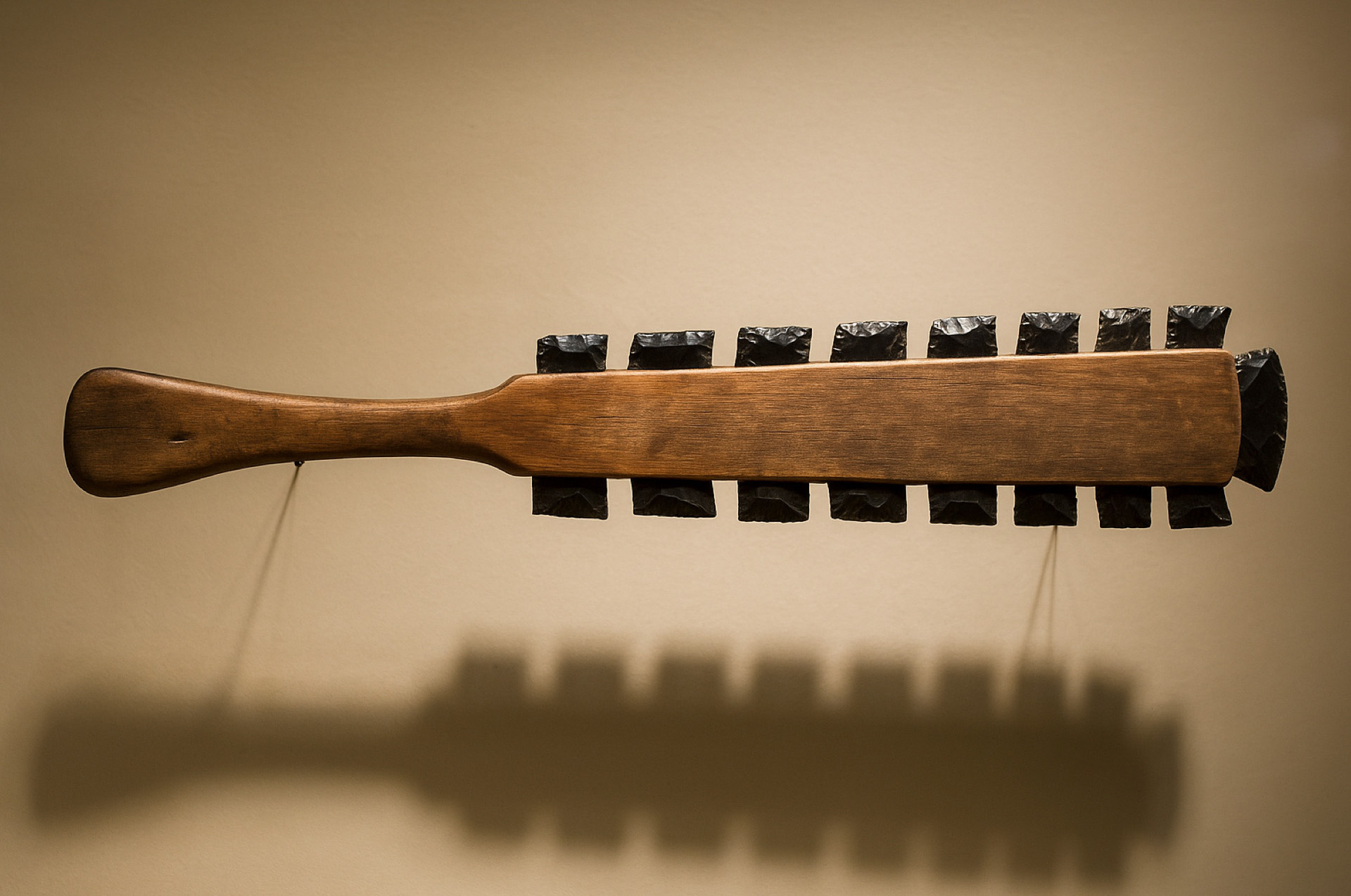
Macuahuitl — Mesoamerican wooden sword-like weapon edged with sharp obsidian blades.

Quick definition: The espada ancha is a Spanish Colonial frontier sword associated with Mexico, northern New Spain, and the American Southwest, usually recognized by its broad heavy blade and practical iron guard.
Region: Spanish Colonial Mexico, northern New Spain, and the American Southwest
Era: mainly 18th to early 19th century
Blade type: broad, heavy, often slightly curved frontier blade
Edge: commonly single-edged, sometimes with a reinforced back or false-edge point depending on example
Typical blade length: often about 26–31 in (66–79 cm), with variation by local maker and surviving example
Use: frontier sidearm, mounted and foot use, military or militia carry, practical cutting, Spanish Colonial and Mexican regional weapon culture
The espada ancha, literally “wide sword,” belongs to the frontier weapon world rather than the formal court or duel. It was typically robust, locally made or locally adapted, and practical for harsh conditions. Many examples have a broad blade, simple but protective iron hilt, knuckle bow, shell-like guard elements, and a utilitarian character very different from refined European small swords or rapiers.
It should not be confused with the European basket-hilted broadsword just because the name translates as “wide sword.” In the American context, espada ancha usually points to Spanish Colonial and Mexican frontier arms. For identification, look for the heavy broad blade, iron guard, frontier construction, Spanish Colonial / Mexican context, and a practical sidearm profile between military sword and large working blade.
Quick definition: The Model 1832 Foot Artillery Sword is a U.S. military short sword with a straight double-edged blade and solid brass hilt, issued for foot artillery and related enlisted military roles in the 19th century.
Region: United States
Era: adopted in the 1830s; associated with antebellum, Mexican-American War, and Civil War-era military equipment
Blade type: short straight blade inspired by French artillery short swords and ultimately by gladius-like military short-sword forms
Edge: double-edged
Typical blade length: about 19 in (48 cm), with overall length around 25 in (64 cm)
Use: foot artillery sidearm, enlisted military sword, NCO or musician-associated use, utility cutting, military equipment and rank display
The Model 1832 Foot Artillery Sword is one of the most recognizable early U.S. military short swords. Unlike cavalry sabers, it has no sweeping curved blade and was not designed around mounted slashing attacks. Its straight double-edged blade, short overall length, and solid brass hilt place it closer to the artillery short-sword tradition than to later American saber patterns.
The sword is often linked with N. P. Ames production and early American military contracts. The brass hilt, simple crossguard, scaled grip texture, and compact blade make it visually distinct from the longer Model 1840 NCO Sword and later cavalry sabers. For identification, look for the short straight double-edged blade, cast brass grip, simple crossguard, U.S. military markings where present, and a form that feels more like a functional artillery sidearm than a dress officer’s sword.
Quick definition: The Model 1840 NCO Sword is a U.S. Army noncommissioned officer’s sword with a straight blade and cast brass hilt, adopted as a rank-related military sidearm and later retained mainly for ceremonial use.
Region: United States
Era: adopted in 1840; associated with the Mexican-American War, Civil War, late 19th-century Army service, and modern ceremonial use
Blade type: straight narrow military sword blade, closer to a spadroon or infantry sidearm than a cavalry saber
Edge: usually single-edged with a thrust-capable point
Typical blade length: commonly about 31 in (79 cm), with variation by maker and period
Use: NCO sidearm, rank symbol, infantry and staff-related military carry, dress sword, ceremony, change-of-responsibility symbolism
The Model 1840 NCO Sword is visually more restrained than American cavalry sabers. It has a straight blade, a brass hilt, shell-style guards, and a military profile tied to rank rather than mounted cutting. It replaced the earlier short-sword vocabulary of the Model 1832 Foot Artillery Sword with a longer, more formal sword for noncommissioned officers.
In historical use, the sword served both practical and symbolic roles. It marked NCO authority, appeared with Civil War-era sergeants, and later became part of Army ceremonial tradition. For identification, look for the straight blade, cast brass grip, shell guard, U.S. military markings where present, and NCO context. It should not be confused with the Model 1840 Cavalry Saber, which is a curved mounted sword, or the Model 1832 Foot Artillery Sword, which is much shorter and gladius-like.
Quick definition: The Model 1840 Cavalry Saber is a heavy U.S. cavalry sabre with a curved single-edged blade, brass guard, leather-wrapped grip, and steel scabbard, widely associated with Mexican-American War and Civil War cavalry service.
Region: United States
Era: adopted in 1840; used through the Mexican-American War and American Civil War period
Blade type: heavy curved cavalry sabre blade with fuller
Edge: single-edged, with a thrust-capable point and cutting-focused geometry
Typical blade length: about 35 in (89 cm), with overall length around 44 in (112 cm)
Use: mounted cavalry combat, slashing cuts, military sidearm, Civil War cavalry service, regulation U.S. Army saber
The Model 1840 Cavalry Saber was built as a serious mounted weapon, not a dress sword. Its heavy curved blade gave cavalrymen strong cutting power from horseback, but that same mass helped earn the saber its nickname, Old Wrist-Breaker. Compared with later lighter cavalry sabers, the Model 1840 feels more forceful, more blade-heavy, and more demanding in the hand.
For identification, look for the heavy curved blade, broad fuller, brass guard with knuckle bow and branches, leather-covered wire-wrapped grip, and steel scabbard with suspension rings. It should not be confused with the Model 1840 NCO Sword, which is straight and rank-related, or the Model 1860 Light Cavalry Saber, which is generally lighter and later in U.S. service.
Quick definition: The Model 1840 Light Artillery Saber is a U.S. military sabre with a curved single-edged blade, brass knuckle bow, leather-wrapped grip, and steel scabbard, issued for light artillery and mounted artillery service.
Region: United States
Era: adopted in the 1840s; associated with Mexican-American War and Civil War-era artillery service
Blade type: curved light artillery sabre blade with fuller
Edge: single-edged, with a thrust-capable point
Typical blade length: commonly about 32 in (81 cm), depending on maker and example
Use: light artillery sidearm, mounted artillery service, military carry, ceremonial and regulation equipment
The Model 1840 Light Artillery Saber occupies a middle ground in U.S. military sword design. It is longer and more saber-like than the short Model 1832 Foot Artillery Sword, but lighter and simpler than the Model 1840 Cavalry Saber. Its hilt usually has a single brass knuckle bow rather than the heavier three-branch guard associated with cavalry sabers.
In practical terms, artillerymen relied on guns, horses, limbers, tools, and crew coordination more than sword combat. The saber still served as a regulation sidearm and military symbol, especially for mounted or light artillery troops. For identification, look for the curved single-edged blade, brass knuckle bow, leather-covered wire-wrapped grip, steel scabbard, and a more compact guard than the heavy cavalry saber.
Quick definition: The Model 1850 Staff and Field Officer’s Sword is a U.S. Army officer’s sword associated with staff officers and field-grade officers, used mainly as a rank symbol, dress sword, and Civil War-era military sidearm.
Region: United States
Era: adopted around 1850; strongly associated with the American Civil War and mid-19th-century U.S. Army officer dress
Blade type: slender straight or slightly curved officer’s sword blade, often etched or decorated
Edge: usually single-edged with a thrust-capable point, depending on maker and pattern variation
Typical blade length: commonly around 30–32 in (76–81 cm), with variation by maker and example
Use: officer dress sword, field-grade rank symbol, staff officer sidearm, ceremonial carry, Civil War military identification
The Model 1850 Staff and Field Officer’s Sword was not built like a heavy cavalry weapon. Its role was closer to officer identity, command presence, and regulation dress than to hard mounted combat. The guard is usually more ornate than the plain utilitarian guards on enlisted weapons, often with pierced brass work, foliate decoration, and U.S. motifs.
For identification, look for the decorated brass guard, wire-wrapped grip, etched blade, officer-grade ornament, and mid-19th-century U.S. Army context. It should not be confused with the Model 1840 NCO Sword, which is tied to noncommissioned officers, or with the Model 1840 Cavalry Saber, which has a heavier curved blade and mounted-combat profile.
Quick definition: The Model 1860 Light Cavalry Saber is a U.S. cavalry sabre with a curved single-edged blade, brass three-branch guard, leather-wrapped grip, and steel scabbard, widely used by Union and Confederate cavalry during the American Civil War.
Region: United States
Era: adopted shortly before and during the American Civil War; also associated with later 19th-century U.S. cavalry service
Blade type: curved light cavalry sabre blade with fullers
Edge: single-edged, with a thrust-capable point and cutting-oriented cavalry geometry
Typical blade length: about 35 in (89 cm), with overall length around 41 in (104 cm)
Use: mounted cavalry combat, slashing cuts, close-range cavalry encounters, Civil War service, regulation U.S. cavalry sidearm
The Model 1860 Light Cavalry Saber was the lighter successor to the heavier Model 1840 Cavalry Saber. It kept the curved blade and three-branch brass guard expected of a cavalry sabre, but the overall weapon was less awkward in mounted use. That made it better suited to the fast, short, violent encounters of Civil War cavalry fighting, where a sabre had to be drawn, swung, recovered, and managed from horseback.
In use, the M1860 was primarily a cutting weapon, although the point could still be used for thrusting at close range. The blade normally has a broad fuller, a sharpened lower edge, a blunt spine, and enough curvature for mounted slashing cuts. The guard protects the hand more fully than a simple knuckle bow, while the leather-covered grip and wire wrap give secure control under movement.
For identification, look for the curved 35-inch blade, brass three-branch guard, leather-and-wire grip, steel scabbard, and Civil War cavalry context. It should not be confused with the Model 1840 Cavalry Saber, which is heavier and known as the “Old Wrist-Breaker,” or the Model 1840 Light Artillery Saber, which has a more compact artillery role and simpler guard construction.
Quick definition: The Model 1902 Army Officer’s Saber is the U.S. regulation officer’s saber adopted in the early 20th century, recognized by its light curved blade, nickel-plated hilt, decorative guard, black grip, and modern ceremonial role.
Region: United States
Era: adopted in 1902; used through the 20th century and retained in ceremonial military contexts
Blade type: light slightly curved officer’s saber blade, usually etched or decorated on dress examples
Edge: usually single-edged with a thrust-capable point
Typical blade length: about 31 in (79 cm) in modern U.S. Army drill reference
Use: officer dress sword, parade saber, ceremony, command presence, presentation sword, rank and service identity
The Model 1902 Army Officer’s Saber marks the shift from practical battlefield swords toward modern military ceremony. It is lighter and more formal than the Model 1840 or Model 1860 cavalry sabers, and it was not intended to serve as a heavy mounted-combat weapon. Its value lies in officer identity, uniform presentation, parade use, and military tradition.
For identification, look for the lightly curved blade, nickel or bright metal hilt, black grip, pierced guard, etched blade decoration, and metal scabbard. It should not be confused with Civil War cavalry sabers, which have heavier brass three-branch guards and battlefield service associations, or with the Model 1850 Staff and Field Officer’s Sword, which belongs to the mid-19th-century officer sword tradition.
Modern sport and HEMA swords are not battlefield weapons in the same sense as a gladius, longsword, katana, or sabre. They are purpose-built training or competition tools, designed around safety rules, fencing conventions, protective equipment, and controlled martial practice.
This section covers the three Olympic fencing weapons — épée, foil, and sabre — plus the feder used in historical European martial arts. These weapons are included because many readers searching for sword types also want to understand the difference between historical swords and the modern blades used in fencing, reenactment, sparring, and HEMA training.
Quick definition: The épée is a modern sport fencing weapon with a stiff thrusting blade, large bell guard, and full-body target area, descended from the dueling sword tradition rather than battlefield sword use.
Region: modern international sport fencing, with European dueling-sword roots
Era: modern Olympic and competitive fencing
Blade type: stiff triangular-section thrusting blade with blunt electric point in competition
Edge: unsharpened; points are scored with the tip only
Typical length: up to 110 cm overall, with a 90 cm blade under FIE sport fencing specifications
Use: sport fencing, point control, thrusting attacks, defensive timing, competitive fencing bouts
The épée is the heaviest of the three modern fencing weapons and has the largest guard. That broad bell guard protects the hand because the entire body is valid target in épée, including the hand and arm. Unlike foil and sabre, épée fencing does not use right-of-way priority in the same way; touches are decided by who lands first, and double touches can count when both fencers hit within the allowed timing window.
In a sword-type guide, the épée should not be described as a battlefield sword. It is a modern sporting weapon derived from the logic of the dueling sword, built for controlled thrusting under rules and protective equipment. For identification, look for the triangular thrusting blade, large round bell guard, electric tip, straight grip or pistol grip, and the absence of a cutting edge.
Quick definition: The foil is a modern sport fencing weapon with a light flexible blade, small guard, and blunt electric tip, used for thrusting attacks to the valid torso target area.
Region: modern international sport fencing, with European training and dueling-sword roots
Era: modern Olympic and competitive fencing
Blade type: light flexible rectangular-section thrusting blade with blunt electric scoring tip
Edge: unsharpened; touches score only with the point
Typical length: up to 110 cm overall, with a 90 cm blade under FIE sport fencing specifications
Use: sport fencing, right-of-way training, point control, distance work, attacks and parry-riposte actions
The foil is the most technical of the three modern fencing weapons in the sense that it teaches point control, line, timing, and right-of-way priority. Unlike épée, the entire body is not valid target. Foil target is limited mainly to the torso, so hand, arm, head, and leg hits do not score even though off-target touches can stop the action.
A foil is not a battlefield sword and should not be described like a rapier, small sword, or military sabre. It is a modern training and competition weapon built around rules, protective clothing, and electronic scoring. For identification, look for the light rectangular blade, small bell guard, blunt button tip, pistol or French grip, and the absence of a cutting edge. Compared with épée, the foil is lighter and has a smaller guard; compared with sabre, it scores only with thrusts, not cuts.
Quick definition: The fencing sabre is a modern sport fencing weapon used for both cuts and thrusts, with valid target limited to the area above the waist, including the head and arms.
Region: modern international sport fencing, with cavalry sabre ancestry
Era: modern Olympic and competitive fencing
Blade type: light flexible sport sabre blade with blunt tip and electric scoring use
Edge: unsharpened; touches can score with the cutting edge, back edge, or point under sabre rules
Typical length: up to 105 cm overall, with an 88 cm blade under FIE sport fencing specifications
Use: sport fencing, fast attacks, cuts, thrusts, parry-riposte actions, right-of-way tactical exchanges
The fencing sabre is the fastest and most cut-oriented of the three Olympic fencing weapons. Unlike foil and épée, it does not rely only on point thrusts. A valid touch may be made with the blade edge or the point, which gives sabre fencing its explosive rhythm, rapid footwork, and aggressive attack-counterattack structure.
It should not be confused with a historical cavalry sabre. A military sabre was a sharpened battlefield sidearm designed for mounted or infantry use, while the modern fencing sabre is a regulated sporting weapon used with protective clothing, electronic scoring, and right-of-way rules. For identification, look for the light blade, curved guard that wraps around the hand, straight grip, blunt end, and competition context rather than a sharpened cutting edge or military scabbard.
Quick definition: The feder is a blunt practice longsword used in historical European martial arts, built with a flexible training blade, long two-handed grip, crossguard, and flared schilt for safer sparring and technique work.
Region: modern HEMA practice, based on European longsword training traditions
Era: historical training-sword inspiration; modern versions used in contemporary HEMA clubs and tournaments
Blade type: long blunt flexible training blade with widened schilt near the hilt
Edge: unsharpened training edges, usually rounded or thickened for safety
Typical length: often close to longsword length; exact size varies by maker, tournament rules, and practitioner preference
Use: HEMA sparring, longsword drills, controlled fencing practice, tournament fighting, historical technique reconstruction
The feder is designed to behave enough like a longsword for realistic fencing practice, while reducing the risk of training with a sharp weapon. Its blade is usually narrower and more flexible than a live longsword blade, and the edges are blunt. The widened section near the base of the blade, called the schilt, helps protect the hands during bind work and gives the weapon its instantly recognizable training profile.
A feder should not be confused with a sharp medieval longsword. A battlefield longsword was a live weapon with cutting edges and a fighting point; a feder is a practice tool for drilling, sparring, and tournament fencing under modern protective standards. For identification, look for the long grip, crossguard, blunt blade, flexible training geometry, and flared schilt. In this article, it belongs in the modern sport and HEMA section, not in the medieval battlefield sword section.
Sword types are not just different names for long blades. Each form reflects a specific mix of region, period, material technology, fighting method, social status, and cultural meaning. A khopesh, gladius, longsword, katana, talwar, shamshir, kampilan, and Model 1860 cavalry saber all belong to the larger sword family, but they were built for very different hands, battlefields, and traditions.
The fastest way to identify a sword is to start with the blade: straight or curved, single-edged or double-edged, short or long, broad or narrow, rigid or flexible. Then look at the hilt, guard, pommel, scabbard, region, and use. A sword’s shape usually tells you what problem it was designed to solve — mounted cutting, infantry thrusting, naval fighting, court dress, ritual authority, martial training, or personal defense.
This guide is meant to work as a visual and practical reference. Use the pictures, quick facts, and regional sections to compare sword forms side by side. For collectors, martial artists, reenactors, historians, and blade enthusiasts, understanding sword types makes it much easier to recognize authentic design features, avoid vague labels like “scimitar” or “samurai sword,” and appreciate why each historical blade developed the way it did.
Author: Aleks Nemtcev | Knifemaker with 10+ Years of Experience | Connect with me on LinkedIn | Follow me on Reddit
The main sword types include straight double-edged swords, curved sabres, short swords, longswords, rapiers, military officer swords, ceremonial swords, and training swords. A clearer way to classify them is by region, blade shape, edge type, era, and use: for example, gladius, longsword, katana, talwar, shamshir, kampilan, and cavalry saber all solve different combat or cultural problems.
Start with the blade. Check whether it is straight or curved, single-edged or double-edged, short or long, broad or narrow, rigid or flexible. Then look at the hilt, guard, pommel, scabbard, region, and historical context. A sword’s shape usually reflects its intended use, such as thrusting, cutting, mounted combat, naval fighting, ceremony, or martial training.
Straight swords are usually better suited to thrusting and direct point control, though many can also cut. Curved swords usually favor slicing, draw cuts, and mounted or mobile cutting actions. A gladius, rapier, and jian are examples of mostly straight sword traditions, while a katana, shamshir, talwar, kilij, and cavalry saber belong to curved single-edged cutting traditions.
A single-edged sword has one sharpened cutting edge and usually a thicker spine, which can make the blade stronger for cutting. A double-edged sword has two sharpened edges and is often more symmetrical, giving it more options for thrusting, back-edge cuts, and edge changes. Sabres, katanas, and talwars are usually single-edged; arming swords, longswords, rapiers, and jian are typically double-edged.
An arming sword is usually a one-handed medieval European sword used with a shield, buckler, or other off-hand tool. A longsword has a longer grip for two-handed use and usually offers more reach, leverage, and control in cut-and-thrust fencing. Both are medieval European swords, but their handling systems are different.
Both are Japanese curved single-edged swords, but the tachi is generally older and traditionally worn suspended edge-down. The katana developed from the uchigatana style and is worn edge-up through the belt. Tachi are more strongly associated with mounted samurai warfare, while katana are more closely tied to later samurai sidearm carry.
Scimitar is a real English word, but it is better understood as a broad Western umbrella term for curved single-edged swords from the Middle East, western Asia, North Africa, and nearby regions. When possible, use the more precise name: shamshir for Persian forms, kilij for Ottoman Turkish sabres, talwar for Indian sabres, nimcha for North African sabres, and pulwar for Afghan forms.
Viking Age warriors used broad, straight, double-edged one-handed swords with short guards and distinctive pommel forms. These swords developed from the late Roman spatha tradition and were usually used with a shield. High-status examples could have pattern-welded blades, inlaid markings, decorated hilts, and rich burial or gift-exchange associations.
A sword is generally a longer bladed weapon designed for reach, cutting, thrusting, or military sidearm use. A dagger is shorter and usually optimized for close-range thrusting or utility. Some historical weapons sit between categories, including the Khyber knife, barong, kris, and certain short swords. In those cases, region, blade length, intended use, and museum classification matter.
Modern fencing weapons are real sporting weapons, but they are not battlefield swords. Épée, foil, and fencing sabre are designed for regulated competition, blunt tips, protective equipment, and electronic scoring. They preserve parts of European fencing logic, but they are not the same as historical rapiers, small swords, cavalry sabres, or military sidearms.
The katana is probably the most globally recognized sword type today, largely because of samurai history, Japanese martial arts, cinema, anime, and collector culture. Other widely recognized sword types include the longsword, rapier, gladius, Viking sword, saber, scimitar, claymore, and cutlass.
Compare sword types by function rather than name alone. Look at blade length, curvature, edge type, point geometry, hilt protection, hand position, weight distribution, and intended use. A cavalry saber, rapier, katana, gladius, and longsword can all be called swords, but they were built for very different methods of fighting.
Related reading on Noblie


There are no comments for this article yet.