


Contents
Buying a gift for someone who likes knives is fairly easy. Buying for someone who has collected them for years is not.
A serious collector may already own dozens of excellent knives and still have a very narrow idea of what belongs in the collection. They may follow one maker, collect variations of the same folder, focus on hand engraving, seek unusual Damascus patterns, or build an entire collection around a material, historical theme, or type of craftsmanship.
That is why another expensive knife is not automatically a better gift.
When someone tells me, “He collects knives and already has everything,” I do not start by looking for the most expensive or unusual knife available. I first try to understand what the collection is actually about.
Repetition is often more informative than variety. Five knives from the same maker may be a deliberate collection, not five versions of the same mistake. Likewise, a cabinet full of engraved fixed blades suggests a very different next purchase from a case filled with titanium folders.
For an experienced collector, the best gift usually does one of three things: it fills a meaningful gap, adds a distinctive piece to an existing theme, or complements the collection without forcing another knife into it.
If the recipient simply likes knives but has not developed a focused collection, our guide to the best knives to gift is the better starting point.
The safest choice depends on how well you understand the collection.
| What You Know | Best Gift Direction |
|---|---|
| You know the favorite maker or model family | A missing model or a configuration that is meaningfully different |
| You know they collect engraving, Damascus, scrimshaw, daggers, or another theme | A piece that advances that part of the collection |
| You know their general taste but not their exact knife preferences | A display box or collector-oriented accessory |
| They value one-of-one craftsmanship | An art knife, hand-engraved piece, mosaic Damascus knife, or other unique work |
| They want something that does not already exist | A custom commission |
| You know almost nothing about the collection | Do not make an expensive guess; involve the collector or choose a complementary gift |
The most useful rule is simple:
Do not try to find a knife they do not own. Try to understand why they own the knives they already have.
Collectors generally become more selective as their collections grow.
A new enthusiast may be delighted simply to receive a quality knife. Someone who has spent years buying, selling, carrying, examining, and comparing knives has probably developed preferences that are difficult for a non-collector to see.
Two folding knives may look nearly identical but differ in exactly what matters to that person: maker, generation, blade material, milling, finish, engraving, configuration, production run, or condition.
The opposite can also happen. An elaborate art knife may look like an obvious upgrade to someone outside the hobby but have almost nothing in common with a collection built around clean modern folders.
Price does not solve that problem.
A four- or five-figure knife can still be the wrong gift. A carefully chosen variation of a familiar type may be far more interesting.
This is why generic lists of “must-have knives for collectors” rarely solve the actual buying problem. Mature collections become personal.

You do not need to become a knife expert before choosing the gift. You do need to notice patterns.
Start with maker names.
If the same maker appears repeatedly, assume that repetition is meaningful until proven otherwise.
The same principle applies to models. An experienced collector may deliberately own several examples of one design because the blade material, finish, engraving, handle treatment, edition, or level of dress is different.
A monosteel folder intended for carry and a full-dress version of the same model with Damasteel and Timascus are not necessarily duplicates from a collector’s perspective.
This is particularly common with low-volume makers, where configurations may change considerably from one example to another.
Look for the missing piece inside the pattern before deciding that the collector needs something completely different.
Wear tells you a great deal.
Pocket marks, sharpened edges, scratches, and patina suggest that the collector also uses the knives. Pristine pieces stored with their original boxes and paperwork indicate a greater emphasis on preservation or display.
Neither approach is more serious than the other.
It simply changes what makes a good gift.
Someone who carries most of the collection may want a special knife that remains practical. Someone building a display collection may care more about artistic technique, materials, documentation, and visual impact.
Sometimes the real collection is not a collection of knife types at all.
It may be a collection of hand engraving, mosaic Damascus, mammoth materials, scrimshaw, historical themes, daggers, wildlife art, or work from particular makers.
Once that pattern becomes visible, the gift decision becomes much easier.
A collector with several hand-engraved wildlife knives probably does not need a random tactical folder just because it is expensive. A collector fascinated by forged patterns may care much more about an unusual mosaic Damascus billet than about a famous production model.
Collectors who preserve the original box, certificate, maker documents, tools, receipts, and accessories are signaling that completeness matters.
Do not separate or discard these materials because you want to repackage the knife more elegantly.
With a collector piece, the original presentation may later become part of its history.

The problem with buying for someone who “already has everything” is usually not finding another knife. It is finding a knife that does not feel interchangeable with what they already own.
This is where the collector side of Noblie’s inventory differs from a conventional knife retailer.
A large part of the assortment is built around individually photographed collector pieces rather than endless units of one standard configuration. The range includes one-off art knives, hand-engraved pieces, mosaic Damascus knives, scrimshaw, ornate daggers, rare natural materials, and individually finished folders.
That means the search does not have to begin with:
What common model has he somehow not bought yet?
It can begin with:
What kind of object would add something new to his collection?
The Noblie collector knife collection is the broadest starting point. From there, the more specialized categories let you narrow the gift around the collector’s actual interests.
A one-of-one piece solves the duplication problem in the most literal way: there is no second identical example to discover in the collection later.
But one-of-one should not be treated as another word for desirable.
The collector still needs a reason to care about the knife. That reason may be the artistic subject, maker, forging, engraving, construction, natural materials, historical reference, or the way several techniques are combined.
Noblie’s collectors knives cover several of these directions within one category, making it the most useful place to start when you know the recipient is an established collector but have not yet narrowed the theme.
For this kind of gift, exact-piece photography is important. Natural materials, forged patterns, hand engraving, carving, and individually finished metalwork can vary enough that the specific example is part of the buying decision.
For a collector who values craftsmanship beyond ordinary knife construction, an art knife may be the strongest answer to the “already has everything” problem.
An art knife can bring together blade making, engraving, carving, precious-metal work, inlay, sculptural handles, rare materials, and presentation as one composition.
The important distinction is that these features should work together.
More decoration is not automatically better art. A successful piece has a coherent subject and enough restraint that the blade, handle, engraving, and fittings still read as one object.
Noblie’s art knives are particularly relevant for collectors who already own high-end working knives and are looking for pieces intended primarily for appreciation, display, or long-term collection.
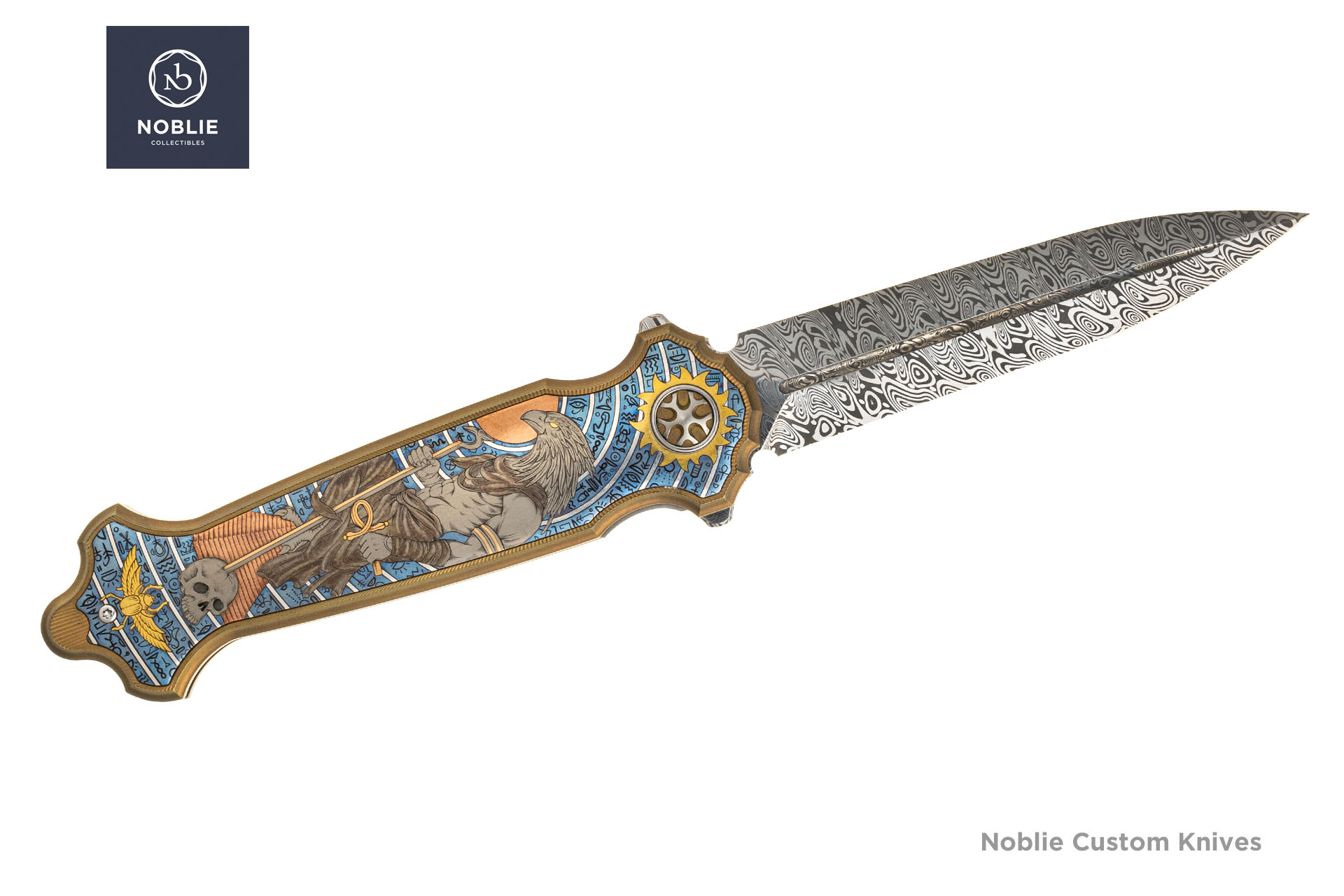
Hand engraving is another collector field in its own right.
The relevant questions go beyond whether a knife is engraved. Collectors may distinguish between scrollwork, bulino, deep relief, carved metal, gold or silver inlay, figurative scenes, and the individual style of the engraver.
A strong engraved knife uses the metal surfaces as part of the overall composition rather than treating them as blank areas that needed decoration.
The Noblie hand-engraved knife collection includes work where engraving is integral to the completed knife.
That is different from adding a personal date or monogram to an existing collector piece. If personalization is the objective, our engraved knife gift guide explains when engraving improves a gift and when an important knife is better left untouched.
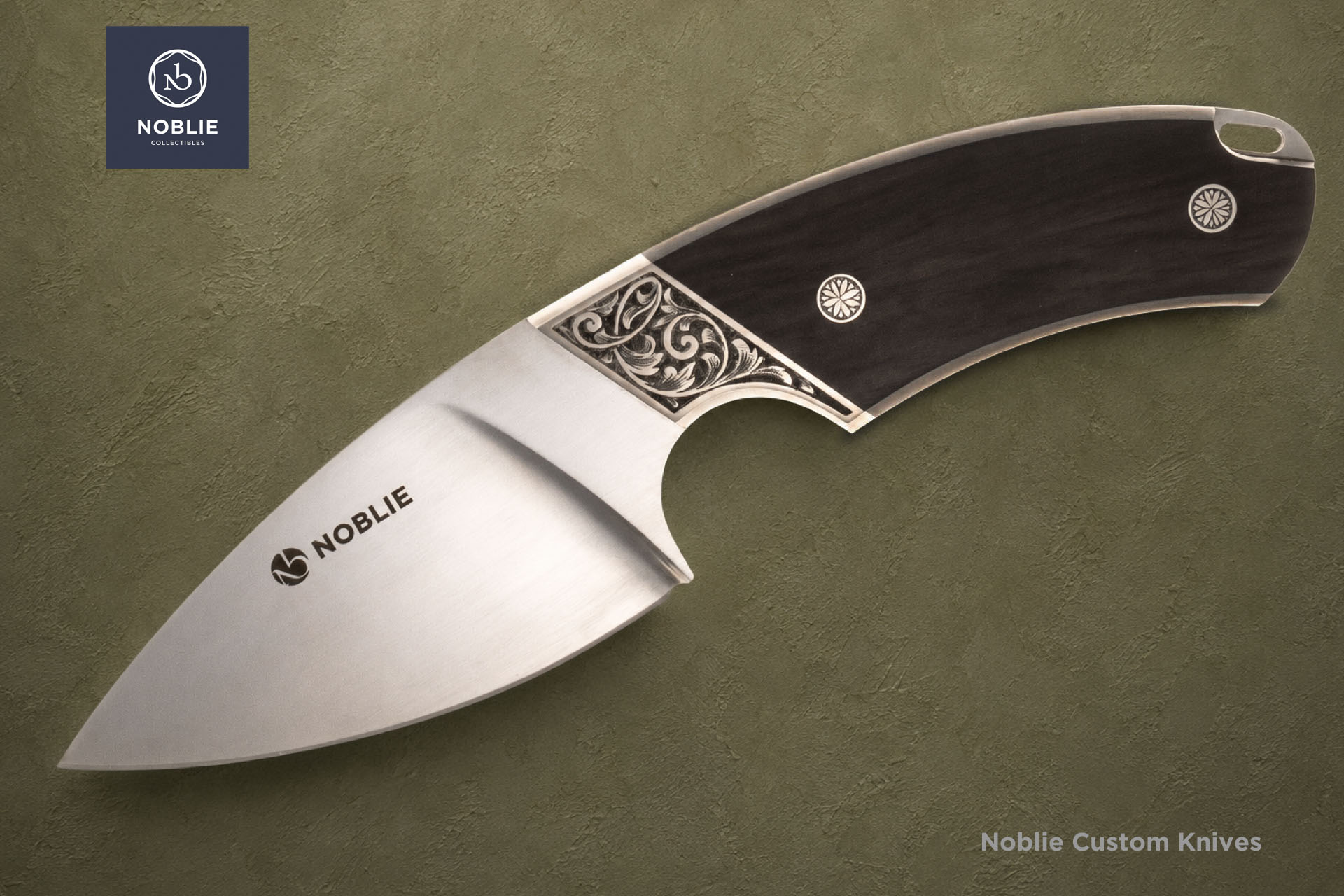
For someone interested in bladesmithing, an intentionally constructed mosaic pattern can provide a much stronger collector story than the generic word Damascus.
Mosaic Damascus is made by arranging the steel so the finished billet develops a planned motif. Even when a smith repeats the same pattern concept, forging and grinding produce individual variation.
This gives the collector two things to appreciate: the finished appearance and the process required to build the pattern into the blade.
The mosaic Damascus knife collection is therefore most relevant when the recipient already notices forging, pattern development, and blade craftsmanship rather than simply wanting an ornamental blade.
There is no need to turn the gift into a metallurgy lesson. The important question is whether patterned steel is already part of the collector’s interests.

Scrimshaw offers a different form of knife art because the image is worked into the handle material rather than engraved primarily into metal.
For a collector drawn to wildlife, portraits, maritime subjects, historical themes, or natural handle materials, this can produce a piece that feels very different from both a conventional engraved knife and a premium folder.
Noblie’s scrimshaw knives use individually worked natural handle materials such as fossil mammoth ivory, tusk, horn, and bone as the surface for the artwork.
Because the material itself varies naturally and the image is worked individually, scrimshaw is particularly suited to collectors who value pieces that cannot be replicated exactly.
It is also a gift where subject matters. A wildlife scene chosen for someone who collects African game knives is far more compelling than simply choosing whichever scrimshaw piece is most elaborate.

Not every knife collector is primarily interested in pocket knives.
For someone drawn to historical weapons, ceremonial design, symmetrical blades, ornate scabbards, kindjals, dirks, stilettos, or medieval forms, a dagger can add an entirely different dimension to the collection.
The Noblie custom dagger collection includes handmade presentation pieces with Damascus blades, engraving, decorated fittings, carved grips, and elaborate scabbards.
This is not the safest choice for a collector whose entire collection consists of compact EDC folders.
But for someone already interested in historical or presentation arms, a dagger may solve the “what could possibly be different?” problem much better than another folder.

A modern folder collector may have little interest in an ornate dagger or scrimshaw fixed blade.
In that case, the better approach is to stay within the collector’s existing language: maker, model family, materials, and configuration.
The key principle is that two examples of the same low-volume model can still be meaningfully different collector objects. A practical monosteel configuration and a full-dress version with Damasteel, Timascus, inlays, or extensive finishing occupy different positions in a collection even when the underlying model is the same.
Noblie’s Herman Knives category is one example of this type of collecting, where a familiar model platform can appear in substantially different configurations, from restrained everyday-carry versions to elaborate full-dress builds.
LesBar provides another low-volume folder direction, with individually finished knives where blade material, titanium work, inlays and decorative metalwork can substantially change the character of the piece. Aviator and Plus+ are useful examples; current configurations are available in the LesBar Knives collection.
The maker should still fit the collector. Do not use a high-end folder as a universal answer merely because the workmanship is excellent.

For the collector who genuinely seems to own every obvious variation, a commission is the one option that does not depend on discovering something they missed.
The knife can begin with the collector rather than available inventory.
Blade format, handle material, theme, engraving, forged steel, dimensions, fittings, and presentation can be coordinated as one project.
The difficult part is deciding how much should remain a surprise.
For a collector with strong technical preferences, I would rarely specify every detail without their involvement. A better gift can be the commission itself: establish the maker or project, define the budget, and let the recipient participate in the decisions that determine how the knife will actually feel and look.
For realistic context on what moves a project from a straightforward handmade knife into complex collector or art-knife territory, see How Much Does a Custom Knife Cost?
Sometimes another knife is not the best answer.
As a collection grows, storage and presentation become real parts of the hobby.
A fitted wooden box can give an important knife a permanent place, protect it from unnecessary handling, and make the collection easier to organize.
This is particularly useful when you know which knife the recipient values but cannot confidently choose their next knife.
Noblie’s knife display boxes occupy the low-hundreds range rather than collector-knife pricing, making them a lower-risk premium gift.
Check the internal dimensions before ordering. A beautiful box that does not fit the intended knife is not useful.

For someone who carries folders, a bead can be more personal than it initially appears.
The better approach is to match it to an existing knife or theme rather than buying generic knife-themed merchandise. Material, weight, bore diameter, and motif all matter, and Noblie’s paracord and knife beads span bronze, silver, titanium, enamel, and other styles.
A collector who already owns the knife they want may appreciate a carefully chosen accessory that changes how the knife is carried or presented without modifying the knife itself.

Care products can also make sense for a collection containing polished steel, natural handle materials, engraving, Damascus, or display pieces.
The important point is compatibility.
Do not assemble a generic maintenance kit without knowing the materials and finishes in the collection. What is appropriate for a working carbon-steel blade may not be the correct treatment for an elaborate engraved art knife.

There is no certification that turns an expensive knife into a collectible.
Different collectors value different things, but several factors repeatedly matter:
| Factor | What to Look For | Why It Matters |
|---|---|---|
| Maker or authorship | Identifiable maker, engraver, smith, or workshop | Places the knife within a body of work |
| Originality | Original finish, parts, engraving, and configuration | Alterations may affect collector interest |
| Scarcity | Genuine one-off, small edition, unusual configuration | Distinguishes the piece, although scarcity alone does not create demand |
| Technique | Forging, engraving, carving, scrimshaw, inlay | Shows where the craft value comes from |
| Materials | Clearly identified blade and handle materials | Can make one configuration materially different from another |
| Condition | Blade, edge, mechanism, finish, handle, fittings | Condition influences desirability |
| Provenance | Maker records, invoices, photographs, seller history | Helps establish where the knife came from |
| Completeness | Original box, COA, sheath, tools, accessories | Preserves the original set |
| Fit with the collection | Maker, material, theme, technique, or model connection | Often matters more to the recipient than price |
One factor should be kept separate from all of these: expected investment return.
Collectibility, rarity, and resale value are not the same thing.
A rare knife may have little secondary-market demand. A widely recognized maker may have stronger resale demand than a technically rarer unknown piece. A knife may also become more or less desirable as tastes change.
Do not buy the gift because you expect the market to repay the purchase.
Buy it because it belongs in the collection.
For a serious collector gift, documentation should stay with the knife.
A certificate of authenticity can be useful, but it is one part of the evidence rather than a document that automatically proves every claim made about an object.
Look for consistency between the knife and its supporting materials: maker marks, serial information where applicable, product description, photographs, invoice, seller history, and original accessories.
Exact-piece photographs are especially useful for modern custom and art knives. Damascus patterns, mammoth material, engraving, carving, anodizing, and hand finishing can make an individual knife visually identifiable.
Keep the original box, certificate, sheath, tools, and supplied accessories even if you use a different outer gift box for the occasion.
For a broader discussion of condition, rarity, documentation, and collector value, see the Noblie guide to collectible knives.
Instead of asking whether someone is simply “a knife collector,” identify what dominates the collection.
A modern folder collector is usually best served by a maker, model, or configuration that fits the existing pattern. An art-knife collector may care more about engraving, carving, inlay, and composition. A forging-focused collector may respond to mosaic Damascus. A collector of natural materials and miniature artwork may be better matched with scrimshaw. Someone interested in historical forms may find a dagger far more compelling than another pocket knife.
These interests can overlap.
A collector might follow one folder maker while also seeking Damasteel configurations. Another might collect wildlife themes across engraving, scrimshaw, and carved handles.
The strongest gift often sits at the intersection of two established interests.
The collector’s preferences determine the sensible budget more than the occasion does.
A useful framework is:
| Budget | Sensible Direction |
|---|---|
| Under $500 | Display box, premium accessory, preservation or presentation gift |
| $500–$1,000 | Selected handmade or specialty knife only when it clearly fits the collector |
| $1,000–$2,000 | Premium handmade knife or high-end maker folder |
| $2,000–$4,000 | Mosaic Damascus, engraved work, collector-grade folders, more elaborate handmade pieces |
| $4,000–$8,000 | Full-dress folders, major engraving, unusual materials, more complex collector pieces |
| $8,000+ | One-of-one art knives, scrimshaw masterpieces, elaborate daggers, extensive inlay, or major commissioned work |
These are buying bands, not quality grades.
The current Noblie assortment spans from premium accessories in the low hundreds through handmade and maker knives in the four-figure range to major art pieces in the four- and five-figure market.
That does not mean the more expensive gift is more appropriate.
A display box that solves a real need can be a better gift than a multi-thousand-dollar knife chosen without understanding the collection.
Damascus is too broad a label to make the buying decision by itself.
A knowledgeable collector may care about who forged the billet, how the pattern was constructed, what steels were used, who made the knife, and how the blade fits the rest of the design.
The word on the product title is not enough.
Duplicates are not automatically bad.
A collector may deliberately own several configurations of one model or several knives built around the same artistic theme.
The problem is buying the same thing again without understanding whether the differences matter.
Adding a personal date can increase sentimental value while reducing collector desirability.
If originality matters, personalize the presentation box or commission a new engraved knife rather than modifying an established collector piece without asking.
Find out what is actually limited.
It may be the total production quantity, blade material, finish, dealer configuration, production year, or simply current availability.
A serial number identifies a piece. It does not by itself establish rarity.
The more unusual and expensive the knife, the less comfortable I am with vague authorship, unclear materials, missing history, or claims that cannot be connected to the maker or seller.
Mystery is not provenance.
A collector gift should not come with an implied financial forecast.
Buy the knife because it belongs in the collection, not because you expect it to appreciate.
You can learn a great deal without directly asking which knife the collector wants.
Ask them to show you a favorite knife and explain why it matters. Knife collectors usually reveal their priorities naturally. They may talk about the maker, action, engraving, forged pattern, material, history, or difficulty of finding that particular configuration.
Listen when they mention a maker they follow or a knife they have been trying to find.
If they have another close friend in the hobby, that person may also know what the collector is looking for.
And if you still cannot identify a confident direction, protect the gift rather than the surprise.
Choose a display or collector accessory, or make the surprise the beginning of a custom commission.
For a serious collector, participating in the design process may be more memorable than opening a knife someone else guessed at.
If you understand the collection, choose something that fills a real gap: a one-of-one knife, missing maker or configuration, art knife, engraved piece, mosaic Damascus knife, scrimshaw work, unusual dagger, or commissioned project. If you do not understand the collection well enough, a quality display or collector accessory is safer than guessing.
Give a knife when you can explain why that specific piece fits the collection. Choose an accessory when the collector’s preferences are too specialized to predict confidently. Better storage and presentation can be very useful in a mature collection.
Look for repeated makers, knife types, model families, materials, techniques, and themes. Also notice whether the knives are carried or kept in pristine condition. Repetition often reveals what the collector values.
They can be excellent gifts because exact duplication is impossible, but uniqueness alone is not enough. The maker, technique, subject, materials, and relationship to the collection still matter.
Yes, when the limitation is meaningful. Check how many were produced, what makes the edition different, whether production is closed, and what documentation accompanies the knife.
No. A serial number identifies the knife within a series. It does not establish demand, importance, or rarity by itself.
It can be, especially for someone who already appreciates forging and patterned steels. For an experienced collector, the smith, pattern construction, materials, finished knife, and provenance matter more than the generic Damascus label.
Yes, when the recipient values natural materials, hand artwork, wildlife, portraits, or historical themes. Because both the handle material and artwork can be individually distinctive, scrimshaw can work particularly well for one-of-a-kind collector pieces.
Maker-integrated hand engraving can be highly relevant to an art-knife collector. Aftermarket personalization of an existing collectible requires more caution because the owner may value original condition.
Not every legitimate collector knife has a COA, but good documentation helps. Maker marks, invoices, photographs, original packaging, serial information, seller history, and other provenance can support the identity and history of the piece.
A fitted display box, premium EDC accessory, or preservation-related gift can make more sense than forcing a knife purchase into an arbitrary budget. The accessory should still relate to the collector’s actual knives or collecting habits.
There is no required amount. Useful collector accessories may cost a few hundred dollars, while serious handmade and collector knives commonly enter four figures and major art pieces can reach five figures. Spend where you understand what the additional money buys for that particular collector.
Some traditions say a knife can symbolically cut a relationship and use a small coin as token payment to avoid the superstition. If that custom matters to the recipient, our knife gift etiquette guide explains it in detail.
For an experienced collector, rarity alone is not enough. Neither are price, exotic materials, engraving, or a famous maker.
The gift needs to make sense inside the collection.
If you understand that collection well, choose the knife: a missing configuration, one-of-one art piece, engraved work, mosaic Damascus blade, scrimshaw knife, collector dagger, or low-volume folder that advances an established interest.
If you know the person well but cannot confidently read the collection, choose something that improves how the knives are displayed, stored, carried, or preserved.
And if the objective is a major gift that should not already exist in anyone else’s collection, consider a commission and let the collector participate in the decisions that matter most.
That is a much better way to buy for someone who “has everything” than trying to outspend a collection that took years to build.
Browse Noblie custom knives to compare current collector knives, art pieces, engraved work, handmade folders, Damascus blades, and other one-of-a-kind pieces.
About the author
Aleks Nemtcev is a knifemaker, collector, and founder of Noblie Custom Knives. He has more than ten years of practical experience working with handmade knives, collector pieces, Damascus steel, custom projects, engraving, and independent knifemakers.
His work includes evaluating knife construction, developing custom concepts, coordinating projects between knifemakers and decorative specialists, and selecting collector-grade knives for U.S. and international customers.

There are no comments for this article yet.