


Contents
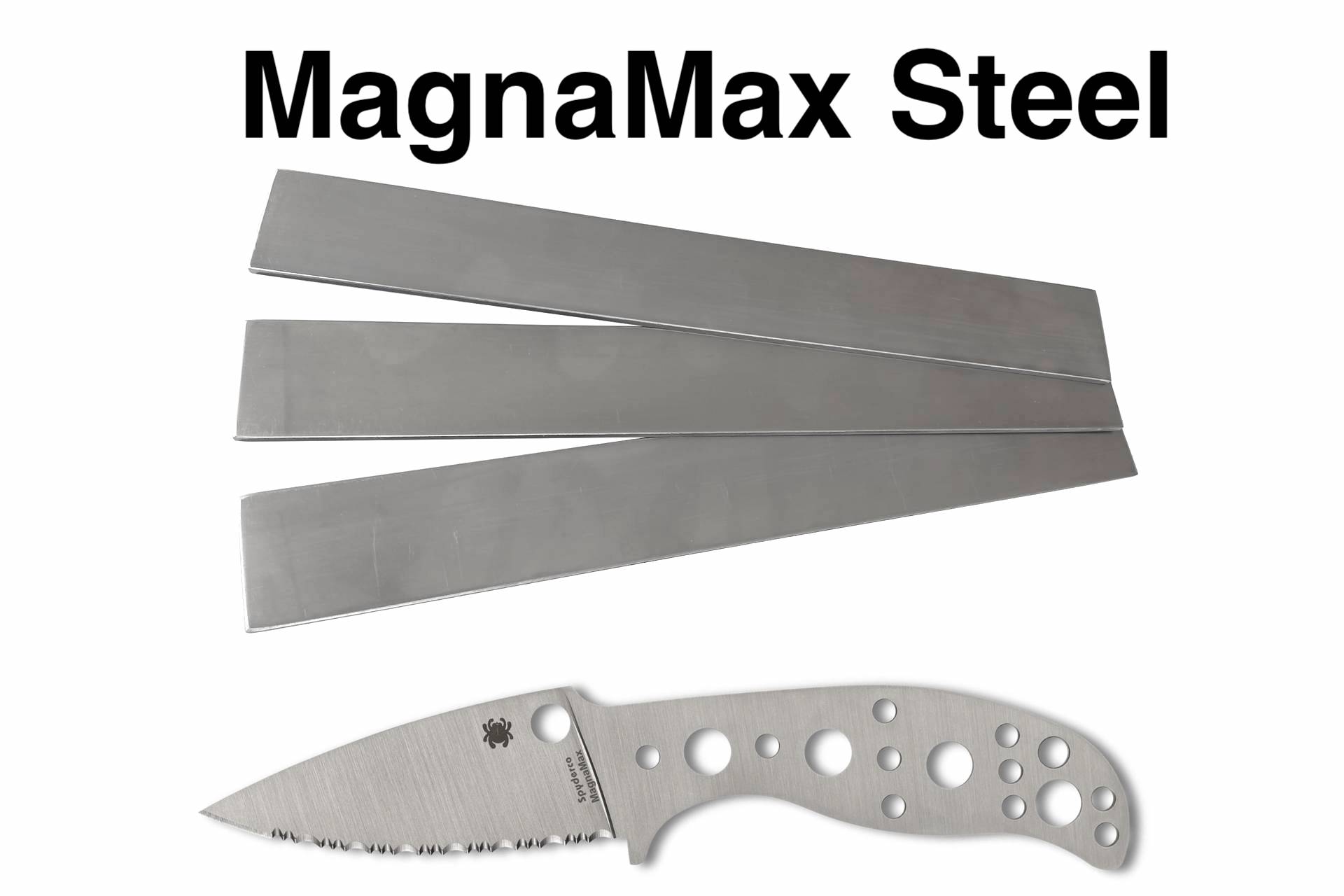
MagnaMax® is a powder-metallurgy stainless knife steel developed by metallurgist Dr. Larrin Thomas. It belongs to the same design family as MagnaCut, but puts more emphasis on abrasive wear resistance and slicing edge retention. The trade-off is lower toughness, not the loss of stainless performance. Niagara Specialty Metals now sells commercial MagnaMax stock, and knife manufacturers have begun using it in finished production models. [4] [7] [10]
The useful question is not whether MagnaMax replaces MagnaCut. It is whether your knife benefits more from additional wear resistance or from a larger margin against fracture and chipping. Heat treatment and blade geometry belong in that decision alongside the steel name.
High-wear knife steels often ask the buyer to accept reduced toughness, more corrosion maintenance, or both. MagnaMax targets the wear-resistance territory of steels such as K390 and CPM-10V while retaining a strongly corrosion-resistant matrix. That makes it a different proposition from simply increasing the hardness of MagnaCut. [10]
The design uses more hard vanadium and niobium carbides without relying on a large population of chromium carbides. The objective is a better combination of properties within the high-wear stainless category rather than the highest possible score in every test. For the lower-carbide starting point, see our MagnaCut steel guide. [5]
In Thomas’s January 2026 toughness-versus-CATRA comparison at roughly 62 HRC, MagnaMax plots at about 715 mm total card cut, versus just over 500 mm for MagnaCut. These are approximate graph readings rather than exact values transcribed from a numerical results table. They indicate a substantial advantage in that abrasive slicing test, not a guaranteed percentage increase in a finished knife’s working life. The MagnaMax result belongs to the material later identified as Erasteel MM#1. [1] [2]
CATRA testing repeatedly cuts standardized silica-loaded card. Total card cut, or TCC, measures cumulative cutting depth over the test. It does not measure resistance to twisting, impact, accidental staple contact, or every form of edge degradation. A buyer cutting clean abrasive material should pay attention to this result; someone whose edges fail mainly by chipping needs a different comparison. [6]
MagnaMax sacrifices some of MagnaCut’s toughness, but that does not make it unusually fragile among high-wear stainless steels. The January comparison places the MM#1 result at about 9.5 ft-lb at 62 HRC, above the M390/20CV, S90V and S110V reference points in that chart. Those reference points are a published comparison, not a promise that any MagnaMax knife will outlast any knife in those steels. [1]
The later MM#2 hardness-toughness plot shows why heat treatment must accompany the number: approximately 63.6 HRC and 8 ft-lb after a 2150°F austenitize and 350°F temper, versus about 65.5 HRC and 5.4 ft-lb after 2250°F and 300°F. Both conditions used plate quenching, liquid nitrogen and two two-hour tempers. These approximate readings come from the toughness specimens, not the separate hardness-only coupons. [2]
The tests use small, unnotched Charpy specimens. Their absorbed impact energy is useful for comparing controlled material conditions; it is not a blade-breaking load, a lock-strength rating or a full-size notched Charpy value. [2]
Both Erasteel MM#1 and MM#2 passed Thomas’s 1% saltwater corrosion test under the reported conditions. The samples were austenitized at 2150°F. That supports strong stainless performance in both tested heats, including the higher-carbon MM#2. It does not establish identical behavior in every environment or heat treatment. [2]
Niagara’s technical documentation also identifies corrosion resistance as a central property of commercial MagnaMax. Stainless should still be read as corrosion-resistant, not immune: the documentation does not certify indefinite saltwater immersion, wet-sheath storage or every blade finish. [4]
Published MM#2 laboratory testing reached approximately 66 HRC in the small hardness-coupon series after 2250°F austenitizing, liquid nitrogen and two 300°F tempers. That is demonstrated hardness potential under a specific laboratory process, not a universal production specification. In a finished-knife example, Bradford specifies 61–62 HRC for its MagnaMax Guardian 3. [2] [7]
Niagara’s guidance spans austenitizing temperatures of 2050–2250°F, with low-temperature double tempering at 300–450°F. These are process windows whose appropriate combination depends on the cold-treatment route and property target, not interchangeable settings. [4]
Those numbers answer different questions: what the material can reach in a particular laboratory process, and what one manufacturer chooses for a particular knife. A lower advertised range is not, by itself, evidence of defective heat treatment; a higher number is not proof of a better knife.
Thomas reports approximately 16% carbide volume in MagnaMax, roughly twice that of MagnaCut. This is a microstructural volume fraction, not the steel’s vanadium percentage or a complete chemical composition. The reported carbide system centers on vanadium and niobium carbides. [1]
Both carbide type and size matter. Hard particles resist abrasive wear, but their distribution and size also influence where cracks can develop. Powder metallurgy helps control that structure. Avoiding large chromium-carbide populations is therefore part of the toughness strategy, while keeping chromium available in the surrounding matrix supports corrosion resistance. More carbide alone would not explain MagnaMax’s intended balance. [5]
Niagara’s current datasheet does not publish a complete nominal composition table; its composition field reads “Patent Pending.” Exact elemental percentages circulated elsewhere should not be substituted for an official formula. For broader context, use the knife steel chart, but retain each source’s hardness and test conditions when comparing results. [4]
A heat is a batch of steel, not a heat-treatment recipe. MagnaMax’s development history includes different heats as well as different hardening processes. Keep those two variables separate.
| Material or test series | Status | Important distinction |
|---|---|---|
| Early Crucible development heat | Prototype | Development material, not a universal commercial baseline. |
| Second Crucible heat, associated with the early Spyderco Mule | High-carbon prototype | Overshot the carbon target; reduced corrosion resistance relative to final material. |
| Erasteel MM#1 | First published Erasteel test heat | Carbon near the lower end of the specification; used in the January property report. |
| Erasteel MM#2 | Later Erasteel test heat | Carbon nearer the specification midpoint; used for the broader heat-treatment study. |
| June industrial heat-treatment series | Production-scale process testing | Peters’ Heat Treating, 2-bar gas quench and different specimen dimensions. |
Sources for the material and process distinctions: [1] [2] [3].
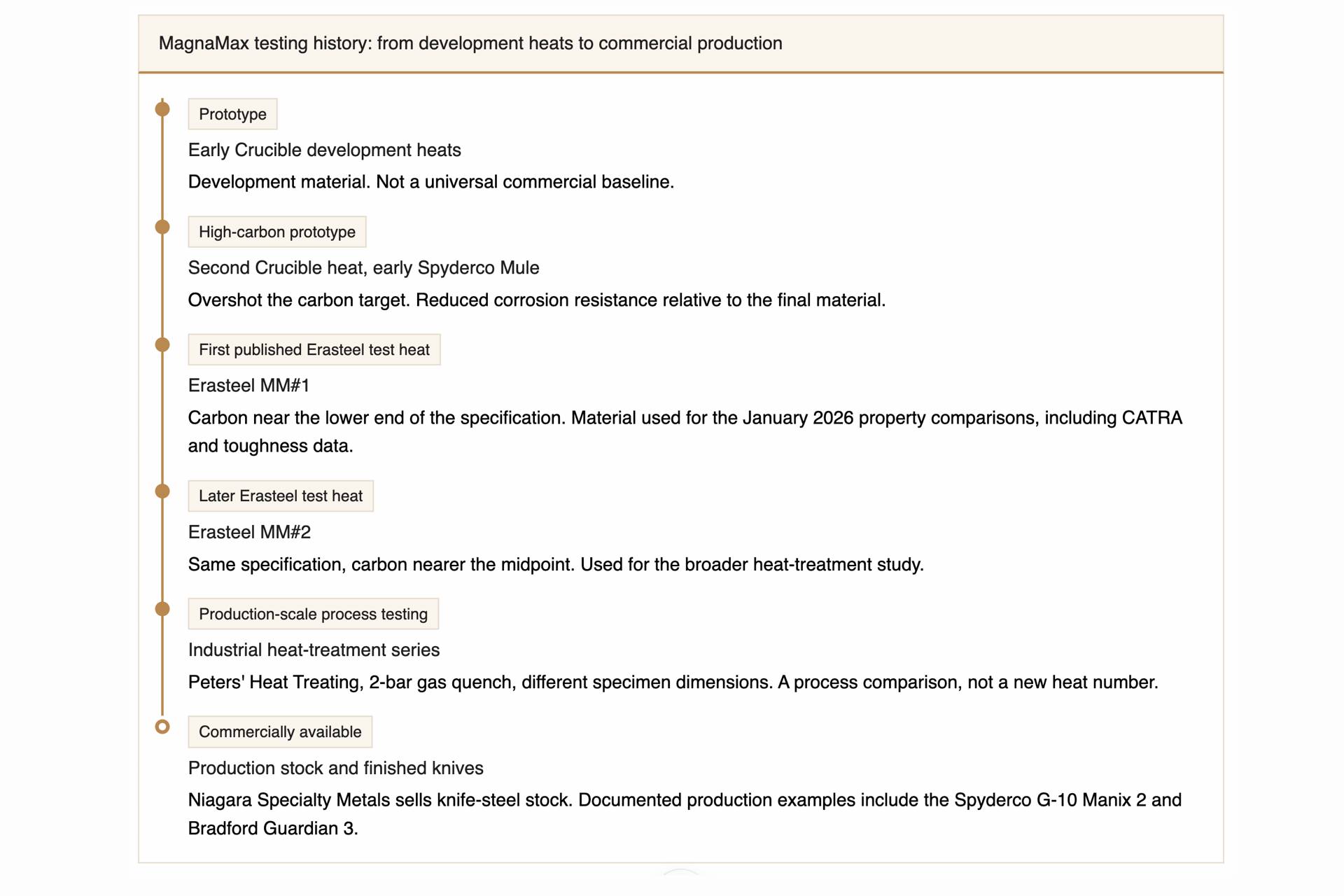
The early Mule-related material is especially important when reading corrosion reports. A result obtained from that prototype is evidence about that specimen, not a clean verdict on later commercial MagnaMax. Conversely, later laboratory results should not be used to rewrite the behavior of an earlier knife. [1]
MM#2 was not a new alloy specification replacing MM#1. Both were within the same specification; the later heat contained more carbon and its results shifted toward higher hardness. The April heat-treatment article also reuses previously tested CATRA results. Its publication date does not turn that chart into a newly measured MM#2 edge-retention dataset. [2]
The June study compared small-shop plate-quench results with industrial vacuum-furnace work using a 2-bar gas quench. Gas-quenched hardness coupons generally returned lower hardness, and the toughness comparison also showed a process-related difference. However, specimen sizes and grouping differed between the series. [3]
The practical lesson is to verify the finished process, not to declare all industrial heat treatment inferior. Quench pressure, furnace loading and section size affect cooling. A recipe that produces one result on a small coupon cannot guarantee the same result throughout a production load. The June series is kept separate here rather than assigned an unverified commercial heat number. [3]
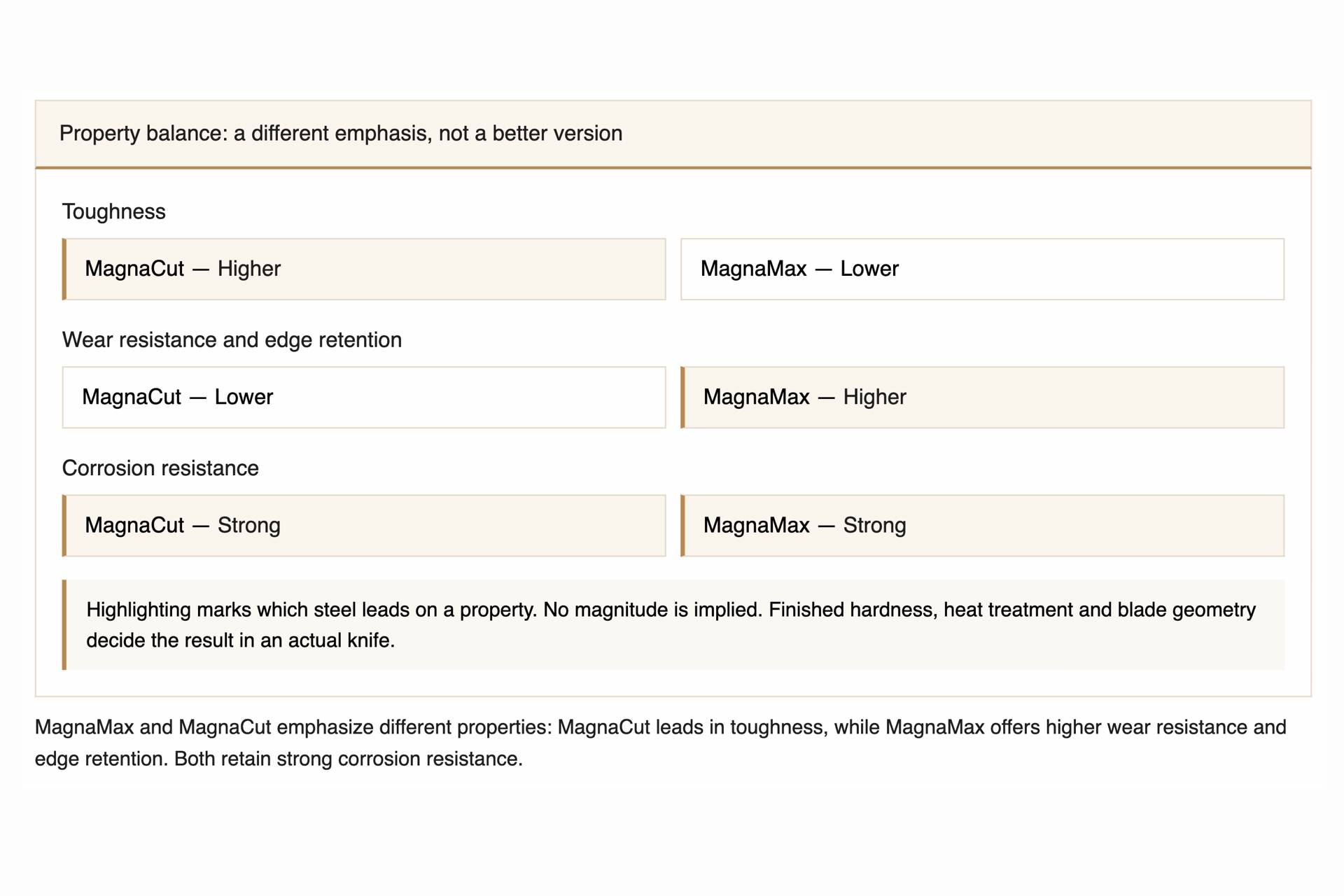
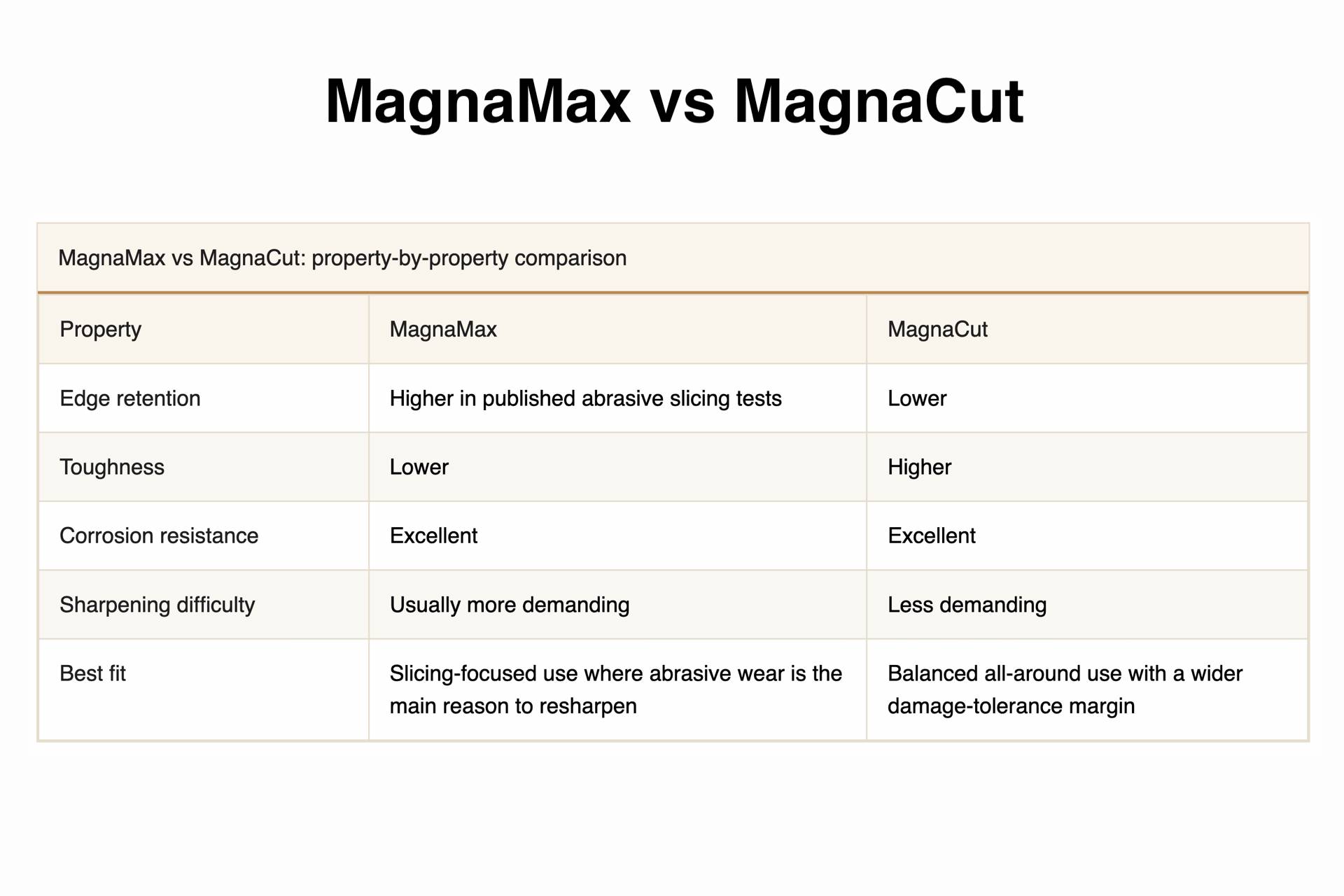
For controlled abrasive slicing, the published CATRA evidence favors MagnaMax. The decision becomes less straightforward when comparing different knife designs: a wear-resistant steel cannot compensate for a thick grind that wedges in the material. Use the steel comparison to select a candidate, then compare the actual blades. [10]
MagnaCut is the stronger choice when fracture resistance is the main priority. Its advantage gives a maker more room to balance edge thinness against damage tolerance. That is not permission to pry with either steel, nor does laboratory toughness alone determine whether a particular apex will roll or chip. Hardness, edge support and the load all remain relevant. [9] [10]
Both steels have strong published corrosion performance. MagnaMax’s appeal is retaining that property while moving into a higher wear-resistance class. The available evidence does not justify a universal corrosion winner across salt, acids, surface finishes and heat treatments. For most buyers, the wear-versus-toughness decision is better supported than an attempt to rank the two by tiny corrosion differences. [5] [9]
MagnaMax’s higher carbide loading gives a reasonable basis to expect more demanding reprofiling or polishing than MagnaCut, especially with poorly suited abrasives. That is a materials-based expectation, not a measured sharpening-time comparison. General knife-steel testing has also shown that burr removal can matter more to perceived difficulty than the number of strokes needed to raise an edge. [6]
As a selection framework, consider MagnaMax for a slicing-focused folder or compact fixed blade when abrasive wear is the main reason you resharpen. Consider MagnaCut when you value a broader damage-tolerance margin, particularly in a knife expected to meet less predictable cutting loads. These are applications inferred from the property balance, not results of a controlled field trial between finished knives. [10]
For a custom order, ask the maker to explain the proposed geometry before selecting the harder or more wear-resistant option. For an existing collection, inspect how your current edge fails: gradual dulling, rolling and visible chips call for different responses. Our guide to choosing knife steel by use provides the broader decision framework.
“MagnaMax” on the blade does not tell you the finished hardness or the process that produced it. Austenitizing prepares the steel’s high-temperature structure; quenching and subsequent cold treatment influence how much transforms into hard martensite; tempering adjusts the resulting properties. Retained austenite is material that has not completed that transformation. Its amount cannot be read from a steel stamp. [9]
One easily missed distinction in the published guidance is that “without cryo” does not necessarily mean “without cold treatment.” The non-liquid-nitrogen recommendation still uses a freezer or dry ice. Buyers should ask what process was actually used rather than treating every mention of “cryo” as equivalent. Makers should follow the current technical documentation, not use this profile as a furnace schedule. [4]
Geometry needs equally precise language. Blade stock thickness describes the starting section; the primary grind controls how that thickness reduces toward the edge; thickness behind the edge describes the material supporting the sharpening bevel. Edge angle describes the bevel itself. A thin spine does not guarantee thin cutting geometry, and a polished bevel does not reveal the thickness above it. [6]
When requesting specifications, ask where thickness behind the edge was measured and whether the sharpening angle is per side or inclusive. For example, 15° per side is 30° inclusive; those are not different sharpening settings. See the knife sharpening angle guide for terminology and the knifemaking hub for related manufacturing topics.
Diamond or CBN is a sensible starting choice for MagnaMax, especially for reprofiling. Both are superabrasives suited to working hard carbide-bearing steels. This recommendation follows the reported microstructure and broader sharpening evidence; the sources reviewed here do not provide a controlled MagnaMax trial establishing one abrasive as faster, longer-lasting or universally superior. [6] [8] [9]
Bond type matters. A plated abrasive surface is not the same product as a resin-, metal- or vitrified-bonded stone. The bond helps determine how abrasive is held and exposed as the surface wears. Follow the particular manufacturer’s instructions for lubrication, cleaning and dressing. Do not select a stone solely because “diamond” or “CBN” appears on the label. [8]
Match grit to the work. Resetting an angle or removing damage calls for a different starting abrasive than a light touch-up. Compare particle size and the maker’s grading system rather than assuming identical grit numbers mean identical finishes. Establish a clean apex before progressing; polishing a bevel that has not reached the edge does not complete the sharpening job. [6] [8]
Use controlled pressure and check the surface. More force is not a reliable cure for a loaded or poorly conditioned stone. Start within the stone maker’s pressure guidance, inspect progress, and lighten the finishing passes. CGS, for example, explains that its bonded stones need some pressure but deteriorate in performance when pressure becomes excessive. That product-specific guidance should not be turned into a universal pressure setting. [8]
Choose the edge finish for the cut. General sharpening research supports distinguishing slicing bite from highly refined push-cutting performance. It does not establish one ideal finishing grit for every MagnaMax blade. A useful personal comparison is to hold the angle constant, change only the finish, and record performance on your usual material. For the underlying workflow, see how to sharpen a knife. [6]
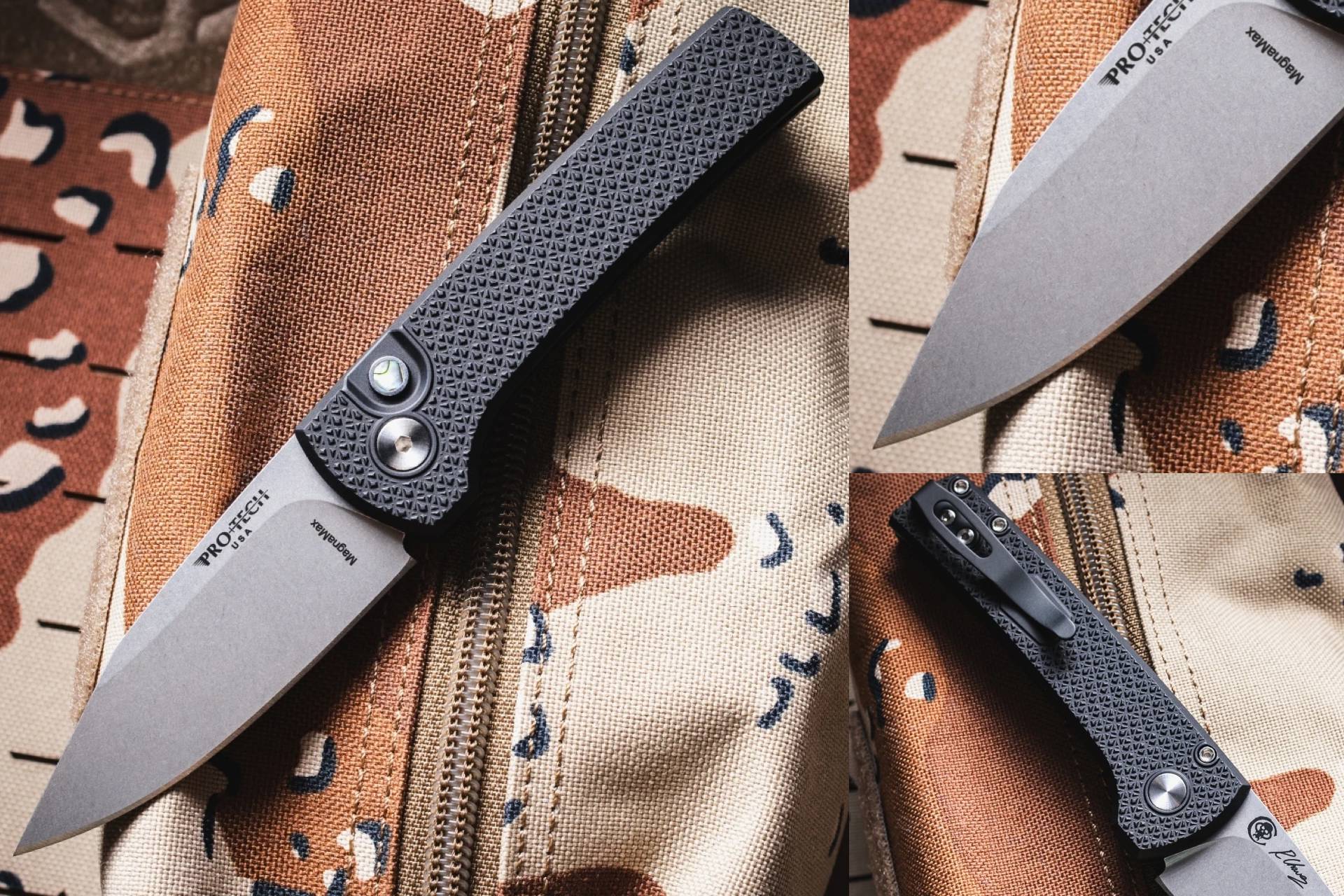
As of September 15, 2026, MagnaMax is commercially available, not merely experimental. Niagara lists raw knife-steel stock. Spyderco’s official G-10 Manix 2 page specifies MagnaMax, and Bradford lists a MagnaMax Guardian 3 with a stated 61–62 HRC range. These are dated examples of adoption, not a guarantee that every configuration is in stock. Older examples of a model may use another steel, so verify the actual knife being offered. [4] [7]
Before buying, request enough information to answer these questions:
A maker may not publish a complete proprietary process or heat number. That is not automatically disqualifying. Clear finished specifications and a coherent explanation of the design are more useful than an unsupported claim of maximum performance.
When comparing a knife at Noblie Custom Knives or commissioning one elsewhere, start with what the blade must do. MagnaMax is worth considering when the additional wear resistance solves a real cutting problem; the steel name alone is not a reason to replace a knife that already works.
Yes. Niagara identifies MagnaMax as a stainless PM knife steel, and the tested Erasteel heats showed strong corrosion resistance. Stainless does not mean rustproof, and early high-carbon prototype results should not be treated as the corrosion specification for all commercial material. [4] [1]
Neither is universally better. MagnaMax favors greater abrasive slicing edge retention; MagnaCut favors higher toughness. The better purchase depends on the finished blade’s geometry, heat treatment and the way its owner actually cuts. [10]
Yes. As of September 15, 2026, official manufacturer examples include the MagnaMax G-10 Spyderco Manix 2 and Bradford Guardian 3. Confirm the blade steel on the specific item rather than assuming that all knives sharing a model name use the latest material. [7]
Finished specifications vary: Bradford lists 61–62 HRC for its MagnaMax Guardian 3, while published laboratory heat-treatment work demonstrates higher hardness potential, approaching 66 HRC in a small hardness-coupon series. Neither number is a universal recommendation. Ask for the finished knife’s stated range and intended use. [2] [7]


There are no comments for this article yet.