


Contents
The best knife steel in 2026 is not one alloy for every blade. A compact EDC folder, a hunting knife, a thin kitchen slicer, a survival fixed blade, a saltwater tool, and a budget work knife all ask for different tradeoffs. Edge retention matters, but so do toughness, corrosion resistance, sharpening effort, blade geometry, heat treatment, and how the knife will actually be used.
This guide is written as a practical decision guide for buyers comparing EDC, hunting, kitchen, survival, saltwater, budget, and collector-grade custom knives. Instead of ranking steels by hype or price, it explains which steels make sense for each knife category and where popular choices such as CPM MagnaCut, M390, CPM 20CV, CPM 3V, Vanax, 14C28N, AEB-L, and Damasteel are strongest.
Use this page when you need a clear recommendation by knife type. If you want a deeper steel-by-steel technical reference with edge retention, toughness, corrosion resistance, sharpening difficulty, HRC ranges, and best-use notes, see our knife steel chart. That page is the technical comparison. This page is the buying guide.
Steel choice matters, but it does not work alone. A well-treated 14C28N, AEB-L, 80CrV2, or S35VN blade with good geometry can outperform a poorly heat-treated premium steel. Before paying for a “super steel,” look at the full knife: heat treatment, edge angle, grind, behind-the-edge thickness, blade finish, handle design, lock or tang construction, and the maker’s execution.
The table below gives practical starting points. These are not absolute rankings. They are steel recommendations based on common knife use, maintenance needs, sharpening difficulty, corrosion exposure, and the balance of edge retention and toughness.
| Use Case | Best Steel Choices | Value / Budget | Why |
|---|---|---|---|
| Best Overall | CPM MagnaCut CPM S45VN CPM S35VN | 14C28N | Balanced corrosion resistance, toughness, edge retention, and sharpening behavior. |
| EDC Folding Knives | CPM MagnaCut M390 CPM 20CV CPM S45VN CPM S35VN | 14C28N Nitro-V D2 | Practical mix of edge retention, stainless performance, and manageable sharpening. |
| Hunting Knives | CPM MagnaCut Elmax CPM S35VN CPM S45VN | 14C28N 80CrV2 1095 | Edge stability, corrosion resistance around blood and moisture, field-serviceable sharpening. |
| Survival & Bushcraft | CPM 3V CPM CruWear CPM 4V CPM MagnaCut | 80CrV2 5160 1095 | Toughness, impact resistance, and easy field repair matter more than extreme wear resistance. |
| Kitchen Knives | AEB-L SG2/R2 CPM MagnaCut VG-10 | 14C28N Nitro-V 52100 | Fine grain, thin geometry, corrosion resistance, and clean sharpening response. |
| Saltwater & Fishing | Vanax SuperClean LC200N H1/H2 CPM MagnaCut | N680 | Corrosion resistance dominates around saltwater, fish, sweat, and marine environments. |
| Max Edge Retention | CPM S90V CPM S110V M398 MagnaMax K390 Maxamet CPM 10V | D2 | Holds an edge longer in abrasive use but harder to sharpen and less forgiving overall. |
| Budget Knives | 14C28N Nitro-V D2 420HC | AUS-8 8Cr13MoV | Easy to sharpen, reasonable corrosion resistance, predictable performance in real use. |
| Collector & Premium Custom | Damasteel CPM MagnaCut M390 CPM 20CV Damascus Mosaic Damascus | 154CM Elmax N690 | Combines performance, rarity, pattern, finish quality, engraving, and maker execution. |
For a full steel-by-steel technical breakdown, see our knife steel chart — it covers edge retention ratings, toughness scores, corrosion resistance, HRC ranges, and sharpening difficulty for all major alloys.
Knife steel marketing often focuses on one impressive property: edge retention, hardness, corrosion resistance, or toughness. Real knives are more complicated. A steel can be excellent on paper and still perform poorly if the heat treatment is weak, the edge is too thin for the job, or the knife is used outside its design limits.
The best way to choose steel is to start with the knife’s purpose. An EDC folder usually needs a different balance than a camp knife. A hunting knife needs different priorities than a kitchen slicer. A saltwater knife should not be judged by the same standards as a dry-use cardboard cutter.
Edge retention is how long a knife keeps a useful cutting edge before it needs sharpening. If you cut cardboard, rope, carpet, plastic strapping, or other abrasive materials, edge retention matters. Steels such as CPM S90V, CPM S110V, M390, CPM 20CV, M398, K390, Maxamet, CPM 10V, and MagnaMax are strong in this category.
The trade-off is sharpening. High-wear steels usually contain hard carbides that resist abrasion. That helps the edge last longer, but it also makes the steel slower to sharpen. These steels are best for users who have good sharpening equipment and do not mind spending more time on maintenance.
Choosing the right sharpening angle for your steel is just as important as the steel itself. Our knife sharpening angle guide explains which angles work best for different steels and use cases.
Toughness is the steel’s ability to resist chipping, cracking, and breaking under stress. It matters most in survival knives, bushcraft knives, camp knives, hunting knives, large fixed blades, and tools that may hit wood, bone, dirt, staples, or hard materials. A tough steel is often more useful in the field than a steel with extreme wear resistance.
Strong toughness choices include CPM 3V, CPM CruWear, CPM 4V, 80CrV2, 5160, 1095, AEB-L, 14C28N, and properly heat-treated CPM MagnaCut. These steels are not all equal in corrosion resistance or edge retention, but they are more forgiving than ultra-high-wear steels when the knife sees rough use.
Corrosion resistance matters when a knife is exposed to sweat, humidity, rain, saltwater, food acids, blood, or long storage. Stainless steels usually need less care than carbon and tool steels, but stainless does not mean rust-proof. Even very corrosion-resistant blades should be rinsed and dried after saltwater or acidic exposure.
For wet and saltwater use, Vanax SuperClean, LC200N, H1/H2, N680, and CPM MagnaCut are the strongest choices. For normal EDC and outdoor use, CPM S45VN, CPM S35VN, M390, CPM 20CV, 14C28N, VG-10, and Elmax are practical stainless options. Carbon steels such as 1095, 52100, O1, 80CrV2, and 5160 need more maintenance.
Ease of sharpening is underrated. A steel that sharpens quickly can be more useful than a super steel that holds an edge longer but is difficult to restore. Field knives, kitchen knives, beginner knives, and hard-use outdoor blades often benefit from steels that can be brought back with simple stones or compact sharpeners.
Easy-sharpening steels include 1095, 420HC, AUS-8, 8Cr13MoV, AEB-L, 14C28N, Nitro-V, 13C26, 440A, and many simple carbon steels. Difficult-to-sharpen steels include CPM S90V, CPM S110V, M398, Maxamet, K390, CPM 10V, M390, and CPM 20CV. Neither group is automatically better. They are built for different users.
Heat treatment often matters more than the steel name. The same alloy can perform very differently depending on austenitizing temperature, quench, cryogenic treatment, tempering, and final hardness. A premium steel with poor heat treatment can chip, roll, corrode more easily, or lose its edge faster than expected.
When buying a serious knife, especially a custom knife, ask about the target hardness and intended use. A kitchen knife, hunting knife, EDC folder, and survival knife should not all be heat treated to the same goal. Hardness should support the knife’s purpose, not just look impressive in a specification table.
Blade geometry decides how the steel actually cuts. A thin blade with a clean grind can outperform a thicker blade made from a more expensive alloy. Behind-the-edge thickness, primary grind, edge angle, spine thickness, and blade shape all affect cutting performance, edge stability, and durability.
This is why the “best steel” question is incomplete without the knife itself. MagnaCut in a thin EDC folder, MagnaCut in a hunting knife, and MagnaCut in a large outdoor fixed blade are not the same tool. The same steel can feel excellent or disappointing depending on geometry and heat treatment.
Blade shape is part of this equation too. Our knife blade shapes guide explains how drop point, clip point, tanto, and other profiles affect cutting behavior and steel choice.

The best steel for an EDC folder should balance edge retention, corrosion resistance, toughness, and sharpening effort. Everyday carry knives usually cut packaging, cardboard, cord, food, plastic, and light utility materials. They are also exposed to sweat, pocket lint, humidity, fingerprints, and occasional careless use. That makes balanced stainless steels more practical for most EDC users than extreme specialist steels.
For a premium EDC folder, CPM MagnaCut is one of the strongest all-around choices. It gives excellent corrosion resistance, good toughness for a stainless knife steel, and enough edge retention for serious daily use. It is especially useful if the knife may be carried in humid weather, used around food, or maintained by someone who wants performance without excessive sharpening difficulty.
M390 and CPM 20CV are better choices when edge retention is the main priority. They are excellent for slicing cardboard, packaging, rope, and other abrasive materials, and they remain common in premium folding knives. Their trade-off is sharpening effort and lower toughness compared with MagnaCut or S35VN. They are best in well-ground folders used for cutting, not prying or impact work.
CPM S45VN and CPM S35VN remain highly practical EDC steels. They do not have the wear resistance of M390 or S90V, but they are easier to sharpen and more forgiving. For many buyers, S45VN and S35VN are better everyday steels than more exotic alloys because they give a useful balance without demanding specialist sharpening equipment.
For value EDC knives, 14C28N and Nitro-V are excellent choices. They sharpen easily, resist corrosion well, and support thin, efficient edges. D2 can also be a good budget EDC steel if the knife is used mostly in dry conditions and the owner understands that D2 is semi-stainless, not truly stainless. If easy maintenance matters more than edge retention, 14C28N is usually the safer choice.
If you are comparing steels for everyday carry, browse our handcrafted pocket knives to see how steel choice, blade geometry, handle material, and lock design come together in finished knives.
For premium titanium folders, the steel decision is especially tied to action, lockup, detent, blade finish, and grind. Our Herman Knives category is a useful comparison point because the current selection includes MagnaCut, M390, M398, RWL34, and Damasteel folders in exact-piece listings.
Best EDC steel picks
If you want to compare what these steels look like in finished blades, the blade gallery shows a range of grinds, finishes, and profile styles across different knife types.
Hunting knives need a different steel balance than pocket knives. A hunting knife may be used around blood, hide, hair, bone, fat, wet grass, rain, and cold weather. Edge retention matters, but so do toughness, corrosion resistance, and field sharpening. A steel that performs well in a controlled cardboard test may not be the best hunting steel if it chips easily or becomes difficult to restore away from the shop.
CPM MagnaCut is one of the strongest modern choices for hunting knives because it combines stainless corrosion resistance with enough toughness for field use. It is especially useful for hunters who want a blade that can handle moisture and organic material without constant maintenance. In a well-designed hunting knife, MagnaCut works for skinning, field dressing, camp prep, and general outdoor cutting.
CPM S35VN and CPM S45VN are also excellent hunting knife steels. They are stainless, balanced, and easier to sharpen than many high-wear PM steels. They make sense for hunters who want reliable performance without moving into very hard-to-sharpen alloys. S35VN has a long track record in hunting and outdoor knives, while S45VN offers a slightly more modern stainless profile.
Elmax remains a strong premium hunting steel when heat treated well. It offers good corrosion resistance, respectable edge retention, and enough toughness for normal hunting tasks. It is not as fashionable today as MagnaCut, but it is still a capable steel for fixed blades and premium outdoor knives.
For value hunting knives, 14C28N is hard to ignore. It is stainless, tough for its class, easy to sharpen, and practical in wet field conditions. For hunters who prefer carbon steel, 80CrV2 and 1095 are good choices when the blade geometry is appropriate and the owner is willing to clean and oil the knife after use.
For finished examples, see our handmade hunting knives, where steel choice is only one part of the full design: blade shape, handle grip, guard, sheath, balance, and edge geometry all matter in the field.
Best hunting steel picks
Survival and bushcraft knives need toughness before anything else. These knives may be used for carving, feather sticks, chopping small wood, batoning, shelter work, food prep, fire prep, and general camp tasks. In this category, extreme edge retention is less important than edge stability, impact resistance, repairability, and predictable behavior under stress.
CPM 3V is one of the best modern steels for hard-use fixed blades. It offers excellent toughness, good edge stability, and better wear resistance than simple carbon steels. It is not stainless, so it needs care, but it is one of the strongest choices for survival knives, camp knives, and larger fixed blades where chipping resistance matters.
CPM CruWear is another excellent hard-use steel. It is tougher and more forgiving than many high-wear stainless steels, while still holding an edge well enough for serious outdoor use. CruWear is especially good for users who want a tough tool steel but do not want the sharpening difficulty of K390, Maxamet, or CPM 10V.
CPM 4V can also work well in hard-use knives when the maker wants more wear resistance than CPM 3V while keeping useful toughness. It is not as impact-resistant as 3V, but it gives a strong mix of edge retention and stability for demanding fixed blades and robust folders.
For traditional and value-oriented survival knives, 80CrV2, 5160, and 1095 remain practical choices. They sharpen easily, tolerate rough use well, and can be repaired in the field with simple stones. Their weakness is corrosion resistance. If the blade will be used in wet climates, around saltwater, or with minimal care, stainless options such as CPM MagnaCut may be more practical.
MagnaCut deserves mention in this category because it gives much better corrosion resistance than tool and carbon steels while still offering strong toughness for a stainless steel. It is not as tough as CPM 3V in a pure hard-use role, but for outdoor users who want one stainless knife for wet and dry conditions, it is one of the most sensible choices.
For hard-use fixed blades, compare real blade designs in our fixed blade knives. In survival knives, steel is only part of the decision; tang construction, handle security, blade thickness, grind, and sheath design matter just as much.
Best survival and bushcraft steel picks
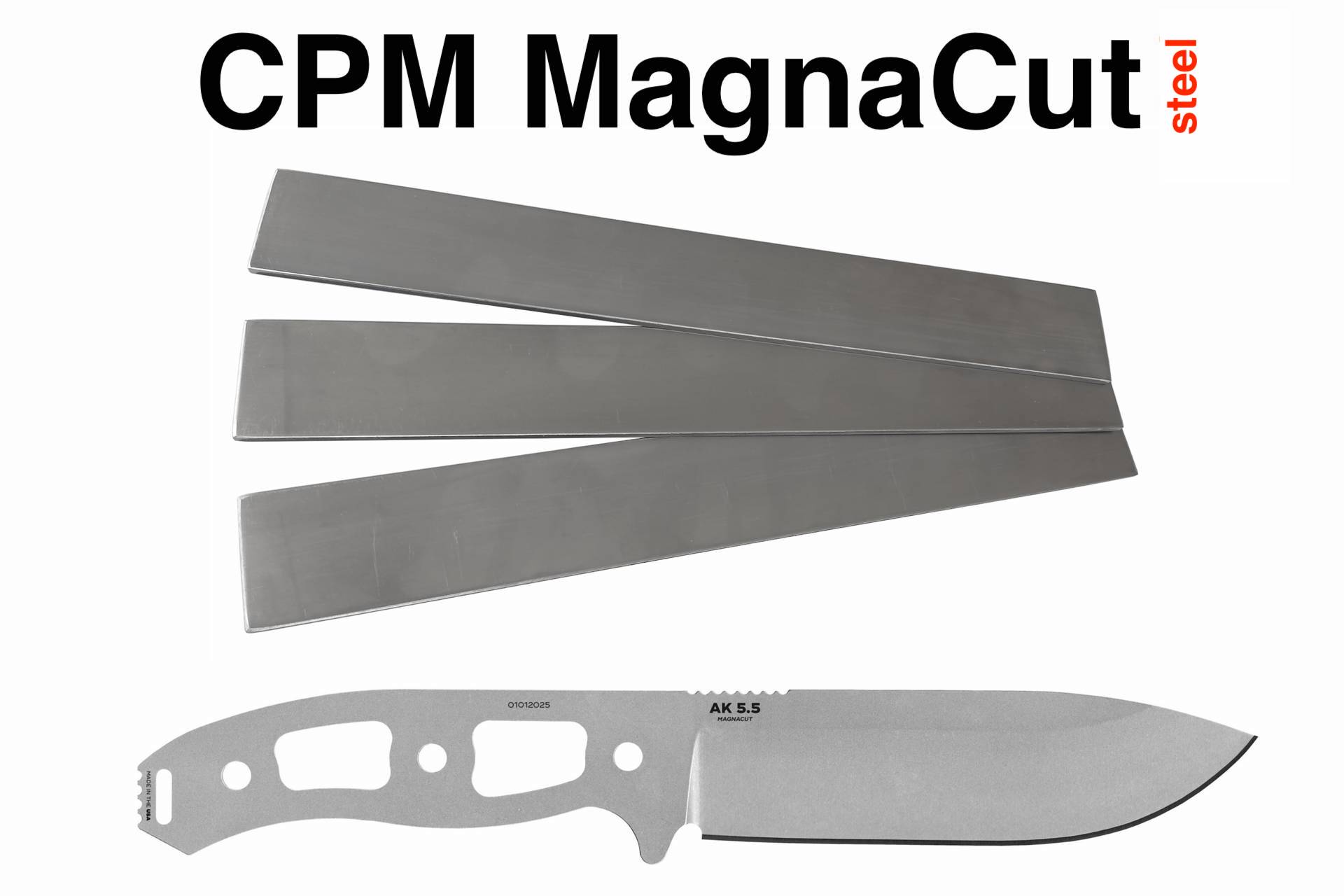
Kitchen knives need fine edges, clean cutting geometry, corrosion resistance, and predictable sharpening. The best kitchen steel is not always the steel with the highest wear resistance. A chef’s knife, slicer, paring knife, or fillet knife usually works with thin geometry, controlled cuts, food acids, moisture, and frequent washing. That makes fine-grained steels especially valuable.
AEB-L is one of the best practical stainless steels for kitchen knives. It has a very fine microstructure, sharpens easily, takes an exceptionally keen edge, and offers excellent toughness for a stainless knife steel. It does not have the extreme wear resistance of S90V, M398, or K390, but that is not the point. In a thin kitchen blade, edge stability and clean sharpening often matter more than maximum abrasive edge retention.
SG2, also known as R2, is a strong choice for high-end Japanese kitchen knives. It is a powder metallurgy stainless steel that can run at high hardness and support thin, precise edges. SG2/R2 is excellent for users who want refined slicing performance and good edge retention, but it should be used with care. It is not a steel for twisting cuts, bones, frozen food, or rough chopping.
CPM MagnaCut is increasingly relevant for kitchen knives because it combines stainless corrosion resistance, good toughness, and useful edge retention. It is not a traditional Japanese kitchen steel, but it works well when the maker wants a modern stainless blade that can handle food acids, moisture, and thin geometry better than many older high-wear stainless steels.
VG-10 remains a proven kitchen knife steel. It offers good corrosion resistance, takes a sharp edge, and performs well in Japanese kitchen knives when the geometry is right. It can be less forgiving if pushed too thin or too hard, but for normal kitchen use it remains a respectable stainless choice.
For value kitchen knives, 14C28N and Nitro-V are excellent. They sharpen easily, resist corrosion well, and support thin cutting geometry. 52100 is also a strong carbon-steel option for kitchen knives, especially for users who like fine edges and do not mind patina or extra maintenance. Carbon kitchen steels can cut beautifully, but they must be wiped and dried after use.
Best kitchen steel picks
Saltwater knives are a separate category because corrosion resistance becomes the first priority. A knife used around fishing, diving, boating, kayaking, wet ropes, bait, sweat, and marine air faces conditions that can quickly damage ordinary carbon steel, tool steel, and even some stainless steels. For this use, a slightly lower edge-retention score may be acceptable if the blade resists rust better.
Vanax SuperClean is one of the strongest premium choices for saltwater and wet-environment knives. It offers extremely high corrosion resistance with better edge performance than many older saltwater steels. It is a good option for premium folders, fishing knives, and coastal EDC blades where rust resistance matters but the user still wants modern steel performance.
LC200N is another excellent saltwater steel. It is known for very high corrosion resistance, good toughness, and easy maintenance. It does not hold an edge as long as M390, 20CV, S90V, or MagnaMax in abrasive cutting, but that is not its main purpose. For fishing, boating, kayaking, and humid climates, LC200N is often more practical than a higher-wear steel that needs more care.
H1 and H2 are highly corrosion-resistant nitrogen-based steels commonly associated with saltwater knives. They are especially useful in serrated blades, rescue knives, fishing knives, and diving-related tools. Plain-edge H1/H2 will not compete with high-wear PM steels for edge retention, but the corrosion resistance is the reason to choose them.
N680 is a good value-oriented corrosion-resistant steel. It is not a super steel, but it works well in wet-use knives, rescue tools, and outdoor blades where rust resistance is more important than maximum edge holding. CPM MagnaCut also belongs in this discussion because it gives high corrosion resistance with better toughness and edge retention balance than many conventional stainless steels.
Even with saltwater steels, maintenance still matters. Rinse the knife with fresh water after salt exposure, dry it fully, and pay attention to pivots, handle gaps, sheaths, screws, and liners. A corrosion-resistant blade can still have other steel parts that need care.
Best saltwater and fishing steel picks
Budget knife steel should be judged by practical value, not by whether it competes with premium PM alloys. A good budget steel should cut reliably, sharpen without specialized equipment, resist corrosion reasonably well, and match the knife’s price. In this category, heat treatment and geometry can matter even more because small manufacturing shortcuts are more noticeable.
14C28N is one of the best budget-to-mid-range knife steels available. It offers a fine grain structure, good corrosion resistance, useful toughness, and easy sharpening. It is not a super steel, but it performs extremely well in real EDC knives, outdoor utility blades, and thin cutting tools. For many users, 14C28N is the smartest value choice.
Nitro-V is another strong value steel. It follows the practical logic of the AEB-L family: fine edge behavior, good toughness, corrosion resistance, and easy maintenance. It works well in EDC knives, kitchen knives, small fixed blades, and practical working knives.
D2 is a good budget edge-retention steel when the knife is used mostly in dry conditions. It holds an edge longer than many simple budget stainless steels, but it is semi-stainless rather than truly stainless. D2 can rust if neglected, and it is not as tough or easy to sharpen as 14C28N. It is a good choice for affordable cutting performance, not for wet carry or hard impact use.
420HC is a better steel than many buyers assume when it is heat treated properly. It is easy to sharpen, corrosion-resistant, tough for its class, and useful in work knives, outdoor knives, and multi-tools. It will not hold an edge like M390 or S35VN, but it is simple, forgiving, and easy to restore.
AUS-8 and 8Cr13MoV are common budget steels. They are not premium choices, but both can be useful in inexpensive knives if the heat treatment and geometry are reasonable. Their main advantage is easy sharpening. Their main limitation is edge retention.
Best budget steel picks
Premium and collector knives are not judged by steel performance alone. Blade steel still matters, but so do rarity, finish, maker reputation, handle materials, engraving, mechanism quality, symmetry, polish, sheath work, and overall execution. A collector knife can be valuable because it combines steel, design, and craftsmanship into one coherent object.
For premium folding knives, M390, CPM 20CV, CPM MagnaCut, Damasteel, S90V, and S110V are common high-end choices. M390 and 20CV are popular because they offer stainless edge retention and a familiar premium profile. MagnaCut is attractive because it gives a more balanced modern performance package. S90V and S110V are more specialized, favoring edge retention over toughness and easy sharpening.
Damasteel is one of the most important premium steels for collector knives. It combines powder metallurgy stainless performance with a patterned structure, giving the blade both technical and visual value. It is common in high-end folders, presentation knives, custom kitchen knives, and collector-grade pieces where the steel’s appearance is part of the design.
Traditional Damascus and Mosaic Damascus belong in a different category. They are not single steel grades, and their performance depends on the steels used, the forge-welding quality, heat treatment, and blade geometry. Their value often comes from pattern, handwork, billet complexity, and the maker’s control. For collectors, that visible craftsmanship can matter as much as laboratory steel performance.
Engraved knives and presentation knives often use steel as part of the whole composition. A blade in Damascus, Damasteel, M390, MagnaCut, Elmax, or 154CM can be excellent if it fits the design and intended use. The best collector knife is not simply the one with the newest alloy; it is the one where steel, geometry, handle materials, finish, and artistic work belong together.
For collector-grade examples, browse our Damascus knives and engraved knives. These categories are useful for seeing how blade steel, pattern, engraving, handle materials, and presentation work together in finished handmade knives.
Best premium and collector steel picks
For a deeper look at how Damascus is made and what separates pattern-welded steel from forge-welded billets, see our guide on types of Damascus steel.


Most knife steels are not “bad” in isolation. They become bad choices when they are matched to the wrong knife or the wrong user. A steel designed for extreme edge retention may disappoint in a survival knife. A tough carbon steel may be a poor choice for saltwater. A budget stainless steel may be fine for light cutting but frustrating in a premium knife expected to hold an edge for a long time.
The safest way to avoid disappointment is to choose steel by use case, not by reputation. A knife steel chart can show relative properties, but a buyer’s guide should ask a simpler question: what will this knife actually do?
CPM S110V, M398, Maxamet, and K390 are excellent high-wear steels when long edge retention is the priority. They make sense in cutting-focused folders and specialist slicers. They do not make as much sense in survival knives, choppers, or hard-use fixed blades that may see impact, twisting, batoning, or rough field work.
The problem is not cutting ability. These steels can cut extremely well. The problem is forgiveness. High carbide volume and high hardness can reduce toughness and make sharpening slower in the field. For survival and bushcraft, CPM 3V, CPM CruWear, 80CrV2, 5160, 1095, or MagnaCut will usually be more practical.
1095, 52100, and O1 can make excellent carbon-steel knives, but they are poor choices for saltwater unless the user accepts constant maintenance. These steels can patina, stain, and rust quickly around salt, sweat, fish, blood, and humid storage. A coating can help, but the edge, scratches, and exposed areas still need care.
For fishing, boating, kayaking, diving, or coastal carry, corrosion-resistant steels are better choices. Vanax SuperClean, LC200N, H1/H2, N680, and MagnaCut are more suitable because they reduce rust risk and require less maintenance in wet environments.
H1 and H2 are strong saltwater steels, especially for wet-use knives and serrated blades. They are not the best choice if maximum plain-edge retention is the main goal. A user who mostly cuts cardboard, rope, packaging, or abrasive material may prefer M390, CPM 20CV, S90V, S110V, MagnaMax, K390, or CPM 10V.
This does not make H1 or H2 poor steels. It means they solve a different problem. They are chosen for corrosion resistance first. For fishing, diving, rescue work, and saltwater use, that may matter more than long abrasive edge retention.
D2 is often marketed as a near-stainless steel, but that can mislead buyers. D2 has high chromium content, yet much of that chromium is tied up in carbides. In practical use, it behaves as a semi-stainless tool steel, not a true stainless steel. It can rust if exposed to sweat, rain, saltwater, food acids, or damp storage.
D2 is a good budget edge-retention steel for dry-use EDC knives. It is less ideal for fishing knives, humid pocket carry, kitchen knives, or users who rarely clean their blades. If corrosion resistance and easy sharpening matter more, 14C28N, Nitro-V, 420HC, S35VN, S45VN, or MagnaCut are safer choices.
High-hardness kitchen steels such as SG2/R2, ZDP-189, and hard carbon steels can perform beautifully in thin slicers. They are designed for clean cutting, not abuse. They should not be used on bones, frozen food, hard squash stems, twisting cuts, or rough chopping unless the blade is specifically designed for that work.
Kitchen knives need the right geometry as much as the right steel. A thin gyuto, santoku, slicer, or petty knife should be treated as a cutting instrument, not as a cleaver. For rougher kitchen work, use a tougher knife with more suitable geometry.
Expensive steel is not automatically the best steel for a specific knife. M398, S110V, Maxamet, and Damasteel may look impressive in a specification list, but they are not always better than MagnaCut, S35VN, 14C28N, AEB-L, or 80CrV2 for real use. The best steel is the one that fits the knife’s job, not the one with the highest price or most exotic name.
For many users, a well-treated mid-range steel with good geometry is the better choice. A thin 14C28N blade can cut better than a thick M390 blade. A properly designed 80CrV2 fixed blade can be more useful outdoors than a high-wear stainless folder. Context matters.
Before carrying an EDC knife, it is worth checking your local regulations. Our U.S. knife laws by state page covers blade length limits, lock restrictions, and carry rules across all 50 states.
Steel choice is only the starting point. Heat treatment determines whether the alloy reaches its intended performance. This is especially important in custom knives, where the maker has more control over hardness, geometry, intended use, and finishing. When buying a serious knife, it is reasonable to ask how the steel was treated and what the blade was designed to do.
HRC is the Rockwell C hardness of the blade. It gives a useful reference point, but it should not be treated as a simple quality score. A hunting knife, EDC folder, kitchen slicer, and survival knife should not all be pushed to the same hardness. The correct HRC depends on steel type, heat treatment, blade geometry, and intended use.
Higher hardness can improve edge stability and edge retention, but it can also reduce toughness if pushed too far. Lower hardness can improve toughness and ease of sharpening, but it may reduce edge life. The best makers choose hardness to support the knife’s job, not to chase a number.
Many steels can be heat treated toward different goals. A thin slicer may benefit from higher hardness and a fine edge. A hard-use fixed blade may need more toughness and a more conservative edge. A premium folder may be optimized for daily cutting and corrosion resistance rather than impact work.
When buying a custom knife, ask what the maker intended the blade to do. A good answer should connect steel, hardness, edge geometry, and use case. If the answer is only “it is super steel,” that is not enough information.
For a broader overview of materials, construction, and what goes into a handmade blade, visit our knifemaking section, which covers the full process from steel selection to finishing.
For complex powder metallurgy steels, heat treatment quality is critical. Steels such as MagnaCut, M390, CPM 20CV, S90V, S110V, CPM 3V, CruWear, K390, and M398 need controlled temperatures and proper cycles to perform well. The maker may heat treat in-house or use a professional heat-treat service. Both can be valid if the process is controlled.
For buyers, the important point is consistency. A premium steel with weak heat treatment can perform worse than a simpler steel treated correctly. If the knife is expensive, the maker or seller should be able to explain the heat-treatment approach in practical terms.
Cryogenic treatment can be important for many stainless and powder metallurgy steels because it helps complete the transformation of retained austenite and can improve final performance when used as part of a proper heat-treatment schedule. It should not be treated as a magic upgrade by itself.
The useful question is not simply whether the blade was cryo treated. The useful question is whether the full heat-treatment process is appropriate for that steel. Austenitizing temperature, quench, cryogenic step, tempering, and target hardness all work together.
Edge angle changes how a steel performs. A thin, acute edge cuts better but is more vulnerable to damage. A wider edge is more durable but may feel less efficient. A kitchen slicer, EDC folder, hunting knife, and survival knife should not all use the same edge angle.
For example, a high-wear folder in M390 or S90V may perform well with a fine slicing edge if used carefully. A survival knife in 80CrV2 or CPM 3V may need a stronger edge to handle wood, impact, and field abuse. The edge angle should match both the steel and the job.
Behind-the-edge thickness often matters more than steel name. A knife that is too thick behind the edge will cut poorly even if it uses premium steel. A knife that is too thin behind the edge may cut beautifully but chip if used for rough work. This is one reason two knives in the same steel can feel completely different.
When comparing artisan knives, look at geometry as closely as steel. A good maker chooses blade stock, grind, distal taper, and edge thickness according to the intended task. Steel alone cannot fix poor geometry.
Steel choice should fit the whole knife. A premium EDC folder with a thin blade, refined detent, and precise lock does not need the same steel priorities as a heavy fixed blade. A collector dagger, a hunting knife, and a kitchen knife also demand different steel behavior.
In knives, the best results come when steel, blade shape, handle material, lock type, sheath, finish, and intended use are designed together. This is why a finished knife should be judged as a complete tool, not as a steel name attached to a handle.
What is the best knife steel overall?
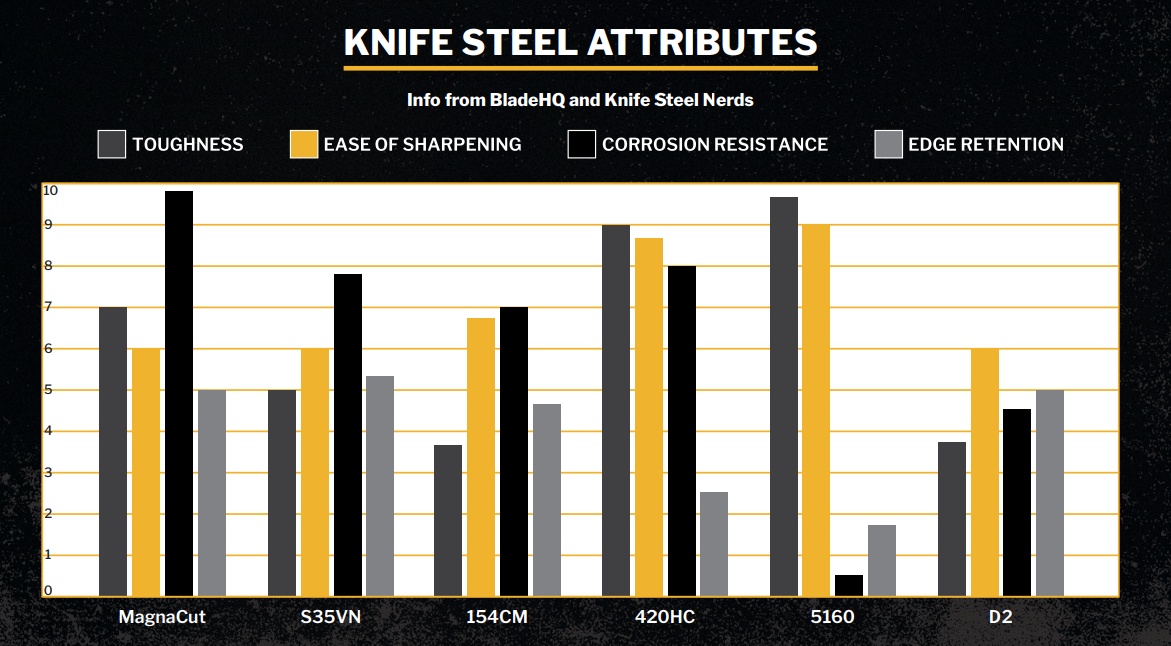
CPM MagnaCut is one of the best overall knife steels because it balances corrosion resistance, toughness, edge retention, and sharpening behavior better than most stainless steels. It is not the highest-edge-retention steel, and it is not the toughest steel ever made, but it is one of the most practical choices for EDC, hunting, outdoor, kitchen, and other types of knives.
What is the best knife steel for EDC?
For EDC knives, CPM MagnaCut is the best all-around premium choice. M390 and CPM 20CV are better if long edge retention is the main priority. CPM S45VN and S35VN are excellent balanced stainless steels. For value EDC knives, 14C28N and Nitro-V are often more practical than many buyers expect because they sharpen easily and resist corrosion well.
What is the best knife steel for hunting?
For hunting knives, CPM MagnaCut, CPM S35VN, CPM S45VN, Elmax, and 14C28N are strong stainless choices. They offer useful corrosion resistance around blood, rain, and field moisture. For carbon or tool-steel hunting knives, 80CrV2 and 1095 can work very well if the blade is properly heat treated and maintained after use.
What is the best knife steel for survival knives?
For survival knives, toughness and edge stability matter more than maximum edge retention. CPM 3V is one of the best modern choices for hard-use fixed blades. CPM CruWear, CPM 4V, 80CrV2, 5160, and 1095 are also strong options. CPM MagnaCut is the best stainless option when corrosion resistance is also important.
What is the best knife steel for kitchen knives?
AEB-L is one of the best stainless steels for kitchen knives because it takes a very fine edge, sharpens easily, and has excellent toughness for thin geometry. SG2/R2 is a strong premium Japanese PM steel. CPM MagnaCut, VG-10, 14C28N, Nitro-V, and 52100 are also good choices depending on whether the user prefers stainless convenience or carbon-steel edge feel.
What is the best knife steel for saltwater?
Vanax SuperClean, LC200N, H1/H2, N680, and CPM MagnaCut are among the best choices for saltwater and fishing knives. In this category, corrosion resistance matters more than maximum edge retention. Even highly corrosion-resistant knives should be rinsed with fresh water and dried after saltwater exposure, especially around pivots, screws, handles, and sheaths.
What is the best budget knife steel?
14C28N is one of the best budget-to-mid-range knife steels because it offers good corrosion resistance, toughness, fine edge behavior, and easy sharpening. Nitro-V is another strong value steel. D2 offers better budget edge retention but needs more corrosion care. 420HC, AUS-8, and 8Cr13MoV can still be useful when heat treated well and used within their limits.
Is MagnaCut better than M390?
MagnaCut is usually better for balanced use, while M390 is usually better for stainless edge retention. MagnaCut has better toughness and corrosion balance, which makes it more practical for EDC, hunting, outdoor, and wet-use knives. M390 is excellent for premium folders and controlled slicing where long edge life matters more than toughness or easy sharpening.
Is S35VN still good in 2026?
Yes. CPM S35VN is still a very good knife steel. It is not the newest option, and MagnaCut has taken much of the attention in premium stainless knives, but S35VN remains balanced, reliable, corrosion-resistant, and easier to sharpen than many high-wear steels. A well-made S35VN knife is still a serious working tool.
Is S45VN better than S35VN?
CPM S45VN is generally a more modern refinement of the S30V/S35VN family, with strong corrosion resistance and practical everyday performance. S35VN is still slightly more familiar to many users and remains a very dependable steel. In real knives, the difference often matters less than heat treatment, blade geometry, edge angle, and the maker’s execution.
Is D2 a good knife steel?
D2 is a good knife steel when used correctly. It offers strong edge retention for the price and works well in dry-use EDC knives and work knives. Its weakness is that it is semi-stainless, not true stainless. D2 can rust if neglected, and it is not as tough or easy to sharpen as steels such as 14C28N, Nitro-V, or S35VN.
Is 420HC a bad knife steel?
420HC is not a bad steel when heat treated well. It is a budget stainless steel with good corrosion resistance, good toughness for its class, and very easy sharpening. It does not hold an edge like M390, S35VN, S45VN, or MagnaCut, but it works well in multi-tools, outdoor knives, traditional folders, and simple work knives.
What knife steel holds an edge the longest?
Steels such as CPM S110V, CPM S90V, M398, Maxamet, K390, CPM 10V, and MagnaMax are among the strongest choices for long edge retention. They are useful for abrasive cutting, but they are usually harder to sharpen and less forgiving than balanced steels. Long edge life is valuable, but it should not be the only criterion.
What is the easiest knife steel to sharpen?
Simple carbon steels and fine-grained stainless steels are usually easiest to sharpen. 1095, 420HC, AUS-8, 8Cr13MoV, AEB-L, 14C28N, Nitro-V, 13C26, and 440A are all easier to maintain than high-wear steels such as S90V, S110V, M398, Maxamet, K390, M390, or CPM 20CV.
Is Damascus steel better than modern knife steel?
Damascus is not automatically better than modern knife steel. Modern pattern-welded Damascus is a construction method, not one fixed alloy. Its performance depends on the steels used, weld quality, heat treatment, and blade geometry. Modern PM steels such as MagnaCut, M390, S90V, and CPM 3V are usually more predictable. Damascus offers craftsmanship, pattern, and collector value.
Is Damasteel good for knives?
Damasteel is good for premium and collector knives because it combines powder metallurgy stainless performance with a patterned structure. It is especially popular in high-end folders, custom kitchen knives, and presentation-grade blades. It should still be judged by heat treatment, geometry, and maker execution, not only by the pattern.
Does higher HRC mean better knife steel?
Higher HRC does not automatically mean better knife steel. Higher hardness can improve edge retention and edge stability, but it can also reduce toughness if pushed too far. The correct HRC depends on the steel, heat treatment, blade geometry, and intended use. A survival knife and a kitchen slicer should not be judged by the same hardness target.
Can a cheaper steel outperform a premium steel?
Yes. A well-heat-treated 14C28N, AEB-L, 420HC, or 80CrV2 blade with excellent geometry can outperform a poorly treated premium steel in real use. Steel name matters, but it does not replace heat treatment, edge angle, grind, blade thickness, and the maker’s understanding of the knife’s purpose.

The best knife steel is not the steel with the highest price, the newest name, or the most impressive laboratory number. The best steel is the one that fits the knife’s job. An EDC folder, hunting knife, kitchen slicer, survival knife, saltwater knife, and collector dagger all need different steel priorities.
For most users who want one modern all-around premium steel, CPM MagnaCut is the easiest recommendation. It gives a rare balance of corrosion resistance, toughness, and practical edge retention. It is not the highest-wear steel and it is not the toughest steel available, but it works across more knife types than most premium stainless steels.
For maximum edge retention in controlled cutting, look at M390, CPM 20CV, CPM S90V, CPM S110V, M398, MagnaMax, K390, Maxamet, and CPM 10V. These steels make sense for users who cut abrasive material and have proper sharpening equipment. They are less suitable for rough survival use, careless impact, or simple field sharpening.
For hard-use fixed blades, toughness matters more than prestige. CPM 3V, CPM CruWear, CPM 4V, 80CrV2, 5160, and 1095 are more practical than many extreme edge-retention steels. For wet outdoor use, MagnaCut becomes especially attractive because it adds strong corrosion resistance to a tough stainless platform.
For kitchen knives, fine grain and geometry often matter more than brute wear resistance. AEB-L, SG2/R2, VG-10, 14C28N, Nitro-V, CPM MagnaCut, and 52100 can all be excellent depending on the knife design and the user’s maintenance habits. A thin, well-ground blade in the right steel will usually outperform a thick blade made from a more expensive alloy.
For saltwater, fishing, boating, and coastal carry, corrosion resistance should come first. Vanax SuperClean, LC200N, H1/H2, N680, and CPM MagnaCut are better choices than carbon steel, D2, CPM M4, K390, 52100, or O1. Around saltwater, the wrong steel can become a maintenance problem quickly.
For budget knives, do not dismiss simple steels. 14C28N, Nitro-V, 420HC, AUS-8, 8Cr13MoV, and properly used D2 can all make useful working knives. A clean heat treatment and good edge geometry matter more than chasing a premium label on an inexpensive knife.
For a full steel-by-steel comparison with edge retention, toughness, corrosion resistance, sharpening ease, HRC ranges, and best-use notes, use our knife steel chart. To compare finished knives, browse the Noblie website, including pocket knives, hunting knives, fixed blade knives, Damascus knives, and engraved knives.
Video Credit: Metal Complex
To see how steel, geometry, handle material, and maker execution come together, browse the knife guide — a practical reference for buyers comparing different knife types and construction styles.
Author: Aleks Nemtcev | Knifemaker with 10+ Years of Experience | Connect with me on LinkedIn | Follow me on Reddit
This guide is based on steelmaker datasheets, independent knife-steel testing, and practical knife-making experience. Manufacturer datasheets are useful for chemistry, heat-treatment windows, and stated material properties. Independent testing is useful because real knife performance depends on heat treatment, geometry, hardness, edge angle, and intended use.
Independent Knife-Steel Research
Steelmaker and Manufacturer References
Related Noblie Guides


I bought a knife with a black blade. On the blade it says HF- JO25, and underneath it CPM MagnaCut. So is the blade real MagnaCut?