


Contents
The best Butterfly Knife skins in Counter-Strike 2 combine the model’s distinctive flipping animation with a finish that looks good in motion. Fade is a strong choice for a bright gradient, Doppler for polished gemstone colors, Marble Fade for a red-blue-yellow blade, and Tiger Tooth for a cleaner gold-and-black look. Collectors who enjoy comparing individual patterns should also look at Case Hardened.
There is no single best finish for every player. Some designs depend heavily on a particular pattern seed or Doppler phase; others look fairly consistent from one example to another. This guide compares eight Butterfly Knife finishes, explains which details matter when inspecting a skin, and identifies the cases associated with each one.
The Butterfly Knife is based on a balisong, a folding knife with two handles that pivot around the blade tang. In CS2, its draw and inspect animations put that mechanism on display: the handles swing, the blade rotates, and the finish remains visible throughout the movement. That makes the Butterfly Knife recognizable even when the player is not actively inspecting it.
Its appeal is visual, not competitive. Equipping a Butterfly Knife skin does not increase knife damage or give its owner a movement-speed advantage over other knife models. The premium is about the animation, appearance, and demand for particular finishes.
For a real-world example of this mechanism, see the Herman Morpho balisong. The mechanical design of a real butterfly knife should not be confused with the cosmetic properties of its CS2 counterpart.
These eight finishes cover several distinct looks: multicolor gradients, reflective Doppler finishes, metallic patterns, and decorative artwork. The comparison emphasizes what to inspect rather than treating the most expensive listing as automatically the best skin.
| Finish | Main appeal | What to inspect | Case family |
|---|---|---|---|
| Fade | Gold, pink and purple gradient | Fade percentage and pattern seed | Operation Breakout |
| Doppler | Glossy blue, purple and red variations | Phase or rare gem finish | Spectrum / Spectrum 2 |
| Marble Fade | Red, blue and yellow color bands | Color placement and pattern | Spectrum / Spectrum 2 |
| Gamma Doppler | Green-toned reflective finish | Phase or Emerald variant | Riptide / Dreams & Nightmares |
| Tiger Tooth | Gold blade with dark stripes | Float and overall appearance | Spectrum / Spectrum 2 |
| Slaughter | Red metallic patterned finish | Visible pattern and wear | Operation Breakout |
| Case Hardened | Blue, gold and purple patches | Pattern seed and blue coverage | Operation Breakout |
| Lore | Gold blade with Celtic-style ornament | Wear around the edge and tip | Riptide / Dreams & Nightmares |
Fade is one of the most recognizable Butterfly Knife finishes. Its polished blade carries a transition between gold, pink, and purple, while the dark handles retain their red inserts. The colors are especially noticeable during flips because the blade continually catches the light.
The important detail is the fade percentage. Different pattern seeds change the balance and placement of the colors. Collectors often prefer examples described as a 100% or full Fade, but a seller’s label is not proof of the pattern. Compare the actual seed and inspect the visible side of the blade before paying a premium.
Fade has a float range of approximately 0.00–0.08, so it appears only in Factory New and Minimal Wear. A lower float can help preserve a clean edge, but it does not replace checking the fade pattern.
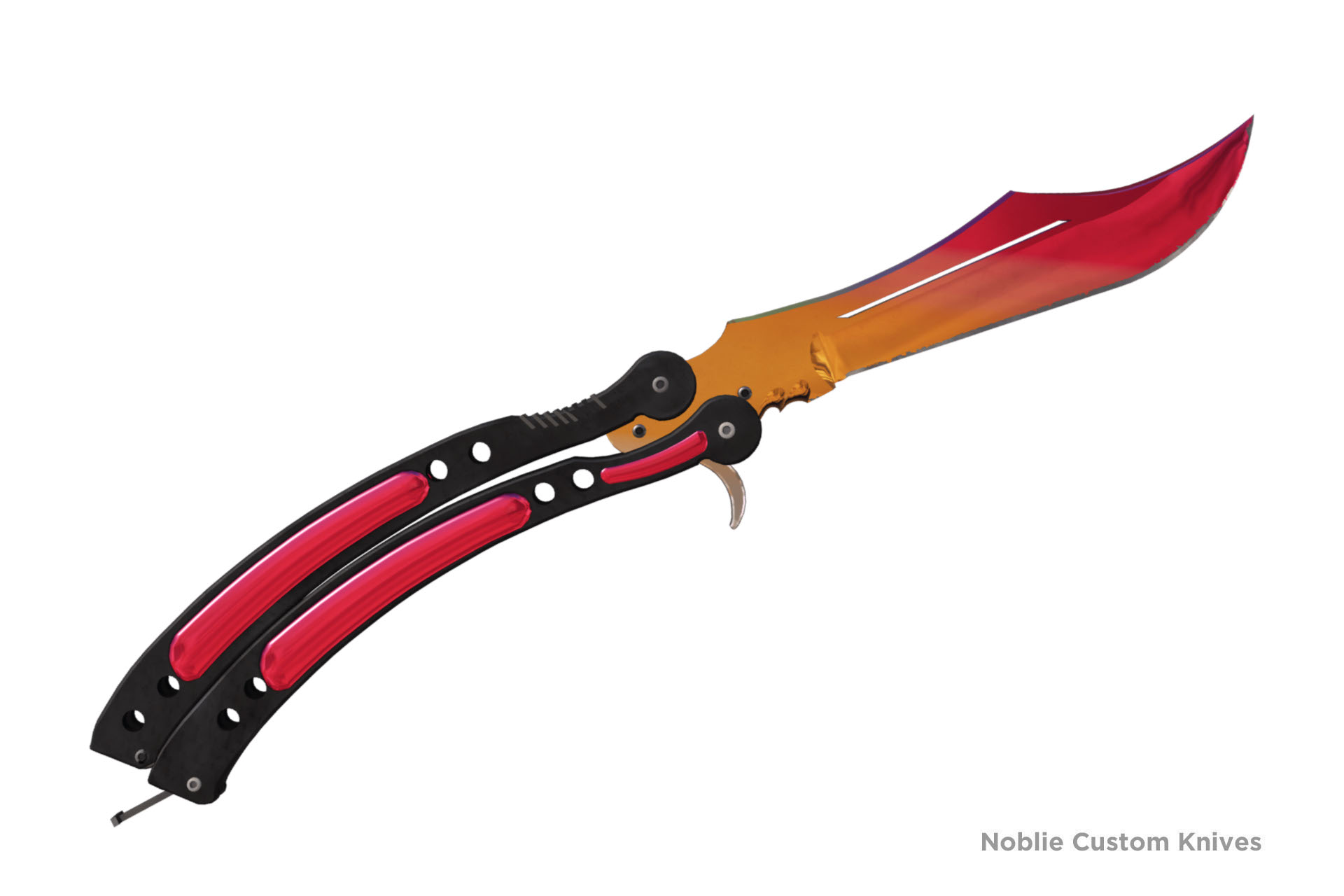
Butterfly Knife | Fade.
Doppler is a family of glossy finishes rather than one identical-looking skin. The standard versions are known as Phase 1, Phase 2, Phase 3, and Phase 4. The family also includes rare gem variants named Ruby, Sapphire, and Black Pearl. These variants can look dramatically different, even though they share the Doppler name.
For Doppler, identify the actual phase or gem variant first. The phase corresponds to a distinct finish or paint index; it is not created simply by changing the pattern seed on an ordinary phase. After confirming the variant, examine the blade under CS2 lighting and compare similar examples. A screenshot alone can make the colors look different from an in-game inspect.
Doppler is available from the Spectrum and Spectrum 2 cases. Its restricted float range of 0.00–0.08 means Factory New and Minimal Wear are the relevant wear categories.
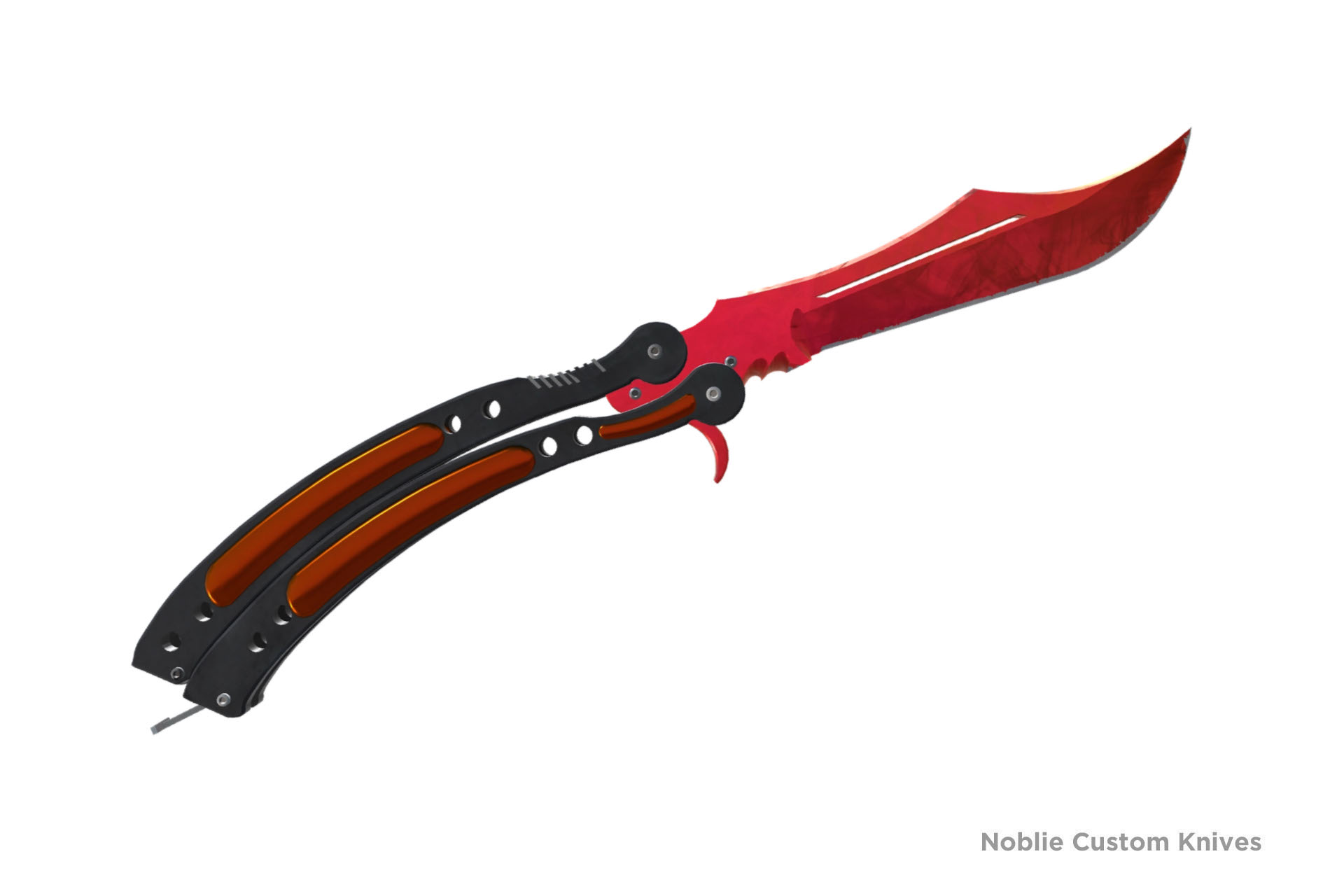
Butterfly Knife | Doppler.
Marble Fade combines bands of red, blue, and yellow in a bright, polished finish. Unlike the smoother gradient of Fade, its pattern can place the colors in more distinct blocks or swirls. Two Marble Fade knives may therefore have noticeably different proportions of blue, yellow, and red.
Some collectors look for patterns informally called Fire and Ice, where red and blue dominate and yellow is limited. That name describes a sought-after appearance, not a separate official skin category. Examine the particular pattern seed rather than assuming that every Marble Fade has the same collector value.
Marble Fade is found in the Spectrum and Spectrum 2 cases and has a 0.00–0.08 float range, limiting it to Factory New and Minimal Wear.
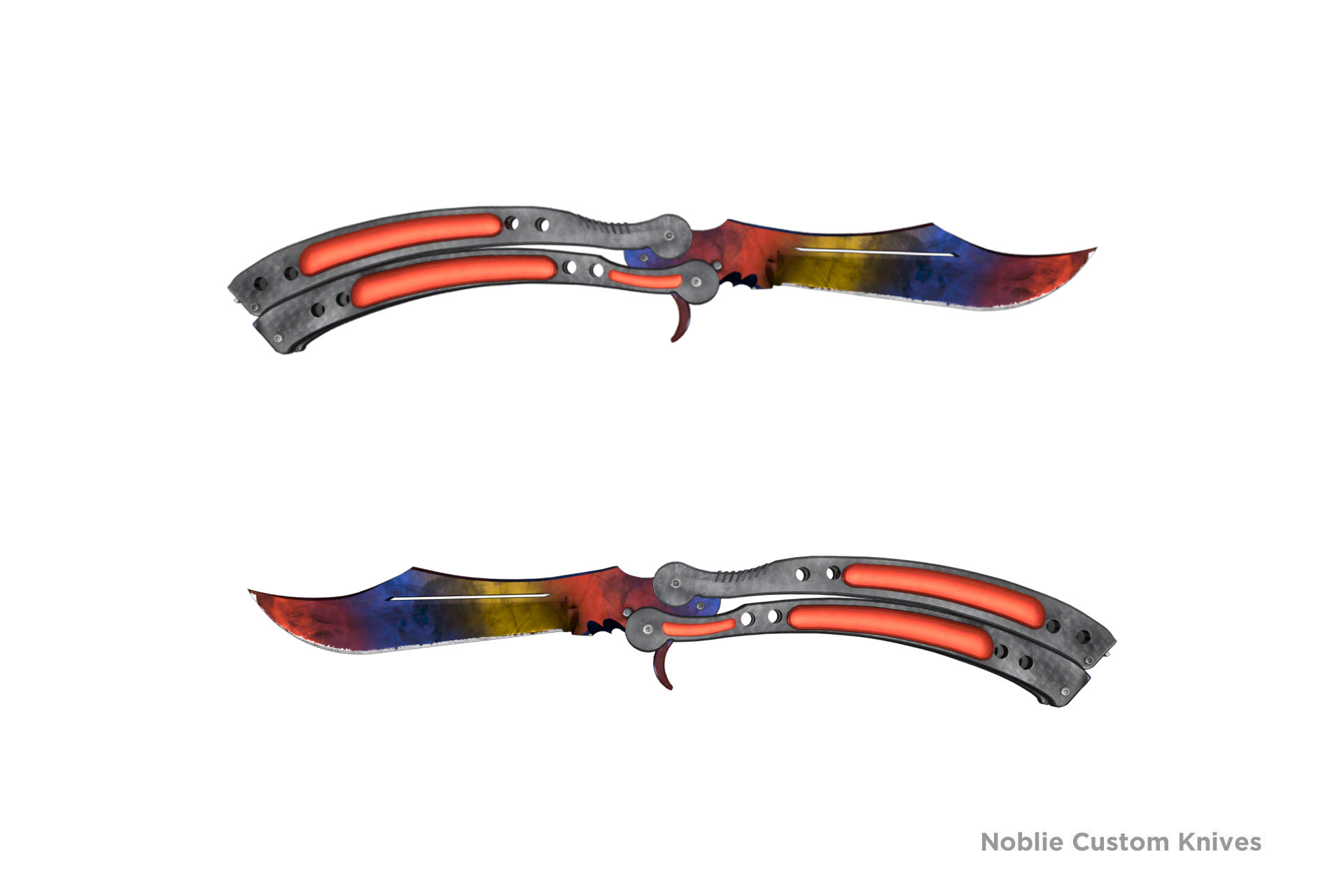
Butterfly Knife | Marble Fade.
Gamma Doppler is the green-oriented counterpart to the original Doppler family. It includes four numbered phases and the particularly distinctive Emerald variant. Depending on the variant, the blade can show combinations of green, cyan, dark blue, and near-black reflections.
Buyers should verify whether a listing is a numbered phase or Emerald. These are different finish variants, and a green-looking screenshot does not establish that the knife is an Emerald. Gamma Doppler comes from the Operation Riptide and Dreams & Nightmares cases, with Factory New and Minimal Wear as the available exteriors.
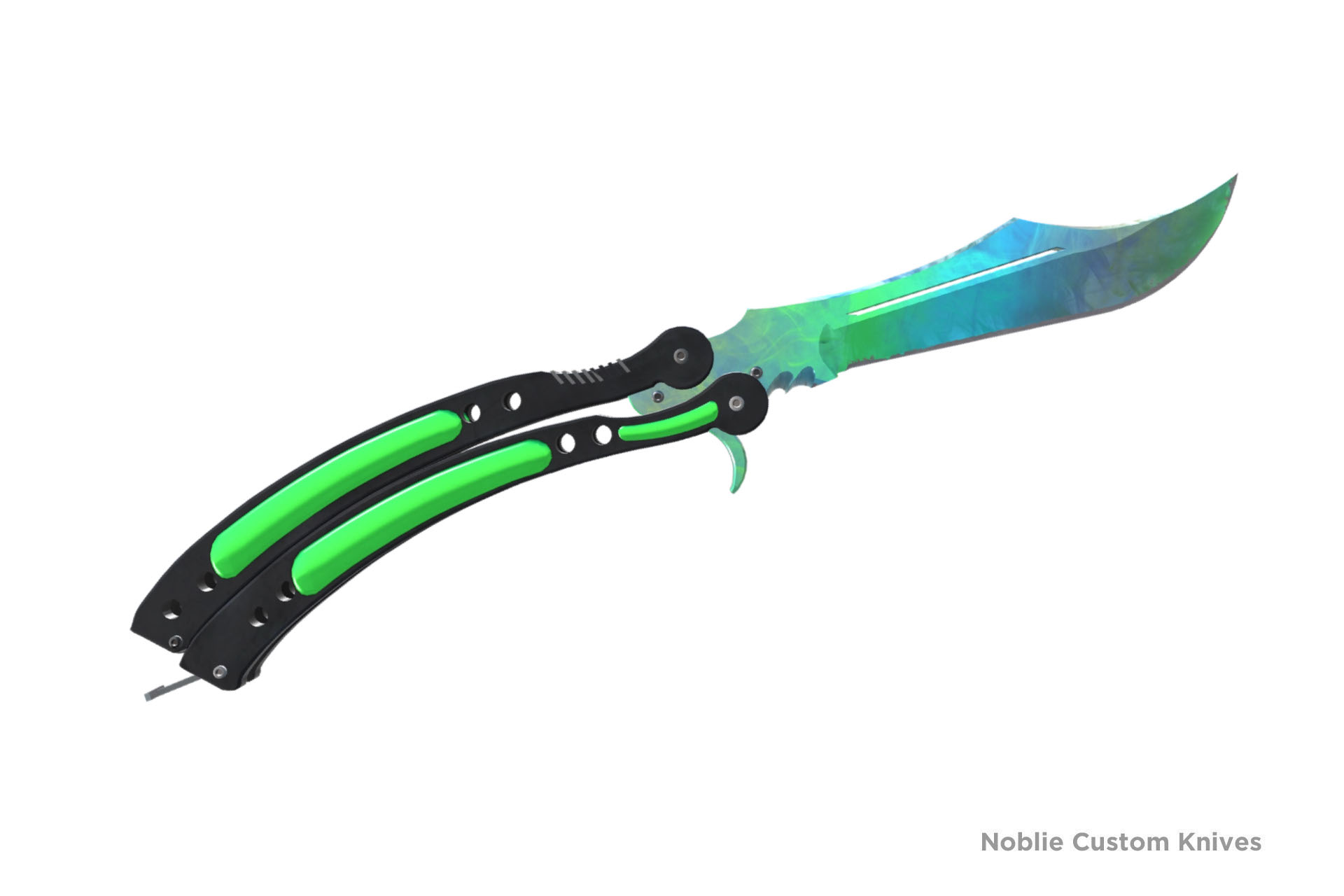
Butterfly Knife | Gamma Doppler Phase 4
Tiger Tooth takes a simpler approach: a warm gold-orange blade crossed by darker diagonal stripes. It is easy to recognize, and its color scheme pairs naturally with black, yellow, or gold inventory themes.
The main buying checks are wear, blade appearance, and the price of comparable listings. Tiger Tooth does not usually require the same pattern-by-pattern evaluation as a full Fade or a high-blue Case Hardened. The finish appears in the Spectrum and Spectrum 2 cases, with a float range of 0.00–0.08.
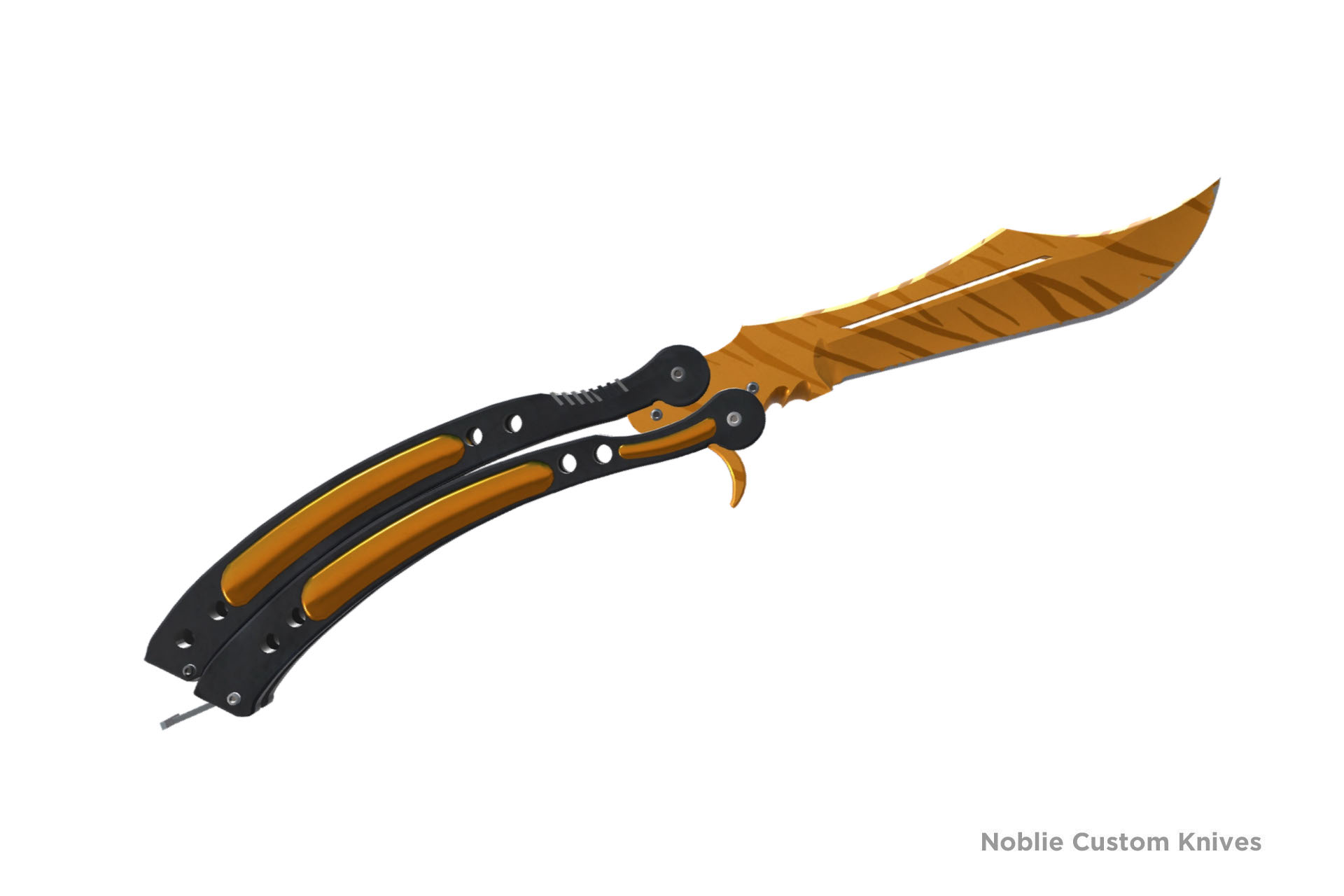
Butterfly Knife Tiger Tooth.
Slaughter uses a reflective red finish with irregular abstract shapes across the blade. It provides a strong red-and-black look without depending on the gemstone colors associated with Doppler.
The pattern seed changes the arrangement of the shapes, and some trading discussions use nicknames for particular motifs. Those informal labels should not automatically justify a higher asking price. Inspect the individual blade and look at comparable completed sales where available.
Unlike Fade and Tiger Tooth, Slaughter can also exist in Field-Tested condition. Its float range is approximately 0.01–0.26. It belongs to the original Operation Breakout group.
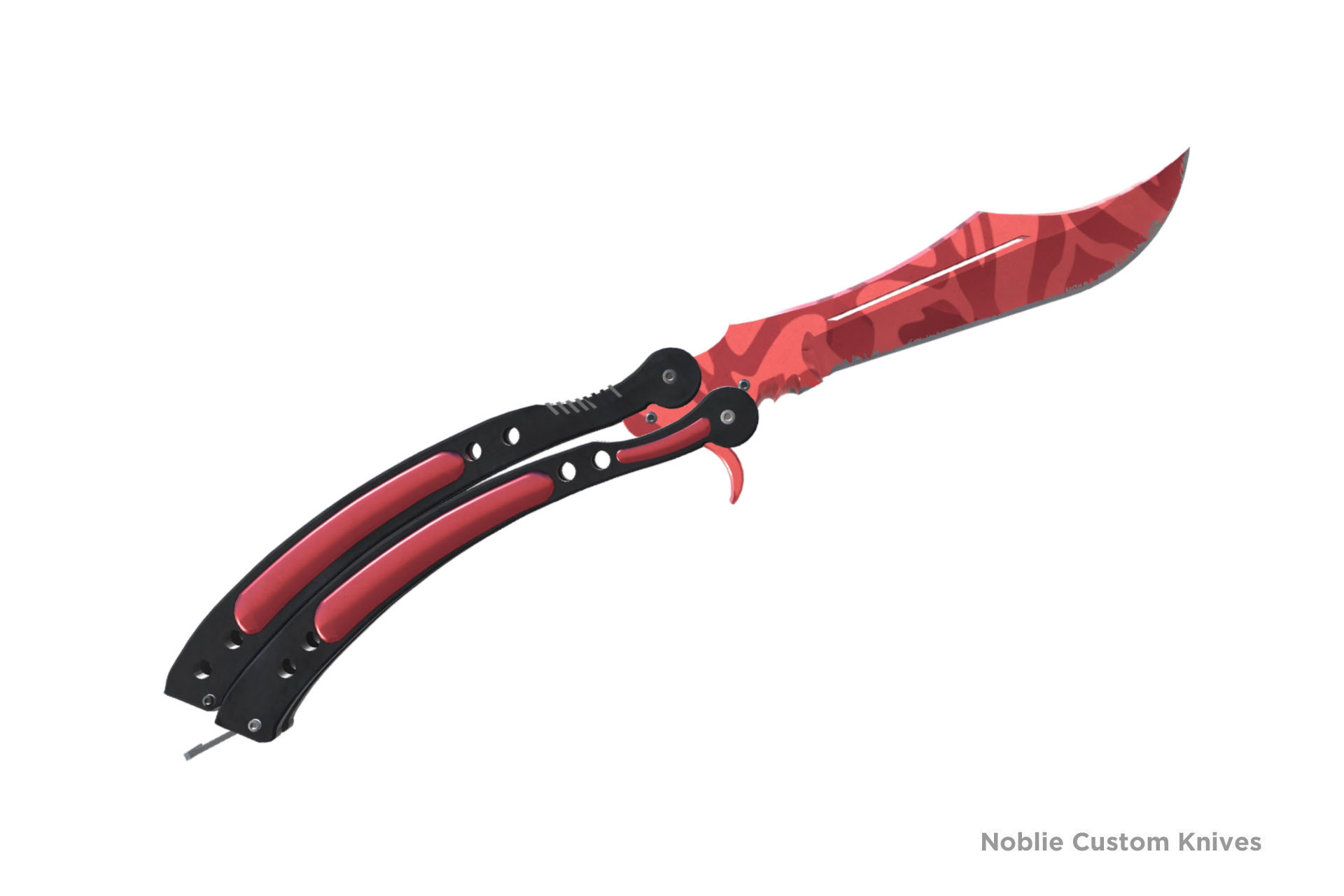
Butterfly Knife Slaughter.
Case Hardened is for players who prefer distinctive individual patterns. Its digital finish mixes blue, gold, and purple areas. The amount and placement of blue depend on the pattern seed, which is why two knives with the same wear rating can command very different asking prices.
Examples with unusually strong blue coverage are sometimes described as Blue Gems. That term is used by collectors; it is not a guarantee of a particular resale value. Check the pattern seed, the visible side of the blade, the opposite side, and the condition before judging a premium claim.
Case Hardened belongs to the Operation Breakout finish group and is available across all five standard wear categories. Its name refers to the game’s cosmetic texture, not proof of a specific heat-treatment process used on a physical blade.
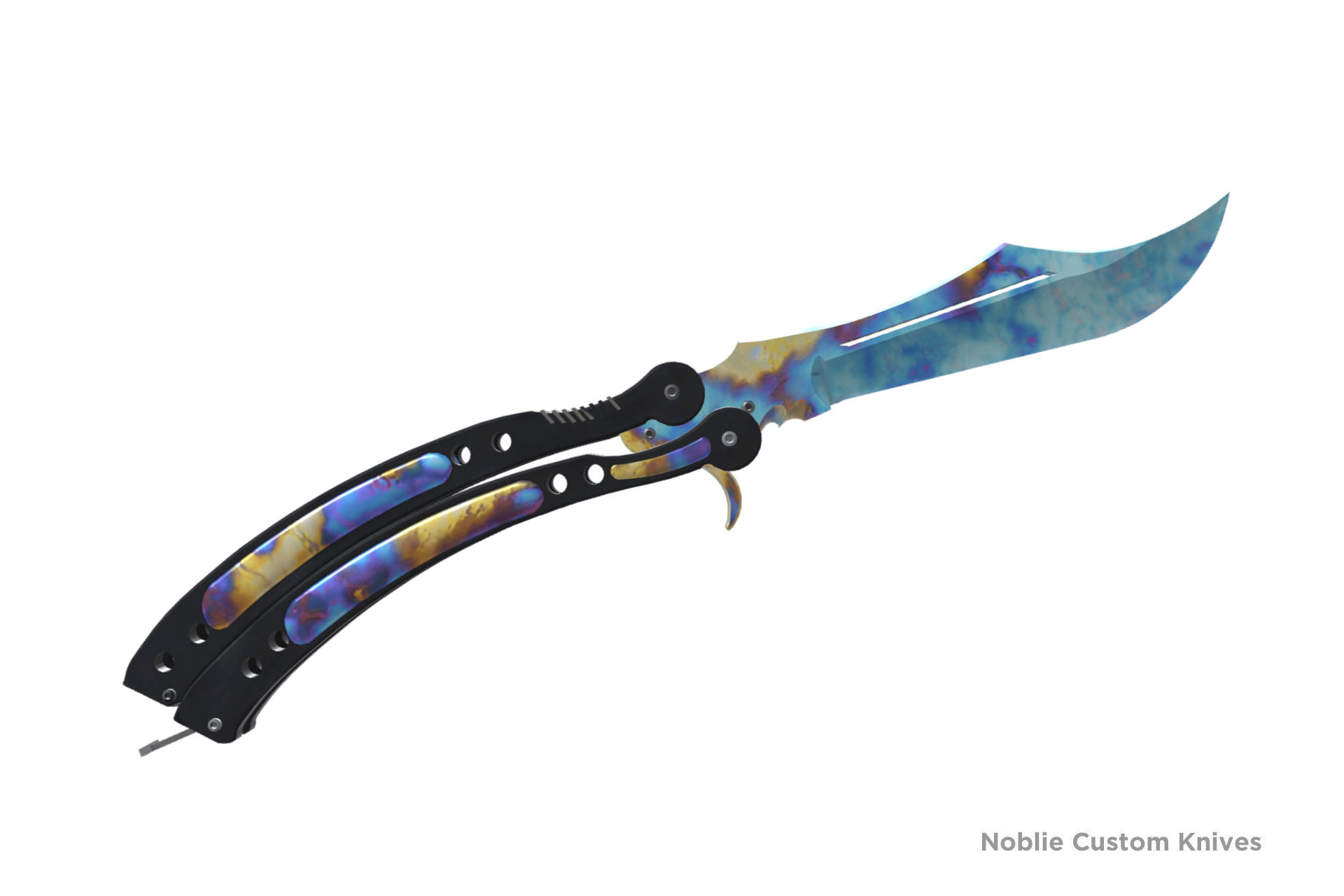
Butterfly Knife | Case Hardened
Lore moves away from abstract color gradients. It uses a gold-colored blade with Celtic-style ornament, paired with green and gold-toned handle details. The design is related visually to the long-running Dragon Lore theme in Counter-Strike.
For Lore, wear is more important than searching for a special pattern seed. Higher floats can substantially reduce the amount of visible artwork. Compare the blade edge, point, and overall finish, especially on used-looking examples. Butterfly Knife | Lore has an unusually broad 0.00–1.00 float range, so all five standard wear categories are possible.
Lore is part of the Operation Riptide and Dreams & Nightmares knife pools.
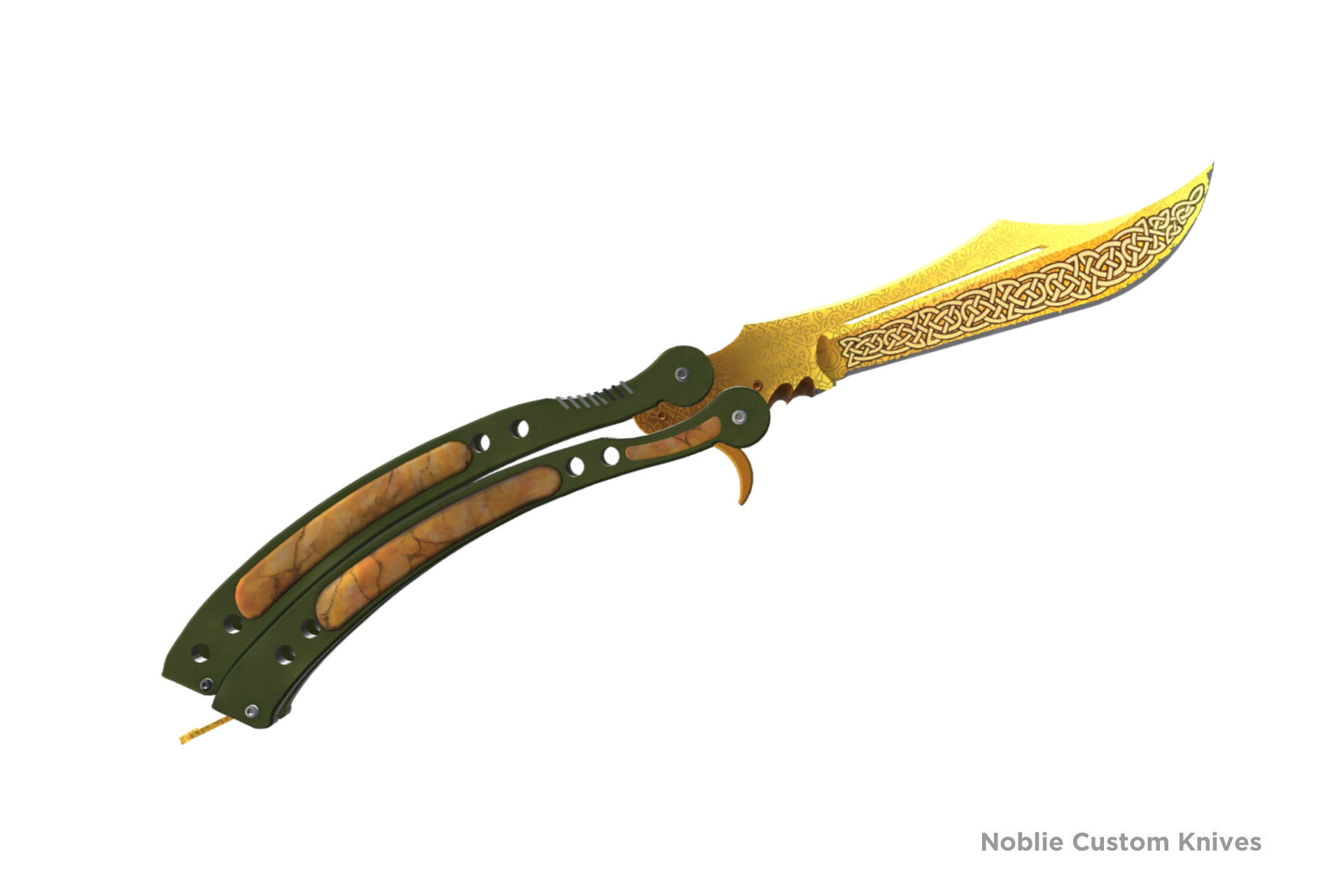
Butterfly Knife | Lore
Three attributes are frequently confused when discussing CS2 knives:
Standard CS2 wear categories are Factory New (below 0.07), Minimal Wear (0.07–0.15), Field-Tested (0.15–0.38), Well-Worn (0.38–0.45), and Battle-Scarred (0.45–1.00). These category boundaries do not mean every skin can appear in every category. Fade, Doppler, Marble Fade, Gamma Doppler, and Tiger Tooth are restricted to the low-float end of the scale.
When comparing two listings, inspect the exact item rather than relying exclusively on a generic catalog render. For seed-sensitive skins, record the pattern number; for Doppler families, record the named phase or gem variant. Compare like with like before treating a price difference as meaningful.
Five weapon cases include Butterfly Knives in their rare-item pools. The case determines which group of finishes is possible, but most of these cases can also produce other knife models.
| Case | Butterfly Knife finish group | Other knife models in rare pool? |
|---|---|---|
| Operation Breakout Weapon Case | Original finishes, including Fade, Slaughter and Case Hardened | No; the rare knife model is Butterfly |
| Spectrum Case | Doppler, Marble Fade, Tiger Tooth and other Chroma finishes | Yes |
| Spectrum 2 Case | Same Chroma knife finish group as Spectrum | Yes |
| Operation Riptide Case | Gamma Doppler, Lore and other Gamma-era finishes | Yes |
| Dreams & Nightmares Case | Same Gamma-era rare knife pool as Riptide | Yes |
A rare knife drop from Operation Breakout uses the Butterfly Knife model, but that does not mean a knife is guaranteed when opening the case. In the other four cases, a Butterfly Knife is one of several possible rare knife models. If you have a particular finish in mind, checking the source case is useful; opening cases repeatedly is not a reliable way to obtain a specific pattern or phase.
Important update: Cases are no longer the only route by which knives can enter the CS2 economy. On October 22, 2025, Valve expanded Trade Up Contracts to allow five eligible Covert items to be exchanged for a knife or gloves from an applicable collection, with a separate rule for StatTrak knives. The contract outcome still depends on the items used; it does not guarantee a chosen Butterfly Knife finish.
For someone who wants a particular finish, inspecting an existing item is more predictable than opening cases and hoping for one exact result. The Steam Community Market is Valve’s official marketplace; prices are denominated in Steam Wallet funds, which should not be treated as the same thing as withdrawable cash. Item listings can differ in float, pattern, and variant, even when they share the same basic name.
Before accepting a trade or purchase, use this checklist:
Steam’s Trade Protection documentation explains that items received through a protected CS2 trade remain protected for seven days and certain recent trades can be reversed. Steam also warns about offers to buy items outside supported trading. These rules matter more than any marketplace’s promise of a quick or risk-free sale.
For another knife design in Counter-Strike 2, compare the finishes in the CS2 Kukri knife skins guide.
Fade is a good all-around choice for a bright gradient, Doppler for reflective gemstone colors, and Tiger Tooth for a simpler gold design. Case Hardened is particularly interesting to collectors who want to compare individual pattern seeds. The best choice depends on appearance, budget, and the specific item’s attributes.
Rare Doppler gem variants, Gamma Doppler Emerald, and exceptional Case Hardened patterns are among the most collector-focused examples. Rarity and asking price are not identical: availability, the exact variant, float, and actual buyer demand all matter.
No. Butterfly Knife | Fade has a float range of approximately 0.00–0.08, restricting it to Factory New and Minimal Wear.
Operation Breakout Weapon Case, Spectrum Case, Spectrum 2 Case, Operation Riptide Case, and Dreams & Nightmares Case. Their rare knife pools and available finishes differ.
No. A phase is a specific finish variant with its own paint index. The pattern seed can affect how the finish looks, but it does not convert an ordinary Doppler phase into Ruby, Sapphire, or Black Pearl.
No. Butterfly Knife skins change appearance and animations, not damage, movement speed, or competitive knife performance.
If you want a colorful classic, start with Fade or Marble Fade. If you prefer reflective blades, compare the individual Doppler and Gamma Doppler variants rather than shopping by the family name alone. Tiger Tooth and Slaughter offer bold, easily recognizable looks; Case Hardened rewards closer pattern inspection; and Lore stands out for its ornament rather than a rare color phase.
Whatever finish you prefer, judge the actual item: check its float, pattern or phase, confirm the case family, and treat future resale value as uncertain. That is a more useful basis for choosing a CS2 Butterfly Knife skin than a ranking based on price alone.

There are no comments for this article yet.