


Contents
Fade gives the CS2 Kukri Knife a bright gradient; Case Hardened covers it in blue and gold; Slaughter and Crimson Web offer two different red finishes; Blue Steel keeps the color subdued. Choosing between them comes down to the look you prefer. Within each finish, pattern placement and wear can change both the appearance and the price.
The Kukri Knife arrived in CS2 on February 6, 2024, with the Kilowatt Case. Its broad blade makes differences in color coverage easy to see, especially on Fade and Case Hardened. Below, you’ll find a comparison of the finishes, their float ranges, and the pattern details to look for.

Use this comparison to narrow down a finish, then inspect individual knives for the details in the last column.
| Finish | Best for | What to inspect first |
|---|---|---|
| Fade | A bright yellow, pink, and purple gradient | Fade percentage and the actual color distribution |
| Case Hardened | Blue-and-gold patterns and individual character | Blue coverage on the side visible during normal play |
| Slaughter | A red metallic blade with a flowing pattern | Overall pattern balance and visible scratches |
| Crimson Web | A red blade with black webbing | Web placement, paint loss, and edge wear |
| Blue Steel | A subdued blue-gray metallic look | Surface tone and how it changes under different lighting |
For a first Kukri, start with the color you enjoy. Once you’ve chosen a finish, compare a few ordinary patterns with the rarer examples to see whether the difference is worth the extra cost to you.
Fade runs yellow, pink, and purple across the blade in a smooth gradient. The pattern seed determines how much of each color appears: some Kukris are mostly yellow and pink, while others show a larger purple area.
Color distribution is the main choice here. A higher Fade percentage may appeal to you if you want more purple, while a lower percentage may give you the yellow-and-pink balance you prefer. Float is a separate measure of wear.
Fade has a float range of 0.00–0.08, so Kukri Fade exists only in Factory New and Minimal Wear. There is no Field-Tested version.

Case Hardened varies considerably from one seed to another. Blue, gold, and purple patches fall in different places, so two knives with the same finish can look almost unrelated: one mostly gold, another largely blue.
A Blue Gem is a community term for a Case Hardened pattern with especially desirable blue coverage. It is not a separate finish or an official wear grade. Look at the normal holding view first: a knife with an attractive reverse side may show much less blue on the face you see during play.
Look for the size and continuity of the blue areas and any gold patches that break them up. Then check the reverse side. If you like the mixed blue-and-gold appearance, ordinary patterns offer plenty of variation too.
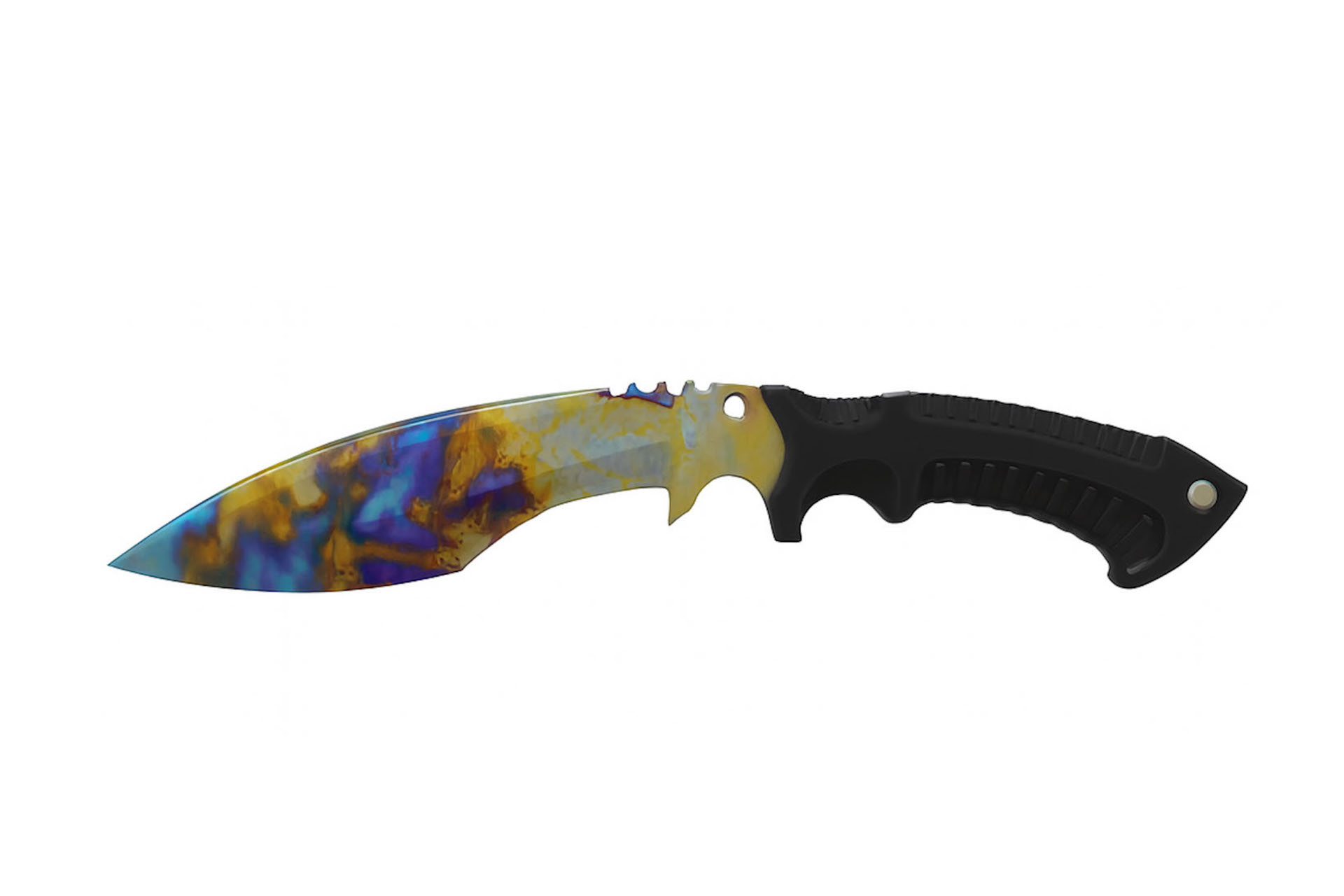
Slaughter has a red metallic finish with contrasting shapes across the blade. It suits a red loadout, especially if you prefer a flowing pattern to Crimson Web’s fine black lines.
Collectors sometimes call Slaughter shapes diamonds or hearts. The resemblance is subjective. For a knife you’ll use in play, look at where those shapes fall on the visible face and how the pattern sits along the curve.
Its float range is 0.01–0.26, covering Factory New, Minimal Wear, and Field-Tested. Within those conditions, visible scratches are worth checking along the edge and across the blade face.
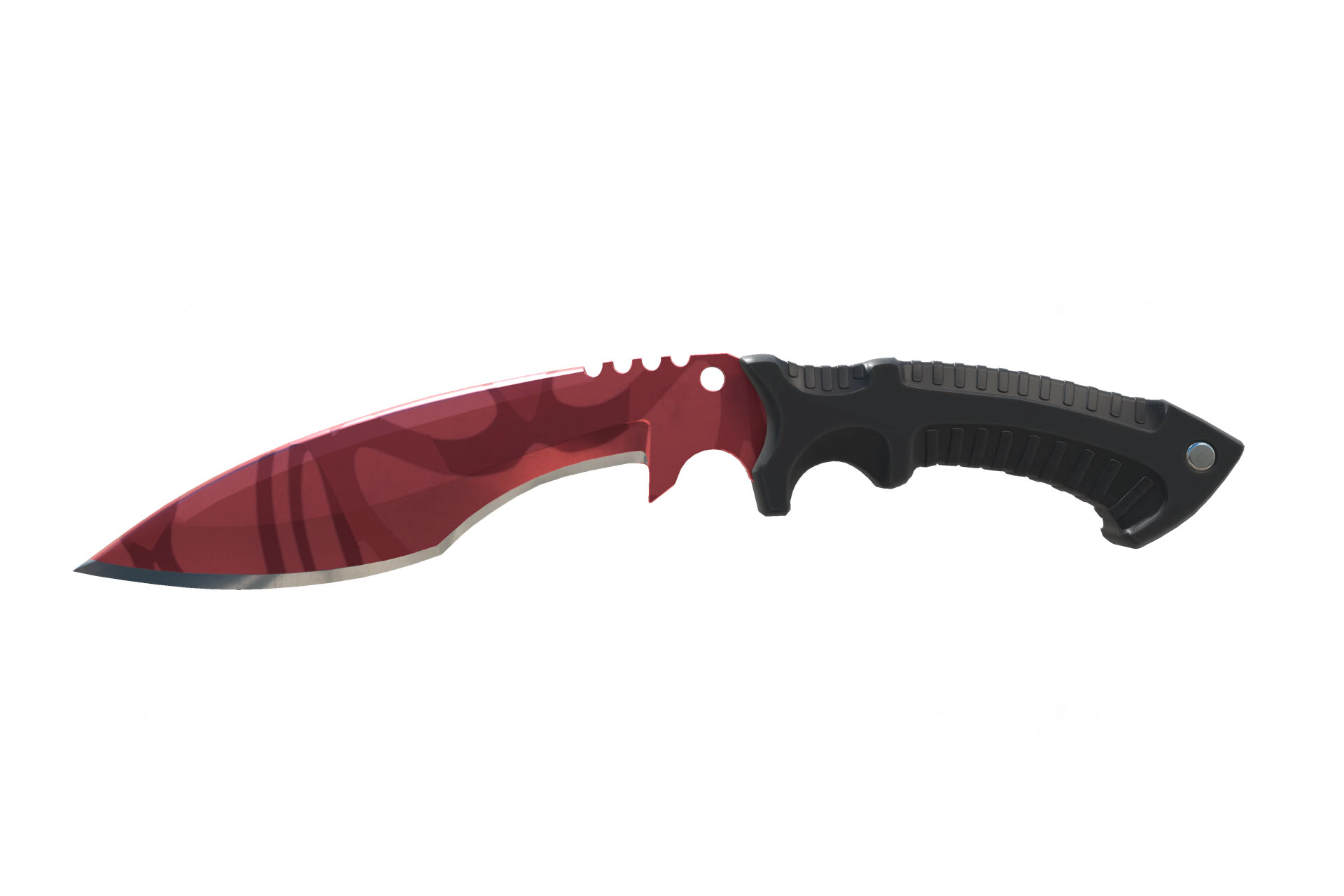
Crimson Web puts fine black webbing over a red base. A clear web center can stand out on the Kukri’s broad blade, while wear can interrupt both the red paint and the web pattern.
Inspect the tip, cutting edge, and broad face for paint loss. For the pattern itself, check whether the webs are complete and visible in the normal holding position. Their placement is more useful to judge than a web count in a listing.
Crimson Web starts at 0.06 float. Factory New therefore occupies only the narrow interval from 0.06 to below 0.07. Before paying extra for that condition label, compare the exact knife with a clean Minimal Wear example in similar lighting.

Blue Steel has a subdued blue-gray surface that leaves the Kukri’s outline easy to read. Its tone shifts as the knife moves between bright and shaded areas, so a single screenshot can give an incomplete impression.
With this patina-style finish, pay attention to surface tone and darkening as well as wear marks. A higher-float example may suit a dark loadout; a cleaner-looking surface may work better with lighter gloves.
Blue Steel is available across all five wear categories, giving you a wide range of surface appearances to compare.

Three terms describe different aspects of a skin:
For example, two Case Hardened Kukris can have nearly identical floats while showing very different blue coverage. Two knives with the same finish and seed can share the same underlying color arrangement but have different amounts of wear.
Fade percentages describe how the gradient maps onto a particular knife model. Higher-percentage Kukri Fades generally show more purple and a fuller spread of the gradient. The number does not mean that a skin has that percentage of paint remaining.
Seed 763 is a well-known Kukri Full Fade reference. Pattern guides can round percentages differently, so check the precise value alongside an in-game inspection. Use a Kukri-specific reference because the same seed can map differently onto another knife model.
Seeds 494, 575, and 770 are useful Blue Gem examples to compare. Community guides commonly rank 494 first. These rankings reflect collector preferences; they are not official item grades.
To assess a listing, compare its visible blue coverage and condition with examples that have sold. Keep asking prices separate from completed sales: an unsold listing tells you what the seller wants.
Yes. Crimson Web seeds change the location of web centers, while Slaughter seeds rearrange the contrasting shapes. A pattern that looks striking in a close-up may be less noticeable during play. Named shapes and web counts alone do not establish a price premium.

Float is a wear value between 0 and 1, but each finish allows only a particular part of that scale. Lower numbers generally represent less wear. They do not measure rarity, Fade percentage, or blue coverage.
| Exterior | Float interval |
|---|---|
| Factory New (FN) | 0.00 to below 0.07 |
| Minimal Wear (MW) | 0.07 to below 0.15 |
| Field-Tested (FT) | 0.15 to below 0.38 |
| Well-Worn (WW) | 0.38 to below 0.45 |
| Battle-Scarred (BS) | 0.45 to 1.00 |
Each finish has its own allowed range within these bands:
| Finish | Allowed float range | Available exteriors |
|---|---|---|
| Fade | 0.00–0.08 | Factory New, Minimal Wear |
| Case Hardened | 0.00–1.00 | All five |
| Slaughter | 0.01–0.26 | Factory New, Minimal Wear, Field-Tested |
| Crimson Web | 0.06–0.80 | All five |
| Blue Steel | 0.00–1.00 | All five |
A 0.149 Minimal Wear knife and a 0.151 Field-Tested knife sit close together on the wear scale despite their different labels. Inspect the actual surfaces: the location of wear marks and the pattern can affect which one you prefer.
The float stays the same when you play. A skin will not accumulate wear over matches.
For neutral metal, camouflage, or a darker blade, consider these other Kukri finishes:
If you’re working to a budget, check the camouflage finishes, Night Stripe, and Stained. The cheapest option changes with condition and available listings. Include Vanilla in the comparison, but don’t assume the unpainted knife will cost less.
A catalog image identifies the finish, but it may not represent the item offered. Use the inspect option attached to the specific listing and check the following:
Buying a specific item lets you choose its finish and seed. Case openings give random results, so they cannot secure a particular knife for a set budget.
The real kukri is associated with Nepal and Gurkha tradition. Its distinctive outline combines a broad forward section with an inward curve closer to the handle. In a physical knife, geometry, mass distribution, and edge shape affect cutting; our guide to knife blade shapes explains the differences between common profiles.
In CS2, names such as Blue Steel and Case Hardened describe a cosmetic appearance. They do not give the item the material properties of a physical blade. The guide to real knife blade finishes covers how surface treatments affect appearance and maintenance. If the craftsmanship behind physical blades interests you, you can also explore handmade fixed blade knives.
The Kilowatt Case and Gallery Case include Kukri Knives among their rare special items. The finish, pattern, and condition vary between individual drops.
Yes, eligible Covert trade-ups can produce Kukri Knives when the input collections lead to that knife pool. Since the October 22, 2025 update, five regular Covert items can produce a regular knife or gloves; five StatTrak Covert items can produce a StatTrak knife. The result depends on the eligible inputs and output pool. A contract does not let you select a particular Kukri finish or seed.
No. Choosing Fade, Crimson Web, or another finish changes the knife’s appearance, not its damage or the player’s movement speed. A higher price or lower float provides no gameplay advantage.
No. It was introduced in CS2 in February 2024. Older naming habits and some graphics still group it with “CS:GO knives,” but the Kukri itself was added after the transition to CS2.
Exceptional Case Hardened Blue Gems can carry prices far above ordinary Kukris. Identifying the most expensive individual knife requires a confirmed sale and its item details, including seed and wear. An asking price or reported offer is not a completed transaction.
No. Updates, changes in supply, and shifts in demand can reduce resale values, while transaction costs cut into any gain. Treat the purchase as spending on a game item you enjoy.


There are no comments for this article yet.