


Contents
Herman Knives are known not only for their blade geometry, liner-lock construction and distinctive action, but also for the way Bartosz Herman finishes Grade 5 titanium. Puzzle and Tesseract are laser-engraved patterns. Hammered is a CNC-milled dimpled texture on current Herman builds. Oerlikon belongs in the same buying conversation, but it describes a different kind of treatment: a family of BALINIT coatings applied over a prepared surface rather than a pattern cut into the titanium.
This distinction matters because one product name can combine several separate features. A Herman folder may have a Puzzle inlay, an anodized titanium frame, a hammered clip, a stonewashed blade and an Oerlikon coating on selected handle components. Those terms are not interchangeable. One may describe laser engraving, another color, another a separate fitted component, and another an engineered thin-film coating.
This guide explains how Puzzle, Tesseract, hammered titanium and Oerlikon differ, how Herman prepares and engraves its patterned titanium, what each treatment contributes in practical use, and what buyers should inspect before choosing an exact knife. To compare current configurations across Slim, Sting, Bee, Ishtar, Mantis, Dragonfly and other models, browse our Herman Knives category with exact-piece photography.
Puzzle is a bold interlocking laser-engraved pattern, often highlighted by contrasting titanium anodizing. Tesseract is a denser laser-engraved geometric pattern with a more technical and multidimensional appearance. Hammered titanium is a CNC-milled dimpled texture rather than literal hand hammering. Oerlikon is Herman’s name for coated finish configurations using Oerlikon Balzers BALINIT coatings, including BALINIT® A, BALINIT® MAYURA and BALINIT® TRITON STAR; BALINIT® CROVEGA is also documented in Herman’s coating material.
In practical product language, it is reasonable to call Oerlikon a Herman finish. Technically, however, it is not one fixed engraving or texture. The titanium underneath may be smooth, laser engraved, CNC milled or otherwise prepared; the Oerlikon coating is applied over that surface.
| Name | Correct classification | Visual character | Best suited to |
|---|---|---|---|
| Puzzle | Laser-engraved titanium pattern; sometimes used as an inlay | Graphic, high-contrast and immediately recognizable | Collectors who want a strong Herman visual signature |
| Tesseract | Dense laser-engraved titanium pattern | Technical, layered and highly detailed | Buyers who value fine machining and close-up detail |
| Hammered | CNC-milled irregular dimpled titanium texture | Organic, tactile and less formal | Users and collectors who want texture without a busy geometric pattern |
| Oerlikon | Herman coated-finish family for titanium handle components | Gold-yellow, brilliant multicolor or black, depending on the BALINIT coating | Buyers prioritizing engineered coatings, color and surface durability |
A premium Herman listing can contain several surface terms at once. Reading them correctly prevents a buyer from assuming that every decorative name describes the same manufacturing step.
A pattern or texture is the physical geometry formed in the titanium, but Herman does not create every surface in the same way. Puzzle and Tesseract are laser-engraved designs. Leaves, Rocks, Spirals, Chrono Circle, Valley of the Kings, Nebula Ripple, Skulls and Dollars are also documented as Herman laser engravings. Hammered is different: on current Herman builds it is a CNC-milled dimpled texture rather than a laser pattern or a surface literally struck with a hammer.
An inlay is a separate piece fitted into the main handle structure. A Puzzle inlay is therefore not the same construction as a full Puzzle-pattern scale. The motif may be similar, but the inlay creates a distinct boundary between the decorated panel and the surrounding titanium frame.
Anodizing changes the apparent color of titanium through a controlled oxide layer. It is not paint. Blue, bronze, violet, gold and multicolor effects can emphasize raised edges and recessed areas, causing the same machined pattern to look very different from one exact knife to another.
These normally describe the blade surface or coating rather than the titanium handle pattern. Our knife blade finishes guide explains how common blade finishes affect appearance, scratch visibility and maintenance.
In Herman product naming, Oerlikon functions as a finish-family name. The visible titanium may still have a separate machined or hammered texture underneath. The coating adds its own color and surface properties while preserving the prepared geometry below it.
Herman’s published workshop process makes an important distinction between the engraving itself and the preparation that comes before it. The titanium is first brought to the intended base finish, then cleaned and degreased before the laser program is run. Depending on the build, preparation can include bead blasting, glass blasting, matting, hand satin finishing, high polishing or a textured base surface.
A typical sequence described by Herman includes:
That sequence explains why a Herman pattern should not be reduced to “laser work” alone. Surface preparation, engraving, anodizing or coating and final inspection are separate operations, and the same graphic pattern can look very different when the base finish or color treatment changes.
Herman has also published the engraving time required for several patterns. These figures describe the documented executions, not a guaranteed production time for every future knife.
| Pattern | Documented engraving time | Buyer-facing character |
|---|---|---|
| Puzzle | 16 hours full handle; 8 hours inlay | Large, instantly recognizable interlocking geometry |
| Tesseract | 24 hours full handle; 10 hours inlay | Dense, layered geometric field with fine detail |
| Leaves | 5 hours | Organic leaf-vein motif |
| Rocks | 5 hours | Angular fracture-like surface geometry |
| Spirals | 5 hours | Flowing circular and vortex-like lines |
| Chrono Circle | 17 hours | Concentric, clock-like circular structure |
| Valley of the Kings | 4 hours | Egyptian-inspired linear motif |
| Nebula Ripple | 11 hours | Wave-like, cosmic surface movement |
| Skulls | 5 hours | Figurative skull motif |
| Dollars | 5 hours | Graphic currency-themed design |
Puzzle is one of the easiest Herman treatments to identify. The interlocking jigsaw-like forms are created by laser engraving and are frequently emphasized with contrasting anodized colors. Some configurations use the design across the main scales, while others place a Puzzle-pattern titanium inlay into a differently finished handle. Herman’s published production notes give 16 hours of laser work for a full-handle Puzzle execution and 8 hours for an inlay.
The main attraction is visual clarity. Puzzle reads from a distance and immediately separates the knife from a plain titanium folder. On broad models such as Mantis, Dragonfly and Ishtar, the pattern has enough area to become the dominant design element. On a compact Bee, it creates a smaller but still unmistakable collector configuration.
From a practical standpoint, Puzzle should be evaluated by the actual engraving depth, edge finishing and location of the pattern. The laser work can create tactile indexing without uncomfortable sharpness, but the pattern does not alter blade steel, heat treatment, lock geometry or bearing performance.
Choose Puzzle when: you want the strongest visual Herman identity, appreciate multicolor titanium and prefer a knife that presents as a collector piece even when the underlying model remains suitable for carry.

Tesseract uses a denser repeating geometric language. Instead of large recognizable shapes, the laser creates a field of small angular paths and intersecting forms. Recessed lines, surface contrast and anodizing make the appearance change with lighting and viewing angle. Herman’s published figures give 24 hours for a full-handle Tesseract execution and 10 hours for an inlay, making it the most time-intensive laser pattern in the documented group.
The pattern can cover much of the handle and may be echoed on the clip or other components. It generally appears more technical and intricate than Puzzle. Puzzle relies on a large motif; Tesseract rewards closer inspection and macro photography.
Tesseract can add mild traction, but not every example will feel identical. Engraving depth, surface preparation, anodizing and the underlying handle contour all affect grip. Exact-piece photos are useful, while handling information is even better when available.
Choose Tesseract when: you prefer fine machining, repeated geometry and a futuristic finish that reveals more detail at close range.

Hammered titanium takes the opposite visual approach. Rather than using a laser-engraved graphic pattern, Herman creates an irregular field of depressions with CNC milling. The name describes the visual effect, not literal hand hammering. The result can resemble pebbled or hammered metal while retaining the repeatability of a machined titanium component.
Herman may apply the texture across complete scales or use it selectively on inlays, clips, backspacers and pivot-area components. A partly hammered configuration can add depth without obscuring the model’s original handle lines.
Hammered titanium is also practical for carry. Its uneven surface tends to make fingerprints and fine handling marks less obvious than uniform polished titanium. It can improve traction, although the real grip depends on dimple depth and how smoothly the high points are finished.
Choose hammered titanium when: you want a tactile, less formal finish that still looks premium and usually ages more discreetly than a smooth high-polish surface.

On April 16, 2025, Herman published material introducing three Oerlikon coatings: BALINIT® A, BALINIT® MAYURA and BALINIT® TRITON STAR. The same material also documents BALINIT® CROVEGA. In the context of Herman listings, Oerlikon is best understood as the name of a coated finish family for titanium handles and related components rather than a single decorative pattern.
This means both descriptions can be true at the same time:
An Oerlikon handle can still be smooth, laser engraved, CNC milled or hammered in appearance underneath. A rugged or textured feel comes mainly from the titanium geometry below the coating; the coating adds its own color and engineered surface properties without replacing that geometry.

BALINIT A is a TiN-based PVD coating with a characteristic gold-yellow color. Oerlikon describes it as a long-established wear-protection coating that reduces abrasive and adhesive wear. For a Herman handle, its most immediate effect is the refined gold appearance, while the industrial coating technology provides a harder protective surface than untreated decorative coloring alone.
The coating should not be confused with gold plating or ordinary yellow anodizing. It is a separate thin-film treatment with its own composition and wear behavior.
BALINIT MAYURA is a carbon-based coating distinguished by brilliant, shifting colors. Oerlikon describes it as extremely thin, hard and smooth. On a Herman handle, the practical attraction is the combination of vivid color and a coating that can preserve fine surface detail rather than filling the underlying machining.
Because MAYURA changes with angle and light, exact-piece photography is particularly important. Two knives using the same coating family may not present the same dominant colors in every viewing condition.
BALINIT TRITON STAR is a black carbon-based DLC coating supported by a chromium-nitride layer. Oerlikon specifies high hardness and a very low coefficient of friction for the industrial coating system. On a Herman handle, it creates a dark technical appearance and a wear-resistant surface while preserving the machining or texture below it.
A hard coating is not invulnerable. Sharp edges, clip contact and repeated abrasion can still develop visible wear. Unlike ordinary titanium anodizing, a damaged BALINIT coating cannot be restored simply by changing voltage or polishing the surface.
BALINIT CROVEGA is a chromium-nitride-based coating designed for smooth surfaces. Oerlikon describes it as dense and smooth, with high wear protection and good corrosion resistance. Herman’s April 2025 coating material includes CROVEGA alongside the better-known A, MAYURA and TRITON STAR options.
For buyers, the important point is that CROVEGA is a coating specification, not a Herman engraving pattern. Availability should be confirmed on the exact product page because not every Oerlikon option appears in every production batch.
| Oerlikon finish | Coating family | Typical color | Practical buyer takeaway |
|---|---|---|---|
| BALINIT A | TiN-based PVD coating | Gold-yellow | Classic precious-metal appearance with an engineered wear-protection coating |
| BALINIT MAYURA | Carbon-based thin-film coating | Brilliant multicolor or rainbow | Strong visual variation while retaining fine machined detail |
| BALINIT TRITON STAR | CrN-supported DLC coating | Black | Dark technical appearance with high wear resistance and low-friction coating properties |
| BALINIT CROVEGA | CrN-based coating | Metallic / coating-specific finish | Dense, smooth coating with wear and corrosion protection; verify availability on the exact knife |
Handle treatment can influence traction, cleaning, fingerprint visibility and how gracefully a knife shows use. It does not change the core mechanical platform. Blade geometry, steel, heat treatment, pivot construction, detent tuning and liner-lock engagement remain more important to cutting performance and action.
| Practical factor | Puzzle | Tesseract | Hammered | Oerlikon |
|---|---|---|---|---|
| Grip | Moderate; depends on pattern depth | Fine, controlled texture | Usually the most tactile | Determined mainly by the titanium texture under the coating |
| Fingerprint visibility | Moderate | Low to moderate | Usually low | Varies with gloss, color and underlying preparation |
| Light scratch visibility | Color contrast can reveal edge wear | Dense geometry can disguise fine marks | Generally forgiving | Hard coating resists wear, but damage may contrast with the base titanium |
| Cleaning | Brush recesses gently | Fine lines can retain lint | Soft-brush cleaning is usually sufficient | Avoid abrasive polishing and aggressive compounds |
Our knife pivot systems guide explains why decorative treatment should not be confused with bearing design, detent quality or pivot adjustment. For a broader comparison of the lineup by size and intended use, see our Herman Knives Model Guide.
Choose hammered titanium, a restrained single-color Tesseract or a black TRITON STAR configuration. These finishes add texture or surface character without dominating the knife. A stonewashed blade usually reinforces the practical EDC appearance.
Choose a multicolor Puzzle, a high-contrast Tesseract or a MAYURA-coated configuration. These treatments create the clearest visual identity and show best in exact-piece photography.
BALINIT A can introduce a gold-yellow accent without using an actual precious-metal inlay. Puzzle or Tesseract can also work in a dress build when the color palette is controlled and coordinated with the clip, backspacer and pivot.
Hammered titanium is usually the safest choice. Oerlikon does not automatically mean more grip because the coating follows the existing surface. An Oerlikon-coated hammered handle may be tactile; a smooth Oerlikon-coated handle may remain comparatively slick.
Choose the model before the finish. A compact Bee, balanced Sting, long Slim and Persian-inspired Ishtar differ more in carry and ergonomics than they do in decorative treatment. Our Herman Bee review, Herman Slim review and Herman Ishtar review explain those differences in greater detail.
Finish names do not guarantee identical appearance. Anodizing voltage, polishing, coating choice, texture depth, inlay placement and component matching all influence the final result. Two Puzzle knives can use different color sequences. Two Tesseract handles can differ in line contrast. Hammered scales can range from subtle dimpling to stronger relief. Oerlikon configurations can use three coatings with very different colors.
Before buying, inspect the actual knife for:
This is why exact-piece listings are especially valuable for Herman knives. The specific laser engraving, CNC texture, anodizing, coating and inlay shown in the photographs are part of the buying decision rather than interchangeable catalog details.
Use a clean microfiber cloth and a soft detailing brush. For skin oils or light residue, slightly dampen the cloth with water and dry the knife immediately. Avoid abrasive metal polish, scouring pads and aggressive compounds.
For T20 pivot adjustment, Pruciak oil, detent care and liner-lock troubleshooting, use our Herman knife maintenance guide. Mechanical service and decorative surface care should be treated as separate tasks.
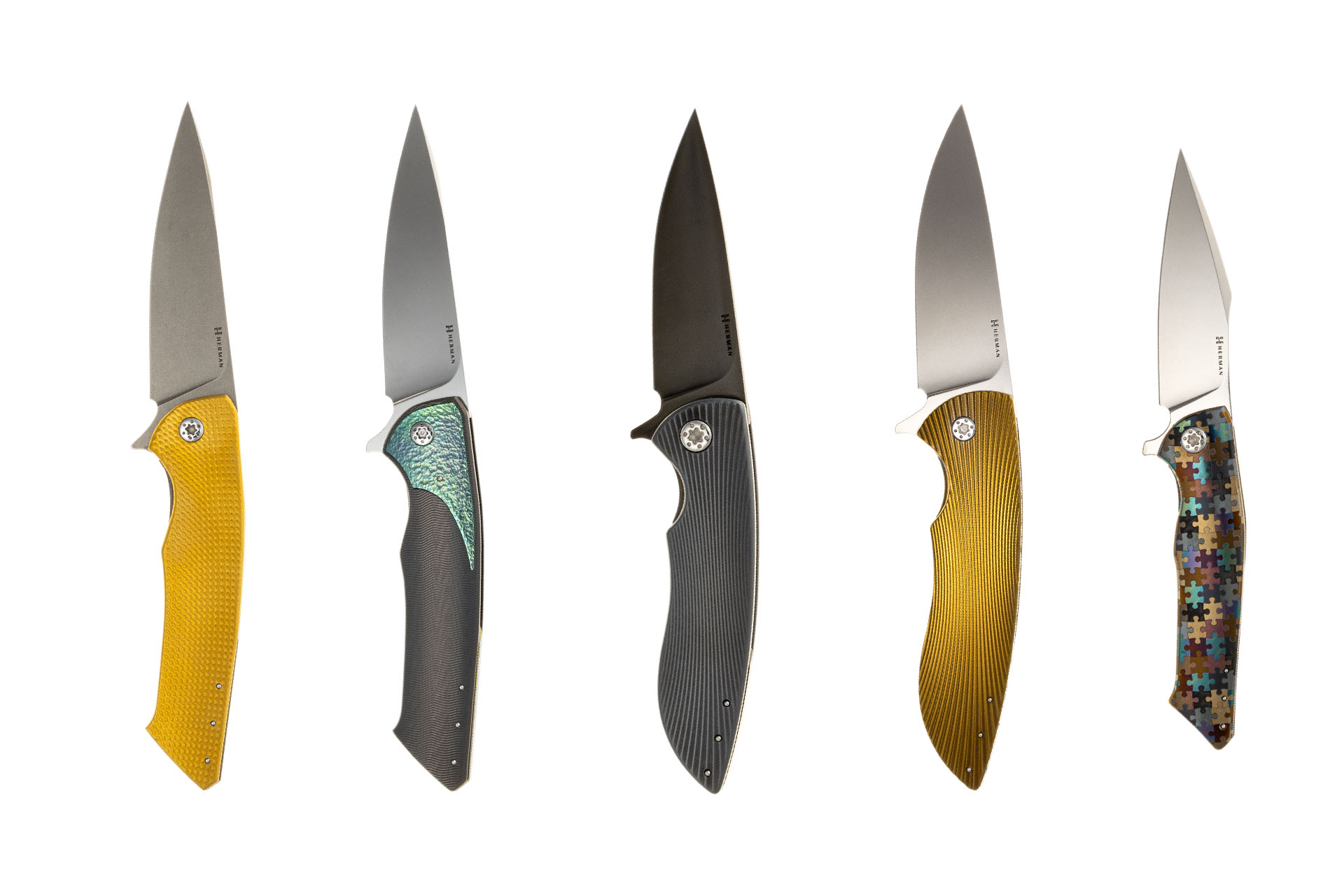
In commercial naming, Oerlikon functions as a Herman finish name. Technically, it is a coating family rather than one fixed laser or CNC pattern. Herman introduced BALINIT A, BALINIT MAYURA and BALINIT TRITON STAR in its 2025 coating material and also documented BALINIT CROVEGA.
Not by itself. The texture comes from the titanium surface preparation beneath the coating. A smooth handle remains smooth, while a hammered or machined handle retains that geometry after coating.
BALINIT A is gold-yellow, BALINIT MAYURA has brilliant multicolor or rainbow effects, and BALINIT TRITON STAR is black. Lighting, surface preparation and the geometry underneath can change the final visual impression.
Puzzle is a laser-engraved geometric pattern on titanium, sometimes used across a scale and sometimes as an inlay. Contrasting anodizing may be added to emphasize the interlocking shapes.
Puzzle uses larger jigsaw-like forms with a stronger graphic impact. Tesseract uses a denser repeating geometric field with finer lines and more close-up visual detail.
No. On current Herman builds, Hammered is a CNC-milled dimpled texture. The name describes the visual effect; the scale remains a precision-machined Grade 5 titanium component.
Hammered titanium and dense, low-contrast Tesseract surfaces generally disguise fine handling marks well. Hard Oerlikon coatings resist wear, but any eventual wear-through can contrast with the titanium below.
It requires specialist recoating or complete removal and replacement of the original finish. It is not equivalent to re-anodizing bare titanium. Any refinishing can change originality and collector value, so consult Herman or an experienced coating specialist first.
Yes. Herman’s published workshop material identifies Puzzle and Tesseract as laser engravings. It gives 16 hours for a full-handle Puzzle and 8 hours for a Puzzle inlay, compared with 24 hours for a full-handle Tesseract and 10 hours for a Tesseract inlay.
Herman’s published figures list 17 hours for Chrono Circle, 11 hours for Nebula Ripple, 5 hours each for Leaves, Rocks, Spirals, Skulls and Dollars, and 4 hours for Valley of the Kings. These are documented production figures for those executions, not a guarantee that every future knife will require exactly the same time.
No. Collector value depends on the complete configuration: model, blade steel, condition, pattern, coating, inlays, blade finish, original accessories and current demand. A rare finish can increase interest, but the finish name alone is not a valuation method.
Puzzle, Tesseract and hammered titanium are three distinct ways Herman gives Grade 5 titanium a recognizable physical surface, but they are not made by the same process. Puzzle is a bold laser-engraved graphic pattern. Tesseract is a denser, more time-intensive laser engraving. Hammered is a CNC-milled dimpled texture with a more organic appearance.
Oerlikon is also a legitimate Herman finish name, but it should be understood correctly. It identifies a coated finish family rather than one fixed engraved pattern. Herman’s published coating material includes BALINIT A, BALINIT MAYURA, BALINIT TRITON STAR and CROVEGA. The titanium beneath the coating may still be smooth, laser engraved or CNC textured.
The most useful buying sequence is therefore: choose the Herman model first, evaluate the exact steel and mechanical configuration, then select the pattern, texture or Oerlikon finish that best matches the intended carry style and collector appeal.
Author: Aleks Nemtcev | Knifemaker with 10+ Years of Experience | Connect with me on LinkedIn | Follow me on Reddit
Sources:
Hi. I am pleased to have found your site & I’m finding your write ups on Herman knives very interesting, though I’m not finished yet. (Called away)
I’m a collector in Spokane and currently have 4 Herman knives, and am now interested in a custom build.
Would you be interested in advising me or helping to facilitate the project?
Regards, John
Hi John,
Thank you for your comment and for your interest in Herman Knives.
Yes, we would be happy to help. Please contact us by email using the address listed on our website. We can discuss the custom build you have in mind, and I will provide you with the available options and explain how the ordering process works.
Best regards,
Aleks