


Contents
Carbon helps a blade harden. Chromium supports corrosion resistance. Vanadium and niobium form hard particles that resist wear. Those familiar descriptions become useful only when you ask where each element ends up after heat treatment.
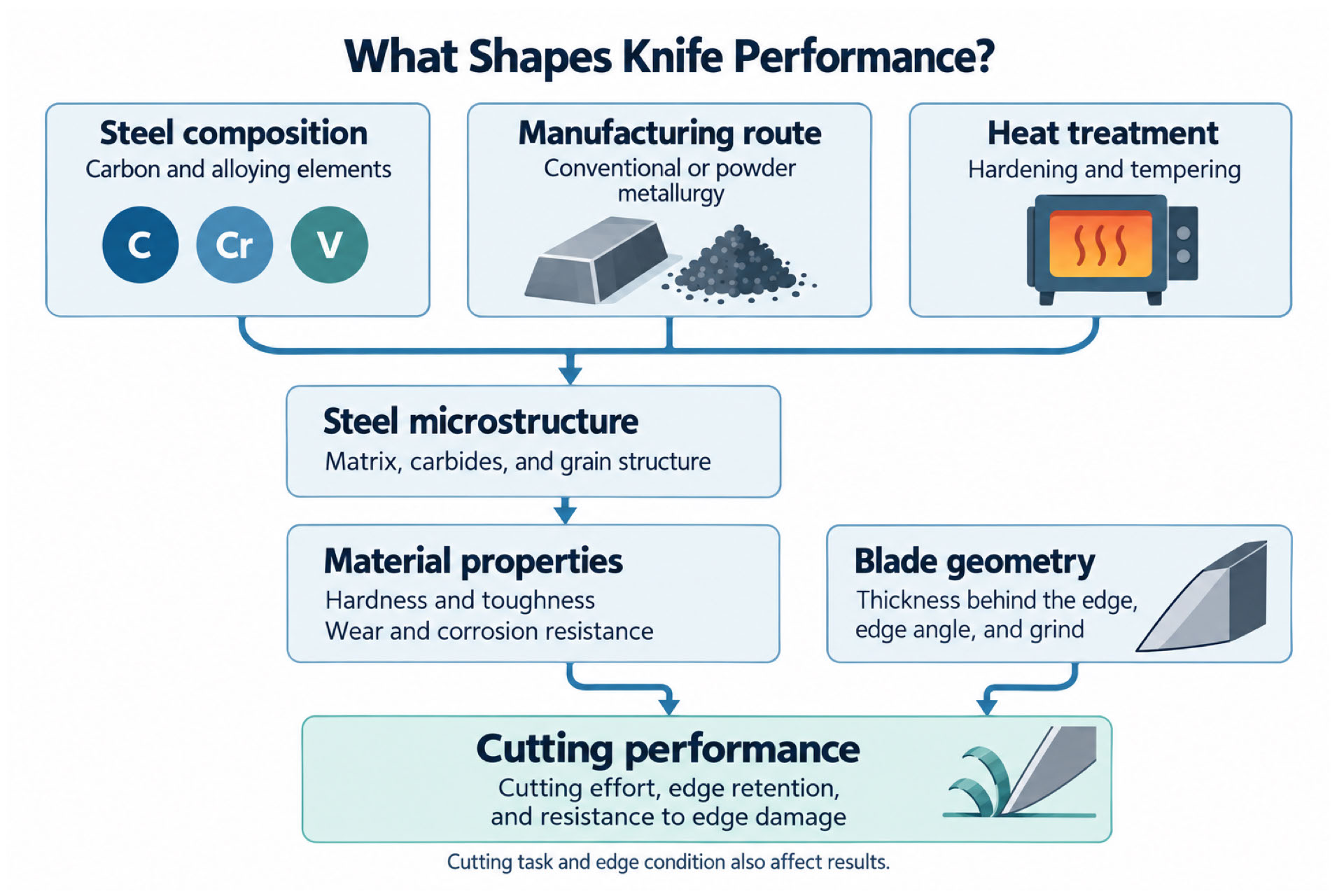
A steel’s composition sets its possibilities. Manufacturing, heat treatment, and blade geometry turn those possibilities into cutting performance, sharpening behavior, and maintenance requirements.
M390 and MagnaCut both contain 4% vanadium, yet they develop different carbide structures. In M390, some vanadium enters chromium-rich carbides. MagnaCut’s design keeps chromium available in the matrix while forming hard vanadium- and niobium-rich particles. The surrounding elements change what that same 4% vanadium does.3, 4, 6
Composition is usually expressed as weight percent: 4% vanadium means approximately 4% of the alloy’s mass. Carbide volume is a separate measurement that accounts for the compounds formed and their densities. Iron makes up most of the remaining mass, alongside other listed or residual elements.
Manufacturer tables give nominal or typical values. Individual production heats fall within a specification, and abbreviated tables may omit minor constituents. A dash in the comparison below means “not listed.”
Within the finished blade, the matrix is the continuous metal surrounding the particles. Carbides are hard compounds of carbon and metallic elements. A conventionally hardened knife commonly contains tempered martensite, carbides, and some retained austenite. Heat treatment changes the balance among them.2
Hardness describes resistance to indentation; toughness concerns resistance to cracking and fracture; wear resistance concerns material lost through wear. An edge may lose sharpness through abrasion, rolling, chipping, or corrosion. The task determines which mechanism matters most.
The table summarizes the main roles and trade-offs. Our knife steel chart compares complete grades.
| Element | Main role | Conditions and trade-offs | Examples |
|---|---|---|---|
| C — Carbon | Matrix hardness; carbide formation | Carbon distribution and heat treatment balance hardness, retained austenite, and carbides. | M390; 14C28N |
| Cr — Chromium | Corrosion resistance; chromium-rich carbides | Chromium in carbides reduces the amount available to protect the matrix. | MagnaCut; M390 |
| V — Vanadium | Hard carbides; grain control | More wear resistance can mean slower sharpening; particle size affects toughness. | M390; MagnaCut |
| Mo — Molybdenum | Hardenability; corrosion and tempering response | The heat treatment controls its distribution between matrix and carbides. | CPM 154 |
| Nb — Niobium | Stable carbides; grain control | Excessive additions can produce coarse particles. | MagnaCut |
| N — Nitrogen | Matrix hardness; corrosion resistance | Modest additions and high-nitrogen designs produce different structures. | 14C28N |
| W — Tungsten | Carbide wear resistance; hot hardness | Carbide type varies across low-alloy, high-speed, and stainless steels. | Blue Super; M390 |
| Co — Cobalt | Resistance to softening during tempering | Its contribution is tied to the alloy and temperature range. | N690 |
| Ni — Nickel | Toughness, hardenability, and etched contrast | Nickel-alloyed steel and separate nickel interlayers have different jobs. | 15N20; laminates |
During austenitizing, the blade is heated into the temperature range used for hardening. Some carbides dissolve, releasing carbon into the matrix. Quenching then forms hard martensite; tempering adjusts its hardness and toughness for use.
The maker balances carbon in solution against the carbides that remain. Excess dissolved carbon can leave more retained austenite after quenching, while a larger carbide population changes wear resistance and toughness.1, 2, 7
M390’s 1.90% carbon and 14C28N’s 0.62% serve quite different alloy designs. Compare their finished hardness specifications alongside their carbide structures and intended edge geometry.
A composition table gives the total chromium in the alloy. For corrosion resistance, the crucial question is how much remains dissolved in the matrix after heat treatment. That chromium supports the thin protective surface film responsible for stainless behavior.1
M390 contains 20% total chromium and retains chromium-rich carbides. MagnaCut contains about 10.7% chromium, with an alloy balance designed to eliminate chromium carbides from the properly heat-treated structure. Its remaining hard particles are predominantly vanadium- and niobium-rich carbides.
This explains how a steel with a comparatively modest chromium percentage can achieve strong corrosion resistance. Carbon balance and the other carbide-forming elements determine how much chromium is available for the matrix.3, 4
Austenitizing dissolves some carbides and releases chromium into solution. The chosen temperature and holding time also influence retained austenite and grain growth. The maker aims for a useful balance across hardness, toughness, and corrosion resistance.
Later tempering can precipitate carbides and reduce corrosion resistance. Alleima’s 14C28N datasheet specifically warns of corrosion loss and brittleness when tempering above 840°F (450°C). This is a heat-treatment limit, far above ordinary use temperatures.2, 5
When choosing a knife for fishing, food preparation, or a humid climate, look for corrosion evidence relevant to the grade and treatment. During use, rinse away salt and food residue and dry the blade. Moisture trapped around a pivot or against a sheath calls for attention even when the blade steel has good corrosion resistance.
Vanadium earns its place in wear-resistant steels through very hard carbides. Their hardness, volume, and distribution influence how quickly an edge wears during abrasive slicing. Small additions can also help control grain growth.
The M390–MagnaCut comparison at the start of this guide shows why chromium belongs in the same discussion. High chromium levels change vanadium’s distribution among the carbide types.6
For a blade with substantial hard-carbide content, diamond or CBN abrasives are practical choices, especially for fine edge work. Match the abrasive to the job: touching up a lightly worn edge takes far less metal removal than resetting a bevel.
A maker needs the blade to harden through its section at a suitable cooling rate. Molybdenum helps achieve that. The term hardenability describes this response to quenching; HRC measures the hardness ultimately obtained.7
In stainless steel, dissolved molybdenum can also support corrosion resistance. Its carbide behavior is more involved: CPM 154 contains about 4% Mo, much of which remains in solution or enriches chromium-rich carbides. Fine carbides formed during tempering can further affect hardness.1, 6
MagnaCut uses 2% niobium alongside vanadium. The intended result is a population of small, hard particles that provides wear resistance while preserving useful toughness.4
Niobium’s strong affinity for carbon helps its carbides remain stable during processing. Fine particles can restrain grain growth. Large additions, however, can produce coarse carbides while the steel is still liquid, before powder atomization. Controlling their size is part of the alloy designer’s job.8
14C28N combines 0.62% carbon, 14% chromium, and 0.11% nitrogen. That modest nitrogen addition helps achieve the intended balance of hardness, edge stability, and corrosion resistance.
Carbon and nitrogen both occupy spaces between metal atoms in the crystal structure. Using nitrogen for part of the hardening contribution can help preserve chromium in solution. High-nitrogen grades may also use nitrides or carbonitrides as part of their design; 14C28N primarily illustrates the value of a modest addition to the matrix.1, 5, 6
Blue Super and M390 both contain tungsten, but put it to work in different alloy systems. Blue Super develops hard tungsten carbides. M390’s high-chromium chemistry makes a separate WC population unlikely, despite its listed 0.60% W.3, 6
High-speed tool steels also use tungsten to retain hardness at elevated temperatures. For a knife owner, the practical questions are wear behavior, toughness at the chosen hardness, and the effort needed to restore the edge.
BÖHLER lists 1.50% cobalt in N690. Cobalt works through the matrix and heat-treatment response, supporting resistance to softening in suitable alloys. Its role becomes especially relevant at elevated tempering temperatures. Assess the finished blade using its hardness, geometry, and the grade’s measured properties.9, 10
The bright layers in a 1084/15N20 blade come from the different etching response of the two steels. 15N20 contains roughly 2% nickel and remains relatively bright after etching. It is also a hardenable blade steel, so those layers can form part of the cutting edge.11
Our guide to forging Damascus steel follows how contrasting steels become a patterned blade. In a laminate, the maker may instead put outer layers around a dedicated cutting core.
One knife by Kaspars Bambis, documented on Damasteel’s website, uses an RWL34 core, nickel interlayers, and patterned DS93X outer layers. Here the core supplies the cutting edge, and the nickel occupies a separate layer in the construction.12
When comparing Damascus knives, identify the constituent steels, any dedicated core, and the material exposed at the edge. Those details establish the basis for heat treatment and care.
Manganese improves hardenability, helping steel form martensite at slower cooling rates. The required amount varies with the alloy and blade section.
Silicon is used as a deoxidizer during steelmaking. Small amounts appear in many knife steels, including M390 and 14C28N.
Manganese’s contribution is covered in Uddeholm’s hardening guidance; experimental work on molten stainless steel documents silicon’s deoxidizing role.7, 13
Sulfur can form sulfide inclusions that encourage pitting. Blade-steel specifications generally keep its level controlled.
Phosphorus is commonly controlled as a residual element. A listed maximum gives the permitted limit for the grade.
Alleima limits sulfur to 0.010% and phosphorus to 0.025% in 14C28N.1, 5
These selected values show three approaches to blade-steel design. All figures are nominal or typical weight percentages.
| Steel | C | Cr | V | Mo | Nb | N | W |
|---|---|---|---|---|---|---|---|
| M390 | 1.90 | 20.00 | 4.00 | 1.00 | — | — | 0.60 |
| MagnaCut | 1.15 | 10.70 | 4.00 | 2.00 | 2.00 | 0.20 | — |
| 14C28N | 0.62 | 14.00 | — | — | — | 0.11 | — |
“—” means not listed in the cited manufacturer’s table. Iron and other constituents are omitted from this selected comparison. Values describe the grade; an individual heat has its own measured composition.3, 4, 5
M390 combines high carbon and chromium with vanadium in a powder metallurgy steel designed for substantial wear resistance. Our M390 steel guide covers its performance and practical use.
MagnaCut uses vanadium, niobium, and a carefully balanced carbon level to retain hard particles while leaving chromium available in the matrix. See the MagnaCut steel guide for its broader property balance.
14C28N emphasizes hardness, edge stability, and corrosion resistance through a modest nitrogen addition and a different carbon–chromium balance. The 14C28N steel guide connects that design to everyday cutting and sharpening.
Chromium dissolved in the matrix supports corrosion resistance. Chromium-rich carbides contribute wear resistance while using some of that chromium supply. Alloy design and heat treatment control the distribution, which is why corrosion performance requires more context than the total Cr percentage.
Vanadium forms very hard carbides that resist abrasive wear and can help control grain growth. Their amount and size affect toughness and sharpening. M390 and MagnaCut both contain 4% vanadium, but their different chromium and carbon balances produce different carbide structures.
Nitrogen supports hardness and corrosion resistance. It can take over part of carbon’s hardening role in a balanced stainless composition, helping preserve chromium in solution. 14C28N uses 0.11% nitrogen as part of this approach.
Cobalt can improve resistance to softening during tempering, with the strongest benefits tied to particular alloys and temperature ranges. N690 contains 1.50% cobalt. Its finished performance comes from the full composition, heat treatment, and blade geometry.
Carbon supports matrix hardness, while elements such as vanadium, niobium, chromium, and tungsten can form wear-resistant carbides. In use, edge retention also involves resistance to rolling, chipping, and corrosion. Match the steel and geometry to the way you cut.
Start with the job. Then use the composition to decide which questions to ask about the finished blade.
Our guide to thickness behind the edge explains how geometry affects cutting resistance. For folders using several of these materials, compare the specifications of individual Herman knives.
When browsing custom knives at Noblie, read the steel designation alongside the maker, hardness, heat-treatment information, and blade geometry. Together, those details give you a practical basis for choosing the knife and caring for its edge.
Compositions come from manufacturer and supplier data. The references below also cover heat treatment, carbide behavior, and the specific alloying mechanisms discussed in the article.


There are no comments for this article yet.