


Contents
Quick verdict
The Herman Mantis is a full-size premium titanium flipper built around a modern Bowie-inspired clip-point blade. Current examples typically combine a blade around 3.70 in (94 mm), an overall length near 8.66 in (220 mm), and a weight of about 4.76–5.04 oz (135–143 g).
Its broad belly, pronounced swedge, full flat grind, and fine point make it more practical than its aggressive profile initially suggests. The Mantis works well for controlled slicing, packaging, cord, clean cardboard, and other daily cutting tasks, while its contoured Grade 5 titanium handle provides a secure four-finger grip for most medium and large hands.
It is not the most discreet Herman model. The Mantis occupies more pocket space than the Bee, Sting, or Slim, and its Bowie-influenced profile attracts more attention than a neutral utility folder.
The model is best suited to buyers who want:
Noblie is an authorized Herman Knives dealer and official distributor. Browse our Herman Mantis knives in stock to compare available blade steels, grinds, handle finishes, prices, and included accessories.
Editorial basis
This review uses exact-piece specifications and photographs from our Herman inventory, official maker documentation, and independent reviewer observations. Where measurements or internal components differ by production generation, those differences are identified rather than presented as universal specifications.
Herman has produced the Mantis across several mechanical generations and many exact-piece configurations. Buyers should not assume that every Mantis has identical dimensions, washers, bearings, blade thickness, or weight.
Current Noblie examples commonly use the following measurements:
| Specification | Common Current Specification | Documented Variation |
|---|---|---|
| Blade length | 3.70 in (94 mm) | Official data lists 97 mm; some listings state 3.74–3.75 in |
| Overall length | 8.66 in (220 mm) | Official data lists 225 mm (stated as 8.78 in) |
| Closed length | 4.88 in (124 mm) | Official data lists 127 mm (5.00 in) |
| Blade width | About 1.10 in (28 mm) | Official data lists 27 mm (1.06 in) |
| Blade thickness | About 0.12–0.13 in (3.1–3.3 mm) | Depends on exact blade and generation |
| Weight | About 4.76–5.04 oz (135–143 g) | Inlays, backspacers, steel, and finish affect weight |
| Handle | Grade 5 titanium | May include engraved titanium, Fat Carbon, or Timascus |
| Lock | Inset titanium liner lock | Not a frame lock |
| Deployment | Flipper | Reverse flicking is possible on some examples but is not guaranteed |
| Pivot | Custom Herman T20 pivot | Tool design varies by production period |
| Bearing system | Ceramic bearings | Cage and washer material depend on generation |
| Origin | Poland | Designed and overseen by Bartosz Herman |
Note that published imperial and metric figures are not always exact conversions of each other. Official maker data pairs a 97 mm blade with 3.74 in and a 225 mm overall length with 8.78 in, although those inch values correspond more closely to 95 mm and 223 mm. Treat the metric figures as the reference measurements and the inch figures as approximate.
The figures do not divide neatly into two fixed specification families. Mixed combinations occur: a knife may have a 3.74-inch blade while retaining an 8.66-inch overall length, or weigh differently because of an inlay, clip, or backspacer.

The buying rule
Use the specification sheet, certificate, and exact product page for the individual knife—not a generic measurement copied from another Mantis.
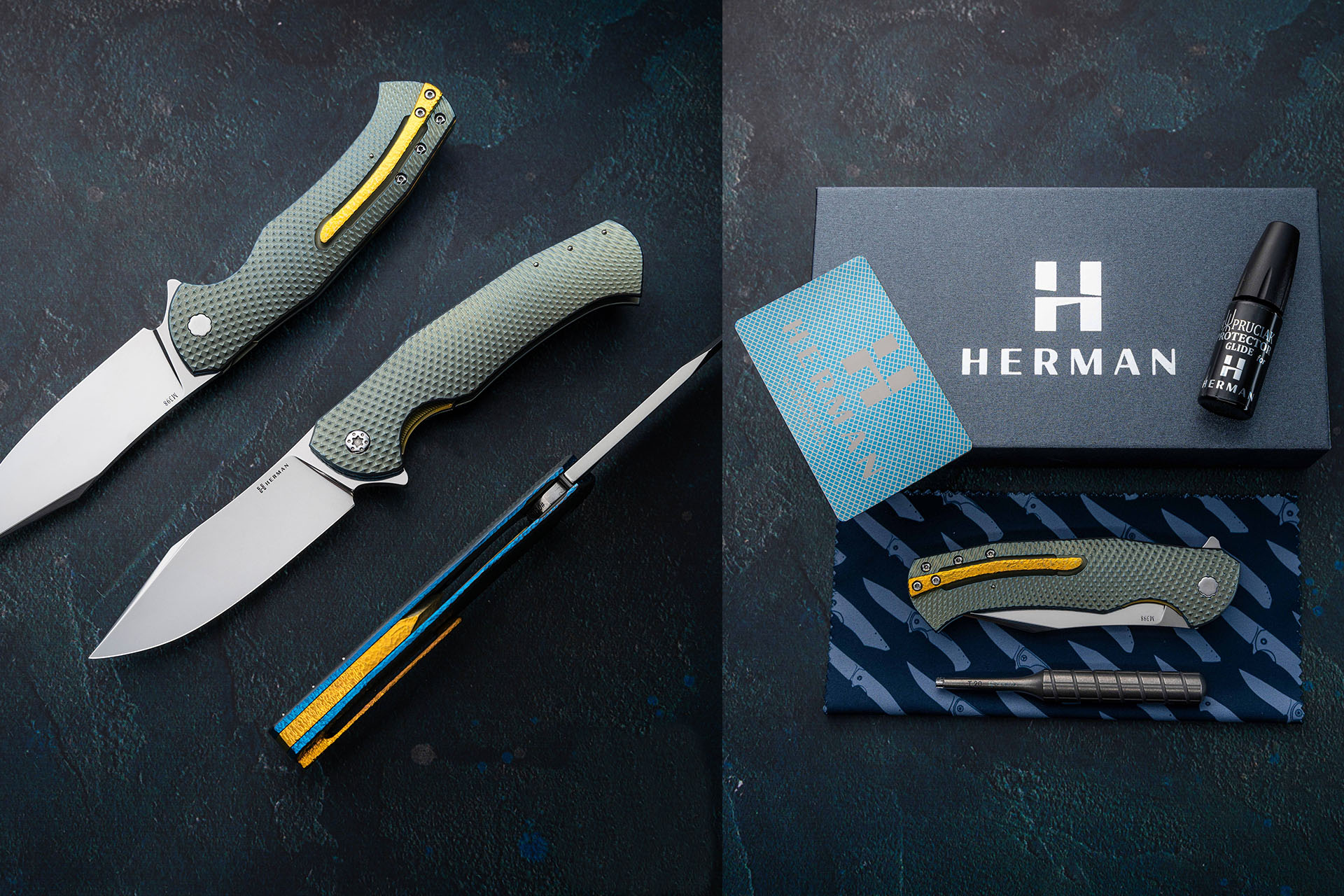
For example, this current Herman Mantis M398 Puzzle configuration is listed at 3.70 inches of blade, 8.66 inches overall, 4.76 ounces, and uses caged ceramic bearings with M390 washers.
Herman describes the Mantis as inspired by the classic American Bowie knife. That description is accurate as a design reference, but the Mantis is not simply a fixed-blade Bowie reduced and placed inside a folding handle.
The blade is better described as a modern Bowie-inspired clip point with:
The clipped spine removes visual and physical mass near the tip. The swedge further narrows the forward section, while the curved edge retains enough material below the point for practical slicing.
A traditional Bowie normally combines a long fixed blade, substantial guard, and a handle designed for leverage and impact resistance.
The Mantis adapts only the elements that work in a premium folding knife:
Its purpose remains that of a folding cutter. It is not intended to replace a fixed blade for chopping, batoning, or impact work.
For a broader comparison of clip points, drop points, Persian blades, and other profiles, see our knife blade shapes guide.
The Mantis looks substantial, but spine thickness alone does not determine cutting ability.
Four dimensions matter:
The full flat grind reduces material progressively from the spine toward the edge. This helps the blade pass through cardboard, food, plastic, and other dense material with less drag than its broad profile might suggest.
One reviewed M398 example was measured near 0.020 inches behind the edge. That figure applies to the individual knife, not every Mantis, but it demonstrates that Herman can combine a substantial spine with efficient edge geometry.
The belly is the central working feature of the Mantis.
A curved edge remains in contact with material through a longer portion of a draw cut. This makes the knife effective for:
The trade-off is that the Mantis offers less extended straight edge than a dedicated utility profile.
The swedge reduces cross-sectional mass near the point and improves access during piercing and detail work.
This gives the knife a precise tip for:
The tip should not be used for lateral prying.
A fine clip-point tip remains vulnerable to damage if twisted in wood, hard plastic, staples, or other resistant material.
The Mantis combines a relatively fine point with a long swedge. A tougher steel provides more margin against edge or tip damage during accidental impact or moderate lateral stress.
That is why CPM MagnaCut is particularly well matched to a user-oriented Mantis. It does not make the tip unbreakable, but its toughness and edge stability are better suited to mixed daily use than a very high-carbide steel optimized primarily for wear resistance.
“Hard use” is too vague to be a useful classification.
The Mantis is a capable premium EDC folder for:
It is not designed for:
The liner lock, premium steel, and titanium handle do not turn the knife into a substitute for a fixed blade.
The Mantis handle is long and tall enough to provide a full four-finger grip for most users.
Its scales are not simple flat titanium plates. They are contoured, internally relieved, and carefully chamfered to reduce concentrated pressure in the palm.
Independent reviewers with different hand sizes repeatedly praised:
For medium and large hands, the Mantis normally provides comfortable spacing behind the flipper tab.
Once the blade is open, the tab acts as a modest forward guard without forcing the index finger into a deep groove.
The design does not rely on aggressive jimping. Grip comes primarily from:
This is generally more comfortable during repeated cutting than sharp texture or deep finger grooves.
The Mantis works for many users with extra-large hands, but the rear shape deserves attention.
The pointed transition near the backspacer may contact the outside of an exceptionally wide palm. Whether this becomes uncomfortable depends on:
A user with very large hands should check where the rear of the handle lands before assuming the knife will fit perfectly.
The backspacer often transitions downward rather than ending in an abrupt square edge. That detail reduces the chance that the index finger lands on a hard corner after deployment.
The same attention appears elsewhere:
These details are not obvious in a specification table, but they determine whether a titanium knife feels refined during actual use.

The Mantis is designed primarily as a flipper.
Its action depends on the interaction between:
The flipper tab is smooth and usually lacks aggressive jimping.
That preserves the clean profile but makes finger placement important.
A direct push-button action—pressing the fingertip toward the pivot—works especially well. A light-switch pull can also deploy the knife, but the finger should engage the lower face of the tab rather than skim across the top.
Reviewers who initially slipped from the tab generally achieved consistent deployment once they adjusted technique.
The practical conclusion is not that the tab is poorly designed. It is that the Mantis rewards deliberate placement rather than an imprecise sweeping motion.
The ceramic detent ball is mounted in the inset liner.
When the knife is closed, the ball seats in the detent hole in the blade tang and retains the blade. Pressure on the flipper forces the ball out of the hole and onto its track.
Once the detent breaks, stored finger pressure and blade inertia accelerate the blade through the opening arc.
This produces the crisp transition associated with Herman flippers.
A properly fitted Mantis should not allow noticeable blade movement while the knife remains closed.
That unwanted movement is commonly called detent lash.
The relevant checks are:
The blade carries enough mass to begin falling once the liner is released.
Many Mantis examples are described as controlled drop-shut or shake-shut rather than completely free-falling.
That is not a deficiency. A stable, centered blade with controlled closing is preferable to an uncontrolled “guillotine” action created by insufficient pivot preload.
Temperature and oil viscosity can also change closing speed. A cold knife may feel slower until the mechanism and lubricant warm during handling.
The bright metallic ring produced during deployment is often called the “Herman sing.”
It is not created by one isolated component.
The sound develops through the interaction of:
The Mantis has enough blade mass and internal volume to make the acoustic response particularly noticeable.
Different steels, inlays, backspacers, pivots, and lock engagement can change the pitch and duration, so individual examples should not be expected to sound identical.
For broader context on premium flipper action and acoustics, see our Herman Knives vs Shirogorov comparison.
Some examples expose enough of the blade flat for an experienced user to reverse flick the knife with a middle finger.
This is a secondary technique, not the intended opening system.
Success depends on:
The Mantis should be evaluated as a flipper rather than purchased on the assumption that every example supports alternative deployment.
The Mantis uses an inset titanium liner lock.
It is not a frame lock.
The locking liner is fitted within the titanium scale and engages the blade tang while leaving the exterior handle profile visually continuous.
A relief cut and textured section provide access to the liner.
Reviewers commonly observed:
Lock percentage alone should not be treated as a universal quality metric. More important factors are:
Current Herman configurations use a tungsten-carbide insert at the lock contact and a separate tungsten-carbide stop pin.
The lock insert creates a hard, wear-resistant surface between the titanium liner and the steel blade tang. This reduces the risk of titanium-on-steel galling and helps control long-term lock wear.
It should not be described as guaranteeing that lock stick is impossible. Contamination, adjustment, surface condition, and geometry still matter.
The stop pin performs a separate function: it defines the blade’s open position and absorbs the repeated impact of deployment.
Modern Mantis knives use Herman’s custom T20 pivot. The pivot is captive, so the opposite side does not rotate during adjustment.
A dedicated tool is normally included.
The pivot should only be adjusted to correct a real symptom such as:
It should not be loosened simply to produce faster free fall.
Detailed adjustment and cleaning procedures belong in our Herman knife maintenance guide, not in this model review.
Herman has used several mechanical configurations across Mantis production.
Documented examples include:
An earlier Mantis M398 configuration documents sintered-carbide washers rated around 1700 HV.
A more recent Mantis M398 Puzzle configuration documents:
Dedicated washers provide a controlled bearing race and prevent the hard ceramic balls from running directly against the softer Grade 5 titanium scale.
The caged system also keeps the balls spaced and retained during normal service.
This generational distinction is important, but the complete engineering explanation is covered in our article on the Herman ceramic bearing system, carbide washers, and M390 raceways.

The Mantis is a carryable full-size knife, but it does not disappear in the pocket.
Its typical dimensions create noticeable presence:
Internal milling keeps the weight controlled for the size, but the knife remains larger than Bee, Sting, Micro Sting, or Slim in practical pocket feel.
The clip is narrow but carefully integrated into the scale.
Herman typically reduces or removes aggressive texturing beneath the clip and mills a relief channel where fabric enters.
Reviewers found this effective with:
The long clip also distributes pressure over a wider section of the palm during use.
One secondary-market example had slight clip movement that disappeared after the mounting screw was tightened. That is an individual maintenance observation, not a model-wide defect.
The Mantis is more visually assertive than a neutral EDC folder.
Its broad blade, clipped spine, and approximately 3.7-inch cutting length may feel excessive in a conservative workplace even when the user considers the knife manageable.
For discreet environments:
The Mantis is well suited to:
It should not be used for:
A plain stonewashed configuration is easier to use without concern than a mirror-polished, engraved, or Timascus-equipped collector piece.

Steel choice should follow intended use rather than perceived prestige.
MagnaCut is the most balanced choice for a working Mantis.
Current Herman examples are commonly listed around 63–64 HRC with deep cryogenic treatment.
Its advantages include:
The Mantis swedge and narrow point benefit from this toughness. MagnaCut provides more margin against microchipping during accidental impact or moderate lateral stress.
It does not make the tip suitable for prying.
For a fuller technical explanation, see our CPM MagnaCut steel guide.
M390 provides a balanced premium-folder combination of:
It is particularly appropriate for satin, mirror-polished, and collector/user crossover configurations.
M390 does not match MagnaCut’s toughness balance or M398’s peak wear resistance, but it remains a versatile choice when treated and ground well.
Read our M390 steel guide for composition, edge behavior, and sharpening considerations.
M398 emphasizes abrasive wear resistance.
Its high carbide volume, including vanadium-rich carbides, supports long edge life during controlled slicing of materials such as cardboard, rope, and synthetic packaging.
The trade-offs are:
M398 is not universally superior to M390 or MagnaCut.
Choose it when edge retention under controlled slicing matters more than toughness.
Avoid:
Our M398 steel guide explains these trade-offs in detail.
| Steel | Wear Resistance | Toughness | Corrosion Resistance | Best Mantis Buyer |
|---|---|---|---|---|
| CPM MagnaCut | High | Very high for stainless PM steel | Excellent | Regular EDC and mixed use |
| Böhler M390 | Very high | Moderate | Excellent | Balanced premium folder and polished builds |
| Böhler M398 | Extremely high | Lower | High | Controlled high-wear slicing |
| Damasteel / Damax | Configuration-dependent | Moderate | High | Collector build with functional cutting ability |
Heat treatment, grind, edge thickness, and sharpening angle remain as important as the steel name.
The Mantis is produced in configurations ranging from restrained titanium users to highly decorated collector pieces.
A practical user configuration normally includes:
This version makes the most sense for regular cutting and daily rotation.
Collector configurations may include:
For example, this Herman Mantis M398 Puzzle engraving combines a mirror-polished M398 blade, engraved Grade 5 titanium, and sintered-carbide bearing washers.
The premium paid for such a configuration is not based only on cutting performance.
It also reflects:
| User Mantis | Collector Mantis |
|---|---|
| MagnaCut or M390 | M398 or patterned steel |
| Stonewash or satin | Mirror polish or deep etch |
| Plain or functional milling | Puzzle, engraving, Fat Carbon, or Timascus |
| Easier to carry without concern | More sensitive to cosmetic wear |
| Price weighted toward mechanics and use | Price weighted toward materials and artistry |
| Best for regular rotation | Best for collecting or selective carry |
Neither version is inherently more authentic. The correct configuration depends on whether the buyer wants a working premium folder or a functional art object.
For broader finish selection, see our guide to knife blade finishes, DLC, PVD, stonewash, and mirror polish.

Independent reviews add information that specification tables cannot provide, but each review describes a particular knife, production period, hand size, and personal preference.
Across several reviews, the following strengths appeared consistently:
Reviewers did not agree completely on:
These differences are useful because they reveal subjective buying variables rather than factual contradictions.
Claims that should not be treated as universal facts
M398 is not automatically better than M390. A visually thicker liner does not prove greater lock strength. Reverse flicking is not guaranteed. A 3.7-inch blade does not make the knife a hard-use tool.
Early loose-bearing reviews do not describe every current Mantis. CNC machining alone does not settle the custom-versus-production terminology debate. A free-falling blade is not automatically better tuned than controlled closing.
Herman is best described as a small-batch premium knife workshop using advanced CNC machining, in-house component production, hand fitting, and individual finishing under Bartosz Herman.
| Feature | Mantis | Ishtar |
|---|---|---|
| Blade identity | Bowie-inspired clip point | Persian-inspired upswept profile |
| Cutting emphasis | Broad belly and draw cuts | Long slicing line and fine point |
| Visual character | Muscular and assertive | Flowing and elegant |
| Best fit | Full-size utility and collector crossover | Buyer drawn to Persian geometry |
Mantis feels broader and more grounded in the hand.
Ishtar places more visual and functional emphasis on its upswept point.
For broad daily utility, the Mantis may be easier to understand. For buyers attracted to flowing Persian geometry, Ishtar has the stronger identity.
Read our full Herman Ishtar review.
| Feature | Mantis | Dragonfly |
|---|---|---|
| Typical blade | About 3.70–3.75 in | About 3.82 in |
| Typical weight | About 4.76–5.04 oz | Usually heavier |
| Main character | Bowie-inspired blade identity | Large overall platform |
| Pocket presence | Full-size but controlled | More substantial |
| Best fit | Large EDC without maximum weight | Buyer wanting maximum handle and blade presence |
The Mantis is generally easier to carry.
Dragonfly is the stronger choice for buyers who specifically want a heavier, more substantial Herman.
| Feature | Mantis | Slim |
|---|---|---|
| Blade profile | Broad clip point | Long, narrow blade |
| Carry feel | Fuller and more assertive | Narrower and more discreet |
| Cutting style | Belly-driven draw cuts | Long, clean slicing |
| Best environment | Enthusiast EDC | Dress or office-oriented EDC |
Choose Mantis for handle volume, broad belly, and visual presence.
Choose Slim for long cutting reach in a narrower package.
Our Herman Slim review examines its ergonomics, action, steel choices, and carry profile in detail.
The Mantis is best for:
Consider another model if:
Our Herman Knives model guide compares the full lineup by size, blade profile, steel, and carry role.
| Pros | Cons |
|---|---|
| Distinctive Bowie-inspired clip-point blade | Large for discreet carry |
| Broad belly with useful cutting length | Close to 5 ounces in many configurations |
| Full four-finger grip | Smooth flipper tab requires correct placement |
| Contoured and internally milled titanium handle | Firm detent may not suit every user |
| Strong flipper deployment and controlled closing | Production generations use different bearing and washer systems |
| Clear liner-lock access | Proprietary pivot makes the supplied tool important |
| Tungsten-carbide lock insert and stop pin | Full-dress versions show cosmetic wear more readily |
| Current caged bearing options | M398 requires more careful use and sharpening |
| MagnaCut, M390, M398, and patterned-steel choices | Fine tip is not intended for prying |
| Practical and collector-grade configurations | Premium price partly reflects artistry and rarity |
| Lower weight than Dragonfly | — |
The Herman Mantis works because its Bowie inspiration is functional rather than cosmetic. The clipped spine creates an accessible point. The broad belly provides a long working edge for draw cuts. The full flat grind allows the blade to pass through material more efficiently than its substantial profile suggests.
The handle gives the model enough volume for a secure full grip without reaching the weight of the Dragonfly.
Mechanically, the Mantis delivers the traits buyers associate with Herman:
It is not the most discreet Herman and not the automatic first choice for every buyer.
Sting remains the safer all-round model. Slim carries more narrowly. Bee takes less space.
The Mantis is the stronger choice when the buyer specifically wants:
Compare current exact-piece configurations, steels, finishes, and included accessories in our Herman Knives inventory.
Video credit: Robs_Nerdy_Knives
It is a Bowie-inspired folding knife rather than a traditional fixed-blade Bowie. Its blade combines a clipped spine, pronounced swedge, curved belly, and fine point in a titanium liner-lock flipper.
Many current examples are around 3.70 inches (94 mm) of blade and 8.66 inches (220 mm) overall. Official maker data lists a 97 mm blade and 225 mm overall length.
Most documented configurations weigh about 4.76–5.04 ounces (135–143 g). Inlays, backspacers, steel, and decorative materials can change the final weight.
No. The Mantis uses an inset titanium liner lock. Some third-party listings incorrectly describe Herman folders as frame locks.
Yes, for users comfortable with full-size folders. It offers strong cutting reach, a secure grip, and controlled weight, but it is less discreet than Sting, Bee, Slim, or Micro Sting.
MagnaCut is the better balanced choice for regular use because it offers higher toughness and excellent corrosion resistance. M398 is better for maximum abrasive wear resistance during controlled slicing.
Current Herman MagnaCut configurations are commonly specified around 63–64 HRC, depending on the exact knife.
Current M398 examples are commonly listed around 62–63 HRC with deep cryogenic treatment.
Yes, but the exact system depends on generation. Documented versions include loose ceramic balls, enhanced carbide-washer systems, and current caged ceramic bearings with M390 washers.
Hardened washers create controlled bearing raceways and prevent the hard ceramic balls from running directly against the softer titanium scale.
No. Some earlier exact-piece configurations specify sintered-carbide washers. Current improved configurations may use hardened and lapped M390 washers.
A tungsten-carbide lock insert reduces titanium-on-steel galling and helps control lock wear. Individual condition, contamination, and adjustment can still affect lock feel.
Some examples can be reverse flicked using the exposed blade flat, but this is not guaranteed. The intended deployment method is the flipper.
It fits most medium and large hands well and works for many extra-large hands. Users with exceptionally wide palms should check where the rear handle transition contacts the hand.
The models can have similar overall length, but the Mantis feels broader and more substantial. Slim is narrower and easier to carry discreetly.
It is designed, machined, assembled, and hand-finished in Poland under Bartosz Herman’s supervision.
Noblie is an authorized Herman Knives dealer and official distributor. Compare exact available configurations, steels, finishes, photographs, and included sets in our Herman Knives inventory.
There are no comments for this article yet.