


Contents
A finished Herman folder can look deceptively simple: blade, titanium handle, pivot, clip and liner lock. The manufacturing process behind it is more layered. A model begins with Bartosz Herman’s design, moves through production of the blade and handle components, heat treatment and grinding, surface preparation and finishing, assembly and mechanical adjustment, then final inspection.
According to Herman Knives, every knife is personally designed by Bartosz Herman and hand-finished in the workshop in Łódź, Poland. Herman also states that Bartosz oversees the process, each finished knife receives an individual certificate, and the complete knife-making cycle takes about three months.
The process combines precision machining with skilled manual work. Machining establishes repeatable geometry; finishing and assembly determine surface quality, mechanical fit and the behavior of the completed knife.
This guide follows that manufacturing path from design to final inspection. For blade materials, see our Herman blade steels and Damascus guide. For model-by-model differences, use the Herman Knives model guide.
Herman knives are designed by Bartosz Herman and produced in Poland through a combination of precision machining, material-specific blade processing, hand finishing, assembly and final inspection. Grade 5 titanium is machined for the handle structure, while blade steels and patterned materials vary by individual configuration. After the principal components are made, they go through the required grinding and surface finishing, followed by assembly around Herman’s custom pivot, ceramic-bearing system and ceramic detent. Current conventional Herman folders use a liner lock. Herman states that centering is checked during assembly and that every knife is inspected again before sale.
| Stage | What it establishes |
|---|---|
| Design | Model proportions, blade shape, handle geometry, ergonomics and mechanical layout |
| Material selection | Blade steel, titanium, dress materials and individual configuration |
| Precision production | Repeatable geometry for the handle structure and mechanical interfaces |
| Blade processing | Heat treatment, primary grind and blade finish |
| Surface finishing | Polish, satin, blasting, texture, anodizing, coatings or other individual finishing treatments |
| Assembly | Blade, pivot, bearings, detent, liner lock, stop system, clip and body components brought together |
| Mechanical adjustment | Centering, pivot relationship, detent feel, lock engagement and opening/closing behavior |
| Final inspection | Mechanical and cosmetic verification before the knife is offered for sale |
Not every Herman goes through the same decorative operations. A restrained MagnaCut or M398 user configuration and a Damasteel or Full Dress knife share the same broad manufacturing logic but require different materials and finishing work.
The model establishes the basic platform: blade profile, handle proportions, ergonomics, pivot location and the relationship between the knife’s moving and locking parts.
That platform stays recognizable even when the individual build changes. A Slim is still a Slim whether it carries MagnaCut, M398, Damasteel or Damacore. A Sting remains the same model family whether the titanium is restrained, laser-patterned or paired with a more elaborate dress material.
The Herman Knives model guide compares those platforms by size and intended use. In production, the functional architecture is established before the decorative specification is applied.
The same model can require a different finishing sequence depending on its specification. Blade steel, grind, blade finish, titanium treatment, inlay, clip, backspacer and dress materials can all vary between individual knives.
This is where Herman’s one-of-one approach becomes relevant. The company states that no two finished knives are identical and that each piece receives an individual certificate. The model platform remains repeatable while materials and finishing distinguish the specific build.
The official Herman site identifies premium stainless powder steels, laminated steels, Damascus steel, Grade 5 titanium and carbon fiber among the materials used across the range. Full Dress configurations can use Timascus or Black Timascus.
Recent Herman builds represented at Noblie have included CPM MagnaCut, Böhler M390, Böhler M398, Damasteel and Damacore blades. Each material brings its own heat-treatment, grinding and finishing requirements, so the blade specification affects the production path from an early stage.
The detailed metallurgy is covered in our Herman Knife Blade Steels & Damascus Guide. A stonewashed M398 blade, a mirror-polished Damasteel blade and a Damacore Full Dress blade require different finishing work. The same is true of plain Grade 5 titanium, anodized titanium, laser-patterned titanium and Timascus.
Herman states that its handles are machined from Grade 5 titanium. That matters because a folding knife contains several interfaces whose relationships have to remain consistent after assembly.
The pivot must locate the blade correctly. The handle structure has to support the mechanism without introducing misalignment. The stop system defines the open position. The liner lock has to meet the blade tang correctly. The clip and body hardware have to seat without distorting the assembly.
A premium folder makes dimensional errors easy to detect. Poor pivot alignment can show up as centering problems or inconsistent action. Misalignment through the handle can affect lock engagement and bearing behavior. Uneven hardware seating can change the relationship between the two sides of the knife.
Herman does not publish numerical production tolerances. In the assembled knife, pivot alignment, lock engagement, hardware seating and blade centering all depend on those dimensional relationships working together.

The blade material is only the starting point. Heat treatment establishes the working condition of the steel, while the primary grind determines how blade thickness transitions toward the cutting edge.
Current Herman knives use different hardness ranges and different primary grinds depending on the specific knife. Flat grinds and large-radius hollow grinds both appear in current production, and two knives using the same steel can cut and sharpen differently if their geometry differs.
Steel chemistry and hardness targets are covered in the Herman blade steels guide. Large-radius hollow geometry changes how a blade cuts and how it behaves after repeated sharpening, which is why grind and steel should be evaluated together.

Herman states that every knife is hand-finished. In practice, finishing determines the final surface after the principal geometry has been established. Depending on the build, titanium and blade components may require polishing, satin work, blasting, texturing or preparation for anodizing, laser patterning or coating.
The finish has to remain consistent around transitions, edges, hardware openings and changes in geometry. A practical stonewashed build and a mirror-polished Damasteel or Full Dress knife place very different demands on cosmetic control.
Puzzle, Tesseract, hammered titanium, anodizing and Oerlikon coatings are different processes and require different preparation. Our Herman Knives Patterns & Finishes Explained article separates laser patterns, physical textures, anodizing and coating systems in detail.
Decorative work can add preparation, treatment and inspection stages before a component is ready for assembly.

Once the components are produced and finished, they still have to work together as one mechanism.
Herman confirms the use of a custom pivot designed by Bartosz Herman, ceramic ball bearings and a ceramic detent. Current conventional Herman folders use a liner-lock construction. The Herman Morpho is a balisong and falls outside that liner-lock description.
Selected current Herman specifications also document a tungsten-carbide insert at the liner-lock interface and a tungsten-carbide stop pin. The internal bearing architecture has changed across production generations, so one washer system should not be treated as universal. Our Herman ceramic bearing system guide separates the documented carbide-washer and M390-washer generations.
Assembly establishes the working relationship between individually finished parts under actual fastener tension and pivot preload.
Blade centering is a useful example. A blade and two handle sides can each be produced accurately, yet the assembled knife still has to hold those relationships after the pivot and body hardware are tightened.
Herman states that each knife is precisely centered during assembly and inspected again before it is offered for sale. Liner-lock engagement is also a relationship between parts in the completed mechanism: the lock and blade tang have to meet correctly after assembly.

The recognizable Herman action is not produced by the ceramic bearings alone. Opening and closing behavior emerges from the interaction of the custom pivot, bearing stack, detent force, blade mass, flipper geometry and lock engagement after the knife is assembled and adjusted.
The mechanics and sound of that system are covered in Herman Knife Action Explained. For the internal bearing architecture and its production generations, see our Herman ceramic bearing system guide. For service and adjustment, the Herman knife maintenance guide explains how pivot tension, centering, play, detent behavior and lock engagement relate to one another.

Final inspection is the last stage before a knife leaves the workshop, and it covers both mechanics and appearance. Herman identifies blade alignment as one specific element of that check.
For a premium liner-lock folder, other relevant inspection points include lock engagement, blade play, action, detent behavior, hardware seating and cosmetic consistency. These are standard build-quality criteria rather than a published Herman factory checklist. Our knife fit and finish guide explains how those characteristics are evaluated in a completed folder.
A stonewashed titanium user configuration can tolerate a different visual standard than a mirror-polished Full Dress knife.
Damasteel, Damacore, Timascus, polished titanium, laser patterns and coatings create surfaces where small defects become easier to see. Added finishing stages also create more opportunities for cosmetic rework before the knife is complete.
That additional material, finishing and inspection work is part of the price difference between restrained and collector-oriented builds. Our Are Herman Knives Worth It? guide examines that value question separately.
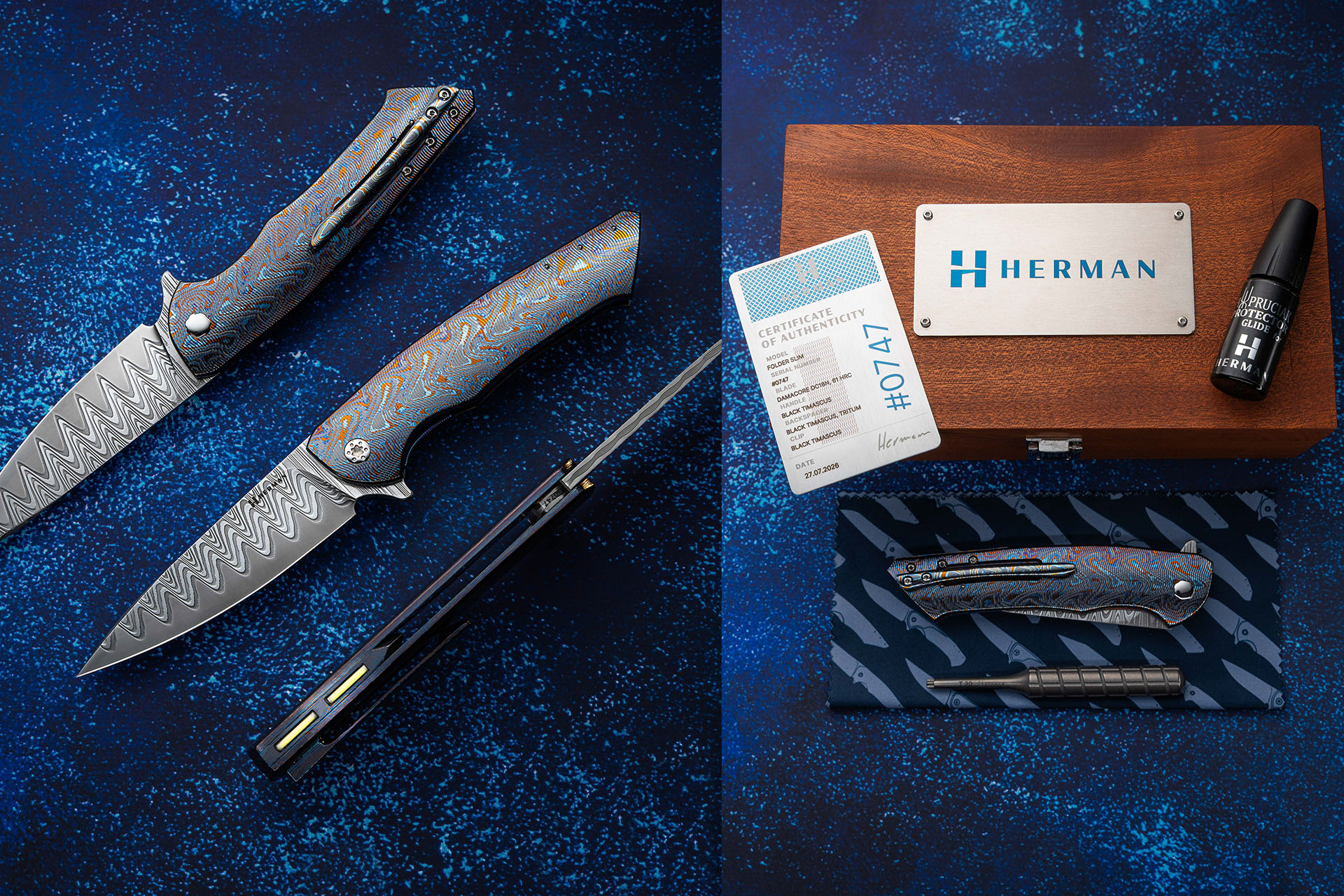
Herman states that the complete knife-making process takes approximately three months. The statement describes the production cycle, not three uninterrupted months of bench work on one knife.
A premium folder moves through sequential operations that cannot all happen at once: component production, heat treatment, grinding, surface preparation, finishing, decorative work where required, assembly, adjustment and inspection.
Complex individual configurations can add further steps.
Herman knives are best described as precision-machined and extensively hand-finished.
The official site describes the knives as handcrafted, states that every piece is hand-finished, and separately confirms that the Grade 5 titanium handles are machined. Those statements are compatible.
Precision machining is appropriate for repeatable geometry such as pivot location, component interfaces and complex titanium features. Manual work becomes important in surface finishing, polishing, satin preparation, final cleanup, assembly, adjustment and inspection.
The value of the process does not depend on avoiding modern machinery. It depends on using machine accuracy where repeatability matters and skilled hand work where the finished part has to be judged for surface quality, fit and behavior.
Herman states that no two finished knives are identical and that each knife receives an individual certificate confirming authenticity.
The model platform remains consistent; individuality comes from the combination of materials and finishing. Two Stings, for example, can share the same underlying model while differing in:
For collectors, the certificate and original configuration identify the specific knife, not only the model family. This is also why individual photography matters when buying a Herman: pattern placement, anodizing, Timascus figure and other visual details can differ from one build to another.
Herman’s production method combines a repeatable mechanical platform with deliberate variation in materials and finishing.
The mechanical platform is where consistency matters. Materials and finishing are where two knives from the same model can become very different purchases.
A practical buying order is:
To compare available knives, browse the Herman Knives category.
Herman describes its knives as handcrafted and states that every knife is hand-finished. Precision machining is also part of the process. “Precision-machined and hand-finished” is the most accurate short description.
Herman states that the Grade 5 titanium handles are machined. The company does not publish a complete machine-by-machine sequence for every component.
Bartosz Herman personally designs the knives and, according to Herman, oversees the manufacturing process.
Herman knives are made and hand-finished in Poland. Herman identifies its workshop as being in Łódź.
Herman states that the complete knife-making process takes approximately three months. That refers to the overall production cycle across multiple operations, not three months of continuous work on one knife.
The underlying model platform is shared, but Herman states that no two finished knives are identical. Individual builds can differ in steel, grind, blade finish, titanium treatment, inlays, patterns, coatings and dress materials.
Herman states that each knife is precisely centered during assembly and inspected for blade alignment again before sale. The company does not publish a numerical tolerance for that check.
Current conventional Herman folders use liner locks. The Morpho is a balisong and is treated separately. Our button lock vs crossbar lock vs liner lock guide explains how a liner lock differs from other common premium folder mechanisms.
What separates Herman from a production folder is not the absence of machinery but where the hand work is placed: after the geometry is fixed, in the surfaces, the fit and the final adjustment of the assembled knife.
The model platform provides the repeatable structure. Material selection and finishing determine how far an individual build moves toward practical EDC, patterned titanium, Damasteel or Full Dress territory. Assembly then brings the pivot, bearings, detent, liner lock, blade and handle into a working mechanical system.
The result is a recognizable family of knives with substantial variation from one build to another. For the buyer, that makes the model, blade configuration and individual finish three separate decisions rather than one specification to judge by price alone.
There are no comments for this article yet.