


Contents
A Herman knife can create two equally reasonable reactions.
The first comes when the blade opens. The ceramic detent releases cleanly, the blade runs through the bearing pivot, and the lockup ends with the metallic ring for which Herman knives have become known.
The second comes when you see the price.
At that point, the question is no longer whether the knife is well made. The question is whether its action, materials, finishing and individuality justify paying several times the price of an already capable production folder.
The answer depends on what you expect the money to buy.
Quick verdict
Herman knives are worth the price for experienced buyers who value distinctive action, advanced pivot construction, premium steels, Grade 5 titanium machining and an individually finished exact piece.
They are not the best value when cutting performance, hard-use durability per dollar or predictable resale are the only priorities.
A restrained M390 or MagnaCut Herman can make sense as a premium user. A Damasteel, Timascus or heavily engraved build should be judged primarily as a collector object rather than a cutting tool.
This article evaluates Herman Knives as both working folders and collector-grade products. It examines what the underlying mechanical platform contributes, which upgrades add practical value, which upgrades are mainly aesthetic, and how Herman compares with other premium flipper brands.
Noblie is an authorized Herman dealer and maintains a large inventory of individually photographed Herman knives. That commercial relationship makes transparency especially important. The conclusion is not that every Herman knife is automatically worth its asking price. Value depends on the exact model, configuration, detent, condition, price and intended use.
Technical claims in this article are based on official Herman materials, documented exact-piece specifications and the known development of the maker’s pivot and bearing systems. Owner reports are used to show recurring praise, criticism and buying concerns. They are not treated as proof that every Herman behaves identically.
Herman knives are designed under the direction of Polish knifemaker Bartosz Herman. The manufacturer states that its knives are individually configured, hand-finished in its workshop in Łódź, Poland, and supplied with an identification certificate.
Herman does not fit neatly into the usual production-versus-custom division.
The knives are built around established model platforms and precision-machined components. A Sting remains recognizably a Sting, while a Slim, Bee, Ishtar or Mantis follows its own repeatable dimensions and design language. Within those platforms, however, blade steel, milling pattern, anodizing, coatings, inlays, hardware, backspacer and blade finish can vary substantially from one knife to another.
The most useful description is high-end small-batch custom production. That places Herman above mainstream premium production folders and in the same broad collector market as Shirogorov, Holt Bladeworks, Koenig and Grimsmo. It does not mean that a Herman is equivalent to a sole-authorship custom knife in which every component is individually designed and fabricated for one commission.
Herman’s value proposition sits between those categories:
The Herman Knives Model Guide explains how Micro Sting, Sting, Big Sting, Bee, Slim, Ishtar, Mantis, Dragonfly, Vespertilio and Ovium II differ in size, geometry and intended role. The value question begins after the correct model has been identified.
There is no meaningful single price for a Herman knife.
For a U.S. buyer, current new-knife asking prices generally begin around $1,100 for relatively restrained titanium builds and can approach $5,000 for elaborate Damasteel, Timascus or engraved pieces. The model matters, but the larger price differences usually come from materials and finishing rather than basic cutting dimensions.
| Configuration level | Typical U.S. retail | What drives the price | Best buyer fit |
|---|---|---|---|
| Restrained user build | $1,100–$1,500 | M390, M398 or MagnaCut blade; titanium handle; simpler milling, anodizing or stonewash | Buyer who wants the Herman mechanism and intends to carry the knife |
| Patterned or upgraded build | $1,300–$2,300 | Puzzle, Tesseract, Chrono, hammered titanium, inlays, coatings or more involved finishing | Enthusiast who wants a premium user with stronger visual individuality |
| Half-dress or Damasteel build | $1,700–$3,500 | Damasteel or Damacore blade, Timascus details, elaborate inlays, labor-intensive hand finishing | Collector who may carry selectively but values materials and rarity |
| Full-dress or art build | $3,000–$4,900 | Timascus construction, complex engraving, rare Damascus, extensive hand finishing | Dedicated collector buying art and exclusivity rather than maximum utility |
These are observed U.S. retail asking ranges, not fixed MSRP bands. Prices change with configuration, availability, import cost and sales channel.
The important pattern is more stable than the exact numbers: the core Herman mechanism is already present in the less elaborate knives. As the price rises, an increasing share of the premium pays for rare materials, surface work and uniqueness.
A Herman price contains several different forms of value. They should not be combined into one vague claim about craftsmanship.
Current documented Herman configurations commonly include a ceramic detent, custom pivot, ceramic bearing system, hardened bearing races, titanium liner lock, tungsten-carbide lock interface and tungsten-carbide stop pin.
The bearing system has evolved through multiple generations. Documented knives include extremely hard sintered-carbide washers and later configurations using hardened, wire-EDM-cut and hand-lapped M390 steel race washers. Some current builds also use a fitted phosphor-bronze bushing around the pivot.
These are functional components. Hardened race washers provide controlled bearing tracks instead of allowing ceramic balls to run directly against softer titanium. The pivot establishes alignment and axial preload. The detent controls closed retention and the point at which the blade releases. The carbide stop pin resists dimensional wear at the end of the opening stroke.
For a component-level explanation, see Inside Herman’s Ceramic Bearing System.
Action is one of the main reasons experienced collectors pay for a Herman.
The value is not merely that the blade opens quickly. Many inexpensive flippers open quickly. A well-tuned Herman combines secure closed retention, a defined detent break, low-friction blade travel, stable centering, decisive lockup and the recognizable metallic response often called the Herman “sing.”
That character is difficult to summarize in a material list. It also has little direct connection to opening packages or cutting cardboard.
The mechanics and acoustics are covered in Herman Knife Action Explained.
Herman uses steels such as CPM MagnaCut, Böhler M390, M398, RWL34, Damasteel and Damacore depending on the exact piece.
For a working knife, MagnaCut usually provides the broadest balance of toughness, corrosion resistance and edge stability. M390 emphasizes wear resistance, corrosion resistance and polishability. M398 pushes wear resistance further but gives up toughness and ease of sharpening. Damasteel and Damacore remain functional blade materials, but a large part of their additional price comes from pattern, finishing labor and collector appeal.
A more expensive steel does not automatically create a better knife. Blade geometry, heat treatment and intended use remain more important than the alloy name alone. For a detailed examination of the most wear-resistant option, see the M398 steel guide.
Grade 5 titanium gives Herman a stiff, corrosion-resistant and relatively lightweight handle platform. It also provides the surface on which the maker applies milling, engraving, anodizing, inlays and coatings.
Titanium itself is common in premium folding knives. Herman’s distinction lies in how many different exact-piece configurations are built around it. Two knives from the same model family may have the same dimensions but completely different surface treatments, colors, inlays, clips and backspacers.
A buyer can therefore choose between a restrained user and a highly expressive collector piece without changing the underlying platform.
Precision machining establishes the geometry. It does not complete the knife.
The final result depends on surface preparation, hand finishing, inlay fitting, polishing, blade finishing, anodizing, lock tuning, centering, sharpening and assembly. The manufacturer states that the complete knife-making process takes three months.
The buyer is paying for details such as:
A more elaborate finish requires more labor, but greater labor does not always produce greater practical usefulness. That distinction becomes important as the price rises.
Herman knives are not interchangeable catalog units.
Two Slim knives can differ in steel, detent, washers, blade finish, anodizing, inlays, backspacer and price. The model name identifies the size and general geometry; it does not describe the complete knife. That makes exact-piece photography, action video and detailed specifications commercially important.
Noblie’s Herman catalog contains more than 100 current and recent exact-piece listings across available and sold inventory. The number in stock changes as individual knives are sold, but the catalog documents the breadth of models, steels and finish levels. Browse the current Herman Knives collection to compare the actual knives rather than generic model photographs.
The underlying mechanism explains the base value. It does not explain why two knives from the same model family can differ in price by several thousand dollars. That difference usually comes from dress level.
Puzzle, Tesseract, Chrono Circle, Leaves, Rocks, Nebula Ripple and similar treatments change the surface geometry of the titanium.
Some patterns add grip or help conceal handling marks. Their larger contribution is visual. They change how the titanium reflects light and allow one exact piece to look substantially different from another example of the same model.
The Herman patterns and finishes guide explains which names refer to milling, engraving, anodizing, coatings or inlays.
Oerlikon treatments and DLC-type coatings can improve surface wear resistance and change color or reflectivity. Their practical contribution depends on the coating and the component to which it is applied.
Part of the price also covers the preparation required before coating and the additional handling needed afterward. A premium coating can improve surface durability. It does not create a proportional increase in cutting performance.
Damasteel introduces patterned powder steel and usually requires additional grinding, polishing, finishing and etching. The added labor is real, and the visual result can be exceptional.
A Damasteel blade does not, however, automatically outperform a correctly heat-treated MagnaCut or M390 blade. For a user knife, the less expensive steel may be the more rational choice.
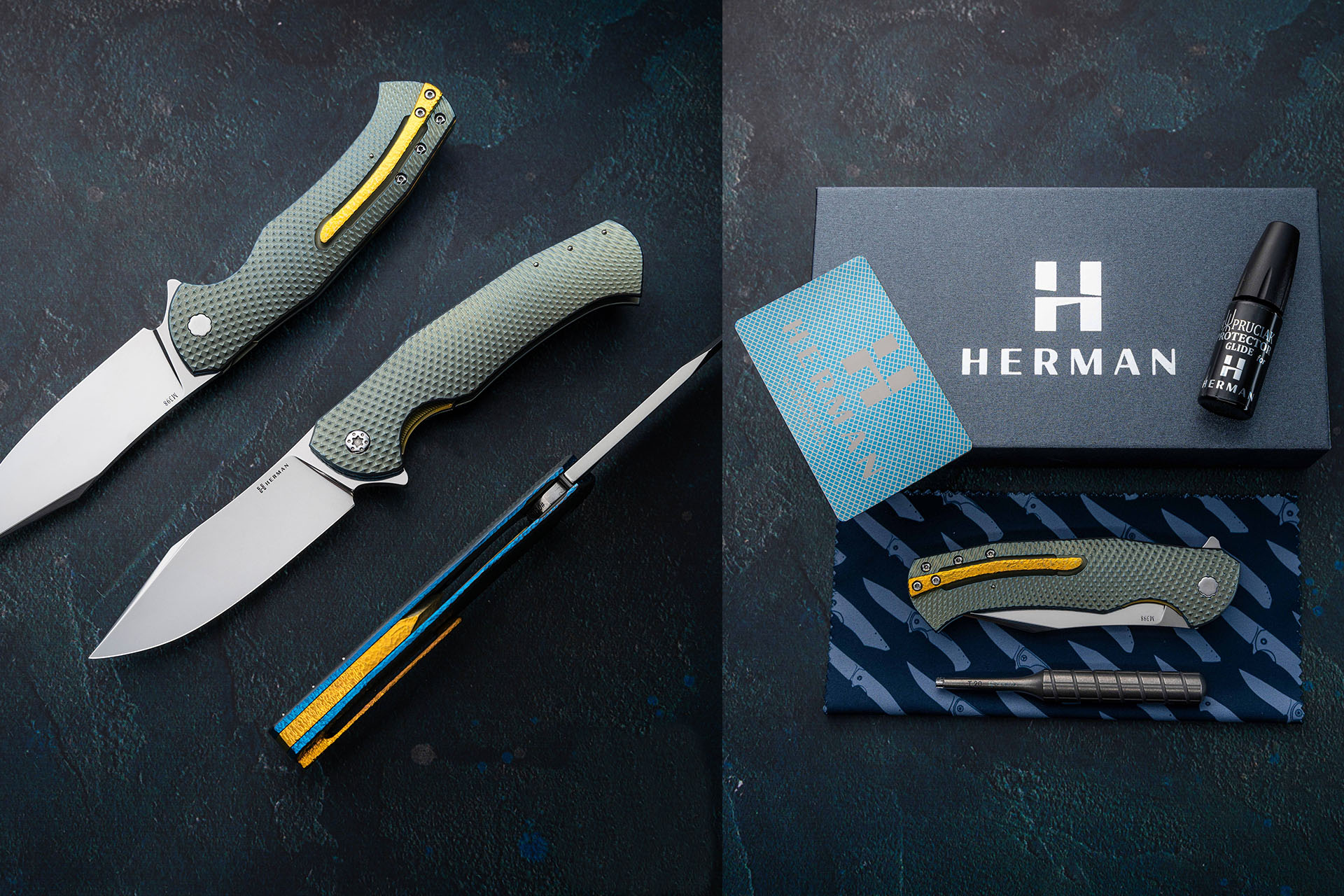
Timascus, Black Timascus, carbon-fiber inlays, rare metals and hand engraving move the knife further into collector territory.
These materials increase labor, material cost and rarity. They may also make the owner less willing to carry the knife. At that level, evaluating the knife solely as a cutting tool no longer makes sense. The relevant comparisons are other collectible knives, metal art and limited maker work.
A useful value analysis must define the limits of the premium.
A $2,000 Herman does not cut four times better than a plain Sebenza 31 in the mid-$400 range, nor eight times better than a capable Reate or WE titanium folder costing roughly $250–$400. All of those knives can handle packages, cardboard, food preparation and ordinary EDC cutting.
Herman’s premium pays for mechanical character, proprietary pivot development, individual finishing, uncommon material combinations and exact-piece identity. It does not multiply cutting efficiency in proportion to price. For ordinary cutting, edge geometry, sharpness, blade profile and heat treatment matter more than how elaborate the titanium handle appears.
Herman folders use premium materials, but they remain precision folding knives.
Bearings can become contaminated. An edge can chip. A fine point can break. A pivot can move. Titanium finishes can scratch, and polished blades can show handling marks quickly.
A tungsten-carbide stop pin reduces wear at the stop interface. It does not turn the folder into a fixed blade or remove the need for appropriate use.
Owner reports show that detent strength can vary between individual Herman knives, including examples from the same model family. One Micro Sting owner cited an unusually soft detent as the specific reason for regretting the purchase.
Some users prefer a forceful detent. Others prefer a medium release and more controlled closing. Compact models may make heavy flipper pressure more noticeable because the available leverage is lower.
Detent should therefore be treated as an exact-piece characteristic. When it matters to the buyer, the action video of the actual knife is more useful than a general model review.
A premium bearing system still depends on clean raceways, correct pivot preload and restrained lubrication.
Older Herman generations can also differ substantially from current caged systems. Some early configurations used loose or less securely retained ceramic balls, making disassembly more difficult. The Herman knife maintenance guide separates current maintenance practices from older designs.
Do not overtighten the pivot
A bearing pivot should not be tightened according to the instinct used on a fixed mechanical joint. Excessive torque can compress the assembly, slow the blade, disturb centering, or crush ceramic components. If the knife arrives centered, stable, and properly tuned, leaving the pivot unchanged is normally the safer decision.
Herman knives are collectible, but collectible does not mean guaranteed appreciation.
Secondary-market results vary. Some desirable configurations retain value well; others sell significantly below their original retail price. Resale depends on model popularity, configuration, condition, documentation, original accessories and current supply.
Buy a Herman because you want to own that knife. Do not buy one because you expect the market to repay the purchase.
A Micro Sting and an Ovium II may share the Herman name, but they do not provide the same hand fit or pocket experience. Typical documented examples illustrate the difference:
The compact knife may feel too small or concentrate pressure at the flipper. The larger knife may provide better reach and grip while taking more pocket space. The correct model matters more than the most expensive finish.
Herman competes in a market where several brands already offer excellent machining, titanium construction and bearing action. The meaningful differences are less about assigning one universal quality ranking and more about platform design, detent character, model variety and finishing strategy.
The prices below use typical U.S. retail asking prices for new knives checked in August 2026. Direct-maker allocations, used sales and auction prices are excluded.
| Brand or platform | Typical U.S. retail | Mechanical identity | Main advantage over Herman | Main Herman advantage |
|---|---|---|---|---|
| Herman Knives | $1,100–$4,900 | Ceramic detent, proprietary bearing systems, titanium liner lock, strong acoustics, extensive exact-piece finishing | Exact-piece variation makes selection more involved | Broad model, steel and finish diversity |
| Koenig Arius | $800–$950 | Large American titanium frame lock, ceramic bearings, hollow-ground blade, multiple deployment methods | A mature, standardized all-around platform that is easier to evaluate | Far wider choice of size, blade shape, steel and collector finish |
| Holt Morpheus | $1,500–$2,650 | Compact titanium liner-lock platform, highly controlled machining, adjustable detent architecture | More consistent platform and user-adjustable detent system | More sizes, blade profiles, steel choices and visually distinct exact pieces |
| Shirogorov F3 / F95 | $1,000–$1,400 | Refined multi-row bearing action, controlled geometry, consistently smooth closing behavior | A longer-established reputation for extremely smooth and repeatable bearing action | Greater visual individuality and broader exact-piece variation |
| Grimsmo Norseman | $1,015–$1,125 | Extensive in-house machining, ceramic bearings, highly distinctive recurve-tanto blade | Strong manufacturing transparency and a clear single-platform identity | More conventional blade options and a much broader model range |
The Arius is one mature platform with strong cutting geometry, a robust frame lock and multiple deployment methods. Herman is a family of platforms.
Koenig is easier to recommend when the buyer wants one proven large American premium folder. Herman is more compelling when the buyer wants to choose a specific size, blade shape, steel and exact finish.
Holt is particularly strong for buyers who prioritize detent control, compact dimensions and highly repeatable machining.
Herman offers more variation and a stronger acoustic identity. Holt may be the more controlled mechanical choice; Herman may be the more individual purchase.
Shirogorov remains a benchmark for collectors who prioritize smooth bearing action and controlled closing behavior.
Herman generally feels more expressive. Its titanium patterns, colors and exact-piece differences are more visible, while Shirogorov often presents a more restrained platform-centered approach. For a detailed comparison, see Herman Knives vs Shirogorov.
Grimsmo emphasizes in-house manufacturing transparency and a tightly defined product identity.
Herman offers more conventional blade profiles and a broader selection of sizes. The Norseman is unmistakable, but its recurve-tanto geometry is more specialized than a Sting, Slim, Bee or Dragonfly.

Independent discussions repeatedly return to four strengths.
Owners frequently place Herman machining, surface transitions, centering and final assembly in the same conversation as Shirogorov, Holt and Koenig.
One BladeForums owner described a MagnaCut Sting as finished to a high level, opening with authority and closing freely. The same owner considered the lock liner visually thin but found the contact solid and intentionally executed rather than cheap.
The combination of detent release, ceramic bearings and blade mass gives many Herman knives a fast, positive opening stroke. The action is not identical between every example, but it has enough character that experienced owners often recognize it immediately.
The Herman “sing” appears repeatedly in reviews and owner discussions. In one owner comparison involving Herman, Holt, Shirogorov and Koenig, Herman was singled out for the most distinctive sound. That is a subjective judgment, but it shows how strongly acoustics contribute to the ownership experience.
Buyers can choose between plain titanium users and highly elaborate collector pieces without leaving the same model family. That exact-piece variation is one of Herman’s clearest advantages over more standardized premium brands.
A credible value article should not dismiss every criticism as personal preference.
Some owners report detents that feel lighter or heavier than expected, and a small number of discussions mention detent lash on specific examples. These reports do not establish a brand-wide defect. They do establish that detent is worth checking on the exact knife.
Older Herman knives may use bearing systems that differ substantially from current caged configurations. Community reports describe early loose ceramic balls that were difficult to control during disassembly. Current technical descriptions should not be applied backward to those knives.
Highly polished titanium, mirror blades, Timascus and elaborate anodizing can make a knife feel too precious for ordinary carry. A buyer may pay for a finish that reduces personal willingness to use the knife. That is not a manufacturing defect, but it can turn an otherwise capable folder into poor value for someone seeking a working EDC.
The higher the price, the less tolerance buyers reasonably have for an imperfect detent, visible marks, lock stick or uneven finishing. A minor issue that might be accepted on a $250 knife becomes a serious objection at $1,500 or $3,000.
The best-value Herman and the most visually impressive Herman are usually not the same knife.
A restrained M390 or MagnaCut build with a stonewashed blade and relatively simple titanium handle usually provides the clearest functional value.
The buyer receives the model geometry, mechanical platform, ceramic detent, bearing action, premium materials and Herman character without paying heavily for surfaces that may feel too delicate to scratch. A Sting, Slim or Bee in this configuration is often the most rational first Herman.
A collector may reasonably value Damasteel, Timascus, engraving or rare patterns more than practical cutting efficiency. In that context, value comes from the integration of materials, rarity, execution and personal attachment to the exact piece.
The relevant question is not whether Timascus cuts better. It is whether the visual and material execution is worth the premium to that collector.
The hardest Herman to evaluate is often a $1,700–$2,300 build with premium milling, coatings or inlays but without the visual impact of a full-dress knife.
It may be an excellent premium user, but the buyer should identify precisely what the higher price contributes. When the only meaningful difference is color preference, a less expensive exact piece may provide nearly the same ownership experience.
Herman has an active secondary market, but resale is not predictable enough to support an investment argument. Some desirable configurations retain value well. Others sell below their original retail price.
The strongest resale factors are usually:
A highly personal color combination or engraving may have required more labor but appeal to fewer secondary buyers.
Herman is a Polish maker. Serious factory service may involve international communication and shipping. That is common in the premium knife market, but it differs from owning a U.S.-based maker whose service center is domestic.
Buying through an authorized dealer can simplify pre-sale inspection, exact-piece verification, shipping and communication. The practical options are covered in How to Buy Herman Knives in the USA.
The buying process should begin with function rather than finish.
Decide whether the knife needs to disappear in the pocket, provide a full four-finger grip or deliver maximum blade reach. The difference between a 2.80-inch Micro Sting and a 4.06-inch Ovium II is more important than the difference between two anodizing patterns.
Use the Herman Knives model guide for full blade-length, handle-length and weight comparisons rather than duplicating those specifications here.
MagnaCut is the broadest user choice. M390 is a balanced premium folder steel with strong wear and corrosion resistance. M398 is the more specialized option for buyers who prioritize edge retention and accept lower toughness and more difficult sharpening.
Damasteel and Damacore should be selected because their visual execution has value to the buyer, not because they automatically outperform the less expensive steels.
A stonewashed blade and restrained titanium finish are easier to use without concern. Mirror polish, Timascus and elaborate engraving make more sense when display value and collection significance are part of the purchase.
Before buying, check the blade centering, lock engagement, detent description, action video, bearing generation, blade hardness, included accessories and total delivered price. Do not assume that another example of the same model will feel identical.
Compare the intended Herman with Koenig, Holt, Shirogorov, Grimsmo and premium production folders at the same price. The correct purchase is the knife whose size, geometry, deployment and ownership profile fit the buyer, not the knife with the longest material list.

A Herman makes the most sense for someone who already understands premium folders. The ideal buyer notices detent quality, pivot behavior, finishing details and exact-piece differences. That buyer values mechanical character and is comfortable paying for aesthetic work that does not improve cutting performance.
For that person, Herman offers something difficult to replace with a standardized production folder.
A Herman is a weak choice when maximum utility per dollar is the main objective. It is also unlikely to satisfy someone who wants a first folding knife, a rough-use work tool, guaranteed resale, identical action across every example or a finish that can be damaged without concern. A simpler production knife may provide more practical confidence and less ownership anxiety.
A restrained Herman can justify its price as a premium user because it combines a distinctive mechanical platform, premium materials, individual finishing and a level of character that standardized production folders rarely match.
A Herman is worth it when you value the exact knife, not merely the specification sheet.
As the price increases, the justification changes.
Around the lower end of the U.S. retail range, the buyer is primarily paying for the model design, premium steel, titanium construction, ceramic detent, bearing system, pivot work and individual finishing. Between roughly $1,500 and $2,500, an increasing share of the price pays for patterns, coatings, inlays, polishing and lower-volume configurations.
At $3,000 and above, the knife should be evaluated as functional art. The extra money buys rare materials, visual integration, engraving and exclusivity, not a proportional improvement in cutting performance.
Choose a restrained version when you want a premium user. Choose an elaborate version when the artistic execution has personal value. Do not pay collector prices while expecting utility economics.
Noblie is an authorized Herman Knives dealer and official distributor. Browse the current Herman Knives collection to compare exact models, steels, finishes, serial numbers and mechanical specifications.
Each listing represents one individually numbered knife rather than a generic model image. Compare the specific steel, certified hardness, blade finish, handle texture, detent classification, weight, bearing generation, included accessories and photographs before purchasing.
Availability changes because many Herman configurations are produced in small numbers.
The price reflects small-batch production, premium steels, Grade 5 titanium, custom pivot and bearing components, individual finishing and exact-piece configurations. Damasteel, Timascus, engraving and complex surface work can add far more cost than the basic mechanism.
They are best understood as high-end small-batch custom production. Herman uses established model platforms and precision machining, then varies materials, finishing and exact-piece details.
A restrained Sting, Slim or Bee in M390 or MagnaCut usually provides the clearest value. It delivers the core Herman mechanism without the large premiums attached to Damasteel, Timascus, engraving or full-dress finishing.
Not universally. The Arius is a mature and standardized premium platform. Herman offers a broader range of sizes, blade profiles, steels and individual finishes. The better choice depends on whether the buyer prioritizes one proven design or exact-piece individuality.
The brands emphasize different qualities. Shirogorov is especially respected for exceptionally smooth bearing action. Herman provides stronger visual variation, distinctive acoustics and more exact-piece individuality.
It can be worth it to a collector who values the pattern, finishing process and rarity. It is not automatically a better working choice than MagnaCut or M390.
Yes, provided the size and finish suit the buyer. Sting, Slim, Bee and Micro Sting are especially relevant to EDC. A restrained stonewashed configuration is easier to carry without concern than a mirror-polished or heavily engraved collector build.
Some configurations retain value well, but resale is not guaranteed. Model popularity, condition, finish, original accessories and current supply all affect the secondary-market price.
No. The overall mechanical character is recognizable, but detent strength, blade mass, pivot tuning and closing behavior vary by model and exact piece.
A Herman is a capable precision folder, but it is not the most economical hard-use choice. Buyers who need impact tolerance, simple field maintenance or low replacement cost may be better served by a less complex production folder or a fixed blade.
Herman knives are designed and hand-finished by Bartosz Herman and the Herman Knives workshop in Łódź, Poland.
Official manufacturer materials are used for construction, production and material claims. Current U.S. retail listings are used to establish price ranges. Independent owner discussions are included only as anecdotal evidence of action, detent variation, older bearing systems and secondary-market behavior.
There are no comments for this article yet.