


Contents
A traditional Mongolian knife was a personal cutting tool worn at the waist. Some sheaths held both the knife and a pair of chopsticks, so the owner could carry a dining set on the belt. In Mongolian, khutga means knife, and khet refers to the fire-making kit. The term khet khutga (хэт хутга) refers to the knife and the accompanying fire-making gear.
We commissioned several Mongolian-style knives for our collection of custom knives. The first two photographs show the knives and chopsticks from our Infinity Knot set alongside their shared scabbard.


An early 20th-century shepherd’s set in Warsaw’s Asia and Pacific Museum (MAiP 13043) shows how the parts worked together. The sheath gave the herder a place for eating utensils, while a separate pouch held the materials for making a fire.
The Warsaw sheath is covered in black, textured leather and fitted with silver and brass. A narrow metal strip on the back covers the joins in the fittings. An engraved medallion bears the Chinese character shou, a symbol of longevity. The floral relief on the pendants was cast. On the tinder pouch, the raised design on the silver fittings was worked from the back of the metal, a technique called repoussé.
Mongolia’s national heritage inventory records a khet khutga made by the smith Demberel in the second half of the 19th century, with steel, silver, and bone. The inventory also lists a 19th-century set associated with the Bogd Khan, with a brown wooden sheath, gold fittings, and separately recorded fire-making gear. On a knife and chopsticks set at the Asian Art Museum in San Francisco, silver fittings carry inlays of coral, turquoise, carnelian, and agate.
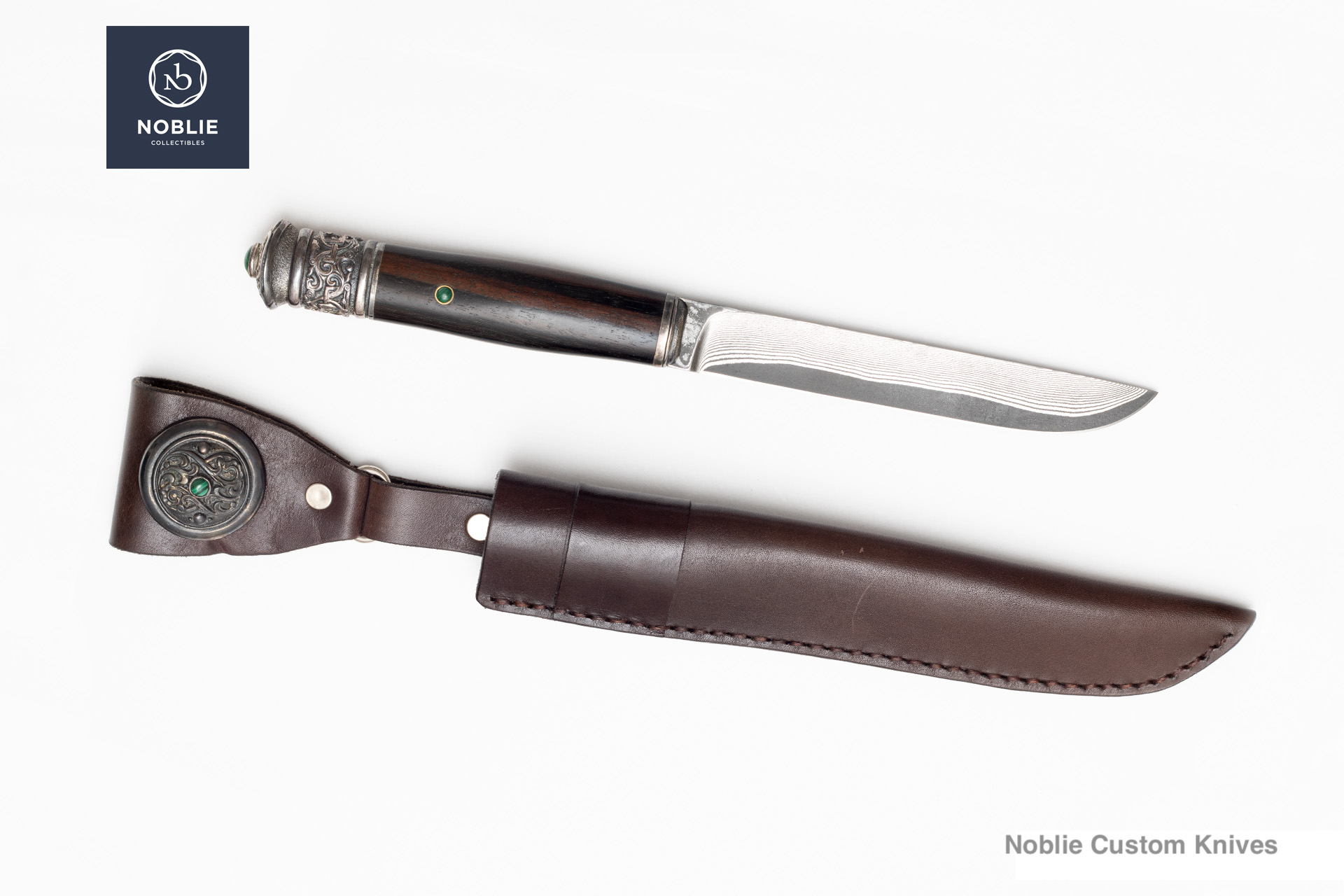
The Mongolian traditional knife in our collection is a contemporary example of a knife with a chain and leather hanger. Its catalog lists a 7.1-inch (180 mm) blade of Japanese laminated steel and silver-coated bronze mounts on the scabbard.


The book Intangible Cultural Heritage of the Mongols records a greeting custom in which a visitor removed his knife from his belt before entering a ger, the traditional round dwelling also called a yurt. The gesture conveyed peaceful intentions toward the household.
In a travel account quoted in Acta Mongolica, F. A. Larson described men wearing the sheathed knife on the right side of the sash and a matching flint pouch on the left. The Warsaw museum also describes the set as a gift a father could give his son on reaching adulthood. The amount of ornament could reflect the family’s means.

The Warsaw shepherd’s knife has a narrow, single-edged steel blade and a straight, oval wooden handle. Copper rivets secure the wood to the steel tang. The museum gives a length of 8.9 inches (22.5 cm) for the knife and 7.7 inches (19.5 cm) for its sheath. The Asian Art Museum lists a 10-inch (25.4 cm) length for its knife and chopsticks set. When comparing catalog measurements, check which part was measured. The overall length of a knife includes its handle, and the length of a set may include its case.
If you come across the label Mongolian dagger, look at the full set and the way the object is cataloged. The Warsaw example has one cutting edge and a sheath built to carry eating utensils. The sheath and belt fittings help explain its place in a herder’s everyday kit.
To identify a set in a photograph, look for the opening beside the knife slot. It may hold two chopsticks in a single channel. The black-handled example above shows another detail to look for. Its chain and leather loop stay on the sheath when the knife is out. For a historical piece, check the catalog attribution too. The Metropolitan Museum of Art dates one knife with a sheath, chopsticks, and belt loop to about 1750–1900 and identifies its culture as Chinese, Manchurian, or Mongolian.

Our Infinity Knot Mongolian knife set pairs two fixed blades with two decorative chopsticks and a Macassar ebony scabbard. The longer blade measures 6.7 inches (170 mm), and the shorter measures 5.1 inches (130 mm). The silver fitting on the scabbard carries the knot that gives the set its name.
The same series includes our Tibet knife, Tibet nomad knife, and Tibetan laminated Damascus knife, each with a laminated steel blade and a leather sheath.
See each product page for its full specifications, photographs, and current availability, or browse our gift knives collection.

There are no comments for this article yet.