


Contents
Quick answer. Is CPM S35VN still worth it?
Yes. CPM S35VN is a powder metallurgy stainless knife steel with good edge retention, enough toughness for everyday cutting, and manageable sharpening for its class. It works well in pocketknives and general-purpose fixed blades. MagnaCut has the clearer advantage when corrosion resistance and toughness matter most. For ordinary carry, the grind and heat treatment of the knife can matter more than the choice between those two steels.
S35VN at a glance
— Aleks Nemtcev, custom knife maker with 10+ years of experience. Connect on LinkedIn
Across several types of knives, S35VN fills much the same role. It gives a thin pocketknife enough wear resistance for cardboard and packaging, and a hunting knife enough corrosion resistance for ordinary field use with routine care. The grind and edge bevel determine how each blade feels in the cut. That applies equally to factory folders and handmade custom knives.
CPM S35VN is a martensitic stainless steel that Crucible developed from CPM S30V. The powder metallurgy process distributes carbides more evenly than conventional ingot production typically does in highly alloyed steels. Crucible adjusted the chemistry to improve toughness and make the annealed stock easier to machine. S35VN found its way into production folders, small-batch knives, and custom blades.
S30V already gave knife makers good abrasive edge retention and stainless performance. Crucible kept the nominal chromium and molybdenum levels the same, lowered vanadium from 4.00% to 3.00%, and added 0.50% niobium. Its datasheet describes a gain in transverse toughness and easier machining and polishing than S30V. Those manufacturing advantages are a separate question from how quickly a hardened edge sharpens on a given stone.
The published figures also distinguish the design goal from a measured cutting result. The 145% figure for S35VN relative to 440C in the original Crucible datasheet was a market-feedback estimate. A Böhler-Uddeholm CATRA comparison discussed by metallurgist Larrin Thomas found that the S30V sample cut more of the test media at the same listed hardness. That is a useful comparison for abrasive slicing.
The nominal percentages describe the bulk alloy. Heat treatment influences which elements remain dissolved in the steel matrix and which are bound in carbides.

S35VN contains hard vanadium- and niobium-rich carbides as well as chromium carbides. The lower vanadium content and small niobium addition reduce the combined amount of the hardest carbides relative to S30V. That helps explain why the two alloys can differ in wear resistance even though their nominal chromium content is the same.
Niobium can help refine a steel’s microstructure. Thomas reported similar-looking carbide sizes in the S35VN and S30V samples he examined, so the toughness difference is best read from the impact data. The chemistry explains the change in carbide populations. The knife’s heat treatment and edge thickness still determine how much support its edge has in use.
S35VN suits a common set of priorities. A pocketknife needs enough wear resistance for recurring cuts through cartons and cord, corrosion resistance for sweat and humidity, and an edge the owner can touch up on a bench stone. S35VN does all three well. Its long record in knife production also gives buyers more knives to judge on the strength of their actual design and heat treatment.
For a comparison across more alloys, see our knife steel chart.
CATRA testing measures how much silica-loaded card a blade cuts under controlled conditions. It is a useful proxy for abrasive wear. An edge can also lose cutting ability when the apex rolls or chips. A knife that dulls slowly in clean cardboard may need attention sooner after it hits a staple, a hard cutting board, or a dirty section of rope.
Two S35VN blades can feel quite different. A thin grind passes through cardboard with less drag than a thick grind, even with equally sharp apexes. Hardness and edge angle affect how well that apex holds up. For a knife that mostly opens packages and trims cord, these differences can matter more than a small gap between two steels in a cutting test.
In Crucible’s transverse Charpy C-notch comparison, S35VN absorbed 12 ft-lb (about 16 J) and S30V absorbed 10 ft-lb (about 14 J). The same table gives 2.5 ft-lb (about 3.4 J) for 154CM and 440C. These are impact results for notched specimens tested across the rolling direction. They tell you about the steel under those test conditions.
On a folding knife, repeated small chips can point to an edge that is too acute for the work. Inspect the apex after removing the damage. If chipping recurs during ordinary cutting, a slightly wider edge bevel can give the apex more support.
S35VN holds up well in ordinary pocket carry, around food, and during occasional rain. Sweat and salt can still leave spots, especially when moisture sits at the pivot or under residue. After exposure to brine or sweat, rinse with fresh water as appropriate for the knife’s construction and dry it before putting it away.
MagnaCut has a clear advantage in Crucible’s salt-spray comparison. Vanax and LC200N are also worth considering for frequent exposure to saltwater. For a folder used around salt, check the pivot and hardware as well as the blade steel.
S35VN generally takes less effort to reprofile than a high-wear grade such as S90V when the edge bevels are comparable. Diamond and cubic boron nitride (CBN) abrasives cut the hard carbides in S35VN efficiently. A suitable ceramic or water stone can refresh an undamaged edge. When a bevel needs to be reset or a chip removed, a coarser diamond or CBN abrasive saves time. Finish by removing the burr with light, alternating passes.
Start with the existing bevel angle on a knife that already cuts well. Around 17–20° per side (34–40° included) is a useful starting point for many EDC folders, with a wider angle for more edge support if needed. Match the angle to the blade and its use. Our knife sharpening angle guide gives starting ranges by knife type.
Crucible’s recommended heat-treatment cycle aims for 58–61 HRC. Its datasheet specifies austenitizing at 1,950°F (1,065°C), quenching below 125°F (50°C), and two tempers at 600°F (315°C) for at least two hours each. The sheet allows an optional freezing step between tempers. This published cycle is one reference point for understanding the hardness a maker lists.
A cold treatment can reduce retained austenite, and its effect depends on the full heat-treatment cycle. Larrin Thomas documented S35VN samples that reached higher hardness with a different cycle. When evaluating a finished knife, use the maker’s published hardness, blade grind, and intended use together. Two makers can select different targets for the same steel.

For an EDC knife that regularly gets wet or sees sweat and salt, MagnaCut’s corrosion resistance and toughness are the strongest reasons to choose it. In Crucible’s original MagnaCut datasheet, CATRA results relative to that table’s 440C reference were 130% for S35VN at 61 HRC and 135% for MagnaCut at 62.5 HRC. These results are close and came from specimens at different hardnesses. The same sheet reports far fewer rust spots on MagnaCut after 72 hours of 1% salt spray. For a dry-use folder that primarily cuts cardboard and packaging, compare the grind and the price of the knives in front of you. See our CPM MagnaCut steel guide for more on that alloy.
Crucible’s impact data favor S35VN, and its machining guidance gives S35VN an advantage in the annealed condition. In the CATRA data discussed by Larrin Thomas, S35VN and S30V measured about 132% and 149% of the test’s 440C reference, respectively, with both CPM grades listed at 61 HRC. These figures belong to that test. They help explain why S30V can last longer in abrasive cutting even when S35VN is the tougher choice.
S35VN fits knives expected to handle several kinds of cutting without complicated maintenance. Match the blade profile and edge geometry to the specific job.
Our guide to knife blade shapes explains what the profile contributes to each type of cut.
Yes. An S35VN blade with a good heat treatment and a grind that suits the work is still a practical buy. When comparing premium custom pocket knives, look at how thin each blade is behind the edge, the stated hardness, and how easily you can maintain it. Those details help you judge the price of the actual knife.
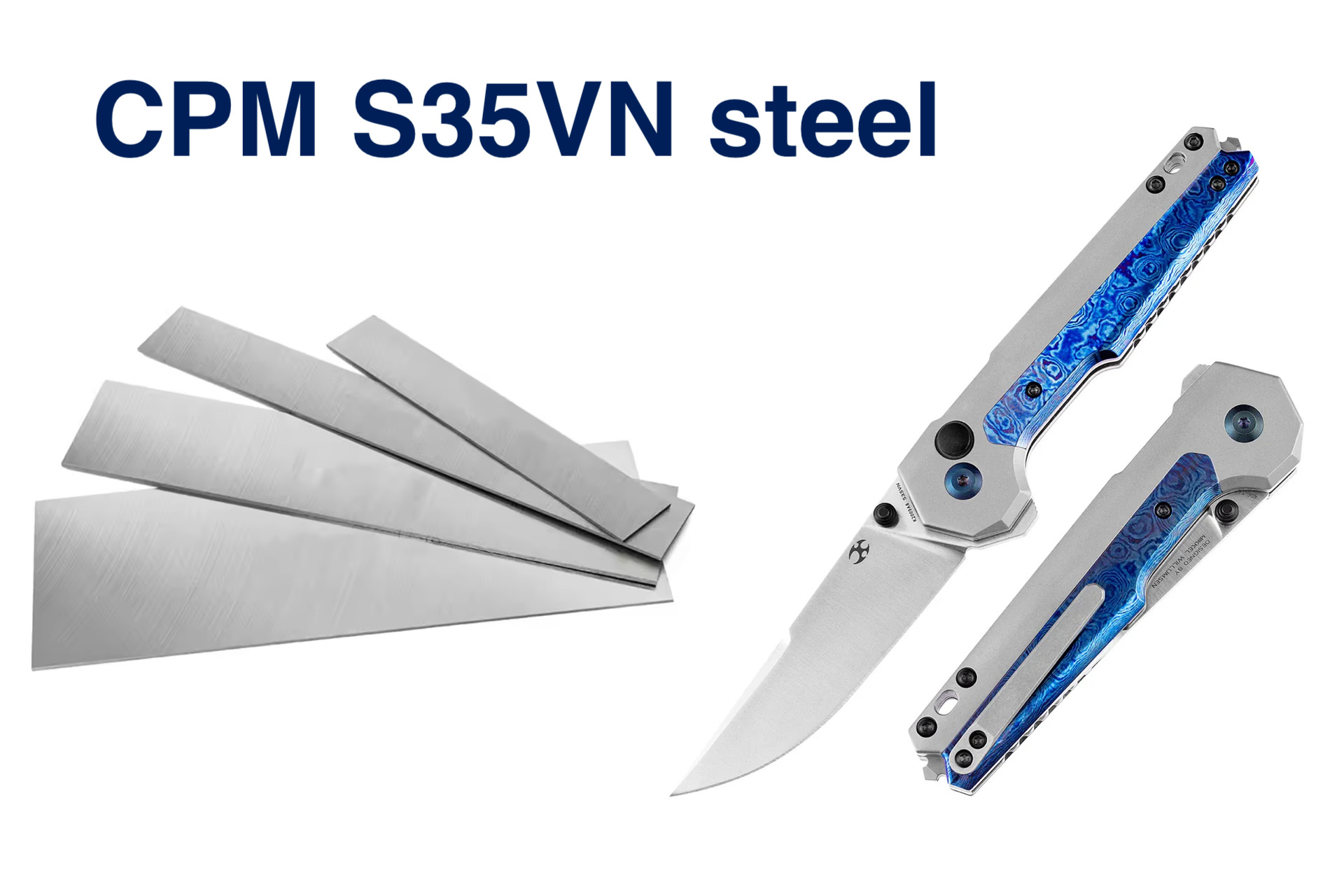
Keep a well-performing S35VN knife in rotation. If you are choosing a new one, S35VN suits mixed daily cutting, M390 favors long abrasive slicing, and MagnaCut or Vanax are worth a closer look when moisture and salt regularly reach the blade. Choose the grind and edge geometry for the work you do most often.
Yes. CPM S35VN is a good stainless knife steel for everyday carry and general cutting. It balances working edge life, toughness, resistance to rust, and reasonable sharpening effort.
S35VN has the advantage in Crucible’s transverse toughness data. S30V can have the advantage in abrasive edge retention, as it did in a CATRA comparison with both steels at 61 HRC.
S35VN had slightly higher transverse impact toughness in the manufacturer’s table. S45VN was designed for better corrosion resistance and is worth considering when the blade spends more time around moisture.
Choose S35VN when easier edge maintenance matters. M390 has the edge in abrasive slicing and generally takes more work to resharpen with comparable blade geometry.
MagnaCut offers higher toughness and better corrosion resistance in Crucible’s comparisons. Abrasive edge retention was close in the original MagnaCut datasheet, so geometry, heat treatment, and intended use matter when choosing between the knives.
S35VN has good toughness for a powder metallurgy stainless steel. Chipping risk depends on the hardness, edge angle, and what the blade hits. A slightly wider edge bevel can help if a thin edge keeps chipping during ordinary cutting.
S35VN is manageable to sharpen for a wear-resistant stainless steel. Diamond or CBN is useful for resetting the bevel. A fine ceramic or suitable water stone can handle a light touch-up.
AUS-10 is a stainless option for value-oriented EDC knives. Our AUS-10 steel guide covers its properties and typical applications.


There are no comments for this article yet.